Alfa Romeo 164 ProCar
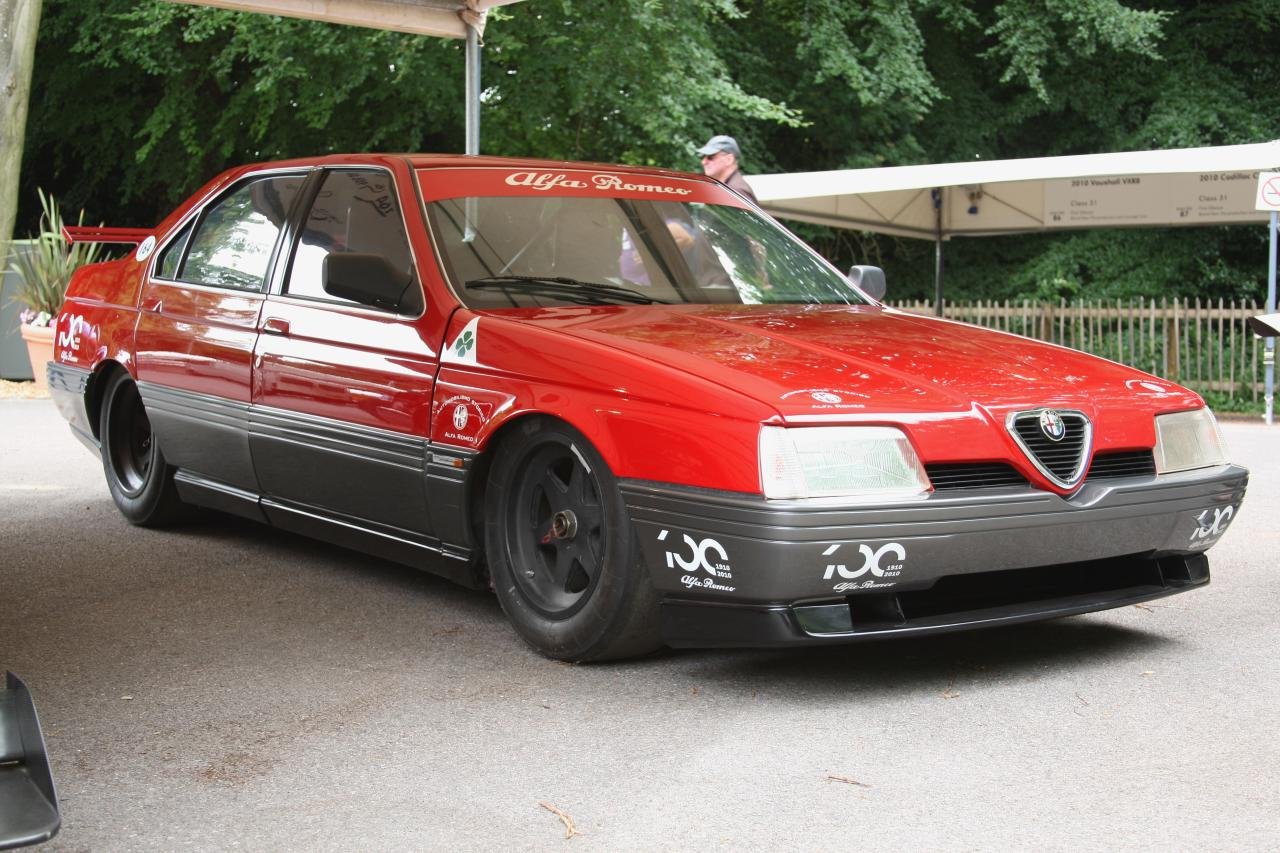
The Alfa Romeo 164 ProCar is the greatest sleeper ever built, and almost nobody in America has heard of it. Picture the 164 sedan that Alfa started selling here for the 1991 model year, the one your dentist leased in burgundy with tan leather. Now strip out everything under the skin and drop in a two-seat Formula 1 chassis, a 3.5-liter V10 screaming past 13,000 rpm, racing slicks and roughly 600 horsepower in a car that weighed less than a Mazda Miata. Alfa Romeo built exactly that in 1988. It showed it to the public for one flying lap of Monza, and then it parked it for good.
No race. No series. No customers. Just a museum piece that still has the fuel filler outline molded into the rear fender, because the rules said it had to look like the one at the dealer.
Win on Sunday, taken to its stupid extreme
NASCAR built an empire on a simple sales pitch: win on Sunday, sell on Monday. The cars stopped being stock a long time ago, but the idea stuck. In the summer of 1987, Bernie Ecclestone, the man who ran Formula 1’s business and had just been made FIA vice president for promotional affairs, sat down with Max Mosley and came up with the most extreme version of that pitch anybody has ever written into a rulebook.
They called it ProCar, borrowing a name with history. The first ProCar series had run in 1979 and 1980 as a support act at Grands Prix, with Formula 1 drivers racing identical BMW M1s of around 470 hp. Niki Lauda took the 1979 title and Nelson Piquet won in 1980. It was a good show, but it was a one-make series.
The new version, officially the FIA Production Car Championship, was something else. Its category was called Formula S, S for silhouette. From the outside, every car had to keep the shape and exterior dimensions of a production sedan built in at least 25,000 units a year. The only concessions were a slightly bigger front air intake and a small rear spoiler that couldn’t reach past the bumper. The dashboard had to be the stock one.
Underneath, almost anything went: naturally aspirated 3.5-liter Formula 1 engines, full racing chassis and a 750 kg minimum weight, about 1,650 lb, the same figure Group C sports prototypes ran with 3.5-liter engines. Somebody even floated a ban on sponsors so the only name on the car would be the manufacturer’s. Races would be short, with one driver per car, and some would run on Grand Prix weekends. The start date was set for 1989 and then pushed back to 1990.
Ecclestone’s real angle wasn’t hard to read. If Mercedes, BMW or Fiat built Formula 1 engines to race their sedans, getting those same engines into Formula 1 would only be a matter of time. Gabriele Cadringher, then technical chief at FISA, the FIA’s sporting arm, later described the whole thing as part of Ecclestone and Mosley’s maneuvering.
Only one carmaker took the bait, and it had a very specific reason to.
A Formula 1 engine with no job
Alfa Romeo already had the engine. In the mid-eighties the company still belonged to the Italian state, through the industrial holding company IRI, and at Arese, outside Milan, there were engineers who wanted Alfa back in Formula 1 as a constructor. From 1985 on, Gianni Tonti, technical director of Alfa Corse, had a team under engineer Giuseppe "Pino" D’Agostino working on a V10. The project number told you everything: 1035, ten cylinders, 3.5 liters. The first engine was built in 1986.
Nobody in Formula 1 ran a V10 back then. Turbo fours and sixes ruled, and the coming switch to 3.5-liter naturally aspirated engines had most people thinking V8 or V12. The logic behind ten cylinders is simple. At the same displacement, more cylinders means smaller pistons, and a small, light piston can spin faster before it tears itself apart. More revs, more power. A V12 takes that to the limit but is longer, heavier and loses more to internal friction. A V8 is short and light but can’t rev as hard. Ten was the middle ground, and Tonti put it plainly: the V10 was smaller and lighter than a twelve.
History proved him right. Honda showed its Formula 1 V10 after Alfa had built one, and Renault came later still. Through the nineties the V10 became the engine to have in Formula 1, and between 2000 and 2005 the rules made it mandatory. The 1035 has a fair claim to being the first V10 designed for the new 3.5-liter naturally aspirated formula.
What made the 1035 tick
The two cylinder banks sit 72 degrees apart. Alfa says the angle was dictated by the use of ignition distributors, the parts that send each spark plug its spark at the right instant. There’s also some tidy math behind it. A four-stroke engine turns twice, 720 degrees, to fire every cylinder once. Split that between ten cylinders and you get one firing every 72 degrees. Match that to the right crankshaft and the pulses come at perfectly even intervals, what engineers call even firing.
The dimensions show what kind of engine it was: 3,495 cc from an 88 mm bore and a stroke of only 57.5 mm. That’s wildly oversquare, meaning the cylinders are far wider than the piston’s travel is long. A short stroke keeps piston speed down at any given rpm, which lets the engine rev without beating itself up.
Block and heads were aluminum-silicon alloy, the pistons aluminum, and the valves and flywheel titanium, a metal much lighter than steel for the strength it offers. Alfa tried four valves per cylinder first, then five. The four camshafts carried cam phasers, which shift valve timing earlier or later as revs change, and they were driven by a gear train instead of a belt or chain. A stack of meshing gears doesn’t stretch, so the timing stays sharp at very high rpm.

Its weak spot was the valve springs. The 1035 used conventional steel springs, and past a certain speed a metal spring simply can’t snap a valve shut fast enough. That set a ceiling on revs. On the dyno the first versions went past 580 hp, and the final evolution made 620 hp at 13,300 rpm, with peak torque of 39 kgm, roughly 282 lb-ft, at 9,500 rpm and usable from 7,500. Nobody even agrees on when it first fired up. One source gives July 1, 1986. Another puts the same July 1 on the test bench in 1987.
The French driver who talked his way out of a deal
Alfa’s first plan for its engines was Ligier, the French Formula 1 team. Late in 1986, in its last days under state ownership, Alfa signed with Guy Ligier to supply engines for the 1987 season. That deal covered the 415T, a 1.5-liter turbo four designed by Tonti, as a stopgap until Formula 1 moved to 3.5-liter naturally aspirated engines. The V10 was supposed to come after that.
Then in November 1986 Fiat bought Alfa Romeo. Fiat already had a Formula 1 team, and it was called Ferrari. Vittorio Ghidella, the most powerful executive in the group, never believed in the Ligier program, and Ferrari was the group’s priority in Grand Prix racing. The excuse for pulling out came from the cockpit.
René Arnoux tested the Alfa-powered Ligier JS29 for the first time on January 29, 1987, at Paul Ricard, and soon after he trashed the engine in public with a food comparison nobody at Alfa found funny. Alfa pointed to a clause in the contract that barred Ligier from damaging the brand’s image and walked away on the eve of the Brazilian Grand Prix. Ligier had no engine, missed the race in Rio and even begged Gianni Agnelli, Fiat’s patriarch, to step in. He didn’t.
That left Alfa holding a finished, very expensive V10 and no car to put it in. Ghidella ordered development to continue anyway. Formula S looked like the answer, and the 164, the big front-drive sedan Alfa unveiled at the 1987 Frankfurt show, cleared the 25,000-unit rule with room to spare. Cesare Fiorio, running Alfa Corse, had already said his department’s future was touring cars, not Formula 1. Late in 1987 Alfa committed to Formula S, and its engineers helped write the regulations.
Brabham builds a sedan
Somebody had to build the car, and Ecclestone had a race shop sitting idle. He’d owned Brabham, the team Jack Brabham founded, since the early seventies, but BMW quit Formula 1 at the end of 1987 and took its turbo engines with it. According to team manager Herbie Blash, Ecclestone had lost interest in running the team.
He didn’t enter Brabham for 1988 and put it up for sale. Chrysler was mentioned as a buyer. So was Jesús Gil, the loud, larger-than-life president of the Atlético Madrid soccer club, who had turned up at the 1987 German Grand Prix at Hockenheim shopping for a team and talked about starting Spain’s first Formula 1 outfit. Ecclestone eventually distanced himself and said everything Gil was saying about the sale was false.
So in 1988 Brabham’s factory in Chessington, just south of London, worked almost entirely on Alfa’s car. Internally it was called the BT57. John Baldwin designed it. He had come from Lotus and worked with Sergio Rinland on the 1987 Brabham BT56. Alfa shipped a stock 164 over from Italy so Brabham could take molds off the body, and Tommy Ross, a Brabham mechanic and fabricator, built a rotating fixture so the crew could flip the chassis and work on the molds upside down.
Did Alfa, or Fiat, end up owning Brabham for a while? Some accounts say yes, and one says Ecclestone agreed to sell. Another source flatly says no. The paper trail only shows that in November 1988, at the Australian Grand Prix in Adelaide, Ecclestone announced the sale of the team to Swiss businessman Walter Brun, who passed it within weeks to another Swiss, Joachim Lüthi. Lüthi was arrested for tax fraud in 1989. If Alfa ever held the title, nobody has produced the document.
Inside the Alfa Romeo 164 ProCar
Under the shell, the ProCar had nothing in common with a showroom 164. Brabham built it around a central cell, the part that is both the structure and the cockpit, a stiff tub that everything else bolts onto. It wasn’t a pure carbon fiber monocoque. The core was an aluminum and Nomex honeycomb, Nomex being a very light synthetic fiber, all skinned in carbon fiber. Honeycomb works just like the one bees make: lots of small hollow cells trapped between two skins give huge stiffness for very little weight. It was a halfway solution between the aluminum tubs of the early eighties and the all-carbon cars that were taking over Formula 1.
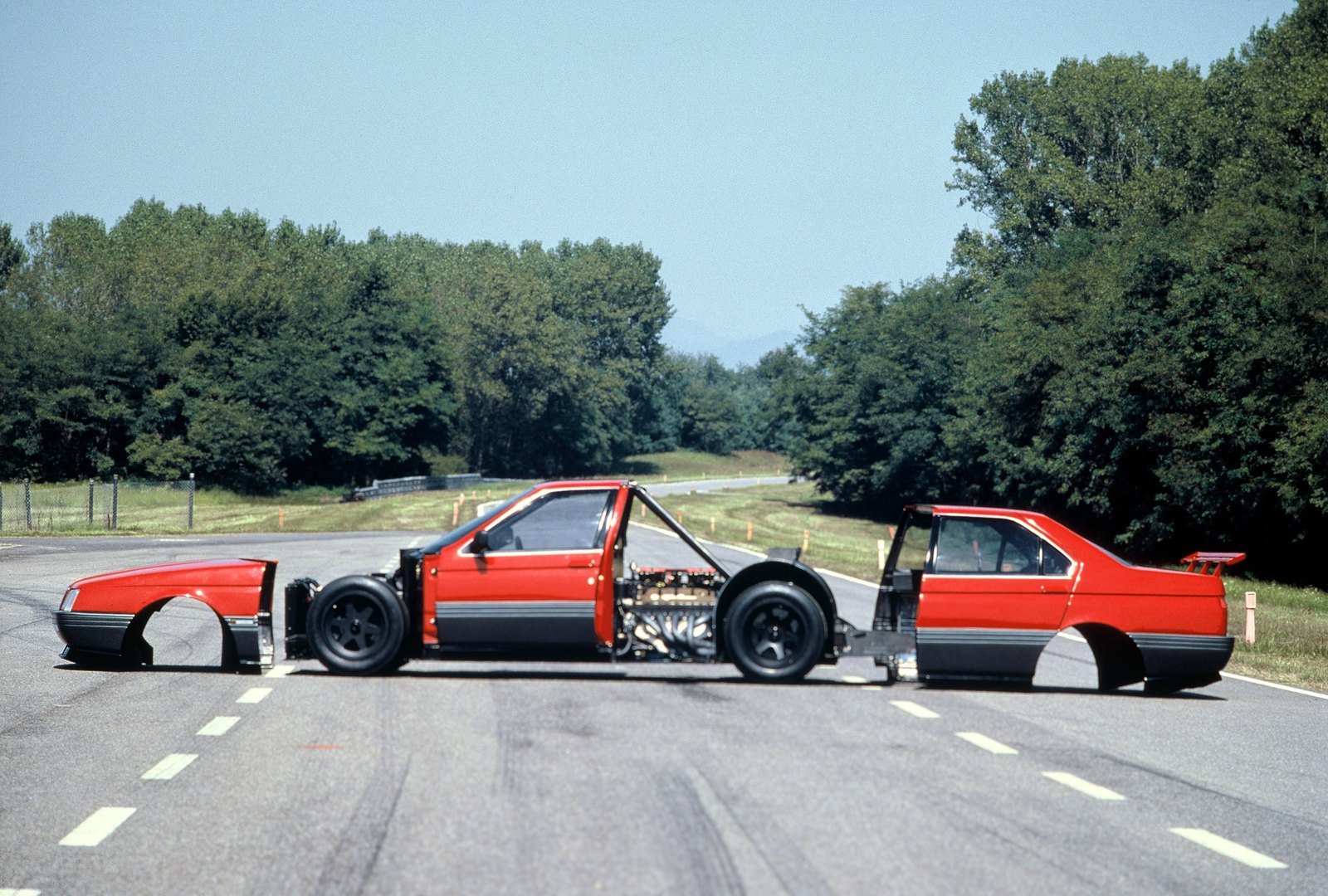
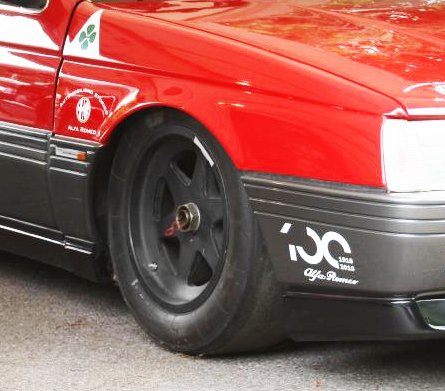
And it seated two. A structural spine ran down the middle of the car, carrying the front suspension and the engine, with a seat on either side. The V10 sat behind the occupants, mid-mounted like in a Lamborghini Countach, while the road-going 164 had its V6 up front driving the front wheels. Power went to the rear through a six-speed Hewland manual gearbox. The suspension was double wishbones with coil springs at each corner, textbook race car, on slicks 9 inches wide in front and 14 at the rear.
The body was two huge composite clamshells, front and rear, that lifted off whole to reach the mechanicals. Every detail of the production car was molded in, down to the outline of the fuel door. Brabham even fixed fake rear seatbacks on top of the engine cover, so anyone peering through the side glass would see what looked like a normal five-seat sedan. The paint was so deep and glossy that it made dealer cars look cheap. From ten feet away you’d swear it was a street car. The only giveaways were the fat rear slicks, which gave it a drag-car stance, and a little wing on the trunk lid.

Alfa’s press sheet claimed a top speed over 340 km/h, about 211 mph, and 0 to 60 mph in 2.1 seconds. For scale, a 1987 164 3.0 V6 made 192 hp and topped 230 km/h, around 143 mph, which already made it one of the quicker sedans on the German autobahn. When the 164 reached the US for 1991, the 164 S made 200 hp. The ProCar had three times that. A 1988 Corvette made about 240 hp and weighed well over 3,000 lb.
Fast in a straight line, scary everywhere else
All that power ran into a basic problem. A Formula 1 car stays glued to the road because its wings and its flat floor create downforce, an aerodynamic push toward the pavement that grows with speed and gives the tires more grip in corners. A road sedan does the opposite. Its body is shaped to slip through the air cleanly, and at high speed it tends to lift.
The ProCar inherited exactly that. Giorgio Francia, the Alfa test driver who put more miles on it than anyone, said it made no downforce at speed at all. There was no front wing, and the rear spoiler was too small to matter, so in corners it lived on mechanical grip, meaning tires and suspension, and there wasn’t a lot to spare.
Because the body had to match the stock 164’s width, the track was narrow for a race car, and the nose wanted to lift. That made it hard to get the front slicks up to working temperature. On the car’s first run, the engineers told Francia to stay under 250 km/h, about 155 mph, because nobody knew what that shape would do beyond it.

Testing was short and private, at Balocco, Alfa’s own proving ground. Besides Francia, Giorgio Pianta did two brief runs. In September 1988, with Francia at the wheel, Alfa logged 340 km/h, 9.7 seconds for the quarter mile and 17.5 seconds for the standing kilometer.
One lap at Monza
The Alfa Romeo 164 ProCar’s public debut came on Friday, September 9, 1988, at the Italian Grand Prix, and the timing gave the whole weekend a strange edge. Enzo Ferrari had died on August 14, less than a month earlier. McLaren-Honda had won every race of the season so far with Ayrton Senna and Alain Prost. That Sunday, Senna tangled with the Williams of stand-in driver Jean-Louis Schlesser while lapping him, and Ferrari’s Gerhard Berger and Michele Alboreto finished first and second in front of the tifosi. It was the only race McLaren didn’t win in 1988.
Alfa picked Schlesser’s teammate that weekend, Riccardo Patrese, to drive the ProCar. Patrese drove for Williams and needed special permission from his team to get into a car built by Brabham, the outfit he had raced for in the two previous seasons. After Friday qualifying he did one lap out and one lap in, with instructions to cruise everywhere except one place: come out of the Parabolica fast and floor it down the front straight to show off the top speed.
He got to about 330 km/h, roughly 205 mph, short of the promised number. Patrese said that above about 300 km/h the car shook violently, and he blamed the V10’s design and the lack of testing. Alfa said the car had been sitting too long, the Michelin slicks were old and a small water radiator leak during the Balocco tests had made everyone cautious. Patrese later said that in those conditions it was impossible to judge either the car or the rules.
That Friday was the first time the public heard Alfa’s V10. It was also the last time the Alfa Romeo 164 ProCar turned a wheel in public on a racetrack. After Monza it only appeared standing still, at the Paris and Birmingham auto shows in 1988. The bare engine was displayed at the Turin show later that year.
Nobody else wanted to play
Formula S died because Alfa was alone. Not one other manufacturer built a car for it. Mercedes and Peugeot looked at it and chose Group C sports cars instead. The touring car makers told Cadringher something very simple: they wanted to race what they sold, and a Formula 1 car in a sedan costume wasn’t it. Costs were huge and the marketing payoff was doubtful. The series was never formally cancelled. It just faded away.
Alfa wasn’t done with the V10. In October 1988 it announced plans for American IndyCar racing and for sports prototypes. The IndyCar effort used a different engine, a 2.65-liter turbo V8, and it ran in CART from 1989 to 1991, first with Roberto Guerrero in a March run by Alex Morales, then with Patrick Racing, which added Al Unser Sr. for Indianapolis and Michigan in 1990 and signed Danny Sullivan in 1991. The Alfa V8 never won a race.
The sports car project was where the V10 should have landed. For 1990 Group C switched to 3.5-liter engines derived from Formula 1 and 750 kg cars, exactly what the 1035 had been built for. Alfa first tested the V10 inside a Lancia LC2, and from that work came the SE 048SP, a prototype that combined Alfa Corse’s engine with an Abarth chassis and transmission. Giuseppe Petrotta, who came from Osella, and Ignazio Lunetta developed the chassis, Giorgio Comaschella handled the aerodynamics and Monfrini built the carbon monocoque.
It never raced with the V10 either. Some say there were doubts about its reliability over endurance distances, others call it a purely corporate decision. All Alfa itself documents is that, for internal group reasons, management chose a single 3.5-liter engine for both sports cars and Formula 1: the Ferrari V12. D’Agostino’s team had to adapt that V12 to Group C rules and modify the monocoque to fit it. In September 1990 the project was suspended, partly because the FIA showed little interest in that championship. The V10 went back on the shelf.
Two cars, one museum, a lot of loose ends
The 164 ProCar lives today in the Alfa Romeo Museum at Arese. Alfa says two were built and that Giorgio Francia tested one of them at Balocco. How complete the second car ever was is murky. People who worked at Chessington remember only one running chassis, and what’s been published about the second one doesn’t line up. The engine count doesn’t line up either: some sources say 15 V10s were made, others only seven.
One of those engines came up for sale in 2021, in a British online auction that closed on July 2. The listing said it had been built for Ligier’s 1990 car, the JS33. That doesn’t square with anything known about the engine. The Ligier deal had died in 1987, three years before. Even on the auction block, Alfa’s V10 can’t get its story straight.
Three chances, zero green flags
Plenty of cars flop in racing. The Alfa Romeo 164 ProCar never even got the chance to flop, and that only makes the legend bigger. Alfa had what may be the first V10 built for the new 3.5-liter Formula 1, and Fiat wouldn’t let it into Formula 1. It put that engine into one of the wildest cars of the decade, and the series never ran a single race. It tried Group C, and the group handed the job to Ferrari’s V12. Each door had its own official reason for closing. Line them up and they tell one story: decisions about a racing brand were being made in Turin, by a group that already had a team to protect.
The idea was right, though. Sedan silhouettes over top-tier racing hardware is exactly what the DTM’s Class 1 and the ITC put on track a few years later, with the Alfa 155 V6 TI beating Mercedes on home ground in Germany. That 155 was built by Alfa Corse, the department that carried on the line of Autodelta, and it won what the 164 ProCar never got to race for. The ProCar was a few years early and had the wrong owner. Alfa itself was gone from American showrooms after 1995, so most US buyers never saw a 164 at all, let alone this one.
For the rest of the sleeper car world, it stays the benchmark. Plenty of people have hidden big engines in boring bodies. Nobody else hid a Formula 1 engine in a car whose rulebook required the stock dashboard. If you want the road car’s full story, the Wikipedia entry on the Alfa Romeo 164 covers the sedan it was dressed up as, and for the first ProCar series there’s our piece on the BMW M1 and its Procar championship.
It’s still sitting in Arese, paint flawless, fake fuel filler, fake back seat. It looks like any other 164. Underneath is a Formula 1 engine that never raced.
Check you’re still alive.
Photos: Alfa Romeo / Stellantis Media (164 ProCar with body off, chassis and engine bay, 1988). Via Wikimedia Commons: 164 ProCar at Goodwood and wheel detail, Richard (CC BY 2.0); Tipo 1035 V10 engine, Lyon84 (CC BY 4.0).