Koenigsegg CC8S Ford V8: the Mustang Block That Beat Ferrari
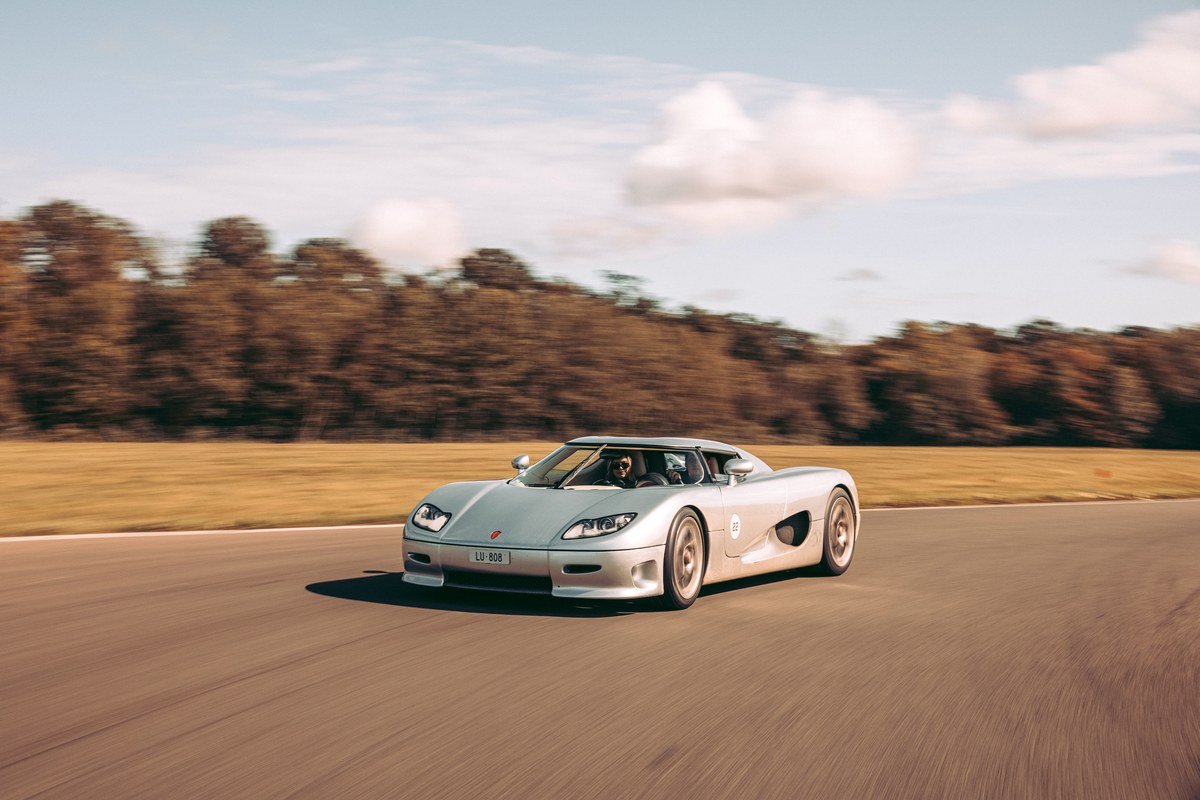
The most powerful production engine on the planet in 2002 started life as a Ford. Same Modular V8 family you’d find under the hood of a Mustang GT at any dealership in Ohio. A Swede with no engineering degree bought the block, built the rest of the engine himself, bolted it into a carbon-fiber car he’d been dreaming about since kindergarten, and walked away with a Guinness World Record. Detroit never mentioned it much.
The car was the Koenigsegg CC8S. Six of them were built. None were ever sold new in the United States.
A kid, a puppet movie and frozen chickens
Christian von Koenigsegg was five when he saw Flåklypa Grand Prix, a Norwegian stop-motion film known in English as The Pinchcliffe Grand Prix. In it, a bicycle repairman builds a race car called Il Tempo Gigante in his workshop and beats the bad guy. For most kids that’s a Saturday afternoon. For this one, in Stockholm, it was a life plan.
He didn’t go to engineering school. What’s on record is economics at the Scandinavian School of Brussels. The money came from trading anything that moved. He has told Hagerty about buying a batch of plastic shopping bags with the logo printed the wrong way round and selling them into Eastern Europe, and about shipping frozen chickens from the USA to Estonia. That’s right: American poultry helped pay for the first Koenigsegg, before an American engine finished the job.
On August 12, 1994, at 22, he founded Koenigsegg Automotive. The shop was in Olofström, a small industrial town in southern Sweden that nobody in the car world had heard of.
Three engines, two dead ends
A tiny hypercar startup doesn’t design an engine from a blank sheet. It borrows a block from somebody big and builds up from there. Who you borrow from decides everything.
First call: Audi and its 4.2-liter V8. Koenigsegg wanted 550 to 600 horsepower out of it. Audi wanted nothing to do with that kind of tuning and refused to support it. He tried a back door through a Danish supplier; Audi found out and shut it down.
Second call, and this one is wild. He signed a deal with Motori Moderni, the little Italian outfit run by Carlo Chiti, the engineer behind Ferrari’s 1961 title car. The engine was a flat-12 that had raced as the Subaru 1235 in Formula 1 in 1990, where it powered the hopeless Coloni. Then Chiti died, Motori Moderni went bankrupt and the deal went with it. Koenigsegg later admitted the flat-12 would never have handled much more than 700 horsepower anyway. Dead end.
Third call: Ford. Ford said yes and sold him the Modular V8. The block that powered the Mustang GT, the Crown Victoria cop cars and the F-150 was about to go to Sweden for a very different career.
Cannes, not Detroit
By 1996 the first prototype, the CC, was running. Touring-car driver Rickard Rydell gave it its first public laps at Anderstorp. A year later Koenigsegg took it to the Cannes Film Festival. Not the Detroit show, not Geneva. Cannes. Red carpets, movie stars, and every photographer on the Riviera. A booth at a motor show costs serious money; a car parked where the paparazzi already are costs almost nothing. It worked. The press covered it, and the attention kept the lights on.
In early 1999 the company moved from Olofström to Margretetorp, a few miles north of Ängelholm on Sweden’s southwest coast. In September 2000, at the Paris Motor Show, Koenigsegg showed the first CC8S production prototype. That car was never sold. It became the test mule and then the crash-test car, the one that got smashed so the others could be homologated. Big manufacturers crash a dozen cars without blinking. For a company this size, sacrificing a complete car was a real hit to the budget. It was also the only way to get license plates.
Production started in 2002. Koenigsegg says the first car was built that year and handed over to its owner, German customer Stephan Reeckmann, who had put down a deposit in 2001, at the Geneva Motor Show in March 2003. Wikipedia puts that delivery at Geneva 2002; the factory’s date is the one used here.
The engine, piece by piece
Here’s what Koenigsegg did to the Ford Modular, according to the company’s own spec sheet. The engine was assembled in-house, taken to 4.7 liters and made legal: full OBD and emissions compliance, which is the part most garage builds skip.
Dry-sump lubrication, so the engine could sit low in the chassis and keep oil pressure through hard corners. Forged pistons and connecting rods to survive boost. Bigger injectors to feed the extra air. Reworked cylinder heads with new camshafts and stronger head bolts. Merged exhaust headers, which pair the exhaust pulses so they help pull each other out instead of colliding. A ram-air intake. Compression dropped to 8.6:1 so it wouldn’t knock under pressure.
And on top, a centrifugal supercharger running 1.2 bar, roughly 17 psi, with a big intercooler.
If you know American V8s, the supercharger choice is the interesting part. The classic Detroit blower is a Roots-type: belt-driven, it pushes a fixed amount of air on every turn and hits hard right off idle. That’s why it was the choice for the 2003 Mustang SVT Cobra, the “Terminator,” whose supercharged 4.6 Modular made 390 horsepower. A centrifugal supercharger is also belt-driven, but inside it’s basically the compressor half of a turbo: an impeller spinning very fast, flinging air outward. Its boost rises with engine speed. Soft at low rpm, ferocious near the redline. For a 2,590-pound car on 2002 tires, that’s exactly what you want: the hit arrives when you’re already moving and the tires can take it.
The intercooler is just a radiator for intake air. Compressing air heats it, hot air is thinner and carries less oxygen, and less oxygen means less power and more risk of detonation. Cool it down and you get the density back.
The result: 655 hp at 6,800 rpm and 750 Nm, about 550 lb-ft, at 5,000 rpm, with a 7,250 rpm redline.
Rocket Cat, the first Koenigsegg invention
Every emissions-legal performance car fights the same enemy: the catalytic converter. It cleans the exhaust, but it’s also a partial blockage in the pipe. That creates back pressure, and back pressure strangles an engine at high rpm.
The usual layout uses two converters in series. A small pre-cat sits close to the engine so it lights off fast on a cold start, when emissions are worst. A bigger main cat sits downstream. The little pre-cat is the bottleneck once you’re up in the revs.
Christian von Koenigsegg invented and patented a fix called the Rocket Cat. When the pre-cat creates too much back pressure at high rpm, the excess flow is routed straight past it to the main cat, which is already hot and does the cleaning on its own. No valves, no actuators, no moving parts at all. Just the shape of the plumbing. Koenigsegg claims it gained nearly 100 horsepower over the existing solutions of the day. That’s the company’s number; nobody outside has published a test.
It’s also the start of a habit. Freevalve camless engines, the Light Speed Transmission, the Direct Drive in the Regera: all came later. The CC8S is where the company stopped buying solutions and started patenting them.
How it stacked up in America
Guinness World Records named the CC8S engine the world’s most powerful production engine in 2002. That’s a specific title, and it’s worth putting next to what American buyers could get at the time.
The 2003 Dodge Viper SRT-10 made 500 hp from 8.3 liters of V10. The Saleen S7, America’s own hand-built supercar, launched in 2002 with 550 hp from a naturally aspirated Ford-based 7-liter V8. The 2003 Mustang SVT Cobra had 390 hp. And when Ford finally built its own halo car, the 2005 Ford GT, it used a 5.4-liter Modular V8 with a screw-type supercharger and made 550 hp.
So a Swede working out of a shed got 105 more horsepower out of a smaller block of the same engine family than Ford did with its own flagship, three years earlier. The CC8S also weighed 1,175 kg dry, around 2,590 lb, thanks to a semi-monocoque of pre-impregnated carbon fiber with honeycomb reinforcement. Koenigsegg quoted 0 to 62 mph in under 3.5 seconds and a top speed of 390 km/h, 242 mph. Those are factory claims, never independently timed.

Europe had its own comparison that fall. At the 2002 Paris Motor Show, Ferrari unveiled the Enzo with a 6-liter V12 making 660 metric horsepower, which is 651 hp in American terms, and a 1,255 kg dry weight. The CC8S had four more horsepower and 80 fewer kilos.
The gearbox was a six-speed manual developed specifically for the car by CIMA, an Italian specialist. A Ford block, an Italian transmission, Swedish everything else.
None of it came to the US. Koenigsegg didn’t sell cars in America until the CCX of 2006, the first model built with US regulations in mind. If you wanted a CC8S here, you imported it the hard way.
The fire
On Saturday, February 22, 2003, about two weeks before Geneva, fire broke out at Margretetorp. The building had a thatched roof, which is lovely on a postcard and a disaster with a spark. One of the production buildings was badly damaged.
The staff saved the cars and the tooling. What burned was the history: nearly all of Christian’s childhood sketches, many of the earliest company records, and even some of Carlo Chiti’s flat-12 blueprints.
The car still made Geneva. The company still delivered. Then it needed a new home, and found one at the former base of the Swedish Air Force’s F10 wing in Ängelholm, decommissioned on December 31, 2002. Huge hangars, its own runway, room to grow. By late 2003 one hangar and an office had been converted. Koenigsegg is still there.
Total CC8S production: six cars, built in 2002 and 2003, four left-hand drive and two right-hand drive. Whether the fire is why the number is so small isn’t documented anywhere. But it’s hard to ignore the timing.
Why there’s a ghost on every Koenigsegg
Look closely at any modern Koenigsegg and you’ll find a small ghost. It’s not the company logo; that’s the von Koenigsegg family crest.
The ghost belonged to the base. F10’s first squadron, Johan Röd, used a ghost as its emblem, with the motto “The show must go on.” Locals called it the Ghost Squadron. When Koenigsegg moved into the hangars the pilots left behind, it took the ghost as a tribute. Fair choice of motto for a company that had just watched its factory burn two weeks before the biggest show of its life.
The CC8S was born at Margretetorp, before the move, and as far as anyone knows it left the factory without one. Koenigsegg has never said which car wore the ghost first.
Doors that go out and up at the same time
The CC8S was also the first production car with Koenigsegg’s Dihedral Synchro-Helix doors. An early version had already appeared on the CC prototype.
A Countach door hinges at the front and swings straight up. A normal door swings straight out. The Koenigsegg door does both in one motion, rotating around a helical path so it moves outward and upward together and ends up standing beside the car. You still need some side clearance, just a lot less than with a long conventional door. And the sill stays clear, which matters when the car has 100 mm, about four inches, of ground clearance.

Small companies usually buy their hinges from a catalog. Koenigsegg designed its own. Same pattern, again, and it ends with the company laying up its own carbon fiber, the story behind Koenigsegg Advanced Manufacturing.
Twenty years later: the CC850
In August 2022, during Monterey Car Week at Pebble Beach, Koenigsegg unveiled the CC850, built to mark twenty years of the CC8S and Christian’s fiftieth birthday. Production was set at 50, then raised to 70 when demand blew past it. It has a 5.0-liter twin-turbo V8 making 1,385 hp on E85 and weighs 1,385 kg.

The clever bit is the gearbox. Koenigsegg calls it the Engage Shift System: the nine-speed Light Speed Transmission from the Jesko, operated through a gated six-speed shifter and a real clutch pedal. It uses six of the nine ratios depending on the mode, and it can also shift itself. It’s the CC8S’s manual spirit grafted onto a gearbox that has no business offering one.
In 2002 Koenigsegg was a handful of people in a thatched building that was about to burn down, using an engine block you could find in a Ford parts catalog. By 2017 the Agera RS had set a production-car top speed record on a closed highway in Nevada. The kid who watched a Norwegian puppet movie built his own Il Tempo Gigante. He just needed some frozen chickens and a Mustang block to get started.
Koenigsegg wasn’t the only small hypercar outfit leaning on CIMA. In Bavaria, the Lotec Sirius swapped its Hewland race box for a synchronized CIMA six-speed to handle a twin-turbo V12 that made 1,200 PS at the wheels.
Check you’re still alive.
Photos: Koenigsegg (press).