Vittorio Jano: the engineer who designed the engines that won for Alfa Romeo, Lancia and Ferrari, and whom almost nobody remembers
Here’s a question. If you walked into Goodwood next summer, stopped any ten people in the paddock, and asked them to name the most influential engine designer in the history of Italian motorsport, what answers would you get?
You’d get Colombo. You’d get Lampredi. You’d hear Forghieri a few times. You’d get Chiti from the older ones. You’d probably get Ferrari himself, which doesn’t count because Enzo wasn’t really an engineer, he was a team principal with a notebook.
Almost nobody would say Vittorio Jano. And almost nobody would be right.
The man designed the engine that won the very first Grand Prix World Championship in 1925. He designed the Formula 1 car that gave Juan Manuel Fangio his fourth world title in 1956. He designed the V6 that powered the Ferrari Dino — the road car, the race car, and every Stratos and 246 GT that followed — and whose basic architecture, a compact narrow-angle V6, opened up a path the engine industry has been walking down ever since. He worked for Fiat, Alfa Romeo, Lancia and Ferrari across half a century. He is, by any fair measure, one of the three or four most important figures in twentieth-century automotive engineering.
And almost no civilian car enthusiast can place him within a generation.
How did that happen? Because Jano never built a brand of his own. He never put his name on a bonnet. He never founded Jano Automobili in 1955 the way Ferruccio Lamborghini founded Lamborghini in 1963. He spent fifty years making other people’s marques famous, and then he died, quietly, in Turin in 1965, leaving behind a body of work distributed across so many badges that no single museum can claim him.
This is the story of the most invisible great engineer in the history of the car.
The Hungarian who wasn’t quite Hungarian
The origin story is complicated already. Vittorio Jano was born on 22 April 1891 in San Giorgio Canavese, a small town in Piedmont about forty kilometres north of Turin. But his birth name wasn’t Vittorio Jano. It was Viktor János.
His parents were Hungarian immigrants who had settled in northern Italy a few years earlier. His father was a mechanical engineer who worked as the technical director at one of Turin’s two military arsenals. Vittorio grew up in a household where Hungarian was spoken at the dinner table and where his father, after the meal, would explain the inner workings of military weapons to his son. That mixture — Eastern European blood, Italian craftsmanship, precise military formation — runs through everything he would build over the next seven decades.
At eighteen, after studying at Turin’s Istituto Professionale Operaio, he took a job as a draughtsman at the Società Torinese Automobili Rapid, a small company founded by G.B. Ceirano. Quiet historical footnote: Ceirano’s earlier company had been sold to a man called Giovanni Agnelli in 1899 and renamed Fabbrica Italiana Automobili Torino. Fiat. So Jano’s first job was effectively inside Fiat’s family tree without him knowing it yet.
In 1911, aged twenty, Fiat itself hired him. They put him under an engineer called Luigi Bazzi. And that’s where the story properly begins.
Ten years at Fiat: learning the trade
The Fiat years are Jano’s apprenticeship. There isn’t one signature car from that period — he was a junior in a department full of senior people. But he was inside everything. He learned racing engines under Carlo Cavalli and Giulio Cesare Cappa, two of Fiat’s top engineers of the 1910s and early 1920s. He learned chassis, transmissions, suspension. He learned the entire grammar of the racing car as Europe understood it.
By 1921, aged thirty, he was leading a design team within Fiat. One of his contributions was the Fiat 805, a two-litre supercharged eight-cylinder Grand Prix car. It’s the period where Jano starts to build something quietly important: a reputation. And it’s the period where he becomes close friends with Luigi Bazzi.
That friendship is about to change history.
Enzo Ferrari’s first major move
In 1923, Bazzi leaves Fiat for Alfa Romeo in Milan. Alfa was trying to set up a proper Grand Prix programme and urgently needed an engineer who could design a winning car from a blank sheet of paper. Bazzi told Alfa’s management that he knew the right man: Vittorio Jano, in Turin.
The problem was that Jano didn’t want to leave. He was comfortable at Fiat, well-positioned, had no particular interest in moving to Milan.
Enter a young Alfa Romeo works driver called Enzo Ferrari. Twenty-five years old. He’d been driving for Alfa since 1920 and had started getting involved in the management side. He was the one who pushed Alfa’s board to sign Jano. And, according to the versions that have come down to us, he was the one who personally went to Turin, knocked on Jano’s door, offered him a significantly better salary, and promised him free rein to design whatever car he wanted.
It worked. Jano left Fiat and joined Alfa Romeo as chief engineer, replacing Giuseppe Merosi. He was thirty-two years old. And finally, the cars that came out of the studio carried his fingerprints from the first drawing.
Alfa Romeo 1923-1937: the golden years
What Jano did at Alfa Romeo between 1923 and 1937 puts him in the European Grand Prix pantheon alongside Robert Benoist’s Delage team, Mercedes-Benz under Hans Nibel, and Auto Union under Ferdinand Porsche. The milestones matter.
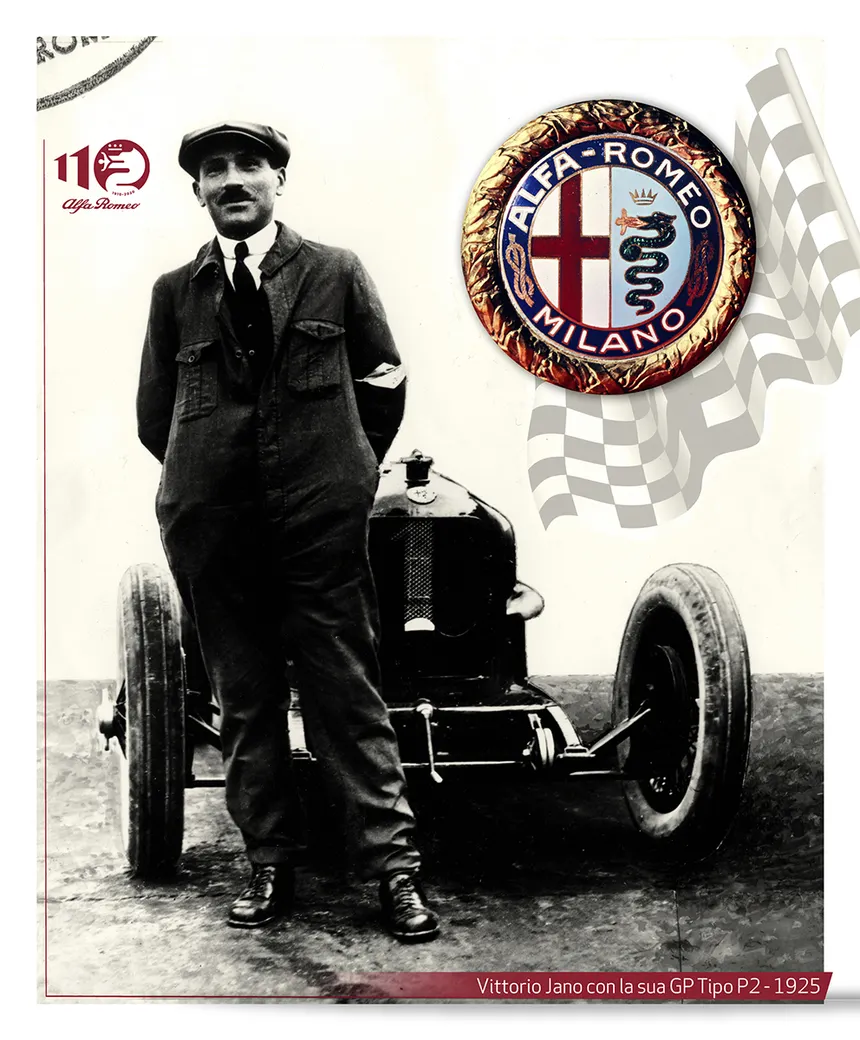
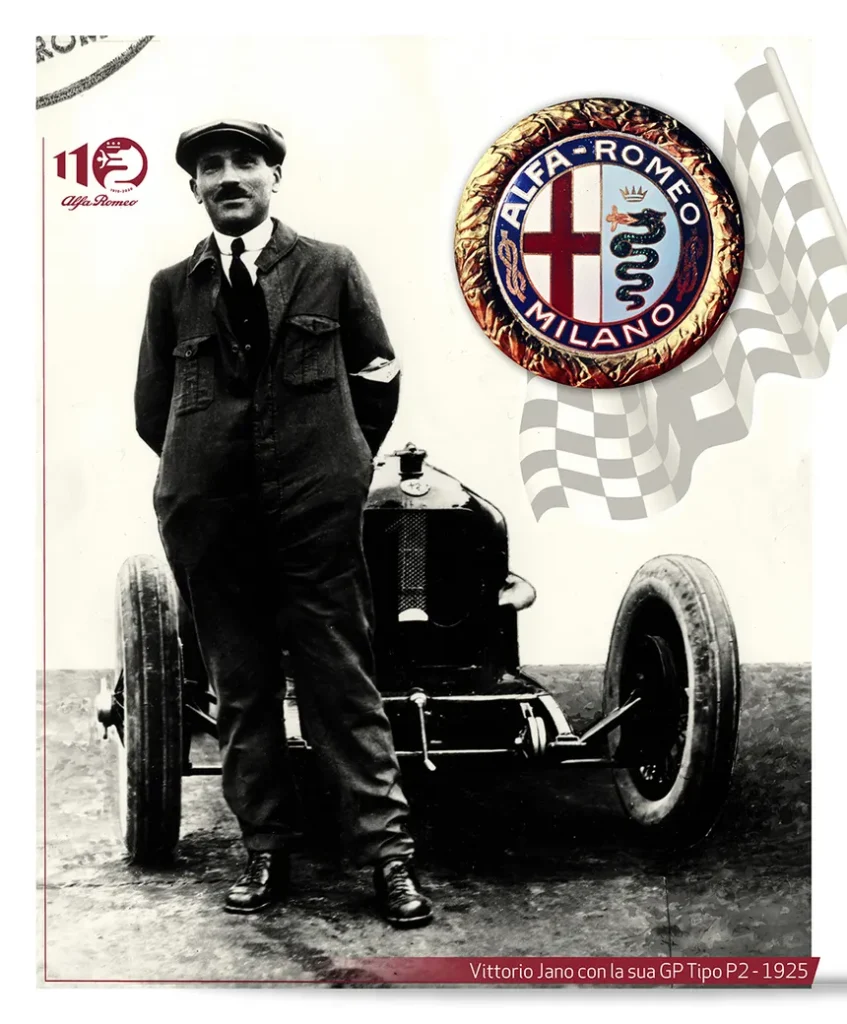
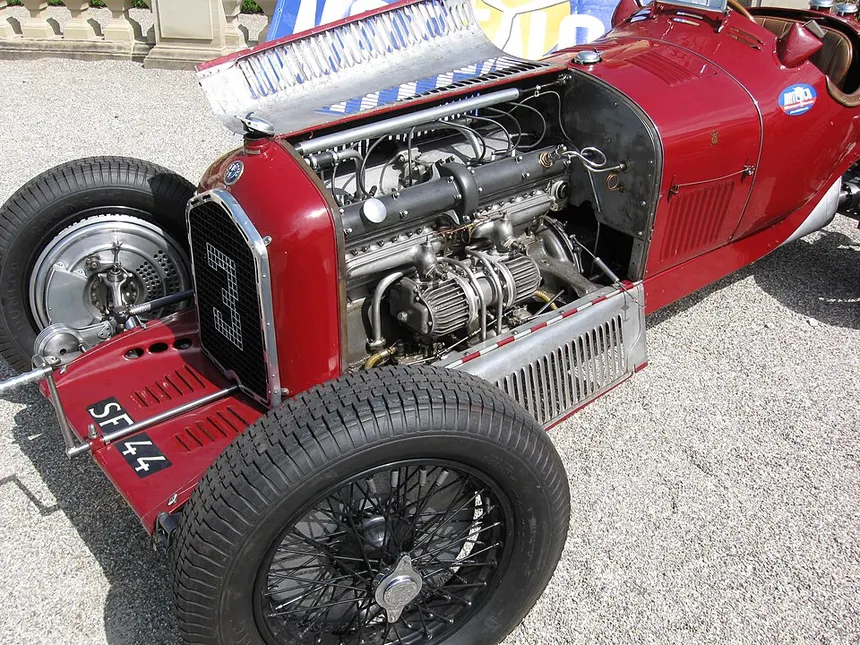
The first big project was the Alfa Romeo P2 of 1924. Grand Prix single-seater with a 2-litre supercharged straight-eight engine. It won its debut race, the Italian Grand Prix, with Antonio Ascari at the wheel — father of Alberto Ascari, who’d become World Champion in the 1950s. The following year, in 1925, the P2 won the first ever World Championship of Manufacturers organised in the history of motor racing. Read that sentence again. The very first world championship was won by a car designed by Vittorio Jano.
Antonio Ascari was killed later that same year driving a P2 at the French Grand Prix. It was the first tragedy that touched Jano personally. It wouldn’t be the last.
For Alfa’s road cars, Jano developed a family of small-to-medium-displacement four, six and eight-cylinder inline engines, all based on the P2 architecture. Light-alloy construction, hemispherical combustion chambers, centrally located spark plugs, two valves per cylinder, twin overhead camshafts. That architecture became the DNA of Alfa Romeo engines for the next five decades. The 1750, the 6C 1500, the 6C 1750, the 8C 2300, the 8C 2900 — all carrying a Jano engine under the bonnet. Arguably the most beautiful sports cars of the 1930s built anywhere on earth.
In 1932 came the masterpiece: the Alfa Romeo Tipo B, better known as the P3. The first pure Grand Prix single-seater in history. Single seat, front-central engine layout, twin propshafts driving each rear wheel separately so the driver could sit lower in the chassis. 700 kilos. An eight-cylinder engine that was effectively two four-cylinders joined at the crank, each with its own Roots supercharger. The P3 won its debut race, the 1932 Italian Grand Prix, with Tazio Nuvolari driving. It won five more races that season. Between 1932 and 1935, the P3 racked up 46 victories.
The P3’s most famous win came late in its competitive life. In 1935, at the German Grand Prix at the Nürburgring, with the car already obsolete against the state-backed Mercedes and Auto Union Silver Arrows, Tazio Nuvolari took a P3 he technically had no business being on the grid with and beat the Germans on their home soil. In front of dozens of Nazi officials. With the circuit’s PA system mysteriously failing to play the Italian anthem when he won. That race is still considered one of the greatest drives in motorsport history. The driver was irreplaceable; the car was Vittorio Jano’s.
The Jano-Ferrari double act starts here too. While Jano designed cars in Milan, Enzo Ferrari was running Scuderia Ferrari out of Modena as Alfa’s official racing customer. Alfa built the cars, Ferrari raced them. Jano and Ferrari worked together for years in an arrangement that was about to define both their futures. And eventually explode.
1937: the year everything broke
1937 was a brutal year for Jano. Two things happened almost simultaneously.
First, Alfa Romeo got into serious financial trouble. The Italian state nationalised it. The decision was made to officially withdraw from Grand Prix racing until things improved. In the meantime, Jano had designed the Alfa Romeo 12C, a V12 monoposto meant to take on Mercedes and Auto Union. The car didn’t work. It didn’t win. And Alfa’s new management, looking for someone to blame, found Jano.
He lost favour. Projects were pulled. He was marginalised. In December 1937 he resigned and walked out of Alfa Romeo.
Second, in February of that same year, Vincenzo Lancia died of a heart attack in Turin. Lancia, Italy’s other major manufacturer, was suddenly without its founder. Vincenzo’s widow Adele Miglietti and his son Gianni Lancia offered Jano the role of chief development engineer.
Jano accepted. He went back to Turin, the city where he’d trained as a teenager. He would stay at Lancia for eighteen years. The best of his second act was about to begin. But first there was a small matter of a World War in the way.
War and post-war: aircraft engines, the Aurelia, the D50
During the Second World War, Jano also worked on aircraft engines, like many other engineers of his generation. Ferdinand Porsche did the same. It’s not the famous part of his career but it tells you something about the technical range of the man: he was capable of designing anything from a Grand Prix car to an aero engine to a truck to a bus.
The work that matters comes after 1945. Two cars.
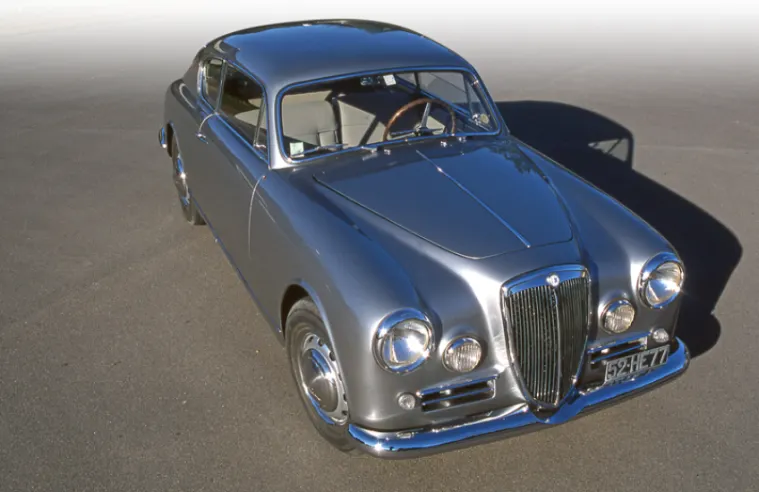
First, the Lancia Aurelia. And here Jano makes history again. The Aurelia, launched in 1950, was the first production car in the world with a V6 engine. Say that one more time. The first production V6 engine in history. Today it’s the dominant configuration for premium and performance cars: Mercedes uses it, Audi uses it, Toyota uses it, BMW uses it, Honda uses it, every manufacturer worth mentioning has used it. The original was invented by Vittorio Jano at Lancia in 1950. A 60-degree V6, single overhead camshaft per bank, two valves per cylinder. The B20 GT version of the Aurelia defined the entire genre of the Italian Grand Tourer: front engine, rear transaxle for weight balance, two-plus-two coupé body. Could drive you in comfort to Monte Carlo and then finish in its class at Le Mans the same week. The first modern GT car is Jano.
Second, the Lancia D50. And here Jano returns to Formula 1.
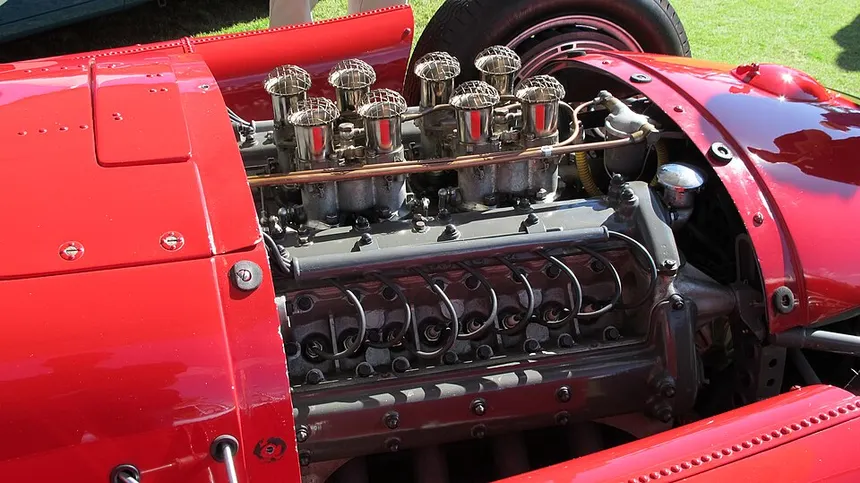
The D50 is one of the most technically radical single-seaters ever designed. A 2.5-litre 90-degree V8 that functioned as a stressed member of the chassis. The engine was the chassis. No rear subframe at all. Fuel tanks mounted in pontoons on either side of the cockpit, between the wheels — an idea forty years ahead of its time. Five-speed gearbox. 260 horsepower. 620 kilograms.
The D50 debuted in 1954. The drivers were Alberto Ascari, son of the Antonio Ascari who’d died in a Jano P2 thirty years earlier, together with Luigi Villoresi and Eugenio Castellotti. The car was fast straight out of the box. Alberto Ascari won the 1955 Naples Grand Prix with it and nearly won Monaco, ending up in the harbour, in the water, alive only by luck.
Four days after Monaco, Ascari borrowed a Ferrari 750 Monza during a private test session at Monza. He went out on track in street clothes, without a helmet, and was killed. The reasons have never been fully explained. Jano had lost the father at the wheel of his P2 in 1925. Now he lost the son at the wheel of a car that wasn’t even his.
Lancia, with Ascari dead, with no money, with an F1 programme that had eaten the books, decided to sell the entire racing team. Enzo Ferrari bought it. For one pound sterling. Yes, one pound. Cars, blueprints, spares, drivers, and most importantly Vittorio Jano.
Ferrari: the V6 that wasn’t just any V6
At sixty-four, Jano joined Ferrari. Not as chief engineer — that role belonged first to Aurelio Lampredi and then to Carlo Chiti — but as a technical consultant and head of special projects. Enzo Ferrari, the same Enzo who’d travelled to Turin thirty-two years earlier to pry him out of Fiat, brought him back. To Maranello this time.
And here Jano did two things that changed Ferrari forever.
First, the D50s that Lancia had sold to Ferrari got rebadged as Lancia-Ferrari D50. With those cars, in 1956, Juan Manuel Fangio won his fourth Formula 1 World Championship. Read that again: Fangio won a Formula 1 title in a car designed by Jano for Lancia and operated by Ferrari. It’s the only championship in F1 history won by a car carrying two manufacturer names on the same body. And the most successful constructor in the history of the sport partly owes its trophy cabinet to an engineer who’d technically been hired by someone else.
Second, and far more important in the long run. In 1956, Enzo Ferrari’s son Alfredo “Dino” Ferrari died of muscular dystrophy aged twenty-four. Dino had been working alongside Jano on a new 65-degree V6 engine, smaller and more manageable than the V12s that had built Ferrari’s reputation. The idea was to use it in smaller-displacement classes to reduce costs and broaden Ferrari’s reach.
After Dino’s death, Jano finished the engine in his memory. Ferrari decided to name the motor, and eventually the cars that carried it, after his late son. Dino.
That engine — the Dino V6 — is probably the single most influential piece of engineering in Jano’s entire career. Which is saying something.
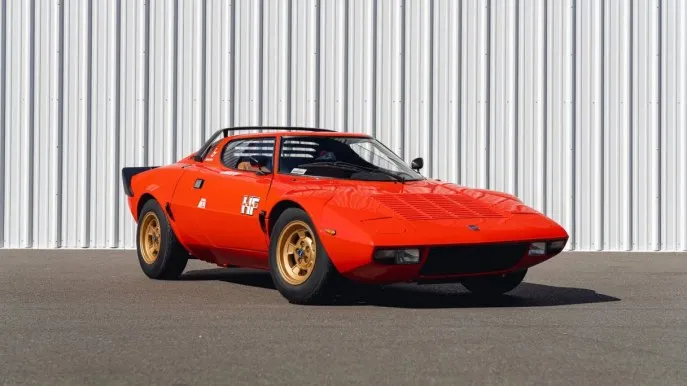
It powered the Ferrari 156 Sharknose with which Phil Hill won the 1961 F1 World Championship. It powered the Ferrari 246 F1, with which Mike Hawthorn had won the 1958 title — the last front-engined car ever to win a Grand Prix. It powered the Dino 206 GT and the Dino 246 GT road cars, Ferrari’s first mid-engined production cars. It powered the Lancia Stratos HF, which won three consecutive World Rally Championships in the 1970s — yes, the Stratos engine is a Jano-designed Dino V6. It powered the Ferrari 308 GT4 and the 308 GTB. It powered the Mondial. And it remained, in evolved variants, the base of an entire engine family that ran into the 1990s.
The Dino V6 isn’t an engine. It’s an inheritance.
The end
Now the hard part. The part where NEC has to write carefully.
In early 1965, Vittorio Jano took two heavy blows in quick succession. His only son died of a pulmonary illness in his early twenties. Around the same time, Jano himself was diagnosed with cancer.
The parallel with Enzo Ferrari is unsettling. Ferrari had lost Dino in 1956. Jano had lost Antonio Ascari’s son in 1955. Now it was his turn to lose his own. Three fathers bound by the same machine — the racing engine — and by the same kind of tragedy.
On 13 March 1965, in his home in Turin, less than a month short of his seventy-fourth birthday, Vittorio Jano took his own life. He’s buried at the Cimitero Monumentale in Turin. The city where he’d started as a draughtsman aged eighteen. The city where Fiat had trained him. Where Lancia had given him his second act. Where, for half a century, he’d designed the engines that other people won championships with.
He left no marque of his own. No museum. No family name attached to a car. But he left something rarer and more important. He left a method.
Why Jano still matters
Because the basic architecture Jano fixed in 1956 with the Dino — compact V6, narrow angle, the right balance of size and smoothness — opened a road the engine industry has been walking ever since. Most modern V6s aren’t direct descendants of the Dino, they’re distant grandchildren. But the first man to prove the configuration made sense was him. Every time a modern car uses the engine as a stressed member of the chassis — almost every Formula 1 car since the 1960s, plus countless prototypes — they’re applying a principle Jano pushed to its limits with the D50 in 1954. Every time an Italian GT uses a transaxle for weight distribution — Ferrari, Maserati, Alfa Romeo — they’re following the recipe Jano wrote for the Aurelia B20 in 1950.
His physical legacy is invisible because it’s dissolved into everything else. There’s no Jano Building at Maranello. There’s no enormous plaque at Arese. At Lancia, where he worked for eighteen years, the recognition is modest. Jano is one of those historical figures who paid a heavy price for one choice: never building a brand of his own. If he’d founded Jano Automobili in 1955, today he’d be remembered alongside Ferrari and Lamborghini. He didn’t, so he’s remembered like Lampredi or Chiti: with respect inside the technical community, with near-total anonymity outside it.
But petrolheads know. Petrolheads know that Fangio won his fourth title in a Jano car. That Phil Hill won his only title in another Jano car. That Nuvolari humiliated Nazi Germany at the Nürburgring in another Jano car. That the Stratos HF, the car that changed rally forever, ran a Jano engine. That the Aurelia B20, the car that invented the Italian Grand Tourer, was Jano. That the first production five-speed gearbox, in the 1948 Lancia Ardea, came out of his engineering team at Lancia.
He did more with the trade than most of the people who have statues. And he left quietly, in Turin, in March 1965, asking nothing in return.
There ought to be a brand called Jano. One that puts his name on the nose. One that gives this man the recognition he’s owed. Until that happens, it’s down to those of us who write about cars to remember who designed half the things we take for granted. And it’s down to those of us who drive an Italian V6, a German transaxle, or any modern single-seater to remember, occasionally, a small quiet man from Piedmont who in the 1920s drew engines on squared paper and who in 1965 decided that was enough.
Vittorio Jano. Hungarian by blood, Italian by craft, engineer above everything else. The most invisible of the great ones.
Check you’re still alive.
1 thought on “Vittorio Jano”