
Mazda Skyactiv-Z and the Iconic SP: The Last Carmaker Still Betting on the Rotary

The last rotary-powered Mazda sold new in America was a 2011 RX-8. If you wanted one after that, you bought used, budgeted for apex seals and learned to check the oil at every fill-up. Fifteen years later, Mazda has 36 engineers in Hiroshima working full-time on the Wankel again, a new four-cylinder that promises to burn fuel cleaner than almost anything with pistons, and a red coupe concept that looks like an FD RX-7 grew up. None of it makes obvious financial sense. That’s what makes it interesting.
This is the fifth piece in our series on who’s still fighting for the combustion engine and why. Aramco designs cheap hybrid engines because it sells oil. Horse Powertrain, owned by Renault, Geely and Aramco, quietly builds engines for half the industry. Chinese automakers are posting record thermal efficiency figures while Europe closes plants. Toyota races hydrogen because it’s the biggest carmaker on earth and Akio Toyoda wanted to. Mazda has none of those excuses. It has a brand that, since the 1967 Cosmo Sport, has been tied to a triangle spinning inside an oval.
Skyactiv-Z: Mazda’s Answer to Tier 4
Start with the engine that pays the bills. Mazda’s current gas engines are getting old. Skyactiv-G dates from 2011. Skyactiv-X, the clever spark-controlled compression ignition engine that never came to the U.S., launched in 2019. The 3.3-liter inline-six arrived in the CX-90 and CX-60 in 2022 and 2023. A new four-cylinder hasn’t appeared since.
In November 2024, in its half-year financial results, Mazda named the next one: Skyactiv-Z. It’s a naturally aspirated 2.5-liter four that will replace both Skyactiv-G and Skyactiv-X. CEO Masahiro Moro framed it as a statement of intent: even in the age of electrification, Mazda’s combustion engine will keep evolving. The redesigned CX-5 shown in July 2025 still uses the familiar 2.5; Skyactiv-Z is due from 2027, paired with Mazda’s first in-house hybrid system.
That last part matters on this side of the Pacific. The CX-50 Hybrid that Mazda builds at its joint plant with Toyota in Huntsville, Alabama, uses a Toyota hybrid system. The Skyactiv-Z hybrid is Mazda’s own.
The engineering idea is called lambda 1. Lambda is the ratio between the air actually entering the cylinder and the air needed to burn all the fuel exactly. At lambda 1 the mix is chemically perfect. Every modern engine runs close to that at part throttle, which is easy. At wide-open throttle, manufacturers have traditionally dumped in extra fuel, because evaporating gasoline cools the combustion chamber and keeps pistons and valves alive. That enrichment costs fuel and spikes carbon monoxide, unburned hydrocarbons and particulates, which is exactly what EPA Tier 4 and California’s LEV IV rules are squeezing.
Mazda says Skyactiv-Z will hold lambda 1 across the whole operating range, including full load, while burning lean at light loads for efficiency. If it works, it’ll be one of the cleanest conventional gas engines on sale. Until it’s in a car and someone has tested it, that’s a target, not a result. Mazda has also said the same technology will reach its inline-six, at a time when much of the industry is downsizing to turbo threes.

The 36
On February 1, 2024, Mazda announced it was re-forming its rotary engine development group inside the powertrain department. Thirty-six engineers. The previous team had been broken up in 2018, six years after RX-8 production ended in June 2012. In the press release, then-CTO Ichiro Hirose called the rotary "a special symbol" of Mazda’s challenging spirit.
Nobody re-forms a 36-person team for an engine with no market to hit next quarter’s numbers. You do it because the badge depends on it.
The brief covers three things: getting the rotary through emissions rules in the major markets, using it as a generator in range-extended electric cars, and running it on carbon-neutral fuels, hydrogen included.
If you’ve never had one apart, here’s the short version. A Wankel has no pistons going up and down, no connecting rods and no valves. A three-sided rotor turns inside a housing shaped like a pinched oval. The spaces between each face of the rotor and the wall form three chambers that grow and shrink as it turns, and each one goes through intake, compression, combustion and exhaust in sequence. The rotor drives an eccentric shaft, which does the crankshaft’s job. Fewer parts, less weight, a lot of revs and a smoothness no four-cylinder can touch. The catch is the apex seals, the thin strips at each tip of the rotor. They wear, they need oil, and the long, narrow combustion chamber burns less completely than a piston engine’s. That’s why RX-8 owners got used to mediocre mileage and a quart of oil on the passenger seat.

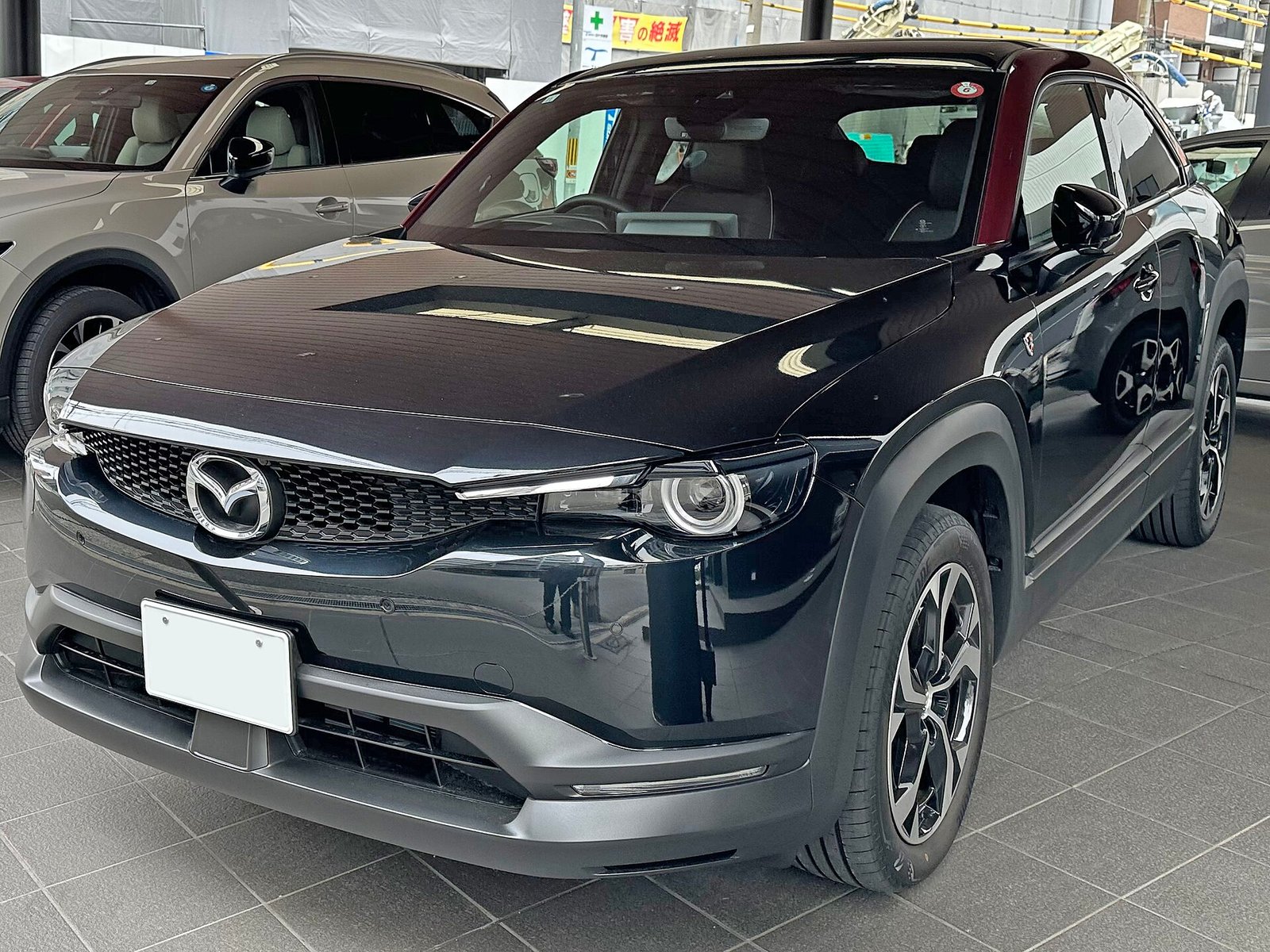
There’s already a production car using the new hardware. The MX-30 e-Skyactiv R-EV, built since June 2023, has a new 830 cc single-rotor engine, the 8C, that never drives the wheels. It just spins a generator to charge the battery. It was the first production rotary Mazda in eleven years. Mazda didn’t bring it to the U.S., where the battery-only MX-30 had already been dropped, but it kept the supplier chain and the machining know-how alive. That’s the foundation everything else stands on.
Iconic SP: The RX-7 Successor in Everything but Name
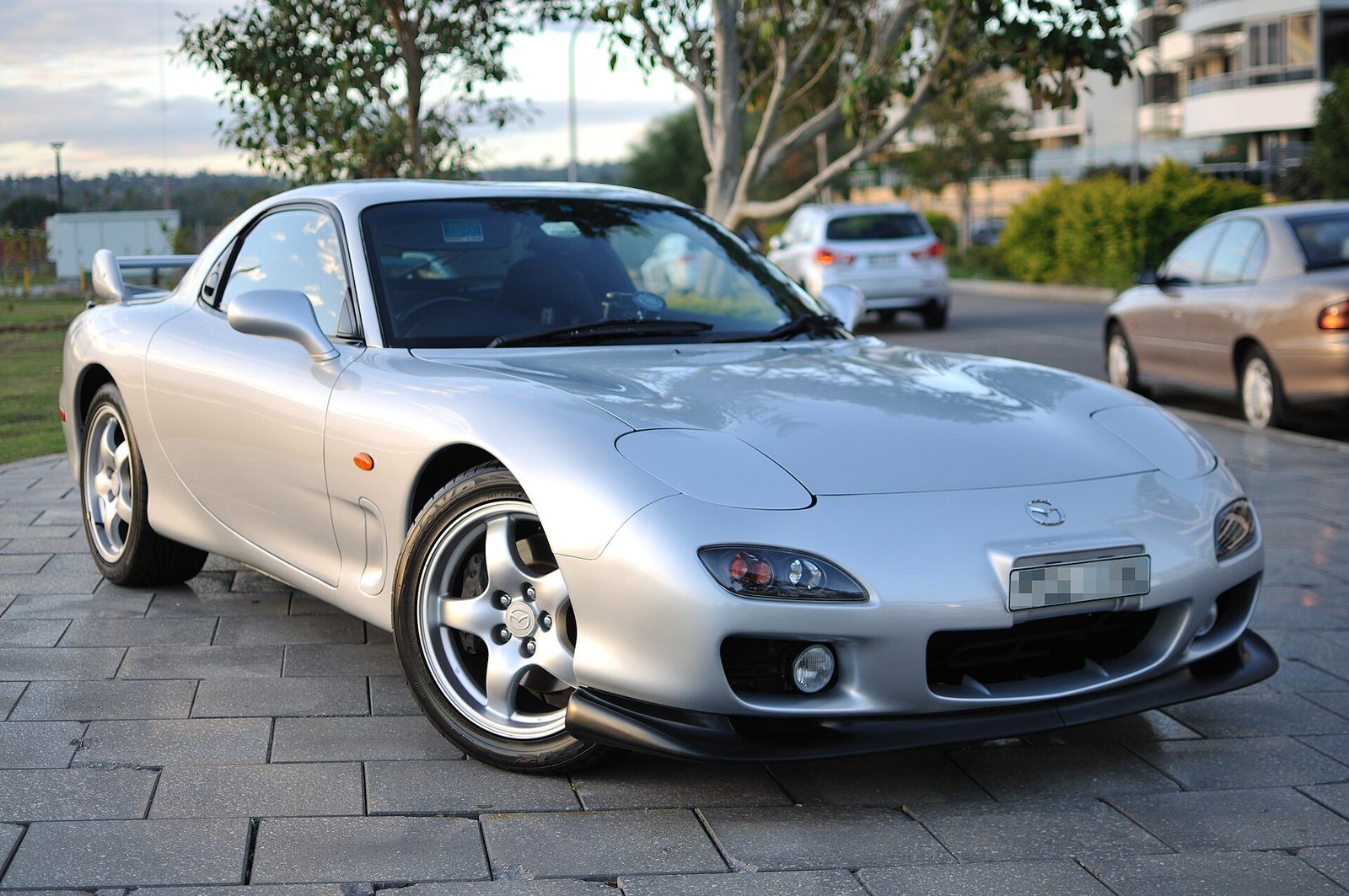
At the Japan Mobility Show in October 2023, Mazda pulled the cover off the Iconic SP. It’s 163 inches long, 73 wide and just 45 inches tall, and weighs 1,450 kg, about 3,200 pounds. Front-mid engine, rear drive, 50:50 weight distribution, doors that swing up and pop-up headlights. Look at it from the side and try not to think of the FD RX-7, the last generation sold here, which Mazda pulled from the U.S. market after 1995.
The powertrain is a two-rotor rotary working as a generator, with an electric motor driving the rear wheels. Combined output is quoted at 370 PS, about 365 hp. That’s more than any factory RX-7: the U.S.-market FD had 255 hp, and the last Japanese-market versions were rated at 280 PS. Mazda says the rotary could run on gasoline, carbon-neutral fuel or hydrogen.
Why use the rotary as a generator instead of driving the wheels with it? Size. A rotary is far smaller and lighter than a piston engine of similar output, so it can sit low and behind the front axle with the battery in the middle of the car. And the generator role sidesteps the two problems that killed the RX-8. Fuel use: if the engine only runs at its most efficient speed to charge the battery, it doesn’t waste gas idling in traffic. Emissions: same reason. It no longer has to swing from 1,000 to 9,000 rpm every time you touch the pedal.

Nobody Will Give You a Date
Mazda hasn’t announced a production date. Design chief Masashi Nakayama said the car was built with production in mind, for "the not-so-distant future." In 2025, current CTO Ryuichi Umeshita said the emissions side was basically solved and the outstanding issue was money. That same year Mazda scaled back its investment in electrified models, and the sports car’s range-extender powertrain was part of that cut. Mazda’s European product people say the project hasn’t been shelved.
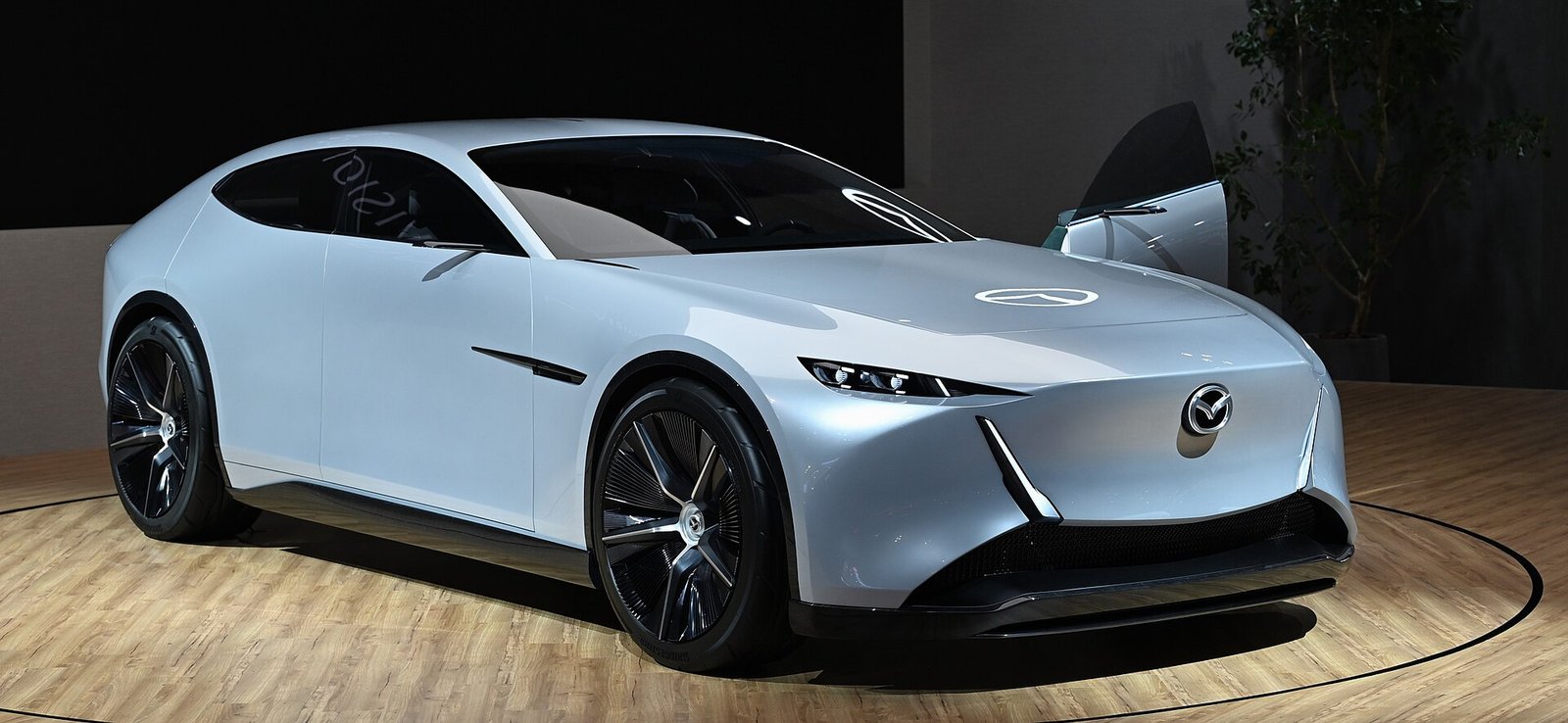
Meanwhile, the rotary found another stage. At the October 2025 Japan Mobility Show, Mazda showed the Vision X-Coupe, a four-door with a turbocharged two-rotor engine and an electric motor that can both drive the wheels. Mazda quotes around 503 hp and about 500 miles of total range. It’s bigger, pricier and probably easier to sell than a two-seater, because a four-door grand tourer can be leased to people who have never heard of an apex seal. If the rotary ever drives a Mazda’s wheels again, it may happen in a four-door before it happens in the RX-7’s heir.
Why Everyone Else Quit
The rotary’s history in America is a list of near misses. General Motors licensed it, planned it for the Chevrolet Monza, built a four-rotor mid-engine Corvette concept, and canceled the whole program in 1974. NSU in Germany launched the Ro 80 with it and nearly went broke paying warranty claims. Mercedes built the C111 and never sold one. Mazda kept going, through the oil crisis and every emissions round after it, all the way to the 787B winning Le Mans outright in 1991, still the only rotary-powered car ever to win the race.
For American fans, though, the rotary’s real home was never Le Mans. It was IMSA. From the late 1970s the RX-7 turned the GTU class into its private property, and in 1990 Mazda celebrated the RX-7’s hundredth IMSA race win, more than any other single model had managed in the series. Club racers did the rest. A first-generation RX-7 with a ported 12A was, for years, one of the cheapest ways to go fast in SCCA racing, and a lot of today’s rotary diehards learned to rebuild a motor on a garage floor in the 1980s and 1990s. That’s the audience Mazda is talking to when it shows a car like the Iconic SP, and it’s an audience that remembers every promise Mazda has made since 2012.
It also explains why Mazda talks about the U.S. rules first. California’s LEV IV and the EPA’s Tier 4 standards are, in practice, the bar the Iconic SP has to clear to be worth building. Europe matters, Japan matters, but a rotary sports car that can’t be sold in America is a very expensive hobby. When Umeshita says the regulations are essentially solved, that’s the market he’s thinking about.
That stubbornness also produced some spectacular dead ends. The Mazda Furai, a rotary-powered concept built on a Le Mans prototype chassis, burned to the ground during a magazine shoot in 2008. Mazda has always been the brand that takes the risk and occasionally pays for it in public.
Look at the numbers. Mazda’s revenue in its 2024 fiscal year was roughly a tenth of Toyota’s. It isn’t owned by an oil company, it doesn’t have a battery partner in the Gulf, and it doesn’t get the kind of state money China has poured into its car industry, more than $230 billion for EVs alone since 2009 according to the Center for Strategic and International Studies. What it has is a board that keeps signing checks for combustion, and for the strangest combustion engine there is.
The rotary has never been efficient and probably never will be. It’s no longer being asked to be. In its new job it doesn’t have to make torque at 1,500 rpm or sip fuel in rush hour; the electric motor does that. It just has to be small, light and smooth, and spin. Thirty-six engineers in Hiroshima are betting that’s enough. Most of the industry is betting it isn’t.
Check you’re still alive.
Photos: Mazda MX-30 R-EV, Tokumeigakarinoaoshima (CC BY-SA 4.0); RX-7 FD, Aaron Lai (CC BY 2.0); Vision X-Coupe, TTTNIS (public domain), via Wikimedia Commons. Iconic SP and rotary engine: Mazda.
Well written. We agree. Mazda can’t no longer fight more against the laws of physics with RE.
It is heroic and stupid to persist. No shame in game : Mazda didn’t invent the Wankel, but their skilled engineers were excellent at improving it. So Mazda can “pivot”, aiming at an other huge icon. The RE is kinematically perfect, in 2D , but suffering from a very flat chamber. The way of salvation for ICE (without mentioning a non-fossil fuel, of course), is very high efficiency (60%) first.
So the “36” could or should embrace a new and this time accessible challenge, of a “spherical chamber engine” (to slash down heat losses at walls), which is diametrically opposed to the RE (on a classical piston ICE center), kinematically moving in 3D, like an heart beating…
More here, with video : https://contest.techbriefs.com/2021/entries/automotive-transportation/11251-0630-183945-spherical-chamber-engine
Thanks for reading. The flat chamber is a known weak point of the Wankel, agreed. But a 60% efficiency target is a long way from a contest entry: heat loss at the walls is only one factor, and sealing, friction and combustion matter as much. Is there a built and measured prototype anywhere?