Maserati MC20: A 10 for Build, With a Thorn in the Ear
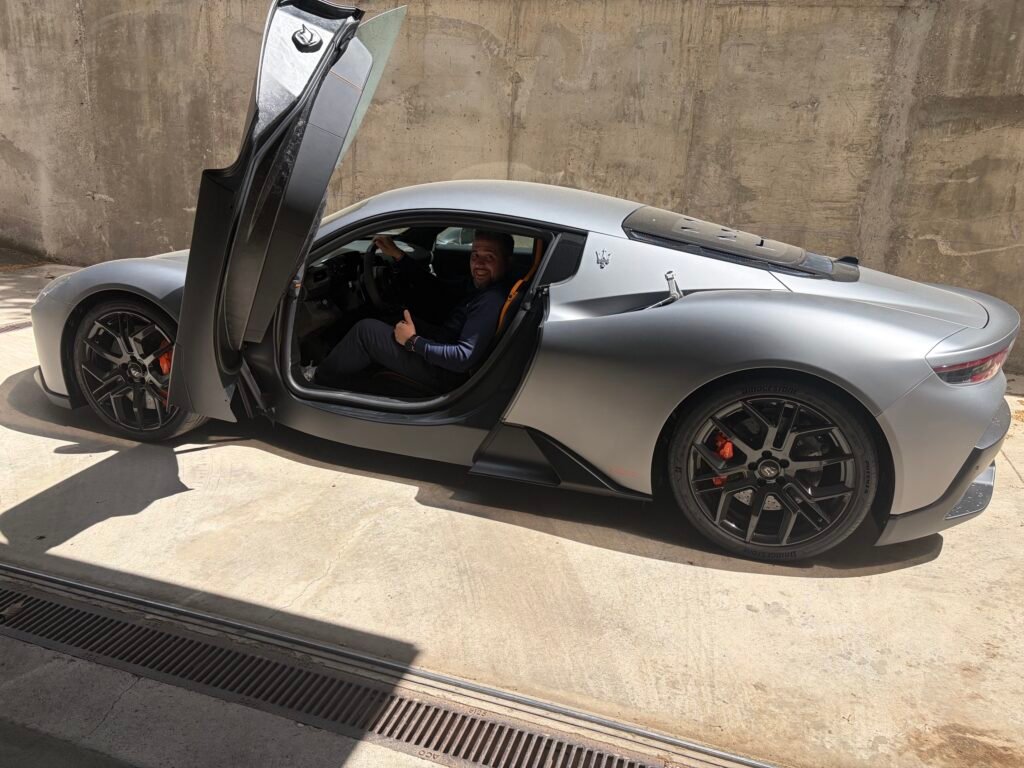
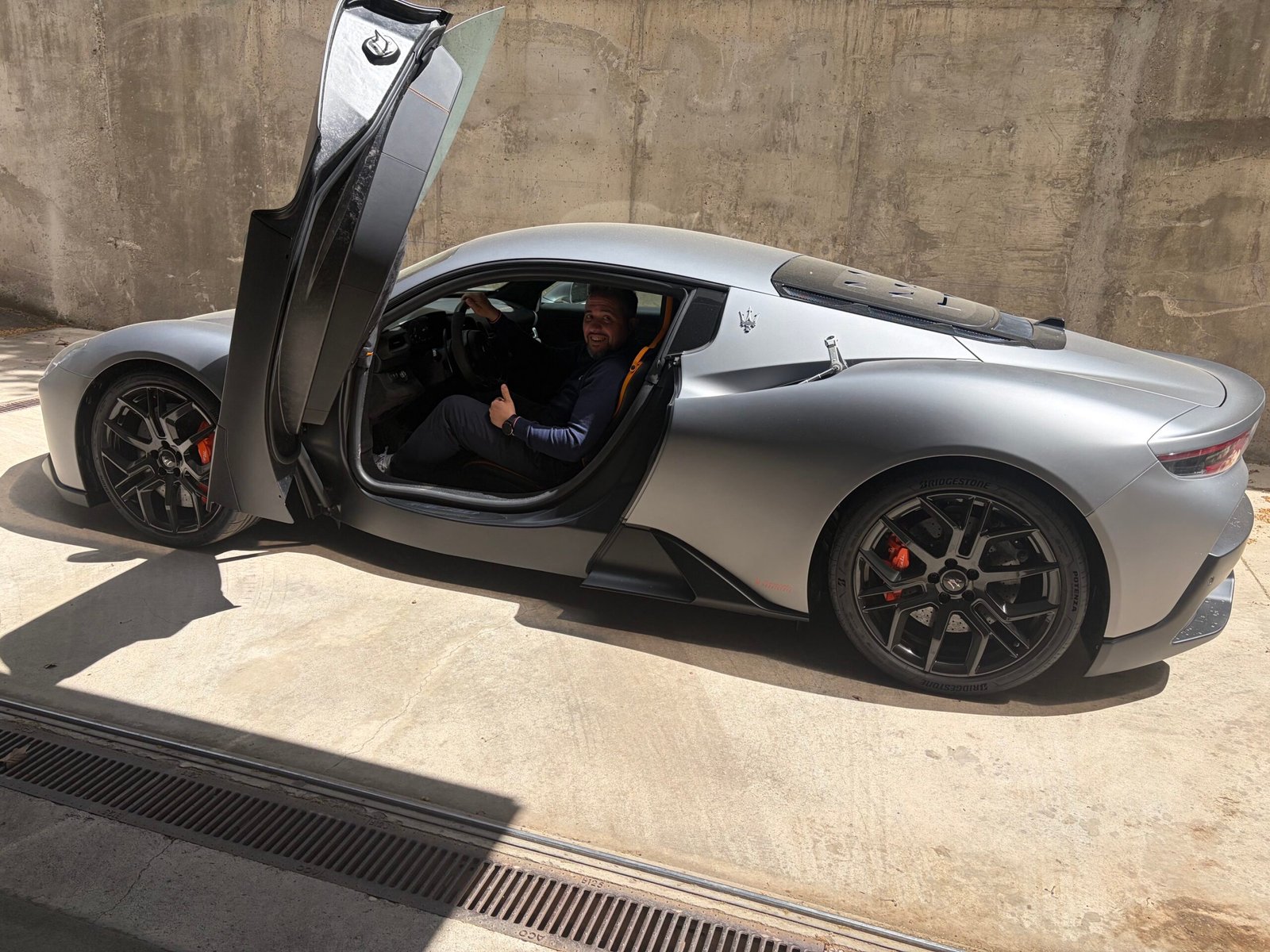
There’s a thing the old Top Gear crew understood better than anyone: a car can tell you the truth about itself in the first second, before you’ve moved an inch. The MC20 has that second. You drop into the seat, pull the butterfly door shut, hit the button, and the Nettuno wakes up a hand’s width behind your skull.
And right there, something strange happens. Your head says you’re sitting inside one of the best-built things you’ve ever touched. Your gut asks for something else.
That’s the MC20 story. Not from a spec sheet. From the seat.
It looks like a toy
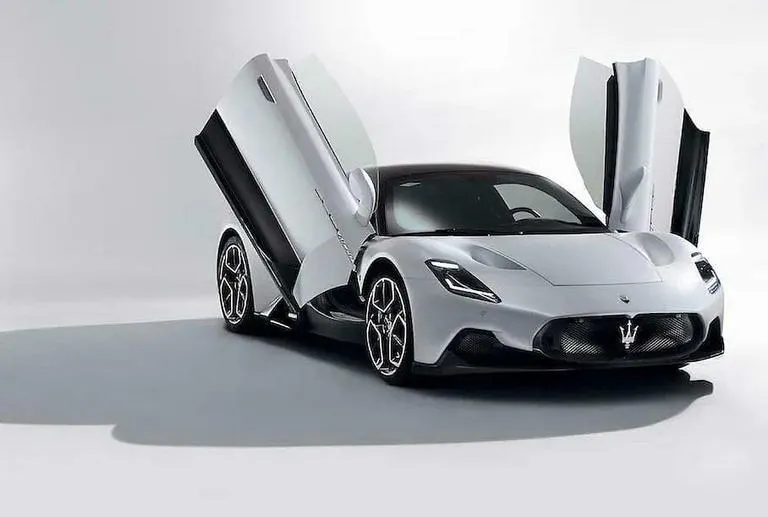
The first thing that hit me was from the outside, before I got in. How small it looks. In photos the MC20 has presence, it reads big, wide, aggressive. In the metal it’s another thing entirely: low, compact, almost a toy planted on the floor. And that, far from hurting it, helps. Because you know what’s inside. You know the 621 horsepower, you know the Dallara-signed chassis, and yet there it sits, small, contained, not puffing its chest. Cars that hide what they’re worth have always done more for me than the ones that shout it.
You step to the door and the second blow lands. The finish. You lift the butterfly and the way the carbon is resolved, the edges, the whole door surround… it floored me. And I’ve handled a few panels in my life. Thirty years on the bench train your eye to catch the bodge hiding under a pretty coat of paint. There’s no bodge here. There’s real work tucked exactly where almost nobody looks.
What it is, before what you feel
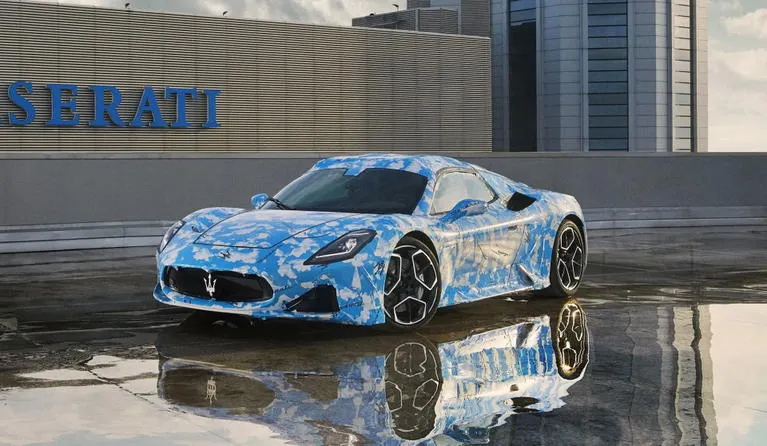
The MC20 is the car Maserati used to come back swinging. MC for Maserati Corse, 20 for 2020. Sixteen years after the MC12, Modena dropped a mid-engine supercar designed and assembled entirely in-house, at the Viale Ciro Menotti plant. The first one 100% built in Modena.
Underneath sits a carbon fibre monocoque. And here’s the first fact that matters: that chassis was developed jointly by the Maserati Innovation Lab and Dallara, and built by Italian specialist Adler. This isn’t a brochure line. Dallara is Dallara, the people who build actual racing cars for half the grids on earth. When a brand tells you Dallara signed off the tub, it’s telling you something real.
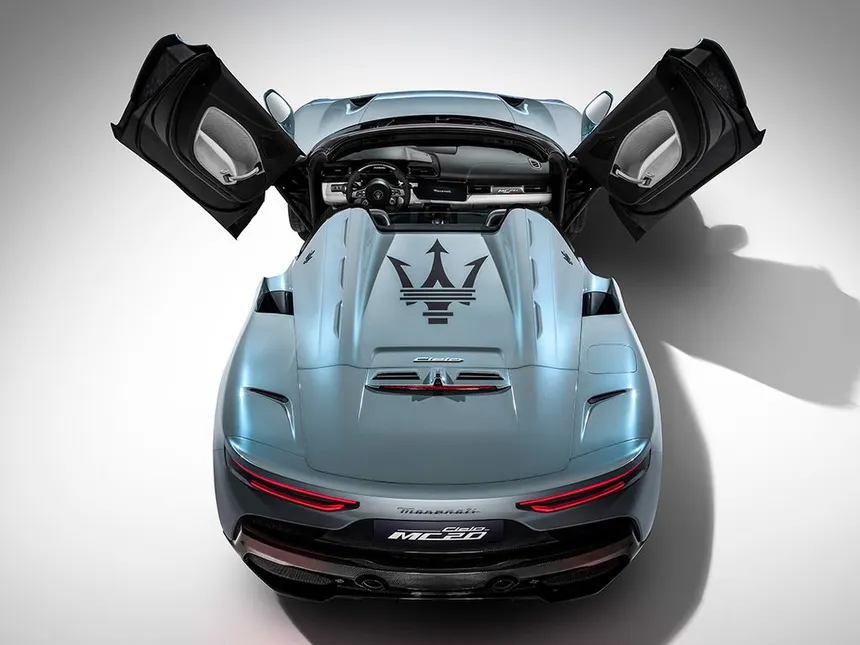
There’s a platform decision here that strikes me as the smartest call in the whole project. The monocoque was designed from the very first sketch for three cars: the coupé, the Cielo convertible and the Folgore electric. Same architecture, same geometry, different stiffness for each. Maserati didn’t build one car and then hack it about for the others. It designed the base knowing it had to carry three lives. The coupé was built to be as light as possible, and it lands around 1,500 kg. For a modern supercar carrying everything they carry today, that’s genuine discipline.
Carbon fibre lets you make shapes pressed steel never could. The butterfly doors are the obvious example, the one everyone points at. But the real work is where you can’t see it: torsional rigidity, the way the car plants itself when you load it up.
Maserati Corse
You have to understand where the name comes from to understand the car. MC is Maserati Corse. The 20 is for 2020. It’s not a marketing flourish: the MC20 marked the trident’s return to racing after years away, just as the MC12 had in its day. The road car is the visible tip of that intent to compete again. And it explains a lot of the choices: the obsession with weight, the track-bred chassis, the aero worked in the tunnel rather than bolted on for show. This isn’t a GT that had muscle added later. It’s a car conceived with the race in mind from the first sketch, then homologated so you can use it anywhere in the world.
Inside
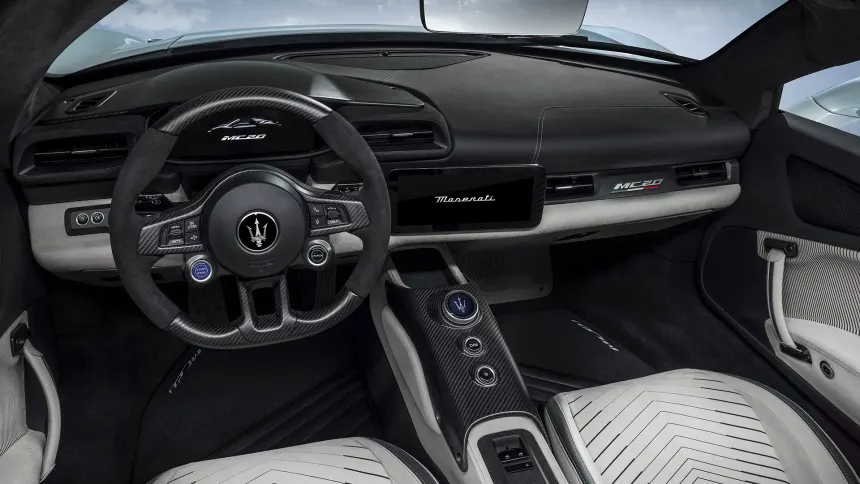
Once you’re seated, the car wraps around you. The MC20 seat was developed by Sabelt, with a high-performance composite structural shell, the first Maserati seat made that way, with power adjustment and lumbar support. It reads like a brochure stat until you put your body in it: it holds you without strangling you, that fine line only people who know real competition seats ever find. The position is low, laid back, the high centre tunnel to your right, a clean wheel ahead. No hundred buttons shouting. Just enough. For a car that trades on track pedigree, the driver’s office was clearly laid out by someone who’s sat in one.
The Nettuno: a technical beast
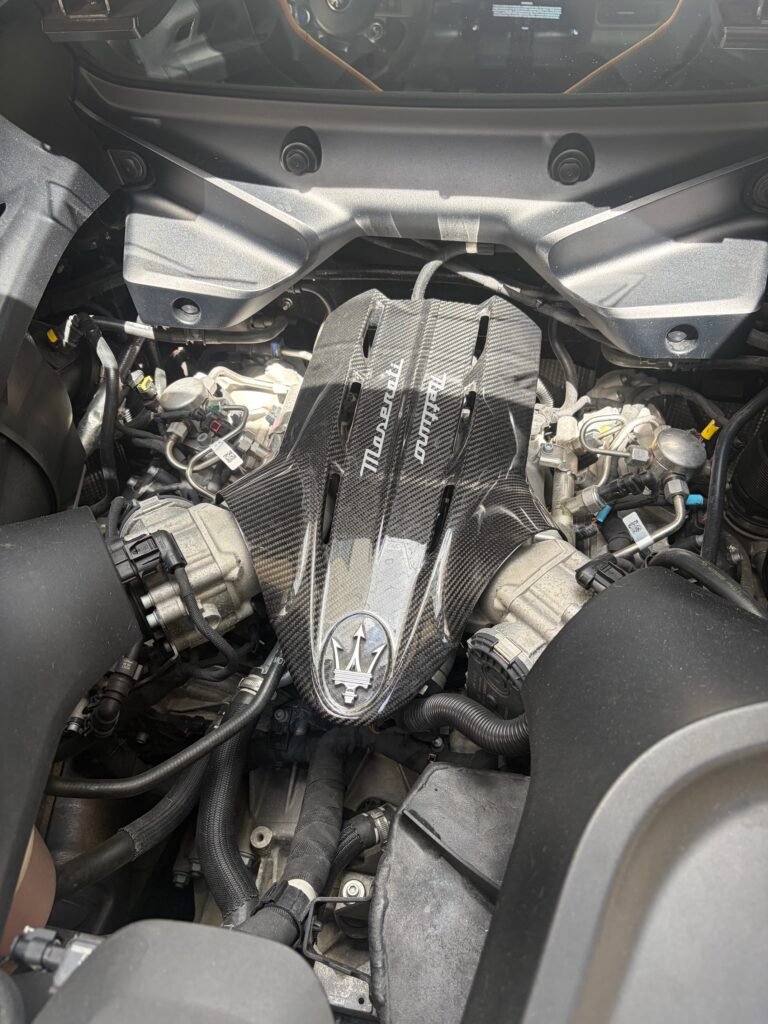
The heart is the Nettuno. A 3.0-litre twin-turbo V6, 90° architecture, with Maserati’s patented MTC pre-chamber combustion. Formula 1 tech brought down to the road. 621 horsepower. 730 Nm available from 3,000 to 5,500 rpm.
On paper it’s a monster, and that’s not hype. Power-to-weight sits around 5.3 lb per horsepower. Zero to sixty drops under 2.9 seconds. It clears 200 mph. All of it from a three-litre six. The engineering is hard to argue with.
I’ve already pulled the Nettuno apart elsewhere as a piece of technology: the pre-chamber, the twin spark plugs, the dual injection. If you want to understand how that cylinder head actually works, it’s there. No point repeating it. Here it’s about the car.
The cold start
And here’s a nuance I want to get right, because it would be easy to be unfair. The cold start.
You hit the button with the engine cold and the Nettuno has its moment. A deep, bodied purr that for a few seconds tells you there’s something serious back there. I won’t kid you: it sounds good. It has character cold, it has presence. Even though it isn’t the engine I’d want, that cold start is easy to love. You have to admit it, because denying it would be as dishonest as overselling it.
The 10 I’ll sign
And the car, as a piece of construction, is a 10. I say that after thirty years assembling parts, after thirty years telling what’s properly made from what only looks the part.
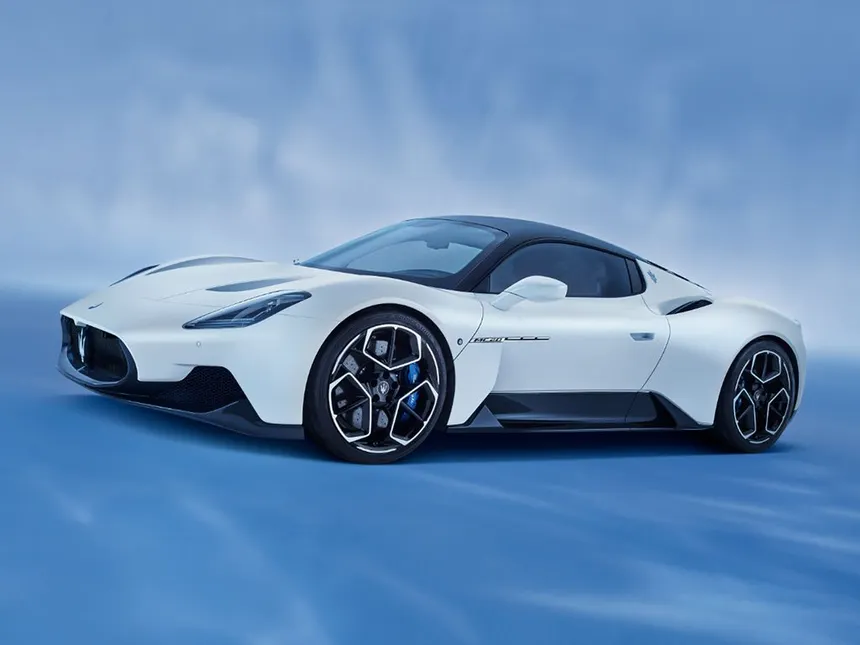
The carbon work is right. You feel the chassis. The styling is brutal in the best sense: that nose, those pure mid-engine proportions, the cleanliness of the lines. Over 2,000 hours in the Dallara wind tunnel for a 0.38 drag figure and a floor worked to the millimetre. And here’s a detail you appreciate from the bench: the MC20 doesn’t wear a giant wing screaming aero at you. It makes its load underneath, with the flat floor and ground effect, vortex generators up front and a worked diffuser at the back. All the aerodynamics tucked where it doesn’t spoil the view. That’s an engineer’s elegance, not a sticker designer’s.
Maserati and Dallara earn the top mark. No asterisk on this part. The MC20 is a superb piece of building, the kind that makes you run a hand over a panel and nod.
The numbers, in their place
It’s worth putting the figures where they belong, against what the car faced, because that’s how you really see them. The MC20 launched at a starting price north of 200,000 euros. Not cheap, but look across: the Ferrari 296 GTB plays well above it on the list, and the McLaren Artura sits in similar territory to the Maserati or a touch above depending on market. On money, the MC20 was the most contained of its generation’s three benchmarks.
And on weight it’s tighter still. The MC20 runs around 1,500 kg, the Artura lands at practically the same figure, barely a couple of kilos between them. They’re carbon copies on the scales, with one catch: the McLaren brings a battery and hybrid gear to get there and the Maserati does it without a plug, on carbon and discipline alone. That’s the assembler’s read: the MC20 weighs what a hybrid rival weighs while being pure combustion. To me, that’s Modena puffing its chest with good reason.
The thorn
But there’s a thorn. And it’s the sound at full chat.
The cold start has its charm, I’ve said it. But the Nettuno, when you stretch it, doesn’t get inside you. It doesn’t fill your ears and your chest the way a naturally aspirated engine does climbing through the rev range. You recognise the intelligence built into it, and you still miss something. It’s not a screaming naturally aspirated V10. Not even close.
And here’s the part that stings most: it isn’t only Maserati’s doing. It’s the whole generation. Look at its rivals from the same window. The Ferrari 296 GTB ditched the V8 for a twin-turbo V6 hybrid. The McLaren Artura, another twin-turbo V6 hybrid. The three benchmark supercars of that moment all made the same call: kill cylinders, add turbos, sometimes bolt on an electric motor. The high-revving atmospheric engine got left off the menu.
And note one detail that shows how close they sit: the MC20 makes 621 horsepower from its V6, the 296 GTB pulls 654 from combustion alone out of a near-identical-capacity V6 before the electric side joins in. The same recipe, repeated brand by brand. The MC20 is no worse than its rivals here. It’s a child of the same era. But that era leaves me hungry.
I’d buy it. But
So here’s what I actually think, no detours: I’d buy it. The MC20 is desirable as hell. The chassis, the carbon, the styling, how properly made the whole thing is. I’d sign for it.
But if there were a naturally aspirated V8, a V10 or a V12 on the options list, that would be the one. No hesitation.
This isn’t a complaint about the car. It’s the opposite. I like it so much that the only knock I have is that they took away the thing that fills me most. Admiration with a thorn inside. And the thorn is atmospheric.
The welcome, and what I took home
I lived this because Astara Maserati in Madrid invited me in. I got to see the Ineos, the Bentleys and the Maseratis up close, drive a Grecale, soak up the house. I climbed into the MC20, fired it up, and felt everything I’ve just told you, live.
Thanks to Astara Maserati Madrid for the welcome. For opening the door and letting someone who comes from the assembly bench, not the press desk, sit inside and reach his own conclusions. And the final conclusion isn’t on the spec sheet. The MC20 left me with the atmospheric thorn lodged in, yes. But sitting in it, firing it up, with that beast purring behind my skull, I was more alive than I’ve ever been. A car that makes you feel that has already won, whatever engine it’s missing.
2 thoughts on “MASERATI MC20”