
Rolls-Royce: From Silent Symbol of Power to Instagram Prop

The Fall of the World’s Most Exclusive Brand into the Hands of Digital Posturing
There was a time when seeing a Rolls-Royce on the street meant something. It meant that inside that car sat someone who didn’t need to prove a thing. Someone who had climbed so high that the car itself was almost a secondary detail. The chauffeur drove, the owner read the paper in the back, and the world kept turning.
Today, a Rolls-Royce on the street means someone desperately needs you to look at them. To follow them. To give them a like.
And that, gentlemen, is the death of a brand.
The Original DNA: When Luxury Didn’t Need to Scream
Sir Henry Royce had a phrase that defined the brand’s philosophy: “Strive for perfection in everything you do. Take the best that exists and make it better.” He wasn’t talking about viral marketing or rapper collaborations. He was talking about engineering, craftsmanship, and creating something so extraordinarily good it didn’t need advertising.
For decades, that was exactly what Rolls-Royce represented.
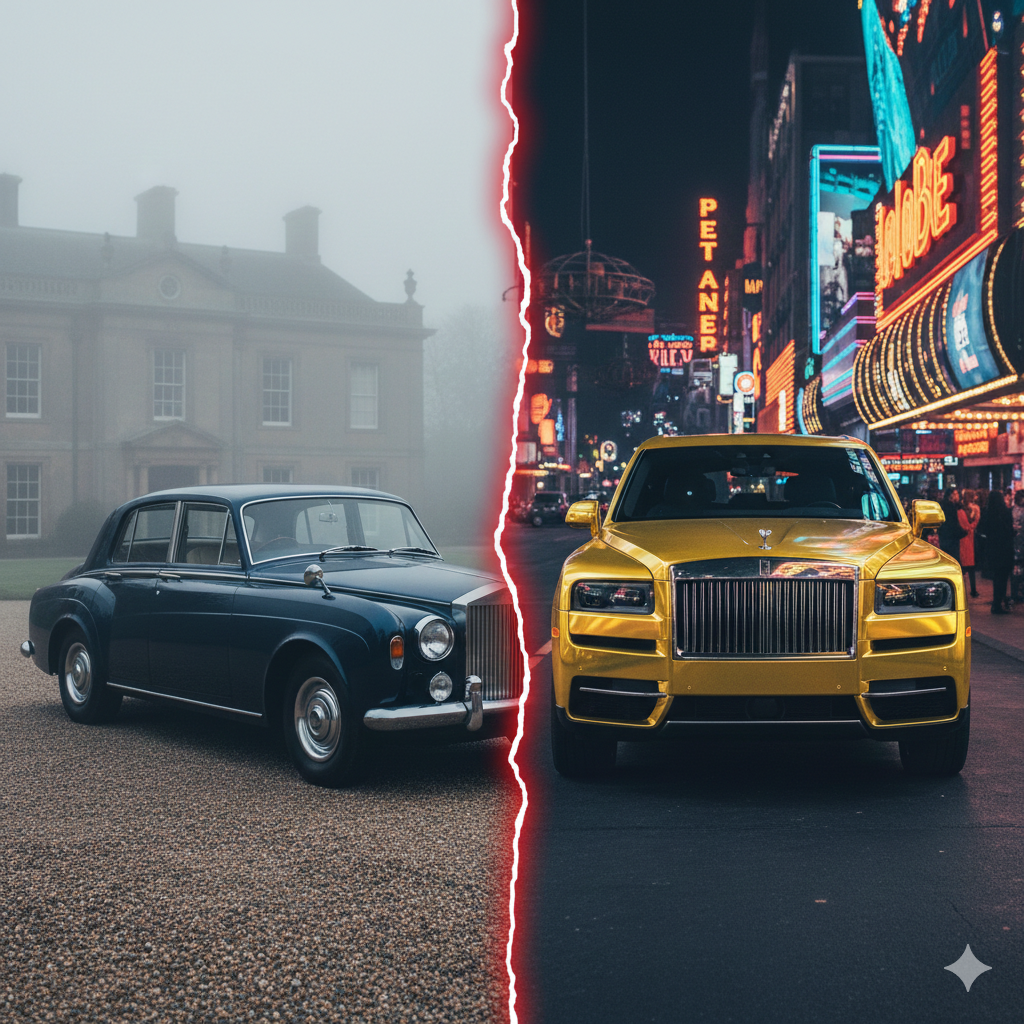
Rolls-Royce clients were industrialists, aristocrats, heads of state, and magnates who bought the car precisely because it didn’t draw attention in the vulgar way a Lamborghini does. The Silver Shadow was discrete. The Phantom was imposing but elegant. The best-selling color was always a shade of black, grey, or dark blue. No chrome wraps. No 26-inch wheels painted pink.
A classic Rolls-Royce was the automotive equivalent of a Savile Row suit: if you had to ask the price, it wasn’t for you. And if you needed to show it off on social media, it definitely wasn’t for you.
The Turning Point: The Cullinan and the Surrender
In 2018, Rolls-Royce introduced the Cullinan, its first SUV. And right there—exactly there—the debacle began.
Don’t get me wrong. As a piece of engineering, the Cullinan is impressive. Aluminum spaceframe, air suspension, 6.75-liter twin-turbo V12 with 563 HP… technically, it’s a masterpiece. But the problem was never the car. The problem was who they designed it for.
The Cullinan wasn’t created for the British aristocrat whose family has been buying Rolls-Royces for three generations. It was created for the Atlanta rapper, the Dubai influencer, the son of a Russian oligarch, and the Tiktoker who needs a nice backdrop for their videos. It was created for people who want a Rolls-Royce not for what it is, but for what it represents in an Instagram photo.
And it worked. Boy, did it work.
In 2023, Rolls-Royce broke its all-time sales record for the third consecutive year. The average age of its buyers dropped drastically—from 56 a decade ago to around 43 today. In markets like China and the U.S., there are buyers under 30.
The numbers are spectacular. The brand identity is a corpse.
The New Clientele: From “Old Money” to “Show Money”
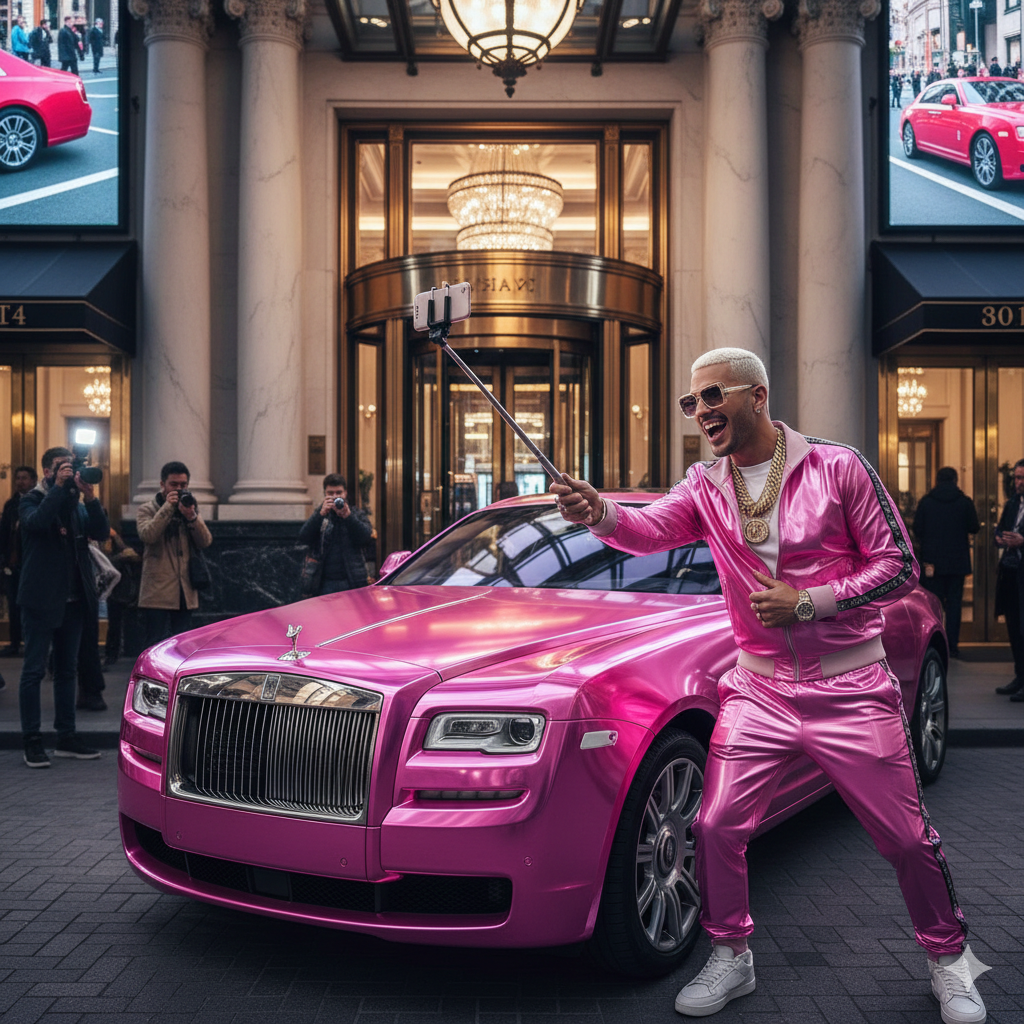
Do an exercise. Search “Rolls-Royce” on Instagram or TikTok. What you’re going to find is:
- Cars wrapped in gold, bubblegum pink, or neon green chrome vinyl.
- Customized interiors with the owner’s logo embroidered on the headrests.
- “Check out my new Rolls” videos with trap music in the background.
- Collections where the Rolls is parked next to a Lamborghini Urus and a Mercedes-AMG G63, all in colors that would make a designer weep.
This isn’t luxury. This is ostentation. And there is a massive difference between the two.
Classic Rolls-Royce luxury was silent, discrete, almost invisible to those who didn’t know how to appreciate it. It was a whisper. What we see today is a constant scream of “Look at me, I have money!”—which, ironically, is exactly what the original Rolls-Royce clientele considered unforgivably vulgar.
Frederick Henry Royce would be rolling in his grave if he saw a Phantom with 24-inch chrome wheels and underglow LEDs parked in front of a Miami club.
The Fault Isn’t Just with the Buyers
It would be easy to point at the new customers and blame them for everything. But let’s be honest: Rolls-Royce hasn’t just allowed this. They have actively encouraged it.
The Rolls-Royce Bespoke program, which used to create museum-grade works of art on wheels, now accepts requests that would have been rejected without a second thought 20 years ago. You want your Phantom painted Barbie pink with a starlight headliner shaped like your clothing brand’s logo? Go ahead; here’s the bill.
The brand has gone from being a guardian of elegance to a luxury customization service for anyone with a high enough bank balance. The filter is no longer taste, class, or discretion. The filter is just the balance.
And the electric Spectre is going to accelerate this trend even further. Now, on top of ostentation, new buyers can add a “sustainable” label to their posturing. A Rolls-Royce electric, wrapped in holographic vinyl. The wet dream of every influencer with an environmental conscience complex.
What Has Been Lost (And Isn’t Coming Back)
What really hurts isn’t that there are new people buying Rolls-Royces. It’s that the brand no longer represents what it once did.
A 1960s Silver Cloud transmitted one thing: consolidated success. Its owner didn’t need anyone to know. A 2024 Cullinan Black Badge transmits something very different: a need for validation. Its owner needs everyone to know. The car is not an end in itself; it’s a means to get attention.
Genius Strategy or Brand Suicide?
From a financial standpoint, what Rolls-Royce has done is flawless. Sales records, a rejuvenated customer base, expansion into new markets. The BMW shareholders (who have owned Rolls-Royce since 2003) are thrilled.
But true luxury brands aren’t just measured in units sold. They are measured in perceived exclusivity, cultural heritage, and the ability to transmit something beyond price. Ferrari understood this for decades by limiting production. Patek Philippe understands it with their famous slogan: “You never actually own a Patek Philippe. You merely look after it for the next generation.”
Rolls-Royce has chosen the opposite path: sell more, to younger clients, with… let’s say, “louder” tastes.
The Verdict
Rolls-Royce continues to make extraordinary cars from a technical standpoint. But a brand is more than a product. It is a story, a promise, and a set of values.
The values of Rolls-Royce in 2026 are: “If you have the money, you’re welcome. And we don’t care what you do with the car afterward.”
Henry Royce wanted perfection. What he has now is a gold-wrapped Cullinan double-parked in front of a trendy sushi spot while its 25-year-old owner records a TikTok.
That, certainly, is not perfection.
What do you think? Is Rolls-Royce stronger than ever, or has it sold its soul to the highest bidder? Leave it in the comments.
— Not Enough Cylinders
11 thoughts on “ROLLS ROYCE”