Citroën Traction Avant: the bet Citroën lost
How an aviation engineer, an Italian sculptor, a trip to Philadelphia and an impossible 18-month deadline gave birth to the car that made half the European industry obsolete, ruined its creator, and laid down the technical DNA of every Citroën that followed
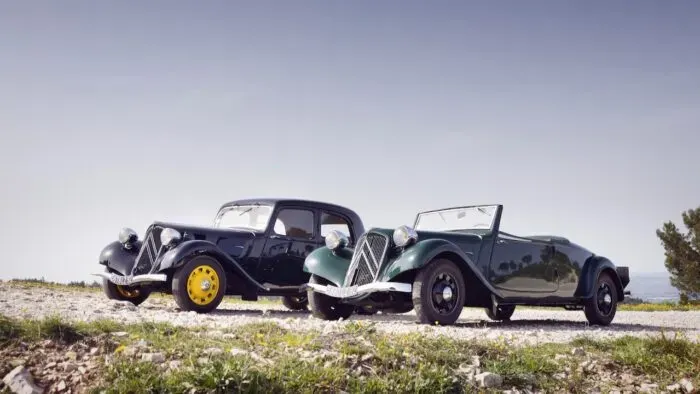
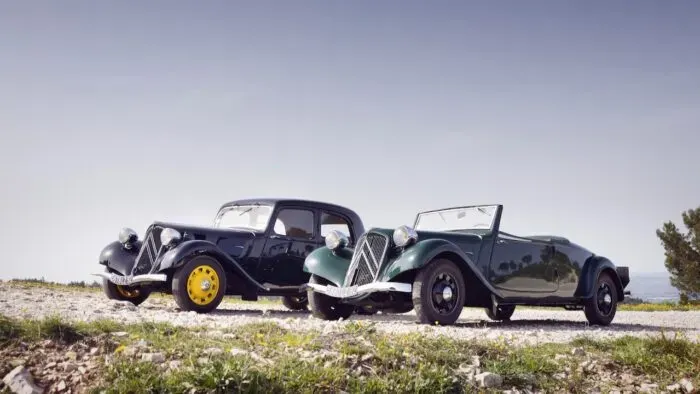
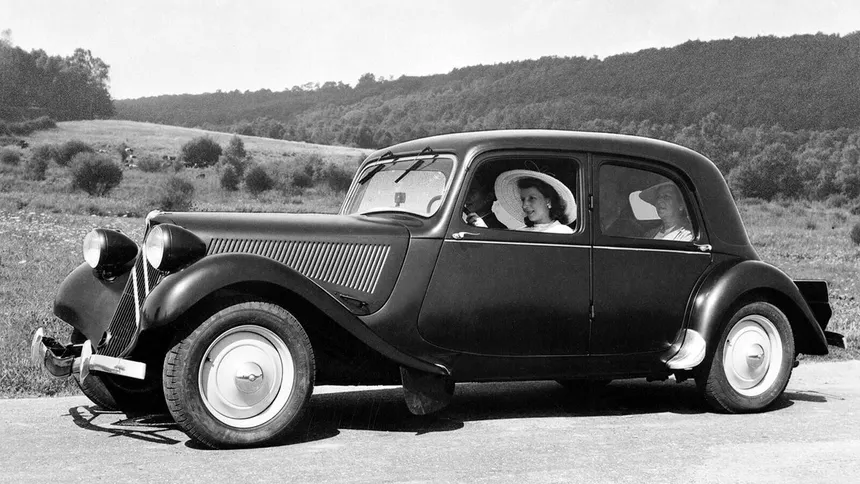
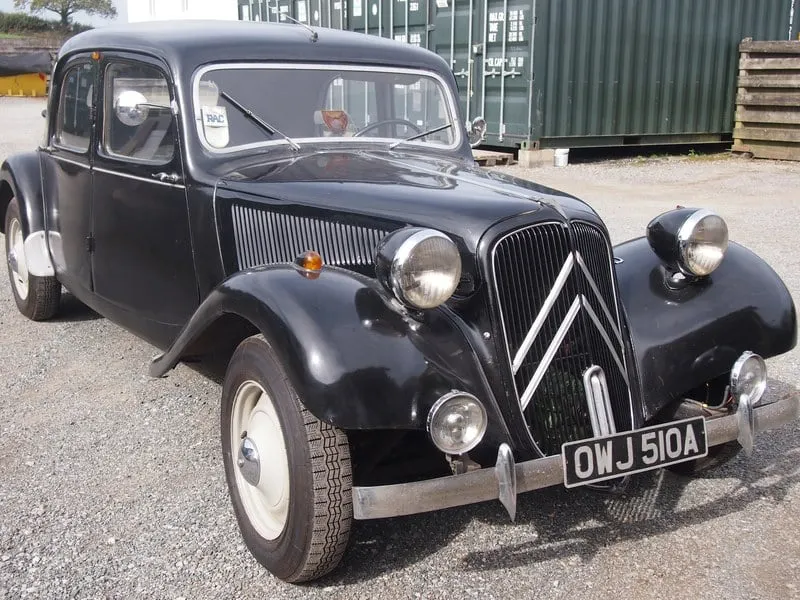
Paris, 18 April 1934. Motor Show. Citroën stand. There’s a low, long, running-board-free car with headlamps perched above a narrow engine compartment and the impression that someone has stripped thirty centimetres of height off the rest of the show. It’s called the 7A. The press immediately christens it the “Traction Avant” (“front-wheel drive”), after its most visible mechanical novelty.
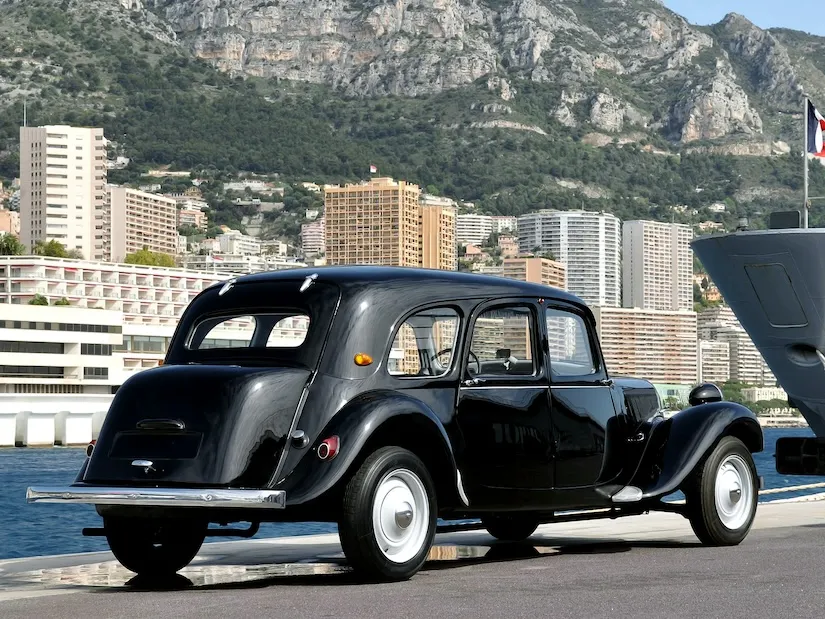
Visitors approaching can’t quite parse what they’re seeing. It’s flat. 1934 cars aren’t flat. It’s low. 1934 cars aren’t low. It has no visible chassis. 1934 cars have visible chassis. The front wheels drive. 1934 cars are rear-driven with a transmission tunnel down the middle. And the whole thing, looked at closely, looks like a 1940 American car that’s been teleported six years back in time into a Paris salon.
What they’re looking at, without knowing it yet, is the car that will make half the European industry obsolete in five years, that will stay in production for 23 years almost unchanged, that will become the car of the French Resistance, of Inspector Maigret, of W. O. Bentley, of the car in which Pierre Michelin will die in 1937 and Pierre-Jules Boulanger in 1950. And above all, the car that will set in motion the technical DNA of the entire Citroën line you’ve already read about at NEC: 2CV, Type H, DS, SM, CX, hydropneumatics.
But it’s also the car that will kill its creator before he can see it succeed. Because eight months after that unveiling, Citroën will go bankrupt. And seven months after the bankruptcy, André Citroën will die of stomach cancer, exhausted, without having seen the car pay off all the debts in two years.
Let’s go piece by piece. This story deserves to be told whole.
André Citroën: the gambler
To understand the Traction you have to understand the man. André Citroën was not a conventional industrialist.
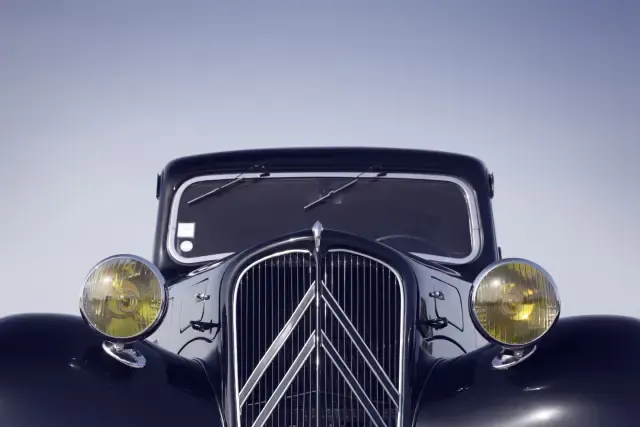
Born in Paris on 5 February 1878, fifth child of a Dutch-Jewish diamond merchant and a Polish mother, he graduated from the École Polytechnique in 1898. Engineer. Spent time in the French Army as an engineering officer. And in 1904, on a family trip to Poland, he discovered a wooden gear with double-helical V-cut teeth used in local water pumps. He bought the patent for a token sum, returned to France, and set up a factory to produce that gear in steel for industrial use. The two chevrons in the Citroën logo are a stylised representation of those helical teeth he turned into a business. The whole brand begins, literally, with a family visit to Poland.
During the First World War, he ran a French Army munitions factory, managing 30,000 workers producing ammunition on Ford-style assembly lines. When the war ended in 1918, he had a vast factory, thousands of trained mass-production workers, and no product to sell. In 1919 he founded Automobiles Citroën. His first model, the Type A, came out in May of that year and was the first European car built on a moving assembly line. Ten thousand units in two years. The French industry had never seen anything like it.
But André Citroën was not Henry Ford. He was a gambler. He liked risk, casinos, daring investments. He was a documented compulsive gambler (Deauville knew him well). And above all, he was a marketing genius. Between 1925 and 1934, he lit up the Eiffel Tower with his name spelled out in 250,000 bulbs, visible from anywhere in Paris. The most expensive advertising spot in history up to that date. That sign cost a fortune, and Citroën paid for it with the money he needed to build cars.
By the late twenties, his company was the fourth in the world and the first in Europe. But the financial structure was overstretched. Citroën kept spending on machines, on factories, on advertising. The 1929 crash hit. By 1932, sales had collapsed. The great builder was cornered.
And at that exact moment, instead of pulling back, he doubled down.
The Budd Corporation visit
In 1931, André Citroën visited the United States. One of his stops was Philadelphia, where the Budd Corporation (a supplier specialising in steel pressings for the auto industry) showed him a project they had in hand: a prototype of a welded steel bodyshell that works as a structure by itself, with no separate frame. What we today call a unitary monocoque.
The idea wasn’t entirely new in academic or theoretical terms. Lancia had something similar on the Lambda from 1922 (although it was a mixed structure, not a pure monocoque). Some aircraft manufacturers used it. But no mass-produced car had implemented it.
Citroën returned to Paris convinced. He bought the rights to the Budd patents at very high prices (one of the most expensive investments in the project). And he set up his gamble: a car with a welded steel monocoque, front-wheel drive, independent torsion-bar suspension, modern overhead-valve engine, and everything most advanced he’d seen on his travels. All at once. In 18 months. No other option.
If the bet paid off, he’d clear the debts. If it failed, the company would collapse.
Lefebvre, Bertoni, Sainturat: the team
To execute the gamble, Citroën assembled the most improbable team in French industry.
André Lefebvre arrived at Citroën in 1933 after stints at Avions Voisin (Gabriel Voisin’s car-and-aircraft marque, where he had spent years on aerospace projects before moving into cars) and a brief spell at Renault. Voisin had closed and Lefebvre needed reinvention. Citroën hired him as chief engineer of Project PV (Petite Voiture, the internal name for the Traction Avant). Lefebvre was the technical brain who would sign every major Citroën through to 1955. Without him, neither the Traction, the 2CV, nor the DS exists.
Flaminio Bertoni was an Italian sculptor from Varese who had moved to France. Not an industrial designer. No formal training in car design. What he had were his hands, an exceptional sense of proportion, and a technique that would change the industry: full-scale clay modelling. Before Bertoni, cars were drawn on paper and then built directly in wood or sheet metal. Bertoni introduced the clay model at full size, sculpting the car in clay like a classical sculpture. That technique, today the absolute standard in every design studio in the world, was invented by him, at Quai de Javel, for the Traction. He would perfect it later on the DS.
Maurice Sainturat handled the engine. Under Lefebvre’s direction, he developed an overhead-valve four (when most of the European industry was still using side valves), with wet cylinder liners (replaceable), and compact architecture to fit the limited space front-wheel drive allowed. Initial displacement: 1,303 cc (32 hp). The 7A engine. It would be replaced within months by the 7B (1,529 cc, 35 hp), the 7C (1,628 cc) and, in November 1934, by the 11 CV at 1,911 cc and 46 hp, which would become the canonical engine and, as we saw in earlier packs, survive in production until 1981 inside the Type H.
There’s a detail worth clarifying about the “record-time” development. There’s a folkloric version that says the car was designed in six months, or a year, or some impressive figure. The reality documented by Ate Up With Motor and other serious sources is that main development took 18 months, brutal but not miraculous. What is true is that Citroën launched the car with unresolved teething troubles because the cash was desperately needed. Early constant-velocity joints (the Glaenzer Spicer Cardans on the front axle), the hydraulic brakes, and overall calibration gave trouble in the first months. Pierre Michelin would resolve them over the course of 1935.
The engineering: what it combined for the first time in mass production
This is where the Traction becomes singular. Let’s review what no other car in the world combined in April 1934.
Arc-welded steel monocoque. Not body-on-frame. Not chassis with a body bolted on top. A single structural piece: a body that carries the mechanical loads, with no ladder frame underneath. 70 kg less per car than an equivalent with a traditional chassis. Flat floor inside because there’s no transmission tunnel. Low centre of gravity because there’s no raised chassis under the body. And above all, a torsionally rigid box that lets the suspension do its job properly, something a flexible chassis didn’t allow well.
Detachable front subframe. This is the most elegant piece of the project. While the rest of the structure is monocoque, the engine, gearbox, differential and entire front running gear (suspension included) mount on a subframe bolted to the monocoque that can be unbolted as a unit. In theory, a mechanic could undo the bolts, wheel the whole powerpack out “like a wheelbarrow”, and work on it on the bench. In practice it was more complicated, but the conceptual solution is the same one General Motors would use thirty years later on the Oldsmobile Toronado (1966) and the first Chevrolet Camaro (1967). In 1934, Citroën had already done it.
Front-wheel drive with constant-velocity joints. The gearbox sits in front of the engine, not behind. That lowers the nose and gives an ideal front-end centre of gravity. The front wheels receive engine torque through Glaenzer Spicer Tracta-type CV joints, a French patent by Pierre Fenaille from 1925. That decision is what defines the car visually: long, low nose, short rear overhang, body planted flat on the ground without useless height.
Independent torsion-bar suspension on all four wheels. While most of the European industry was still using live front axles and semi-elliptic leaf springs, the Traction uses double-wishbone front independent suspension with longitudinal torsion bars, and rear suspension with transverse torsion bars on a tubular live axle. Three inches of steel tube as a rear axle. Light, simple, and allowing suspension travel that the Citroën DS would later push to extremes.
Hydraulic brakes. When rivals were still using cable brakes (mechanical rod systems), the Traction fits hydraulically actuated drum brakes on all four wheels. Better force distribution, less maintenance, much more effective. One of the first European mass-produced cars with this solution.
Rack-and-pinion steering (from 1936 on). Another novelty for the European industry, which still used worm-and-roller or worm-and-nut systems. Rack-and-pinion is direct, precise, slack-free. The Traction debuts it in 1936 with the model update and keeps it until end of production.
Engine lubrication with wet liners. The engine’s cylinders are replaceable wet liners wetted by coolant. When they wear, you don’t have to rebore the whole block: you swap the liners and pistons. A solution suited to large-scale industry. Far cheaper to maintain in the long run.
Combining all those pieces in one car, in mass production, in 1934, is what makes the Traction unique. It didn’t invent any of them (FWD existed in the Alvis 1928, Cord L29, DKW F1; monocoque in the Lancia Lambda; hydraulic brakes in some Americans). But it integrated all of them at once for the first time. That’s the difference between having five separate pieces and having a complete system.
The bankruptcy: November and December 1934
The Traction launched on 18 April 1934. Orders came in. Sales started. But the investment needed to launch it (a new Quai de Javel factory four times larger than the previous one, brand-new tooling, Budd licences, engine development) had drained the cash. And the first cars went out with problems (CV joints and brakes), generating returns, warranty costs, damaged reputation.
The figures according to Ate Up With Motor: 150 million francs of debt (over 7 million dollars at the time, a fortune). Pierre Michelin was the principal creditor by virtue of tyre accounts. In November 1934, a steering-wheel supplier filed a debt enforcement in commercial court. Citroën couldn’t pay. Bankruptcy was officially declared on 21 December 1934.
On 10 January 1935, the commercial court demanded André Citroën resign as CEO. On 31 January, he did. Michelin, who already had financial control as the principal creditor, officially acquired more than 50% of the voting capital that same January. Pierre Michelin took over the presidency in July 1935. Edouard Michelin would soon delegate operational management to Pierre-Jules Boulanger, the same Boulanger who would later sign the 2CV brief. Here begins the Michelin era at Citroën, which would last until 1976.
The death of André Citroën
André Citroën was already ill with stomach cancer during the bankruptcy negotiations. Some sources suggest the cancer developed precisely from the stress of the preceding years, which is hard to prove medically but matches chronologically. What is documented is that after losing formal control of the company, his health deteriorated quickly.
He died in Paris on 3 July 1935, aged 57. He was buried at the Cimetière du Montparnasse. His funeral was led by the Chief Rabbi of Paris (Citroën was Jewish, although secular). And, in the contemptuous phrase Louis Renault had used for years, he was buried as “le Juif de Javel” (“the Jew of Javel”). His grave, which anyone can visit today, is of extreme simplicity.
He didn’t live to see what came next. Within less than two years, the Traction Avant was generating enough cash for Michelin to restructure the debt. Within four or five years, all the technical problems were resolved and the car had become a commercial success. Twenty-three years later, in July 1957, when it was finally retired from production after the arrival of the DS, 759,111 units had been built according to official records (several sources round it to 760,000). The car André had bet everything on, and lost, was the same car that saved the company he had founded.
There’s an additional macabre irony. Pierre Michelin died on 29 December 1937, near Montargis, personally driving a Citroën Traction Avant that collided with a Peugeot. Three occupants of the Peugeot died, Pierre Michelin died the following day in hospital. Thirteen years later, on 12 November 1950, Pierre-Jules Boulanger (Pierre Michelin’s successor, the father of the 2CV and the Type H) also died in a crash driving another Citroën Traction Avant, on the road between Clermont-Ferrand and Paris. The two successive Citroën presidents who carried the company forward after André both died in the same model of car that had allowed them to keep the company. The Traction was the car of their redemption and the car of their death.
The 15-6H: the hidden laboratory
And here comes the detail that connects this pack with piece 6 of the series (hydropneumatics as a system). In 1954, a year before the DS launch, Citroën quietly introduced the 15-6H: a variant of the Traction 15-Six with self-levelling hydropneumatic suspension on the rear axle. It was the first commercial application of Paul Magès’ system. It served as a field test through the final year before the DS. Units were few, buyers barely aware of what they were getting, but the engineering validated that year on the 15-6H was what allowed the DS to hit the market in October 1955 with full functioning hydropneumatics.
This matters for one reason: it means the Traction Avant is not just the first modern Citroën, but the first hydropneumatic Citroën. The two technical milestones that defined the brand’s DNA for the next 60 years (FWD monocoque, and hydropneumatic suspension) both debuted commercially in the same model, with 20 years between them. The Traction doesn’t just open the series. It closes it hydraulically as well.
International production
The Traction was built mainly at Quai de Javel (Paris), but also at international plants:
- Slough, England: 26,400 units. These Tractions had market-specific finishes (wooden dashboards, leather upholstery, 12 V electrics instead of the continental 6 V, adapted bumpers and headlights).
- Forest, Belgium (near Brussels): 31,750 units.
- Cologne, Germany: 1,823 units, before the war interrupted the operation.
This made the Traction one of the first genuinely pan-European cars in manufacturing terms. Each plant integrated local suppliers for tariff and market reasons, so a Slough Traction isn’t exactly the same as a Javel Traction. This industrial architecture is what Volkswagen would later exploit with the Beetle and what the entire European industry would eventually adopt.
The French Resistance and Inspector Maigret
During World War II, the Traction became one of the most-used vehicles by the French Resistance. The reason is practical: it was the car any reasonably well-off civilian might own, fast enough to escape a checkpoint, discreet enough not to attract attention, powerful enough to carry clandestine cargo. The image of a black Citroën Traction Avant racing down a rural French road at night is one of the visual icons of occupied, resistant France.
After the war, Georges Simenon turned the Traction into the official car of Inspector Jules Maigret in his novels. Every time Maigret heads out to investigate a crime, he does it in his Traction Avant. The association between the car and the Parisian detective archetype is etched into French popular culture forever. W. O. Bentley, founder of Bentley Motors, owned a Traction for years and praised it publicly. For the creator of the most prestigious British interwar sports cars, that’s a statement of technical respect far greater than any magazine road test.
Why the Traction Avant is the closing piece of the NEC Citroën series
This is the seventh pack in NEC’s Citroën series. The previous six covered cars and systems chronologically later: Type H (1948), 2CV (1948), Méhari (1968), SM (1970), CX (1974), hydropneumatics (1954-2017). All children of the Traction. And it’s worth explaining why.
The Type H uses the Traction’s 11 D engine (with reversed rotation) and reuses much of its mechanicals. Without the Traction, no Type H.
The 2CV was led by André Lefebvre, the same technical brain who signed the Traction. The “monocoque as a volume solution” philosophy reached the utility car thanks to the Traction precedent. Without the Traction, Lefebvre has no technical credibility for Boulanger to trust him with the 2CV.
The Méhari uses a platform derived from the Dyane (which is derived from the 2CV). That is, without the Traction, no 2CV, no Dyane, no Méhari. Pure genealogy.
The DS is the direct successor to the Traction (replacing it in 1955), shares FWD monocoque architecture and torsion bars, and debuts the full hydropneumatics already tested on the Traction’s 15-6H.
The SM is derived from the DS, sharing stretched platform and technical philosophy.
The CX is the next link from the DS, retaining hydropneumatics, FWD and monocoque.
Hydropneumatics as a system is invented inside the Traction (15-6H) before being generalised to the whole Citroën line.
That’s why this pack closes the series rather than opens it. If you read it after the other six, everything clicks. You recognise the Traction’s bones in every car that followed. You recognise Lefebvre in every technical decision. You recognise the FWD monocoque in the 2CV, the DS, the CX. You recognise the torsion bars, the CV joints, the detachable subframe.
The Traction Avant is the stem cell of the classic Citroën DNA. Everything the brand produced between 1955 and 2017 descends, technically, from that 1934 car. The hydropneumatics on the 2016 C5 is a direct grandchild of the 1954 15-6H. The FWD monocoque on the current C3 is a direct great-grandchild of the 1934 7A. The “solve the technical problem first, decide how to sell it later” philosophy is exactly what André Citroën applied in 1931 when, instead of shutting down the company, he doubled the bet.
The price he paid
Here’s the lesson the industry still hasn’t learnt, and one you’ve already seen in the SM pack applied at a different scale.
André Citroën got the calculation right. The Traction gamble was objectively the only reasonable way out in 1931-1932. The bankruptcy that arrived in 1934 was foreseeable. The commercial success of the car in 1936-1937 was foreseeable too. The only thing he hadn’t calculated was the personal cost. He died at the exact moment the company was beginning to breathe, without having seen the outcome of his bet. He died of cancer, yes, but the cancer grew through the years of maximum pressure, and that’s not a minor medical coincidence.
The Traction Avant is one of those cars that got built because someone decided to pay whatever the price would be. André Citroën paid with his company, his public reputation and, finally, his life. In exchange, he left the marque a car that ran 23 years in production, a technical architecture that ran 60 years in the catalogue, and an industrial philosophy that reached 2017.
It’s the most expensive bill any founder has ever paid in the history of the European automobile. And the one that paid the highest long-term return. Only other people collected the dividend.
That’s the Traction Avant. The bet André lost. And the car that gave birth to the whole marque that came after.
If you’ve read the six previous packs in this series, you now know where they came from. If you’ve only read this one, go back to the other six. You’ll see the Traction’s bones in each of them. That’s the mark of a foundational car. And the genetic closing of the entire NEC Citroën series.
Check you’re still alive.