Lancia Sibilo: Gandini’s last wedge, a Stratos in alien clothing
Picture this. Turin Motor Show, April 1978. The car industry is five years deep into a hangover that just won’t lift. The 1973 oil crisis has rewired everything. Big cars don’t sell anymore. Safety regulations are forcing designers to bolt rubber bumpers onto everything like life preservers on a sinking ship. Paint schemes have gone dull. Interiors are filling up with cheap plastic. The sharp wedges that defined the first half of the 70s — Miura, Countach, Stratos Zero — are giving way to softer, friendlier forms. Cautious. Conformist. Regulator-pleasing.
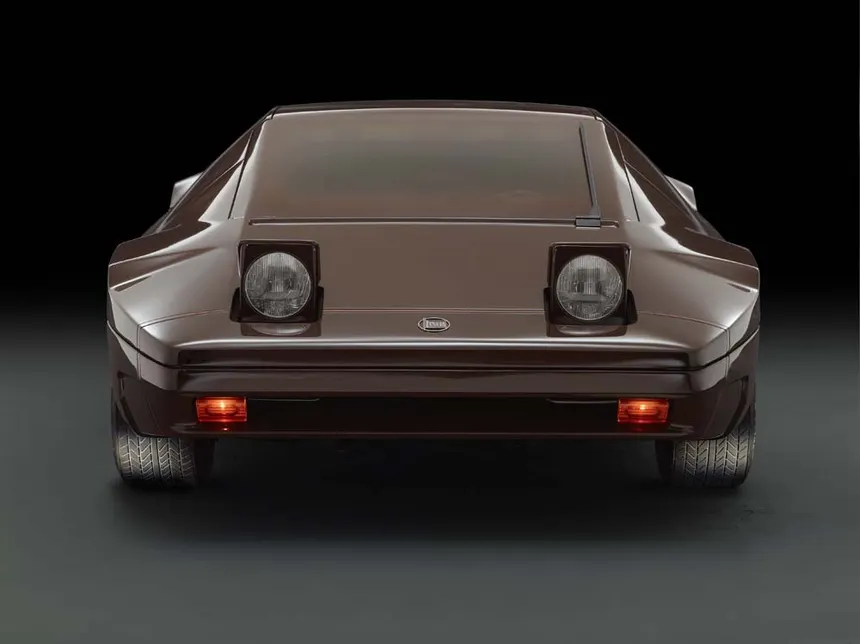
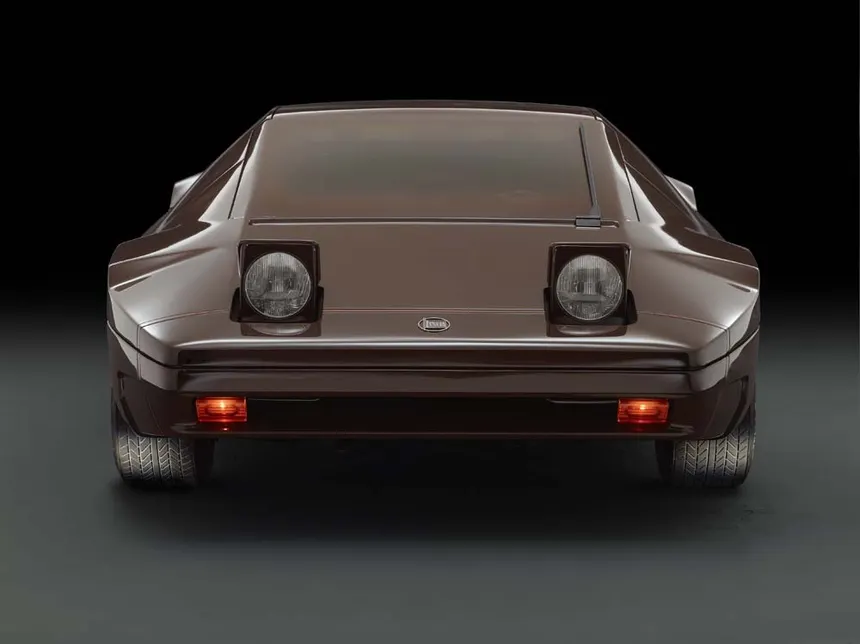
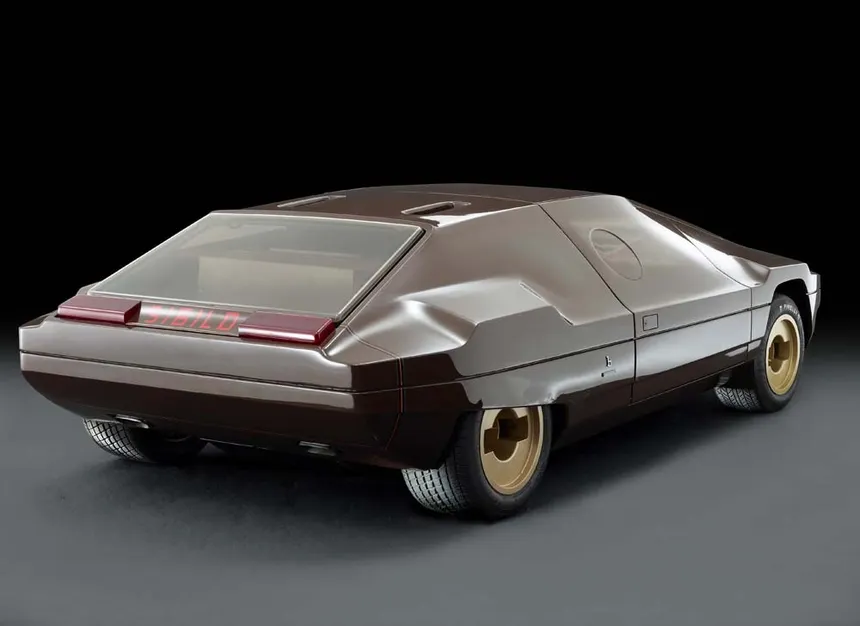
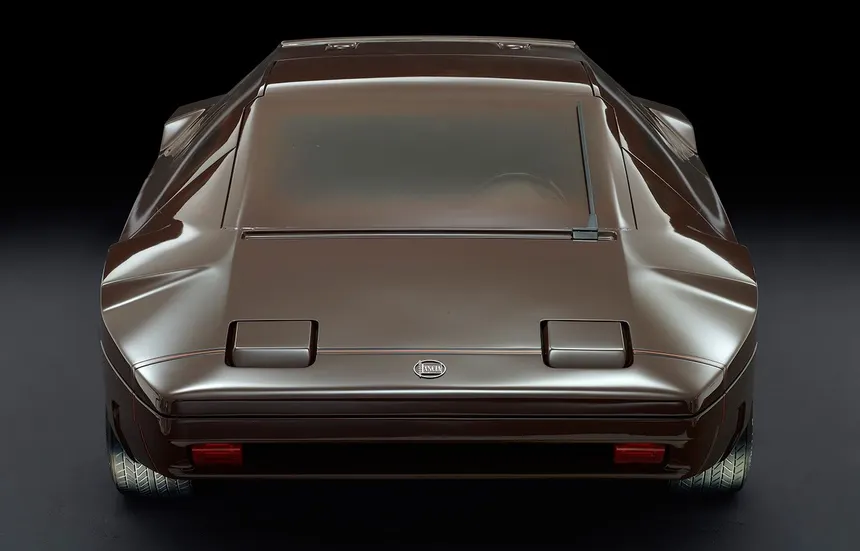
Right in the middle of that grey scene, Marcello Gandini locks himself into Bertone’s small Turin studio and refuses to accept that the party is over. He grabs a road-going Lancia Stratos. He stretches the chassis by 100mm. He drops in a 2.4-litre Ferrari Dino V6, transversely mid-mounted. And then he wraps the whole thing in a body that looks like a flying saucer that collided with a band saw at high speed. Impossible aerodynamics. Round windows that retract inwards and slide forward on rails. Chocolate-brown paint with orange pinstripes. And a spokeless steering wheel, with an integrated speaker, sculpted to match the natural grip of a human hand.
He unveils it at the Turin show and the public doesn’t know whether to laugh, cry, or politely ask Bertone if Mr Gandini might consider taking some time off.
That car is the Lancia Sibilo. It’s Gandini’s last great wedge. The final, defiant attempt to keep alive the design language he’d personally invented with the Stratos Zero in 1970. And, in one of those plot twists life occasionally provides, it has since become one of the most coveted and expensive pieces in the entire history of Italian concept cars.
The context: 1978, the wedge hangover
To understand the Sibilo you have to understand where Gandini was coming from.
Marcello Gandini had been Bertone’s head of design since 1965, when he’d replaced Giorgetto Giugiaro in the role. Over the following decade, this one man had signed off on some of the most important cars in the history of industrial design. The Lamborghini Miura in 1966. The Alfa Romeo Carabo in 1968, where he’d pioneered the pure wedge concept. The Lancia Stratos Zero in 1970. The Lamborghini Countach in 1971. The Lamborghini Bravo in 1974. The Alfa Romeo Navajo in 1976.
That list is arguably the best single-decade design run any one human has ever managed in the car business. And it’s almost entirely wedges. Sharp geometry, hard lines, near-horizontal windscreens, bonnets sloping like ski jumps. Gandini didn’t just contribute to the wedge era — he defined it. He authored a way of thinking about the sports car that has shaped automotive culture for half a century.
But by 1976, that aesthetic had started running into walls. Safety regulations demanded impact-absorbing bumpers that cut up the clean surfaces. Black plastic crept into every body panel. The pure wedge, without compromise, was becoming nearly impossible to homologate for production. And worse: the public was getting tired of it. The oil crisis had cooled the sports car market. Buyers wanted efficient hatchbacks, not Martian sculptures.
Most designers accepted the new reality and adapted. They moved towards softer, rounder, more commercial forms. Giugiaro, over at Italdesign, drifted into pure functionalism — remember the Megagamma from the same 1978, an MPV with no wedge in sight. Pininfarina experimented with smooth aerodynamic surfaces. Zagato went back to its organic roots.
Gandini went the other way. In his small Bertone studio in Turin, he decided to do precisely the opposite. If the wedge was dying, he was going to draw the most extreme wedge possible. The most absolute. The most uncommercial. The most alien.
And the platform he chose for that suicide mission was a road-going Lancia Stratos.
The car: anatomy of a battle craft
Picking the Stratos as the base wasn’t accidental. Gandini had designed the Stratos Zero eight years earlier, and the road-going Stratos HF also carries his fingerprints, via the Stratos HF Prototipo of 1971. The Stratos is his. He knows it intimately. He knows the platform — tubular steel chassis, mid-mounted transverse Ferrari Dino V6, Ferrari gearbox, independent suspension front and rear — is one of the best experimental platforms of its era.
But the racing Stratos is short. Its 2,180mm wheelbase was optimised for tight rally stages. For the Sibilo, Gandini needed more room. He extended the chassis by precisely 100mm, taking the wheelbase to 2,280mm. That gave him space for a longer cabin and more visually settled proportions.
The engine sitting behind the cockpit is a 2,418cc Ferrari Dino V6. The same family of engines that Vittorio Jano and Dino Ferrari had begun developing at Maranello in the late 50s, that powered the Ferrari 246 GT road car, the Ferrari 156 Sharknose with which Phil Hill won the 1961 F1 World Championship, and the Stratos HF with which Sandro Munari took three consecutive WRC titles. 190 horsepower at around 7,400 rpm. Five-speed manual gearbox. Rear-wheel drive, obviously.
Mechanically, up to here, the Sibilo is just a slightly stretched Stratos road car. The revolution starts above the chassis line.
The bodywork: zero seams, round windows and bonded glass
The Sibilo’s bodywork is hand-beaten steel throughout. There’s no press tool. There’s a wooden buck shaped to the exact intended volume, and Bertone craftsmen who spend months tapping with hammers until every panel matches perfectly. That technique was standard for Italian one-off concepts in the 70s — the cost of building proper tooling for a single car was prohibitive, so the carrozzerie worked the way they had done since the 1920s.
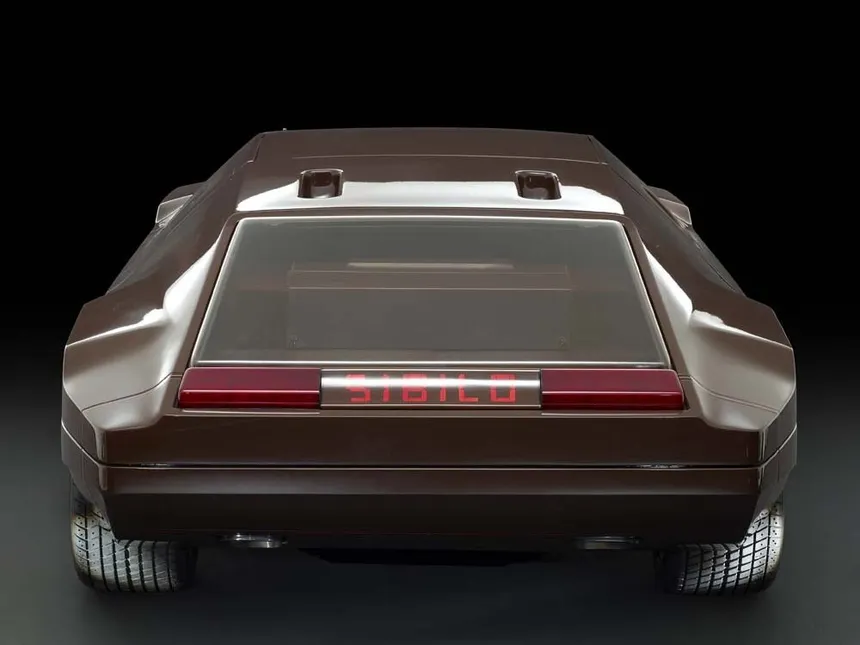
What Gandini did with that hand-beaten steel is where it gets interesting. The first principle of the Sibilo design was to erase every visible joint between separate elements. The windows aren’t really windows; they flow into the roof as if they were extensions of the body. The bumpers aren’t separate components; they emerge from the body’s own volume. The headlights aren’t round bulbs stuck onto the front; they’re folded into the steel itself, retractable.
To achieve that visual fusion of glass and body, Gandini did something nobody had attempted at this level before: he painted the borders of the windows the same chocolate brown as the body, so that where the steel ended and the polycarbonate began, your eye couldn’t find the line. The whole car reads as one continuous, sanded, polished, lacquered surface. Like a hundred-square-metre piece of single-coloured sculpture.
Here’s the detail that almost tells itself. Bertone’s usual glass supplier couldn’t deliver in time for the April 1978 Turin show. Gandini, rather than postponing the unveiling, decided to use polycarbonate — the material used in fighter jet canopies — for the Sibilo’s windows. A logistics accident that ended up becoming one of the car’s most memorable visual signatures, because polycarbonate could be machined and painted in ways glass simply couldn’t.
And the side windows. This is the part that stops you when you see the car for the first time. They don’t drop down like normal windows. There’s no winder, no electric motor. What you get are perfect circles, cut into the polycarbonate side panels, that retract inwards into the cabin and then slide forward on rails. A completely original solution. Completely Bertone. Completely impractical for any series production. But perfect for a concept that only ever exists at motor shows.
The interior: Gandini’s last flight
Inside the Sibilo, the alien universe continues.
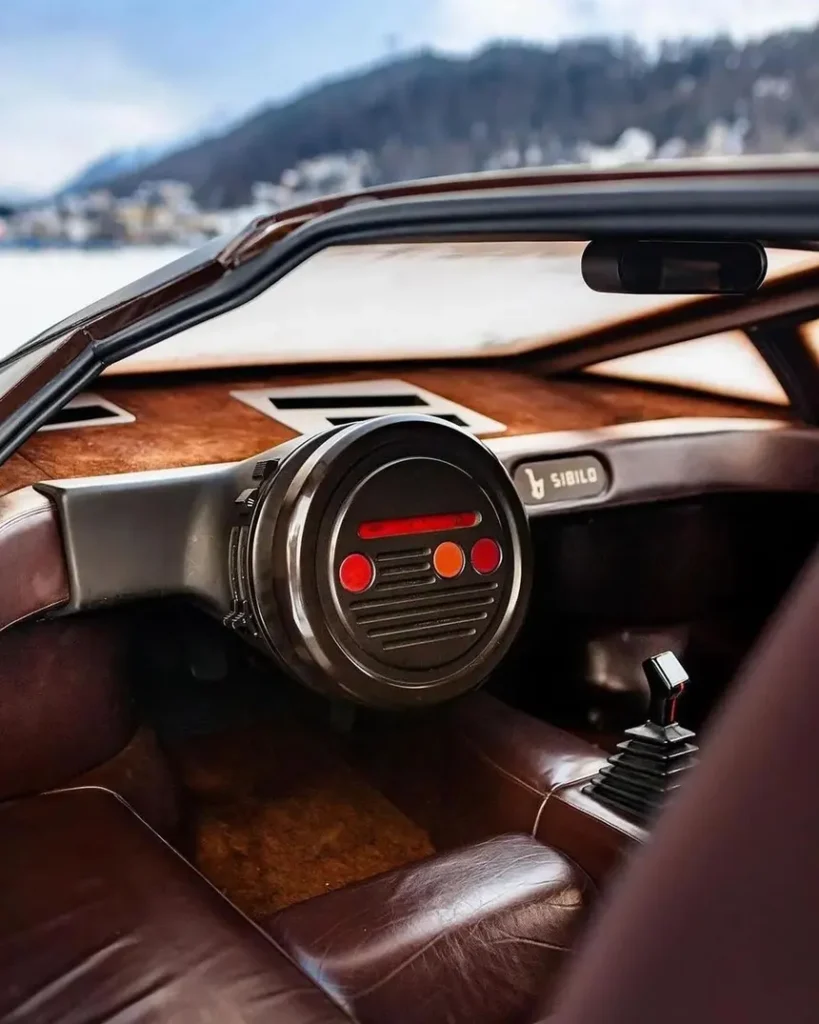
The dashboard is minimalist to the point of being almost monastic. The transversal beam of the original Stratos dashboard structure is preserved, but wrapped entirely in brown leather and matching brown velvet, colour-coordinated with the seats. The flat upper surface of the dashboard, instead of plastic, is finished in short-pile brown carpet. Yes. Carpet. On the top of the dashboard. Gandini was clearly experimenting with textures and rules that nobody else dared touch.
The instrumentation is fully digital. Horizontal LCD displays carved into the centre of the dashboard, angled towards the driver. This is 1978, remember. The early years of digital electronics applied to cars. The red and green warning lights you’d come to take for granted in the 80s weren’t yet standard equipment; seeing them integrated like this, on a concept car, was almost science fiction novel material.
And then the steering wheel. Here Gandini permitted himself one of the strangest design choices of his career. The Sibilo has a spokeless steering wheel. A single solid piece linking the rim to the central hub, in an elongated form. The official technical description says the shape ergonomically reproduces the natural grip of a human hand — that is, it’s sculpted so your fingers fall exactly where they should without effort. In the centre of the hub there’s no horn, no airbag (this is 1978, airbags don’t exist yet for road cars). There’s an integrated speaker, circular buttons for the headlights and indicators, and a strip of warning lights. It’s a steering wheel that looks like it came out of a Soviet fighter aircraft.
The pedals are pushed forward, the seats are sunk between wide sills and the bulky transmission tunnel that Gandini intentionally leaves exposed. It’s a cabin designed as a cockpit. Not as a car interior.
The Turin reveal: confused applause
The Sibilo was unveiled at the Salone dell’Automobile di Torino in April 1978, on Bertone’s stand. The public reaction is well documented in the period press.
There was surprise. There was nervous laughter. There were journalists who wrote respectfully but admitted they couldn’t quite parse what Bertone was trying to say. There were others who called it absurd straight to the page. The Sibilo didn’t look like anything else and didn’t have a clear purpose. It wasn’t going to production. It wasn’t a proposal for Lancia. It wasn’t a conceptual statement about future mobility. It was, simply, an exercise in pure style at a moment in the industry when exercises in pure style had fallen out of fashion.
But there were also, among the visitors, the ones who understood they were looking at something unique. Collectors. Younger designers taking notes. Specialist journalists writing small but significant pieces in serious magazines, suggesting that however strange the car looked, there was genius inside.
The Sibilo stayed as a single unit, owned by Bertone. It went into the coachbuilder’s historical archive. It came out occasionally for commemorative events. And for thirty-three years, it lived in a kind of limbo: too strange to be a beloved classic, too important to be ignored, too off-catalogue to be coveted.
The Sibilo’s late vindication: Lopresto, Goodwood, and overdue recognition
In 2011, Bertone — by then in serious financial trouble — decided to sell parts of its historical collection. The Sibilo went to auction at RM Auctions, at Villa d’Este. The buyer was Corrado Lopresto, the Milanese architect and one of the world’s most serious collectors of Italian prototypes. Final price: $135,795. €95,200 at the rate of the time.
Pause on that for a moment. €95,000 for a unique piece signed by Marcello Gandini at his peak, on a Stratos road car platform, with a Ferrari Dino V6 inside. For context: in 2011, a regular Lancia Stratos Stradale was selling for between €250,000 and €350,000 depending on condition. The Sibilo, infinitely rarer, went for less than half the price of a regular Stratos. It was still a “misunderstood” concept.
What happened next is another story. Lopresto restored the car with fanatical care, preserving every original material — the brown leather, the dashboard carpet, the polycarbonate of the round windows, the hand-beaten steel of the body. And he started taking it to elegance concours and specialist events.
In 2013, at the Goodwood Concours of Elegance, the Sibilo won in the prototypes class. In 2012 it appeared at the Ludwigsburg Concorso. In 2014 at Spa Italia. In 2018 it returned to Geneva, this time at the Motor Show — not as a new concept, but as a historical piece. In 2019 it appeared at “The Ice” in St. Moritz, the most exclusive snow event on the European calendar.
The Sibilo, thirty-five years after its original unveiling, finally became what it should have been from the beginning: a rolling work of art. A blue-chip collector’s piece. Gandini’s last wedge, recognised at last as such.
Today, its actual market value is hard to estimate because it hasn’t returned to auction. But the figures privately mentioned among serious collectors — never official, always whispered — place the Sibilo somewhere around or above the million-euro mark if Lopresto ever decided to part with it.
And one detail almost nobody tells you: Total Recall
There’s one final note that only appears in pieces like this, because hardly anyone bothers to mention it.
In 1990, when Paul Verhoeven directed Total Recall — the Schwarzenegger film based on the Philip K. Dick story — the production needed a futuristic car for some Mars taxi scenes. The film’s production designer couldn’t build a vehicle from scratch in the time available. So he took the Sibilo as direct visual inspiration and built a prop vehicle that copies, without any attempt to disguise it, the Sibilo’s silhouette, its integrated round windows, and its continuous seamless bodywork.
If you’ve ever watched Total Recall and looked carefully at the robotic taxis ferrying Schwarzenegger through the streets of Mars, you’ve seen a direct descendant of the Lancia Sibilo. The car Gandini had imagined in 1978 ended up, twelve years later, defining the visual look of how Hollywood imagines the future car.
There are few higher honours for a concept car designer than that. To have your unique piece, unveiled at a provincial motor show in 1978, end up twelve years later being the visual shorthand Hollywood uses to teach a couple of generations what the 21st-century car looks like.
Why it matters
The Sibilo matters for two reasons that have nothing to do with the usual “is it pretty or ugly” debate.
The first is historical. It’s the last concept from the golden age of the Italian wedge. After the Sibilo, Bertone, Pininfarina, Italdesign and Zagato all moved decisively towards different aesthetics. Extreme wedges disappeared as a main design language. The cars of the 80s started taking softer, more commercial forms, adapted to the post-crisis market. If you want to pick a single date for the end of the golden age of pure Italian design, the Turin Show of April 1978 with the Sibilo standing on Bertone’s stand is probably the best candidate. After that, nothing was the same.
The second reason is that the Sibilo demonstrates a difficult truth about collecting and design appreciation. Beauty is relative to context. In 1978, the Sibilo was widely seen as “too much”. In 2013, winning at Goodwood, it was unanimously celebrated as a masterpiece. Same car. Same steel. Same absurd round windows. The only thing that changed was what we were willing to see.
That lesson — that genius doesn’t always get recognised on time, that pieces ahead of their time need decades to find their public — is the Sibilo’s real moral. And it’s why it deserves the long-form treatment, not a footnote in some specialist book.
If you ever find yourself walking through an Italian concorso and you see a low, chocolate-brown car with orange pinstripes and round windows where the normal ones should be, you’ll know what you’re looking at. The car you finally gave a Goodwood class win in 2013. The car you gave a symbolic million euros to in 2024. And the car you gave, most importantly, the recognition that in 1978 had cost it so much laughter.
It’s a Lancia. It’s a Gandini. It’s a Bertone. It’s the last night of the wedge.
It’s the Sibilo. And it hisses.
Check you’re still alive.