JCB Hydrogen Engine: Approved for Sale Across All of Europe
The paperwork is signed. Full EU type-approval under Regulation (EU) 2016/1628, certifying compliance with Stage V emissions standards, valid across all 27 member states plus the EEA and EFTA territories that recognize the European standard. JCB’s hydrogen combustion engine can be sold and put to work on any jobsite on the continent. Today.
For American operators used to EPA Tier 4 Final as the ceiling of emissions compliance, Stage V is the European equivalent — and hydrogen just cleared it burning inside a piston engine, not powering a fuel cell.
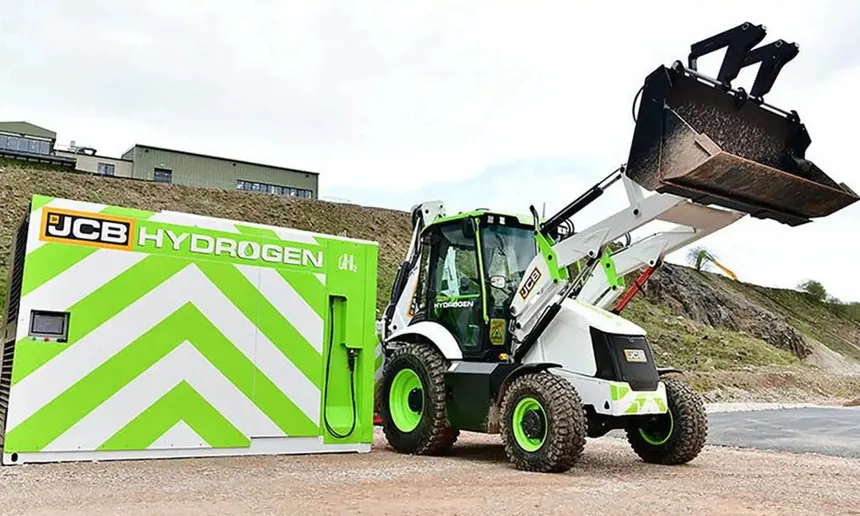
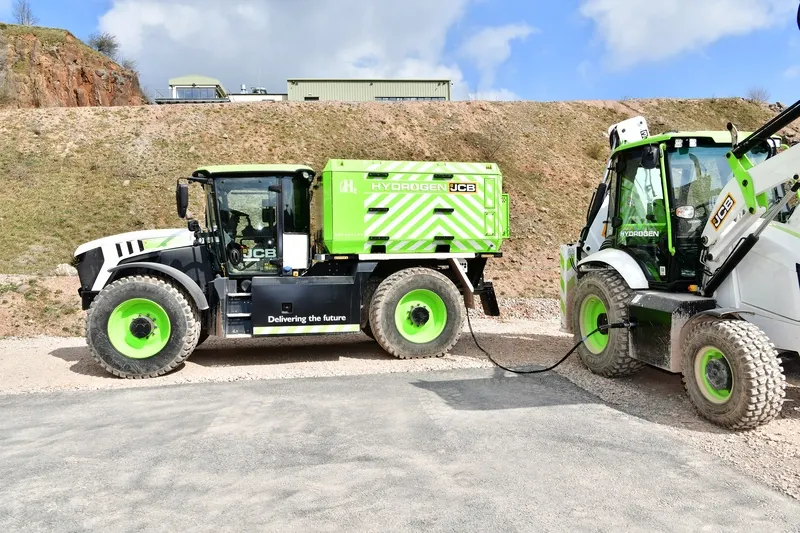
This isn’t a prototype waiting for its moment either. The 3CX backhoe loader with the hydrogen engine is in series production and taking orders, alongside the G60RS H generator set. There are machines working. Not renders spinning on a trade show screen.
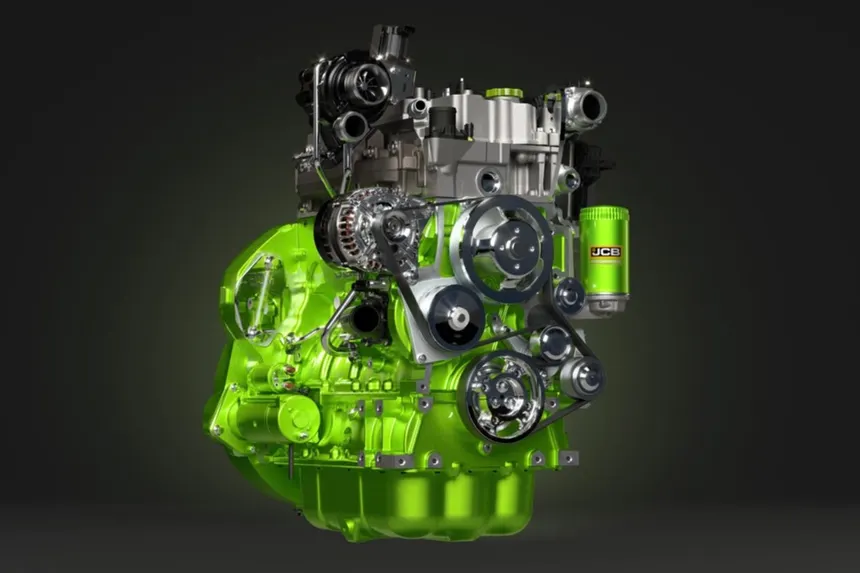
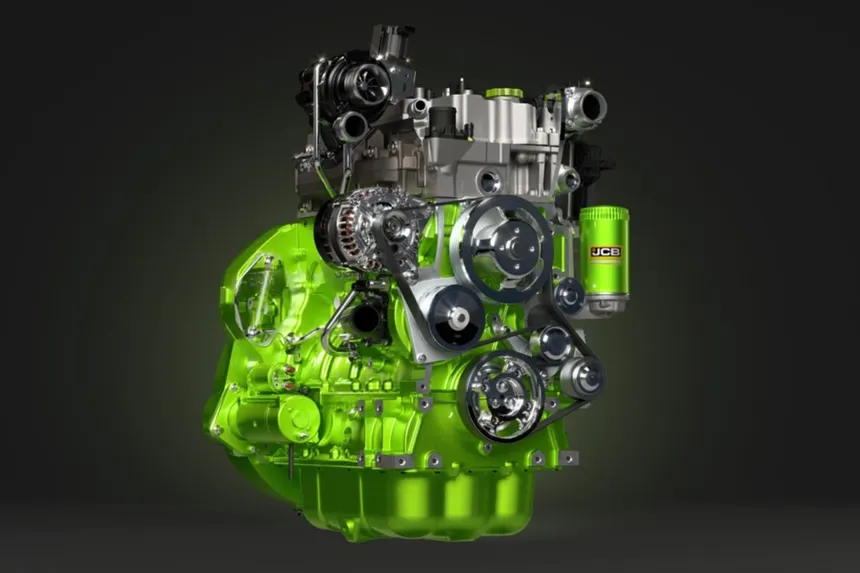
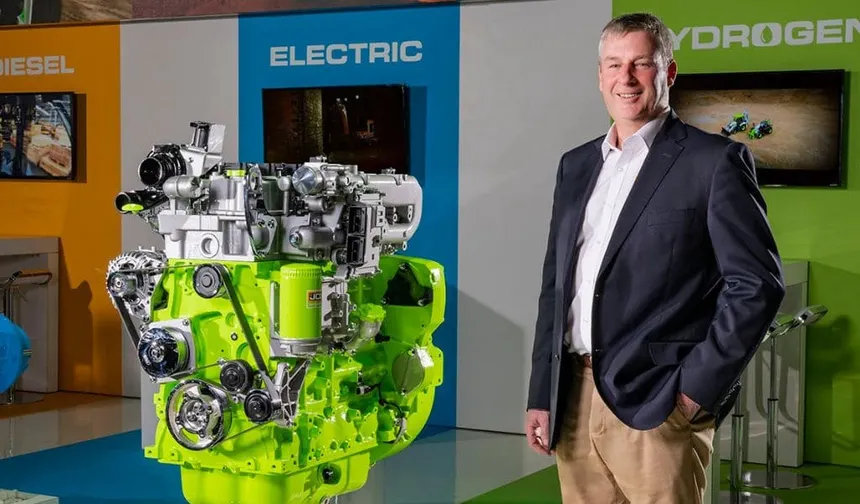
The part that matters most never makes the headline. That engine is the same 448 it always was. Same crankcase, same cylinder block, same cooling system, same variable geometry turbo. They swapped the cylinder head, dropped in spark plugs where compression used to do the work, and it burns hydrogen while delivering identical power and torque to its diesel twin.
Nothing was reinvented. They touched what needed touching and left alone what already worked.
The Cylinder Head Is the Only Thing That Changed
The starting point is the Dieselmax 448: four cylinders, 4.8 liters, years of service in backhoes and telehandlers burning diesel without drama. For the conversion, JCB left the crankcase untouched, along with the 1.2-liter-per-cylinder block, the cooling circuit, and the service points. The variable geometry turbo stays exactly where it was.
Everything happens up top. Out goes the diesel head, out goes the 2,000-bar common rail built for liquid fuel. In comes a new head with port fuel injection — hydrogen arrives as a gas, not a fluid — and spark plugs, because hydrogen needs an ignition source rather than compression until it detonates on its own.
In the 3CX the figure is 55 kW, identical to the diesel version of the same machine, same torque, same transmission, same hydraulics. The only visible difference for the operator climbing into the cab is three aluminum tanks wrapped in carbon fiber mounted on the cab roof. The feel of the machine, the response, the handling: all identical to what they’ve been running for years.
Tim Burnhope, JCB’s Special Projects Director, explained the reasoning by contrasting it with the road they didn’t take. With a fuel cell, they would have had to throw away 75 years of engine development and start from scratch, redesigning everything from chassis to wiring. With combustion, nearly everything they already knew still applied.
Seventy-Six Failed Attempts Came First
Burning hydrogen in a piston engine wasn’t JCB’s idea. People have been trying for decades, with results ranging from mediocre to catastrophic. Before touching a single component, JCB partnered with RWTH Aachen University and sat down to study 76 previous academic papers, working out exactly why everyone else had failed.
The pattern repeated: they’d start with an existing gasoline engine, feed hydrogen straight in, and the mixture came out too rich, at too much pressure and too much heat. Dirty combustion, NOx spikes, inconsistent output. That’s the origin of the myth — repeated for thirty years — that hydrogen combustion can’t work at industrial scale.
The fix was inverting the logic: a very lean mixture, minimal hydrogen and plenty of air, burned at low pressure and low temperature. That cleans up combustion and cuts the NOx spikes. Cuts, not eliminates. The only real emission is water, plus some NOx that high combustion temperatures still produce. Anyone selling this as absolute zero emissions is selling smoke, and that’s worth saying even when it dents the headline.
Thirty years ago the recipe was impossible. There were no turbos capable of managing a mixture that lean with the required precision, and no computing power to model combustion in the necessary detail. The breakthrough wasn’t new technology. It was understanding something that already existed.
The Ones Who Got There First and Crashed
This is where it gets interesting, because JCB isn’t the first to knock on this door. It’s the first to have it opened.
Mazda pushed further than anyone back in 2003 with the RX-8 Hydrogen RE, a twin-rotor Renesis running dual-fuel and switching between hydrogen and gasoline with a dashboard button. The rotary had a genuine physical advantage: separate chambers for intake and combustion, which eliminated the backfiring that plagued piston engines. It earned street approval in 2005 and reached real customer leasing in Japan in 2006, with thirty units delivered to Norway’s Hynor project in November 2007. The numbers killed it: 107 hp on hydrogen against 206 hp on gasoline, and roughly 62 miles of range with the tank swallowing the entire trunk.
BMW went the opposite direction between 2005 and 2007 with the Hydrogen 7, a dual-fuel V12 built on the 760Li that made 260 hp on either fuel. Eight kilos of hydrogen bought 125 miles of range, at consumption equivalent to about 5 mpg. A Honda FCX Clarity fuel cell from the same era managed the equivalent of roughly 16 mpg. The comparison was brutal and the project died.
Toyota is the one still genuinely fighting. Its Corolla H2 has been racing in Japan’s Super Taikyu series since 2021 — with Akio Toyoda himself driving under the Morizo alias — has moved from gaseous to liquid hydrogen, and at the 2025 season finale at Fuji debuted a liquid hydrogen pump with a superconducting motor exploiting the fuel’s own –253 °C. At the 2025 Fuji 24 Hours it completed 468 laps and finished 32nd overall, a long way from the last-place finishes of its two previous outings. Cummins, closer to home, showed a hydrogen combustion truck at IAA Transportation in 2024.
What separates all of them from JCB isn’t the technology. It’s where they put it. Mazda and BMW tried selling range and performance to a driver comparing against the gasoline car in the next bay, and that comparison always lost. JCB put it in a machine that works twelve-hour shifts somewhere with no power hookup, where ten minutes of refueling against eight hours of charging settles the argument outright.
A Quarry in Kent as the Proving Ground
All the theory in the world collapses if the machine can’t survive a full shift. A hydrogen-powered Loadall 540-180H went to work at Gallagher’s quarry in Hermitage, Kent, during the first week of June 2025, doing quarry work and directly replacing a diesel machine. Not a fifteen-minute demo with press cameras rolling: a real shift, mobile refueling on site, emissions measured under working conditions.
That machine is part of the Lower Thames Crossing, the road aiming to be the greenest ever built in the United Kingdom, which has committed to removing diesel from its construction sites entirely before 2027. If the schedule holds, the works will run on electric vehicles, electric machinery, and hydrogen-powered heavy equipment covering exactly the gap batteries can’t reach.
On cost, the available reference comes from the trucking side: in the conversion Daimler is developing with KEYOU, consumption falls below 6 kilos per 100 km, and hydrogen at 6 to 8 euros per kilo at the pump is the point where total cost of ownership starts closing on diesel. It isn’t cheaper yet. It’s close, and the curve is heading the right way.
Not One Rubber Stamp, Nine Separate Regulators
European type-approval didn’t come from a single accommodating signature. Authorities in the United Kingdom, Germany, France, the Netherlands, Belgium, Spain, Finland, Switzerland, Liechtenstein, and Poland validated the same engine independently, each with its own certification process and emissions assessment. When countries with different regulatory regimes all reach the same conclusion, luck stops being the explanation.
Behind that sit more than 130 hydrogen engines built for evaluation programs alone, with thousands of accumulated hours in backhoes, telehandlers, generators, and jobsite prototypes. And behind that: £100 million, 150 engineers, and more than 50 prototypes built at JCB’s engine plant in the UK.
Lord Bamford has been making the same argument for years, and not only about construction. In large tractors, agricultural telehandlers, and combines, the working day is measured in consecutive hours, often far from any charging infrastructure, and refueling speed decides whether a technology works or stays on paper. Planting and harvest seasons don’t accommodate eight-hour charging stops.
Bonneville Again, Twenty Years Later
Then JCB does what only a company that trusts its own engineering does: takes that engine and drops it into a land speed record car.
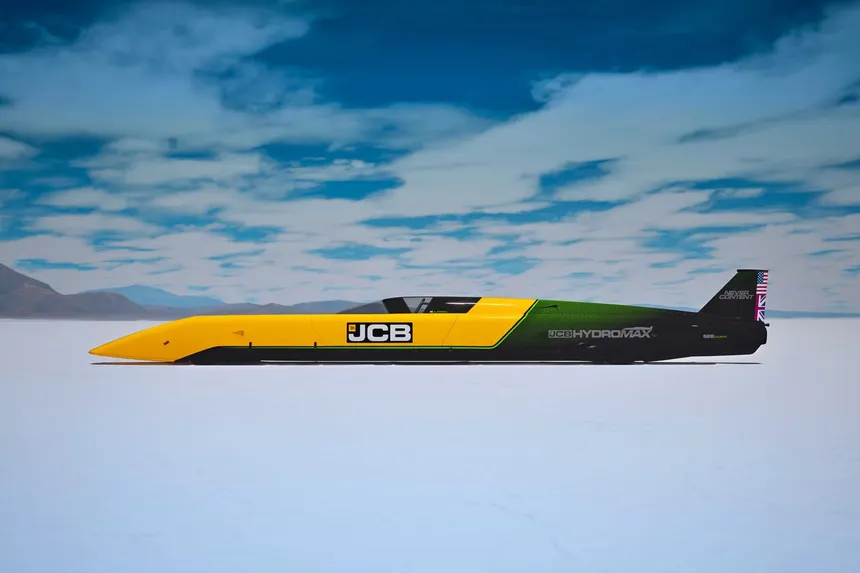
It’s called Hydromax, runs nearly thirty-three feet long, and carries two four-cylinder hydrogen combustion engines derived directly from the production units already in the machines, making between 800 and 1,000 hp each for 1,600 hp combined. Real combustion, spark and explosion, not a fuel cell in disguise. Behind the wheel: Andy Green, the same driver who took the JCB Dieselmax to 350.092 mph at Bonneville in 2006, a mark still standing twenty years later. In testing at RAF Wittering the Hydromax has already hit 177 mph with both engines at full load, and the Bonneville run is announced for August — as of this article’s publication the result isn’t confirmed — targeting 350 mph and, along the way, the hydrogen combustion land speed record currently sitting at 185.5 mph.
Bamford put it plainly: dropping an advanced engine into a record car shows the world what that engine can do in a way an excavator never will. For American readers, the symbolism lands harder than anywhere else. The Bonneville Salt Flats are where every serious claim about internal combustion has been settled for a century.
Here’s where NEC plants its flag. The death of combustion has been treated as settled for years, and the facts keep pointing elsewhere. China, which controls the battery supply chain end to end and pushed EVs onto the entire world, keeps investing in combustion and hybrid powertrains in parallel. The most powerful groups in the industry, with the money and the engineers to bet everything on a single technology, aren’t doing it. They ran the numbers, and the numbers don’t work.
They don’t work because the capacity doesn’t exist — not generation, not grid, not charging points — to sustain a total, near-term transition to electric across every use case combustion currently covers. Hybridization, synthetic fuels, and hydrogen aren’t transitional patches or the vanity project of manufacturers who failed to adapt. They’re the part of the future that can actually be built with the infrastructure that exists and the infrastructure there’s time to build. A backhoe working a quarry in Kent and a car aiming at 350 mph across a salt flat, both running the same engine, are telling the same story.
Check you’re still alive.