Ferrari Daytona: The Name Enzo Cancelled
America gave this car its name. America redrew its face. America ran it across the continent in thirty-five hours. America faked it twice over. And then America priced Ferrari’s twelve-cylinder engine out of the country for eleven years.
The 365 GTB/4 is one of the most imposing things Maranello ever built. Almost nothing that defines it was Maranello’s decision.
Two versions of the name
Here is the version everybody repeats, Ferrari included. In February 1967, at the 24 Hours of Daytona, the factory took the entire podium with a 330 P3/4, a 330 P4 and a 412 P, a direct answer to what Ford had done to them at Le Mans months earlier. When the new grand tourer appeared at the Paris Salon in October 1968, the press started calling it the Daytona in tribute. A journalist’s nickname that swallowed the real name whole.
Ferrari’s own website still frames it that way: unofficial, coined by the press.
Specialist sources tell it differently. According to them, Daytona was going to be the model’s official name, it leaked before the launch, and Enzo Ferrari, furious that the surprise had been spoiled, killed the designation and left the car with its numerical badge. Supporting that account is one detail that is hard to explain any other way: the sales documentation for the second prototype carries the word Daitona, in Italianized spelling, referring to the car.
Which would mean Ferrari has spent fifty years crediting American journalists with a name that was its own, rather than admit the boss torpedoed it in a temper.
I do not have the factory document that settles it, so it stays as it is: two versions, the official one and the specialist one, with the second resting on physical evidence that is awkward to dismiss.
What 365 GTB/4 means
365 GTB/4. The 365 is the displacement of each individual cylinder in cubic centimeters; multiply by twelve and you get the 4,390 cc Colombo V12. GTB is Gran Turismo Berlinetta, the closed body. The 4 is the number of camshafts, two per bank.
Open the roof and the B becomes S for Spider: 365 GTS/4.
It arrived obsolete on purpose
This is the decision that defines the car.
Lamborghini had shown the Miura in 1966, mid-mounted transverse V12, Marcello Gandini bodywork, and the entire industry got the message: the engine belongs behind the driver. Everyone expected Maranello to answer in kind.
Two years later, Ferrari turned up in Paris with a front-engined grand tourer.
That was not an oversight. It was doctrine. Enzo held that the engine goes in front, and the stubbornness cost his road cars years while his racing division had already surrendered to the evidence. On paper the Daytona was born an elegant dinosaur next to the new reptile from Sant’Agata.
It won anyway. It outsold the Miura, aged better, and is now the car most people sketch when you say classic Ferrari. Ferrari’s own mid-engined replacement, the 365 GT4 BB, took another five years to arrive.
Why the gearbox sits at the back
The 4.4-liter V12 with six twin-choke Weber carburetors made 352 hp at 7,500 rpm, good for roughly 174 mph and a shade over five seconds to 60.
The interesting part is not the output. It is where they put the gearbox.
The Daytona does not carry its transmission bolted to the engine. It uses a five-speed transaxle mounted at the rear next to the differential, connected to the engine by a shaft spinning at engine speed inside a torque tube. The reason is mass distribution: with a long V12 hanging over the front axle, adding the gearbox there too would have loaded the nose badly enough to ruin the car. Sending the transmission to the rear axle balanced the package and let a car with an endless hood behave far better than it looks like it should.
It is the same solution the earlier 275 GTB/4 used, and it is the technical reason the Daytona drives well rather than merely photographing well.
Washington redesigned the front end
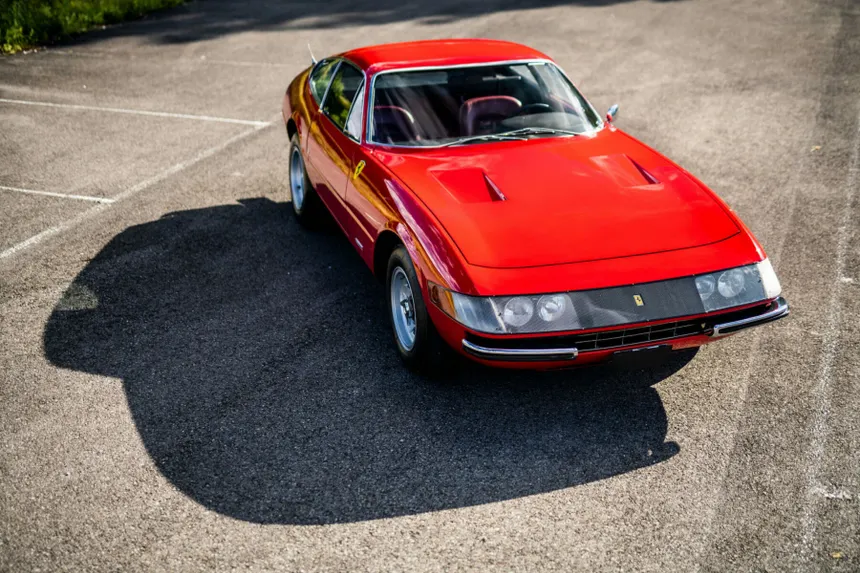
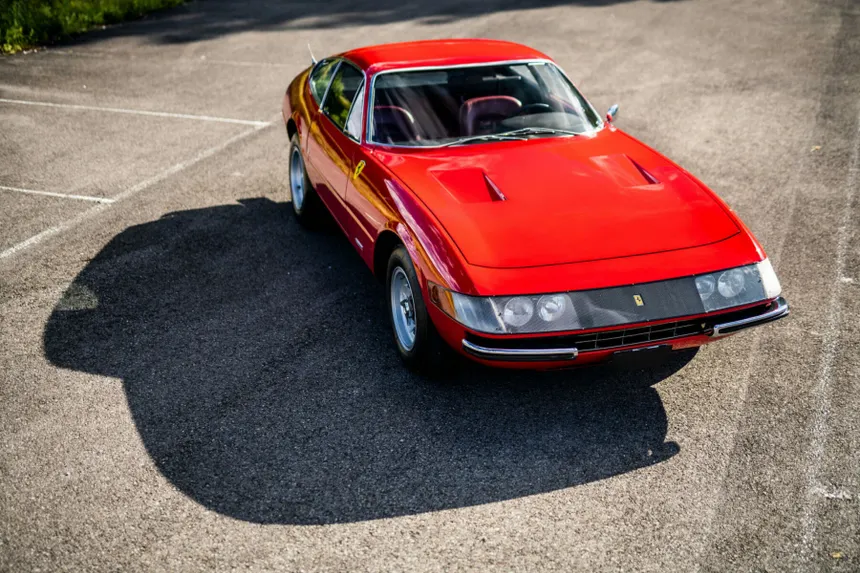
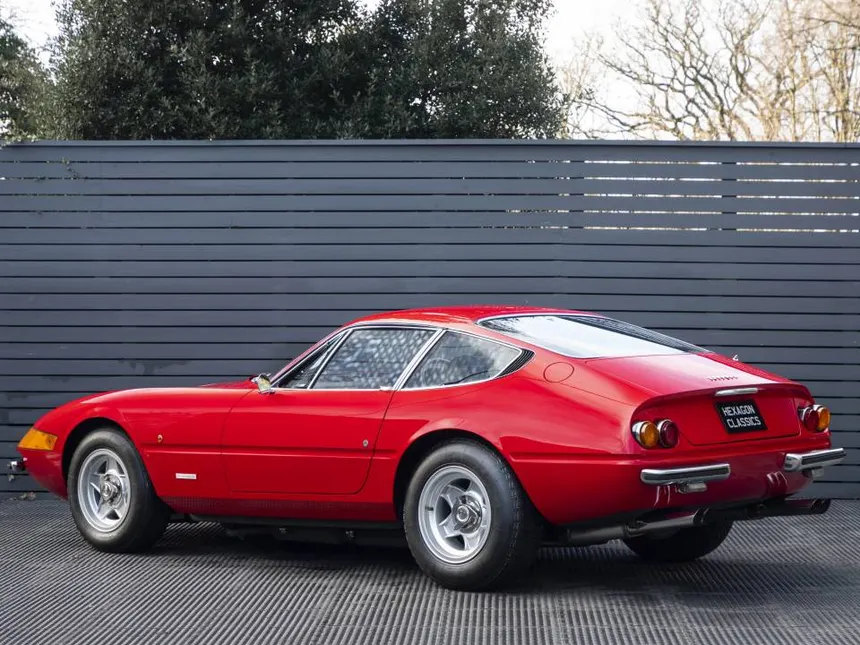
Early cars carried fixed headlights behind a transparent plexiglass band running the full width of the nose. It is the car’s signature, and to a lot of people the best face Ferrari has ever produced.
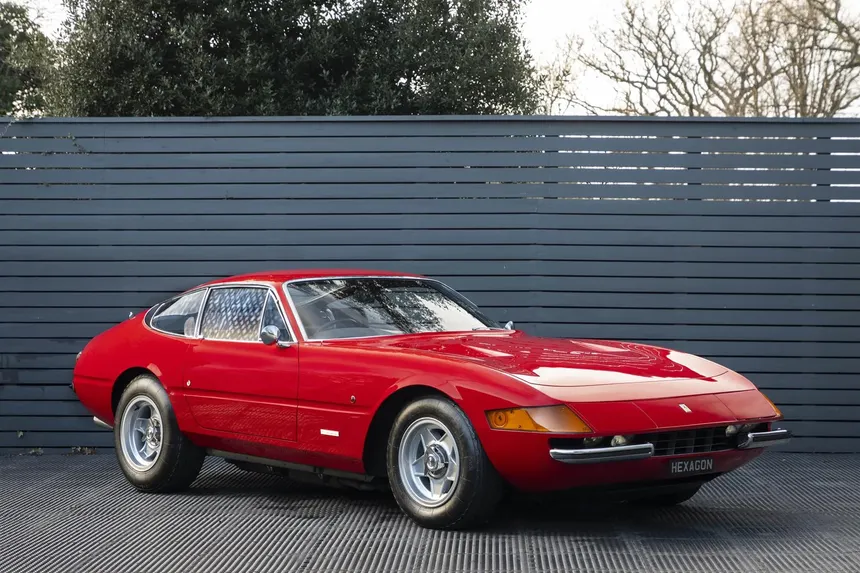
It lasted until 1971. That year, US legislation outlawed headlights mounted behind covers, part of the same regulatory wave that killed knock-off spinners and wood steering wheels and phased in headrests and side markers. Since the United States was the market carrying sales, Ferrari did not argue. It redesigned the nose and fitted pop-up units.
Roughly 400 cars were built with the plexiglass nose before the switch. Those are the ones collectors chase today and the ones carrying the model’s biggest premium.
Read that again. The price hierarchy of a classic Ferrari was set, unknowingly, by a federal safety rulemaking in 1971.
New York to Los Angeles in 35 hours and 54 minutes
Just after midnight on November 15, 1971, eight vehicles left a garage in Manhattan with one rule: get to California by whatever route and at whatever speed you judge practical. This was the Cannonball Baker Sea-to-Shining-Sea Memorial Trophy Dash, organized by Car and Driver editor Brock Yates as a protest against federal speed limits.
Yates paired up with Dan Gurney, the only man who had won in sports cars, Formula 1 and NASCAR, and they took a dark blue production Daytona, unmodified. They covered 2,863 miles in 35 hours and 54 minutes, averaging over 80 mph including stops, finishing 53 minutes ahead of the second-place Chevrolet van.
Gurney collected a citation in Arizona for 135 mph in a 70 zone. He said afterward that they never exceeded 175 mph at any point in the trip, which, coming from him, reads roughly the way it would if he told you he had two drinks.
The movies that turned the Cannonball into cheap mythology came later. The car that actually won it was a road-going Ferrari someone had just bought.
Fifteen competition cars
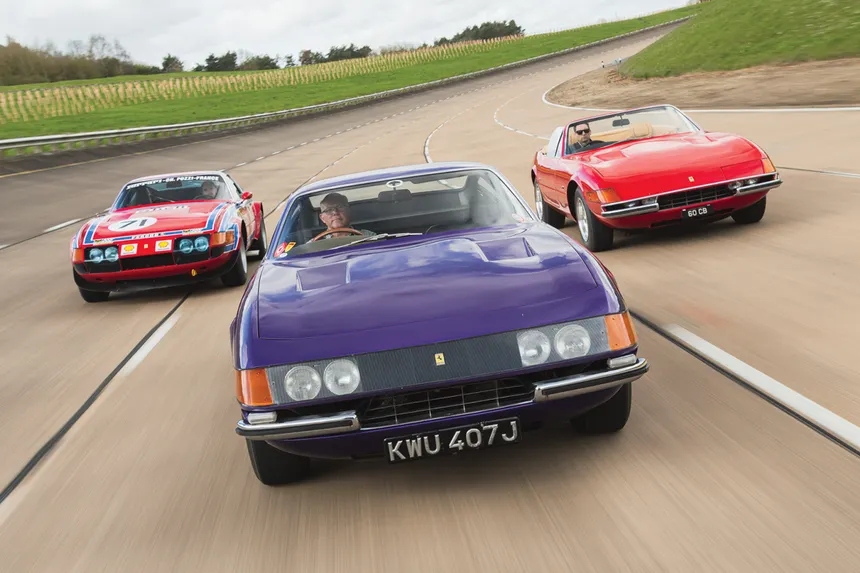
The Daytona was conceived as a grand tourer, not a competition car. Even so, Ferrari’s Servizio Assistenza Clienti prepared fifteen examples between 1971 and 1973 for FIA Group 4 and Group 5, with aluminum bodywork, plexiglass in place of glass and heavily worked engines that reached 450 hp in the final evolutions.
The results embarrassed a number of purpose-built prototypes. At Le Mans in 1972 they took the top five places in class, repeated the class win in 1973 and again in 1974, and as late as 1979, six years after production had ended, a Daytona finished second overall at the 24 Hours of Daytona.
A long-nosed GT designed to cross Europe with luggage stayed competitive in endurance racing for a decade.
The Spider and the chassis-number fraud
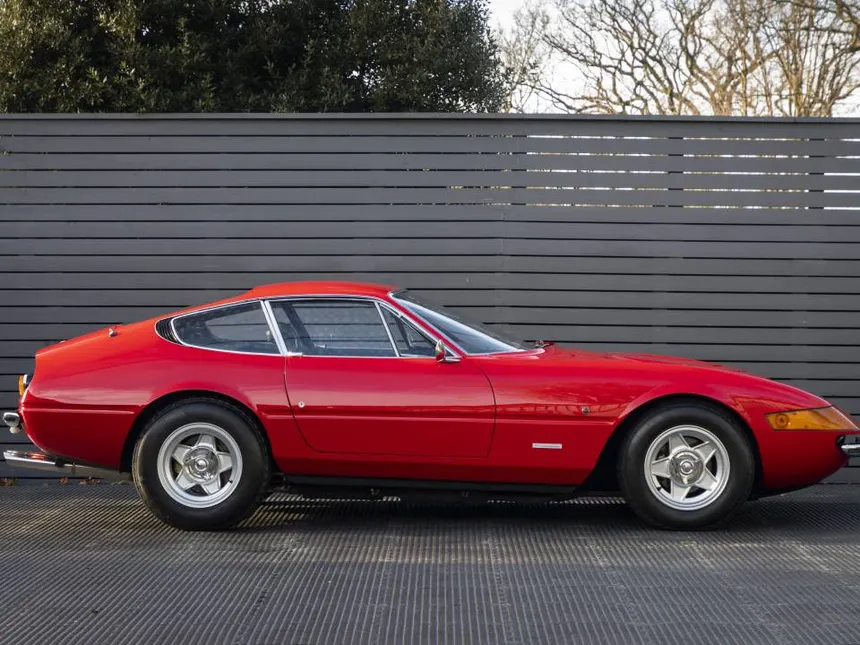
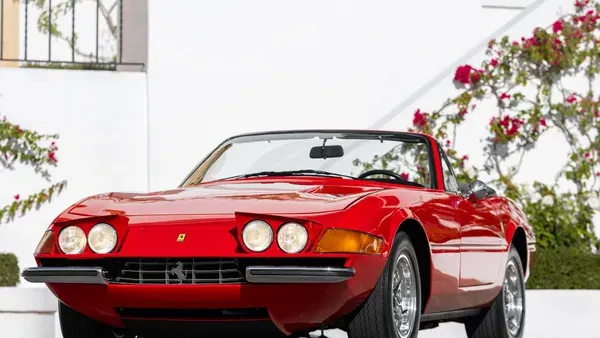
Of roughly 1,400 cars built in total, only 122 left the factory as Spiders. The rest were berlinettas, plus the fifteen competition cars.
That scarcity created a problem that is still live. Because a genuine Spider is worth a multiple of a coupe, plenty of berlinettas went through independent shops in the seventies and eighties to have their roofs removed. Some of that work was crude. Some of it, particularly Richard Straman’s operation in Newport Beach, used factory panels and finished to a standard essentially indistinguishable from original.
And here is the detail that turns this into a minefield: on US-specification cars, the chassis number does not distinguish a berlinetta from a Spider. Nothing in the numbering tells you which is which. Some conversions even incorporated the steel-reinforced inner fenders and revised A-pillars characteristic of factory Spiders.
Buying an open Daytona without complete provenance documentation means buying somebody’s word.
The Miami Vice Daytona was fake
For the first two seasons of Miami Vice, Sonny Crockett drove a black Daytona Spyder with nothing Ferrari about it: a fiberglass replica over a Chevrolet Corvette C3 chassis, built by McBurnie Coachcraft. Ferrari sued, and out of that settlement came the two Testarossas that replaced the car in season three.
So the fake Daytona is the direct reason the Testarossa ended up on television and became the poster of an entire decade. The full story of that lawsuit is in our Testarossa piece.
The eleven-year exile
This is the fact that surprised me most while researching, and it comes from Ferrari’s own model archive.
The Daytona was the last twelve-cylinder Ferrari sold new in the United States through official channels until 1984, when the Testarossa arrived. Eleven years with no Maranello V12 legally on sale in its most important market.
The reason was not demand, it was cost. Meeting the escalating US emissions and safety requirements was not viable for a manufacturer building so few cars, so Ferrari simply stopped trying with its twelve-cylinder models and sat out more than a decade. The Boxers that reached American soil in that period came in through the gray market, federalized one at a time by third parties.
The next official V12 was the car whose side strakes were shaped by another American regulation entirely.
There is a pattern there, and it does not flatter the Italian mythology.
The last car of Enzo’s era
One piece of context worth adding. The Daytona was the last twelve-cylinder model announced before Fiat took control of Ferrari’s road car production in 1969 by acquiring 40 percent of the company.
In the strictest sense, it is the last great Ferrari road car conceived while Maranello still belonged only to Enzo. Everything after it had Turin’s money behind it.
The verdict
Ferrari has spent fifty years selling the Daytona as a triumph of Maranello’s will. What it actually was is a car that had most of its identity handed to it from outside.
The name was imposed, and the company would rather credit American journalists than admit a tantrum killed it. The face was imposed by a rulemaking in Washington. The eleven-year exile from its best market was imposed by the cost of compliance. And the one genuinely independent decision Ferrari made, keeping the engine in front while the entire world had swung to the rear, is the one everybody at the time called wrong.
That is the good part of the story. Enzo picked the wrong era and the right car. The Miura was more modern, more daring and more advanced, and today the Daytona looks better, drives better and does not catch fire. Doing the opposite of what the moment demands fails ninety percent of the time. The other ten percent is what we call a classic.
What I will not forgive Maranello is the rewrite. A car this good does not need its biography touched up.
How many cars launching this year will still be right in fifty?
Check you’re still alive.