Tazio Nuvolari: The Italian Who Humiliated the Silver Arrows On Their Own Soil
On 28 July 1935, in the rain-soaked German hell that was the Nürburgring of the Eifel mountains, a 42-year-old Italian called Tazio Nuvolari climbed into a Grand Prix car carrying 110 horsepower less than the competition and proceeded to win a race that the regime of the Third Reich had designed, financed and packaged as a demonstration of German technical supremacy. Three hundred thousand spectators, the vast majority of them German, applauded when he crossed the finish line two minutes and ten seconds ahead of the second-placed Auto Union. The high command of the Reich, sitting in the main grandstand, was reportedly enraged. The German radio service, which had prepared a recording of Deutschlandlied for the inevitable home victory, had to scramble for a replacement: the Italian national anthem played at the medal ceremony came from a personal record one Italian journalist had brought to Germany in his car boot, because nobody in the Nürburgring organisation had considered the possibility of an Italian victory and the protocol cinematic of motorsport demands the winner’s anthem be played. The most overtly propagandistic Grand Prix of the 1935 season ended with the Marcia Reale echoing across the Eifel and a 5-foot-5 man from Mantua holding the trophy above his head in front of the worst political crew of the twentieth century.
That is the postcard. The Nürburgring 1935. The race that for many serious historians of motorsport remains, almost a century later, the greatest single performance ever delivered by a Grand Prix driver. But Tazio Nuvolari is not just the Nürburgring. Nuvolari is 92 race wins, 24 Grands Prix, 2 Mille Miglia, 2 Targa Florio, a Le Mans, a Vanderbilt Cup in the United States, the inaugural European Drivers’ Championship in Grand Prix racing (1932), a yellow short-sleeved shirt with his initials embroidered in white, a gold tortoise given to him by the poet Gabriele D’Annunzio as a personal talisman, two sons dead before either of them turned twenty, a progressive deafness caused by decades of inhaled exhaust gases, and a funeral cortège through Mantua in which the coffin, mounted on the bare chassis of a racing car, was pushed by hand by Alberto Ascari, Luigi Villoresi and Juan Manuel Fangio.
That image — three of the most important active racing drivers in the world pushing a coffin through an Italian city — is the kind of moment that doesn’t repeat. And it is why Ferdinand Porsche, who had watched Rosemeyer, Caracciola, Lang and a dozen better-resourced German drivers carve their names into Grand Prix folklore, told a journalist in 1935 that Nuvolari was “the greatest driver of the past, of the present, and of the future”. That is not poetry. That is a German engineer describing what he had seen with his own eyes that summer at the Nürburgring.
Castel d’Ario, November 1892
Tazio Giorgio Nuvolari was born on 16 November 1892 in Castel d’Ario, a farming village about ten kilometres north of Mantua, in Lombardy. The location and date are worth fixing because they set him apart from almost every great Italian driver of his generation. Antonio Ascari was from the Veneto. Sivocci had been born in Aversa by family accident. Nuvolari came from the heart of agrarian Lombardy. His father, Arturo Nuvolari, was a comfortable farmer and a respected local cyclist. His mother was Elisa Zorzi. His paternal uncle, Giuseppe Nuvolari, was the Italian national champion of track cycling in 1894 and 1904, a serious figure in his discipline who lived until 1962. The culture of competitive physical effort was in the family before Tazio was born.
The boy never wanted to be anything else. A line attributed to him, preserved at the Tazio Nuvolari Museum in Mantua, reads: “I never dreamt of fairy tales or pirate adventures. I always and only dreamt of speed.” Whether the sentence is exact or reconstructed by the museum is another question. But every biographical source agrees on the substance: from the moment Tazio could understand what was moving past on the road, he was only interested in what moved fast. Father and uncle in cycling, cousins in motorcycling. A household where speed was a trade.
He took his motorcycle racing licence in 1915, at age 23. The First World War interrupted everything. Italy entered the war in May 1915, and Tazio was mobilised as an ambulance driver in the Italian army. This detail matters. He didn’t drive military trucks. He didn’t service aero engines, like Antonio Ascari. He drove ambulances. Across broken roads, carrying wounded men away from the Alpine front, for three years. That sustained experience — human lives depending on his speed and his judgement — formed him as a driver more thoroughly than any racing school could have done.
The first race, under the borrowed name
When the war ended Tazio went back to Castel d’Ario and entered his first competition. It was on 20 June 1920, at the Circuito Internazionale Motoristico in Cremona. He rode a Della Ferrari motorcycle (no relation to the later Ferrari). And here’s the curious detail: he entered the race using his middle name, Giorgio, not Tazio. The biographers’ speculations vary: either he didn’t want his father to know, or he didn’t want to risk the family name on a competition he expected to retire from. And retire he did. First race, retirement. Twenty-seven years old, late debut, did not finish.
Anyone else would have moved on to a different career. Tazio kept going.
In March 1921 he debuted in cars, in an Ansaldo Tipo 4 at the Coppa Veronese di Regolarità, a reliability event. He won. First car race, first car victory. In 1922 he moved permanently from Castel d’Ario to Mantua. The city where he would live the rest of his life, run his Bianchi bicycle and motorcycle dealership (Bianchi in interwar Italy was roughly what Triumph was to interwar Britain), marry Carolina Perina, raise two boys, and die thirty-one years later.
European motorcycle champion, 1925
The first half of Tazio’s racing career was on two wheels. He rode for Bianchi and in 1925 won the European 350cc Championship. That fact is often forgotten: before he became a Grand Prix legend, he was a continental motorcycle champion. And here’s the technical detail that any working mechanic ought to admire. Tazio competed simultaneously in motorcycles and cars, sometimes on the same weekend, occasionally on the same day. Switching from an Alfa Romeo Grand Prix car to a 350cc Bianchi motorcycle within hours — with completely different body position, braking technique, cornering line, and physical conditioning — required a neuromuscular adaptability that few contemporary athletes could replicate.
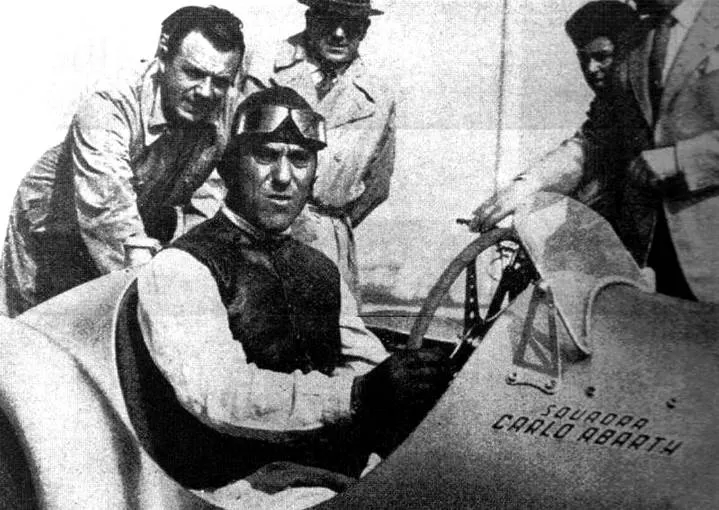
That dual phase lasted until 1930. In 1931, aged 38 (an age by which most modern Formula 1 drivers have been retired for three years), he chose to concentrate exclusively on cars and accepted the offer of Alfa Romeo’s works team, Alfa Corse. Alfa had been state-owned since 1933 through the IRI (I told you about that in the Nicola Romeo article), and the sporting operation was managed by the Scuderia Ferrari, Enzo’s outfit set up in Modena in 1929 as the contracted operator of Alfa’s racing programme.
The yellow shirt, the gold tortoise, and the poet godfather
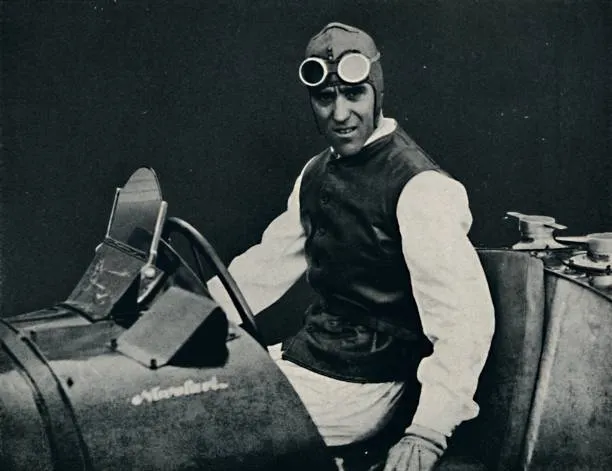
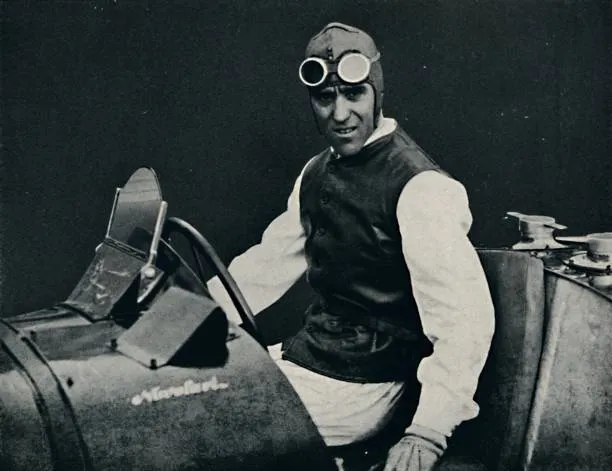
It’s worth pausing here because Nuvolari’s visual presentation is inseparable from the racing legend. Tazio raced wearing a canary-yellow short-sleeved shirt with TN embroidered in white on the chest, light blue trousers, a basic leather helmet, metal-framed goggles, gloves, and not much else. That colour combination — yellow and blue — was not arbitrary. They were the colours of Mantua, his adopted city. He wore the city on his body every time he climbed into a car. The whole kit is preserved today at the Nuvolari Museum in the deconsecrated Church of the Carmelino in Mantua, alongside trophies, medals, and letters.
And the gold tortoise. It hangs as the centerpiece of the personal collection. It was a gift from the poet Gabriele D’Annunzio, the key figure of early-twentieth-century Italian nationalism and a close intellectual ally of Mussolini whom you already met in the Antonio Ascari funeral coverage. D’Annunzio, fascinated by the cult of speed and by the mythology of the driver-hero, presented Tazio with a small gold tortoise inscribed with “To the fastest man, the slowest animal”. The gesture was poetry, irony and superstition compressed into one pendant. Tazio wore that tortoise on a chain around his neck for every major race of his life. It is the most famous personal talisman in twentieth-century Italian motorsport.
D’Annunzio also coined the nickname. Il Mantovano Volante, the Flying Mantuan. A poetic phrase that stuck in the contemporary Italian press and became the unofficial designation. Nuvolari never disowned it.
Ferrari, the manager, the running argument
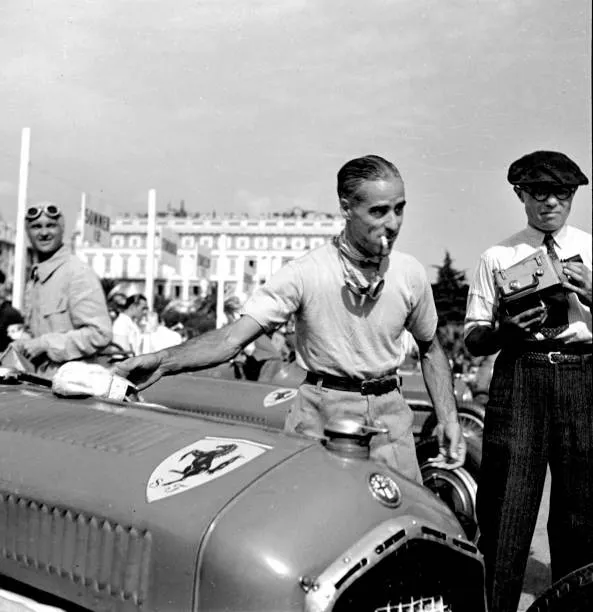
The relationship between Nuvolari and Enzo Ferrari, during the years when the Scuderia Ferrari managed the Alfa Corse programme (1929-1939), is one of the great soap operas of pre-war motorsport. Ferrari, as team principal, handled budgets, equipment decisions and driver rotations. Nuvolari, as undisputed star, handled the steering wheel and the temperament that comes with it. The two clashed repeatedly. There were seasons in which Tazio left for other teams (Maserati especially). He came back. He left. He came back again.
In early 1935, before the season that would define the driver forever, Ferrari and Nuvolari had fallen out again, and seriously. The regime, which understood perfectly the propaganda value of Nuvolari as an Italian hero against the emerging German dominance of motorsport, intervened: Benito Mussolini personally telephoned Modena to pressure Ferrari into reconciling with Nuvolari before the start of the season. It worked. Tazio returned to the team in March 1935. Three months later they would be in Germany for what became the most extraordinary single race in the history of pre-war Grand Prix racing.
Nürburgring, 28 July 1935
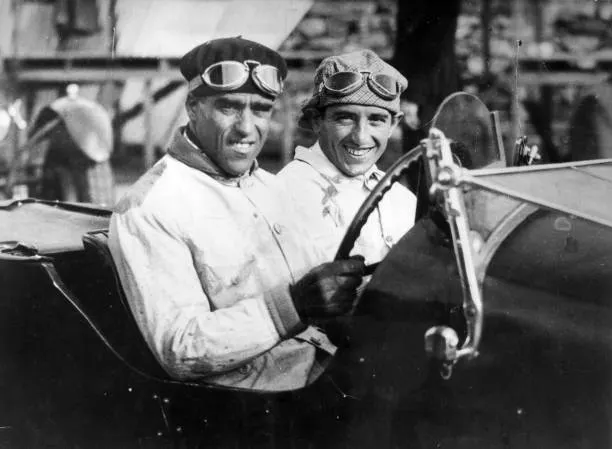
The Nazi regime had been investing unprecedented sums in Grand Prix car development for two years. The official justification: national prestige. The actual industrial logic: developing engineering technologies that would shortly be applied to military aviation. Mercedes-Benz had presented the W25B, a streamlined single-seater with a 3.99-litre, inline-eight, supercharged engine producing 375 horsepower. Auto Union, the conglomerate of four marques (Audi, Horch, DKW, Wanderer) formed in 1932, had the Type B with a V16 mid-mounted engine (a radical new architecture for the era), also 375 horsepower. Nine German cars total were entered for the German Grand Prix at the Nürburgring. Their press nickname: Silberpfeile, the Silver Arrows, after the polished aluminium bodywork.
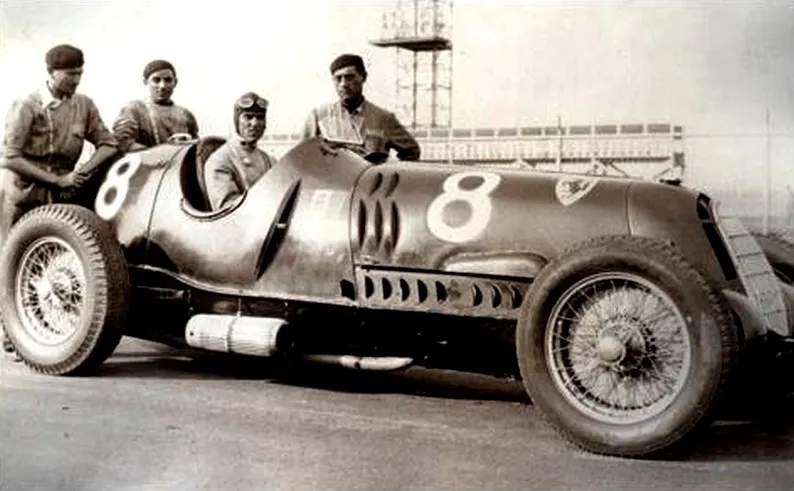
On the Italian side: the Scuderia Ferrari entered three Alfa Romeo P3 (Tipo B) cars, with 3,165 cc, 8-cylinder supercharged engines producing 265 horsepower. One hundred and ten horsepower less than the German competition. A car designed in 1932, three years behind the technical state of the art in 1935. The drivers: Tazio Nuvolari, Antonio Brivio and Louis Chiron. Three Italian veterans against the industrial muscle of the Reich.
Race day broke wet. The Nürburgring of 1935 measured 22.8 kilometres, with 174 corners, and a sodden surface turned it from a hard circuit into a near-impossible one at racing speed. Three hundred thousand spectators, mostly German, had filled the Eifel margins overnight. In the main grandstand: the high command of the Third Reich. The race was designed as a political statement as much as a sporting one.
Start. Brivio retired on lap 1. Chiron retired on lap 5. Within minutes, Nuvolari was the only Alfa Romeo still racing against nine German cars. On paper, impossible.
Tazio started recovering ground. Lap after lap, taking two, three, four seconds out of the German leaders. On lap 12 (of 22), he pitted for fuel. The refuelling pump of the team’s tanker broke. Six minutes were lost while crew members refilled the tank manually with cans. When he rejoined the track, Tazio had dropped to sixth place. Any reasonable driver would have written the race off.
Tazio kept pushing. The seven laps that followed are the ones that enter any serious history of motor racing. He passed an Auto Union. He passed another. He passed a third Mercedes. He passed the fourth. By lap 18 he was second, just over two minutes behind the leader, Manfred von Brauchitsch in a Mercedes W25B. Four laps remained. The gap looked recoverable only if the German made a mistake.
Von Brauchitsch didn’t make a mistake. He made something worse. He destroyed his tyres. In the wet, with a faster but heavier car and rubber compounds poorly adapted to the conditions, von Brauchitsch began degrading his tyres rapidly in his attempt to maintain the gap. By lap 21 (the penultimate), his Mercedes was running on rubber worn down to the canvas carcass. On the last lap, before the finish, Nuvolari caught him and passed him cleanly.
Tazio crossed the finish line two minutes and ten seconds ahead of the second-placed car (now Hans Stuck’s Auto Union B, not Brauchitsch). Four hours of racing. Three hundred thousand Germans applauding a 42-year-old Italian in an obsolete car. The Reich’s high command, according to the period accounts, incandescent with rage.
The Italian anthem that wasn’t supposed to play
Here’s the detail most accounts forget. The Nazi regime, as the host of the event, had not prepared a recording of the Italian national anthem because they hadn’t seriously contemplated a non-German victory. When Nuvolari stepped onto the podium, the organisers were panicking: international protocol required the winner’s anthem to be played, and they had no recording. The solution: an Italian journalist covering the race for a sports magazine had a personal 78rpm recording of the Marcia Reale (the anthem of the Italian Kingdom of the period) in his car boot. He lent it to the circuit’s PA service. And so, for more than two minutes, the Italian anthem rang across the Eifel while the Italian tricolour rose to the top of the Nürburgring’s main flagpole, in front of the Reich high command who were obliged by protocol to stand at attention.
It is one of the most politically dense moments of twentieth-century sport. Not for the sporting drama. For the political theatre. Nazi Germany, then preparing the 1936 Berlin Olympics as an exercise in propaganda totality, received — before the Olympic event itself — a public sporting blow that no propaganda system could downgrade to “minor defeat”.
The rest of the season, the rest of the decade
Nuvolari won many other races. Monaco 1932 (with Jano’s brand-new P3, that year). Le Mans 1933 with the Sommer team in an Alfa Romeo 8C 2300. Mille Miglia in 1930 and 1933. Targa Florio in 1931 and 1932. The 1936 Vanderbilt Cup in the United States, the first time a European had taken the American Grand Prix trophy. AIACR European Champion in 1932, the inaugural season of the European Drivers’ Championship. Three Italian championships (1932, 1935, 1936).
By 1938, frustrated with running increasingly outdated Alfa Romeos against the Silver Arrows, he signed for Auto Union. The decision raised obvious political eyebrows: a famous Italian going to the marque most politically aligned with the Nazi regime. But Tazio, by then 45 years old, wanted to drive the best machinery available to him before he retired. Auto Union was in crisis after the death of Bernd Rosemeyer in February 1938 while attempting a speed record on the Frankfurt-Darmstadt autobahn. Nuvolari was the obvious replacement. He won the 1938 Italian Grand Prix at Monza and the 1939 Yugoslav Grand Prix in the Auto Union Type D before the Second World War shut down European motorsport.
Carolina, Giorgio and Alberto
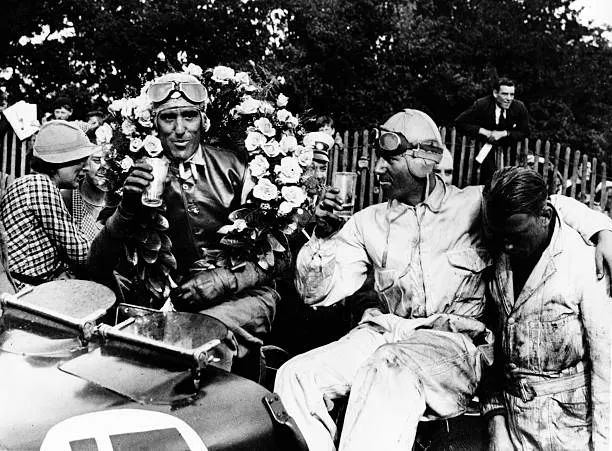
While Tazio was accumulating trophies on track, the household in Mantua was accumulating the worst kind of personal disasters. Giorgio Nuvolari, the elder son, born on 4 September 1918 in Mantua, died in 1937 at the age of 19 of myocarditis, an inflammation of the heart muscle. Alberto Nuvolari, the second son, died in 1946 at the age of 18 of nephritis, kidney failure. Two sons. Less than a decade between the deaths. Neither lived past nineteen. Antonio Ascari’s widow had lost her husband. Carolina Perina, Tazio’s widow-in-life, lost both her sons while her husband was still racing across Europe.
The sources agree on this point: Tazio never recovered emotionally. He carried on racing, won some more events after the Second World War (he led the 1947 Mille Miglia and the 1948 Mille Miglia without winning either, mechanical failures in the closing kilometres with Cisitalia and later with a Ferrari 166), but the man who returned to Mantua after each race was quieter, more isolated, more solitary each time. Towards the end, even his wife reported barely recognising him.
The deafness and the first stroke
There’s another physical factor worth mentioning because it explains why Nuvolari, a 60-year-old man on paper, was a physical wreck by the end. Decades of racing in open cockpits, with no exhaust filtration, with manifolds that ended virtually next to the driver’s ear. The combustion gases had penetrated his ears, his lungs and his bloodstream over thirty years of accumulated exposure. By 1950, Tazio was almost completely deaf, suffered spontaneous internal haemorrhages, and bore the marks of a series of brutal accidents (including a 1946 Cisitalia crash he survived only because the car came to rest the right way up by chance).
In 1952 he suffered a stroke which left him partially paralysed. He spent the following months largely bedridden. On 11 August 1953 a second stroke killed him in his Mantua home. He was 60 years old.
The funeral that stopped a city
Between 25,000 and 55,000 people (the figures vary depending on the source) attended the funeral. At least half the population of Mantua took to the streets. The cortège stretched a mile long. The coffin was mounted on the bare chassis of a racing car, as is traditional for racing drivers in Italy. And here is the detail that defines the moment. The four handles where the cortège had to physically push the chassis through Mantua’s streets were taken by Alberto Ascari (then double Formula 1 World Champion with Ferrari, son of Antonio Ascari from the previous article in this series), Luigi Villoresi (Ascari’s Ferrari team-mate, twice Italian road champion), Juan Manuel Fangio (Argentine, by then already a multiple European champion and future five-time World Champion), and a fourth driver whose name varies between accounts.
Three of the most important active drivers in the world physically pushing Nuvolari’s coffin through the streets of Mantua. That doesn’t happen. It hadn’t happened before, and it hasn’t happened since. It is the mechanical recognition of an internal hierarchy of the paddock: when a driver of drivers dies, the other drivers don’t send wreaths. They push the car carrying the coffin themselves.
Nuvolari was buried in the Cimitero Degli Angeli of Mantua, on the road towards Cremona. The inscription above the entrance to his tomb reads: “Correrai ancora più veloce per le strade del cielo.” You will run even faster on the roads of heaven. The line is attributed to D’Annunzio himself, although the attribution is not fully confirmed.
What this story leaves on the workshop floor
There’s something you learn over decades on the assembly bench: legends aren’t built on records. They’re built on moments when the impossible piece worked because the man holding it decided it had to work. The Nürburgring 1935 is that. 265 horses against 375. An obsolete three-year-old chassis against the industrial muscle of the Reich. A 42-year-old driver against a generation of German pilots on million-mark win bonuses. And Nuvolari still won by more than two minutes. The difference wasn’t in the car. The difference was in what the driver decided to do with the car he had.
That’s what defines the greats. Not the kit they were handed. What they did with what they had. Sivocci, Antonio Ascari, Nuvolari — the three drivers of the post-Musketeer arc at Alfa Romeo — can all be classified in the same category. All three won what they won with cars that were not always the best in the paddock. The difference between them is that two of them died young on track, and the third survived everyone. And honestly, I’m not sure which I’d prefer. The frozen mythology of Sivocci and Ascari, killed in their prime, or the worn-down mythology of Nuvolari, outliving both his sons, losing his hearing, paralysing slowly, dying in bed after a second stroke at 60.
Probably the second is worse. Living long enough to see both your sons die before either of them turns twenty, while you yourself are still racing across Europe for thirty years and coming home each time with a fresh trophy and one fewer child, is not the life any driver would ask for. But the great ones don’t always get to choose what happens to them. They only get to choose how they climb into the car each morning. Tazio Nuvolari climbed into his car each morning with the yellow shirt, the light-blue trousers, the gold tortoise hanging from his neck, and the decision to win against whatever needed beating.
When Porsche said Nuvolari was the greatest driver of the past, the present and the future, he wasn’t making poetry. He was a German engineer describing what he had seen with his own eyes at the Nürburgring in 1935. And German engineers, as a category of professional, are not famously prone to cheap marketing statements.
Check you’re still alive.