

Apollo EVO Caribbean Dragon: 123 Hours to Print One Exhaust Pipe

The exhaust takes 123 hours to make.
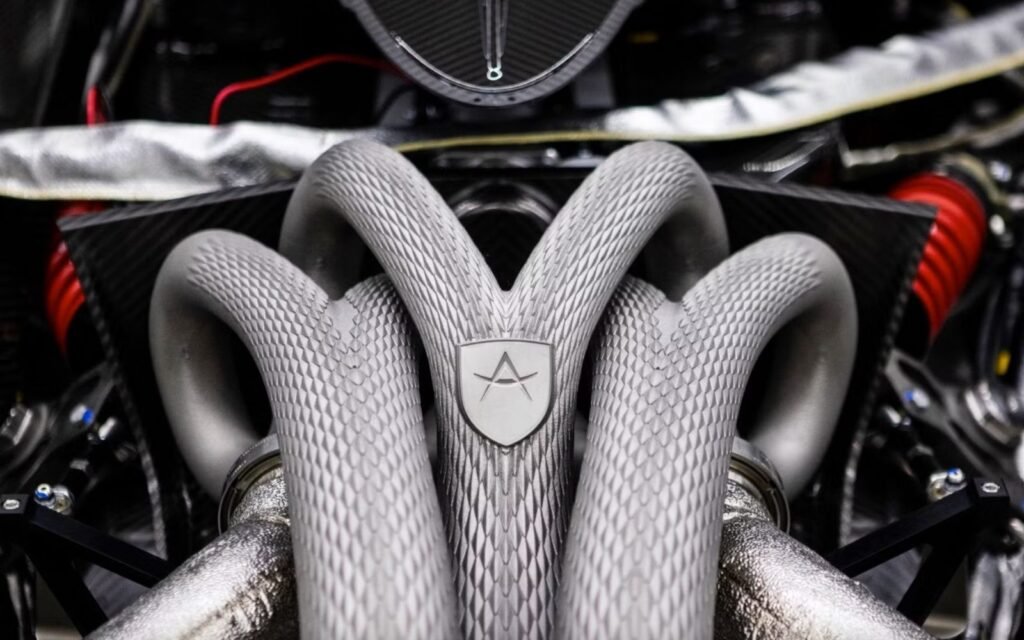
Not to design. Not to develop. To make. One hundred and twenty-three hours of a 3D printer laying down titanium, layer by layer, to produce a single piece — the largest one-piece 3D-printed exhaust ever fitted to a production car, according to Apollo. It’s textured to look like reptile scales. It survives 1,000°C. And with use, the titanium develops the blue heat-tint that anyone who has ever pulled a hard-run manifold off a track car knows on sight.
Apollo calls it Dragon Skin, and says the colour change represents the living spirit of the car.
Strip away the poetry and it’s this: your exhaust changes colour depending on how hard you’ve thrashed it. Which is true of every stainless manifold on every track car ever built. The difference is that here it’s deliberate, it’s titanium, and it costs about what a house costs.
We got customisable multicolour exhausts before GTA 6.
The number that stops you
Two figures, and you need to read them next to each other.
Downforce: 1,350kg at 300km/h. Dry weight: 1,300kg.
The Apollo EVO generates more downward force than the car itself weighs. Find a light enough driver, run the tank nearly dry, and on paper the thing could theoretically drive along the roof of a tunnel.
Nobody will ever try. Ten exist. Each costs €3 million before tax. And it isn’t road legal, so you can’t even drive it to a tunnel to find out.
But the number is real. And that number is the entire thesis of the car.

Goodwood, two days ago
The first customer Apollo EVO broke cover at the 2026 Festival of Speed. It’s called the Caribbean Dragon, and it ran the hill on Friday.
The functional prototype appeared in 2021. Five years. Five years between a running prototype and a customer taking delivery. In boutique hypercar land this is routine, but let’s say it out loud anyway: somebody put down a seven-figure deposit and then waited half a decade.
The car was commissioned by Fred Grifhorst through Apollo’s Forge bespoke programme, and it’s one of those specifications that only happens when someone has three million euros and no particular hurry.
Pearl White with a Diamond Dust finish — a paint loaded with particles that make the bodywork glitter under direct sun. Over it, Ocean Blue accents and blue-tinted carbon fibre. Apollo says the name comes from the contrast between the light of a Caribbean beach and the depth of the sea.
Over 75 individual carbon panels. An eight-layer, hand-applied paint process.
And here’s the figure that genuinely floored me:
Over 1,000 working hours just to paint it.
A thousand hours. That is roughly six months of one person, full time, painting. One car.
The Ferrari V12 nobody will name
Now the funny part.
The EVO runs a 6.3-litre naturally aspirated V12. It revs to 8,500rpm. It makes 800PS (789bhp) and 765Nm. In the Intensa Emozione that preceded it, the redline was reportedly 9,000rpm.
It’s a Ferrari engine. Specifically, it descends from the F140 family — the same lineage that powered the Enzo, the F12 and the LaFerrari.
When Top Gear visited Apollo during the Intensa Emozione era and started asking where the engine came from, they reported that the Apollo people clammed up the moment the F-word came out. The official line was that the engine is “related to” a certain Ferrari project and has been thoroughly reworked by Italian partner Autotecnica Motori. There is not a single prancing horse anywhere on the car.
So don’t go thinking it’s a Ferrari engine. Understood?
It’s a Ferrari engine.
Autotecnica Motori develops it in Italy. HWA AG finishes it in Germany. And that name deserves a pause.

HWA: the people who built the CLK GTR
HWA is the motorsport engineering house founded by Hans Werner Aufrecht. The A in AMG. The man who founded AMG, and who — once Mercedes absorbed the brand — set up HWA to carry on doing what he’d always done.
HWA built the Mercedes CLK GTR. The GT1 that won the FIA GT Championship in 1997 and 1998, and spawned one of the most deranged road cars ever homologated.
Here’s the coherence almost nobody points out. When Norman Choi resurrected Apollo, he said he wanted to build a nostalgic nineties GT1 racer for the 21st century. And to build it, he hired the actual people who built the best nineties GT1 racer.
The EVO is assembled in Affalterbach. The same town where HWA builds its race cars. The same town as AMG.
The carbon monocoque comes from Capricorn Group. The gearbox is a Hewland six-speed sequential with paddles. Brakes are Brembo carbon-ceramic. Suspension is pushrod-operated with adjustable Bilsteins.
This isn’t a startup’s parts bin. This is a proper racing car supplier list.
The bit Apollo doesn’t put in the press release: Gumpert
Roland Gumpert ran Audi Sport. Under him, Audi took 25 World Rally Championship wins and four titles. This is the man behind the Quattro era — Group B, the whole rewriting of what a rally car was.
In 2004 he founded Gumpert Sportwagenmanufaktur in Altenburg. The idea was simple and it was good: a car homologated for Le Mans that was also road legal. The Gumpert Apollo arrived in 2005 with a twin-turbo Audi V8.
And it worked. In 2008 the Apollo lapped the Top Gear track in 1:17.1. Outright record. It stood for two years, until the Bugatti Veyron Super Sport turned up.
Now the ugly part.
The Gumpert Apollo was savagely fast and commercially unviable. No air conditioning. A sequential gearbox that behaved like a hammer at low speed. Output peaked at maybe 50 cars a year, and across the entire production run they never reached 150 cars.
August 2012: provisional insolvency. August 2013: bankruptcy and liquidation, after an anonymous backer walked away from the deal that might have saved the company.
The Altenburg factory closed. A court-appointed receiver sold off the IP, the tooling and the leftover parts.
In January 2016, the Hong Kong consortium Ideal Team Venture — who’d bought De Tomaso the previous year — acquired the wreckage. They renamed it Apollo Automobil GmbH.
And in June of that same year, Roland Gumpert was removed from the company he founded. It was announced publicly in November: he was no longer associated with Apollo, or with any of its current or future projects.
Gumpert has another company now. It’s called RG. It builds the Nathalie, a methanol fuel-cell electric sports car. It has nothing whatsoever to do with Apollo.
The people who bought the corpse kept the name. The man who created it walked away with nothing.

The company building this sells jewellery and loses money
This is the angle nobody is writing, and it’s the hardest one.
Apollo Automobil today belongs to Apollo Future Mobility Group (AFMG) — a company listed on the Hong Kong Stock Exchange under code 860.
What is AFMG? By its own description, an investment holding company engaged in the trading, retail and wholesale of jewellery, watches and other commodities. It also designs and manufactures high-performance hypercars. It also provides mobility technology solutions. It also runs a money lending business.
You read that correctly. The most analogue, most visceral, most defiantly anti-hybrid car on earth — a naturally aspirated V12 revving to nine thousand, conceived explicitly as a slap in the face to electrification — is built by a subsidiary of a Hong Kong financial conglomerate whose roots are in the jewellery trade.
And the company loses money. In the nine-month 2025 results published in March 2026, AFMG reported revenue of HK$88 million and negative earnings per share. Market commentary describes it as a high-risk, high-reward proposition, actively winding down its legacy jewellery business to reinvent itself as a mobility technology firm.
A company trying to pivot to EVs. Holding a stake in Divergent 3D. Talking in its own materials about sustainable luxury mobility and the green revolution in transport.
And which, at Goodwood in July 2026, wheeled out a naturally aspirated V12 with a 123-hour titanium exhaust.
There’s something oddly sincere in that contradiction, and I don’t say it to sneer. The company needs the EVO. Ten cars at €3 million is €30 million. For a holding company posting losses, that isn’t a brand indulgence. That’s cash flow.
The most romantic car on the planet exists because the spreadsheet demands it.
Against the Praga Bohema: two ways of saying the same thing
We wrote about the Praga Bohema recently. These two cars are the same argument, made from opposite ends.
| Praga Bohema | Apollo EVO | |
|---|---|---|
| Engine | Twin-turbo V6 (Nissan GT-R) | NA V12 (Ferrari F140) |
| Power | 700bhp | 789bhp |
| Weight | 982kg | 1,300kg |
| Downforce | 900kg @ 250km/h | 1,350kg @ 300km/h |
| Road legal | Yes | Track only |
| Price | €1.36m | €3m |
| Units | 89 | 10 |
The Bohema wins the weight war by over three hundred kilos. Three hundred kilos is not a rounding error. The EVO wins on downforce and on engine.
But the real difference isn’t in the table.
The Bohema proves its thesis with a stopwatch. It went to Dunsfold, to Most, to Slovakia Ring, and it walked past the Porsche 911 GT3 RS and the Koenigsegg Jesko Attack. There are VBox-verified numbers.
The Apollo EVO has not published a single lap time. Not one.
And in fairness, it can’t claim them on the same terms — it isn’t a road car. It’s a pure circuit machine with no homologation, and comparing its laps to a road-legal car’s would be cheating.
Praga says: look at the clock. Apollo says: look at the exhaust.
Both are right. They’re two denominations of the same church.
The elephant: you cannot drive it on the road
Let’s be blunt, because the press material tiptoes.
The Apollo EVO is not homologated for public roads. Neither was the Intensa Emozione before it. It’s a private-circuit car. Full stop.
The entertaining footnote: a handful of Intensa Emozione cars have quietly found their way onto public roads anyway. There’s footage of one howling through Hong Kong. Homologation is one thing; what people with three million euros and a permissive jurisdiction actually do is another.
But on the record: buy an EVO and, absent a legal workaround, that car lives and dies inside a circuit. You trailer it there. You cannot drive it to the track the way Ben Collins drove the Praga to Dunsfold.
That’s an enormous difference. And at €3 million, it’s a difference that stings.
The criticism that has to be made
I’ll be straight, because the car is magnificent and that’s exactly why it doesn’t need flattery.
Five years late. Running prototype in 2021, first customer car in 2026. That isn’t “the normal boutique manufacturer process.” That’s a customer waiting half a decade.
There is no dynamic data. No lap times. No independent press drives. Journalists have seen it in the Goodwood paddock, received the release, and published. Nobody has driven it. Everything we know about how the EVO behaves comes from Apollo.
The figures wobble. Top Gear reports 0-62mph in 2.7sec and 207mph. The Supercar Blog says 2.5sec and 208mph. One outlet says 789bhp, another says 800hp — the same number in different units, but when the press can’t keep that straight, you know exactly which link of the copy-paste chain you’re reading.
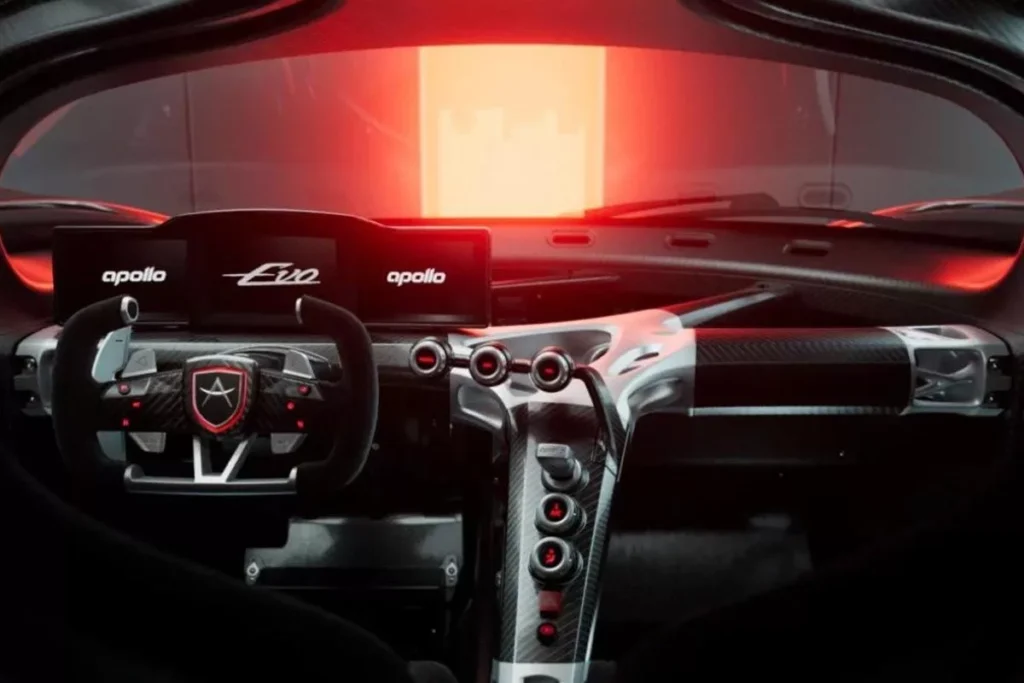
And the big one: this car is a sculpture. A thousand hours of paint. A colour-shifting exhaust. Diamond Dust. Solid-milled aluminium. All of it is wonderful, and all of it is precisely the vocabulary of an object bought to be looked at. Of the ten built, how many will see a genuine track session? The Intensa Emozione also had ten units. One of them turned up at auction with 340 miles on it, the interior stripped out and part of the fuel system removed, after the owner’s bespoke project stalled halfway.
Three hundred and forty miles. In its entire life.
That’s what happens to these cars. And it’s infuriating.
What the Caribbean Dragon actually means
In July 2026, with the industry knee-deep in mandated electrification, with regulators tightening dates, and with nearly every major manufacturer explaining why their new two-and-a-half-tonne machine is somehow a sports car, a German firm owned by a Hong Kong jewellery holding has produced a naturally aspirated 6.3-litre V12 revving to nine thousand, dropped it into 1,300kg of carbon, pressed 1,350kg of downforce onto it, and bolted on a 3D-printed titanium exhaust that turns blue as you use it.
Ten units. Three million each. Not homologated. No lap times to back it up. Nobody in the press has driven it yet.
It is, technically, indefensible.
And it’s glorious.
Because there’s one thing this car does that no sustainability report will ever do: it exists as evidence that somebody’s hands still shake. A thousand hours painting a car. A hundred and twenty-three hours printing an exhaust. A V12 nobody needs, in a chassis you can’t register, for ten men who probably won’t use it.
None of it makes sense. Which is exactly why it deserves celebrating.
Twenty years from now, when all of this is history and cars drive themselves, someone is going to fire up one of these ten. That V12 will climb to nine thousand. And the noise coming out of that scaled titanium exhaust will explain, without a single word, everything we gave away.
Check you’re still alive.