Ferrari 456: The Station Wagon Maranello Erased
When Ferrari launched the Purosangue, half the planet reacted the same way: the company was betraying its essence by building a family car.
Ferrari had already built a station wagon. And a four-door saloon. And a four-seat convertible. All on the same platform, in the 1990s, with the factory’s express consent. And it mentions this nowhere.
The car is the 456, and its entire history is made of things Maranello would rather you did not know.
Michigan built the gearbox
Start with the part that matters most to an American reader, because it closes a loop.
In March 1996, at the Geneva show, the 456 GTA arrived with a four-speed automatic transmission. Ferrari developed it in partnership with FF Developments, a company based in Livonia, Michigan, later acquired by Britain’s Ricardo. And here is the detail that finishes it: the gearbox was designed and built around General Motors internals.
Twenty years after buying the Turbo-Hydramatic out of the Cadillac parts bin for the 400, as we covered in that article, Ferrari again fitted an automatic with General Motors hardware inside to a twelve-cylinder car. This time with bespoke development wrapped around it, but the core of the mechanism came from the same place.
Ferrari mounted it alongside the rear differential to protect the weight distribution, and added electronic management that adapted itself to driving style and made a conventional kick-down unnecessary. It worked: 0 to 62 mph came in two tenths behind the manual and top speed dropped by one mile per hour.
It was the second and last hydraulic torque-converter automatic Ferrari has fitted to a road car. That lineage starts with the 400 in 1976 and ends here. Everything after it was paddle-shifted, which is the story we told in the F355 and the 599 pieces.
Three years without a four-seat twelve
The gap this car fills is the one we flagged in the 400 article. When the 412 left the market in 1989, Ferrari had no twelve-cylinder 2+2 in the catalog at all, and stayed that way for three years. A customer needing four seats had the Mondial, with its mid-mounted V8 and a reputation much of the industry treated with contempt.
The 456 GT was announced in September 1992 and arrived at the worst possible moment: the early-1990s recession, with markets across the world stalled and Ferrari in the condition we described in our F355 piece.
And the launch detail sticks with you. It was not held at a motor show. It took place in Brussels and at Spa-Francorchamps, during the celebrations for the fortieth anniversary of Garage Francorchamps, the brand’s Belgian distributor. The public debut at the Paris show followed a month later.
Ferrari chose a dealer’s birthday party to unveil its new car. That says plenty about commercial priorities at the time.
The name goes back to the Daytona system
The 456 is the displacement of each of the twelve individual cylinders, adding up to 5,474 cc in total. It is the same criterion as the Daytona and the 400.
That is the eighth entry in this series on how Maranello names things, and the third to use this system. Daytona by single-cylinder displacement, 512 BB by liters and cylinders, F355 by liters and valves, 360 by total capacity plus a city, 599 by capacity divided by ten plus a racetrack, 612 by rounded capacity plus a coachbuilder, 400 back to the Daytona system, 550 by liters plus a town. And the 456 by cylinder again.
Camardella, the Daytona and the last pop-up headlights
Pietro Camardella signed the design at Pininfarina, under Lorenzo Ramaciotti, with the interior by Maurizio Corbi. Camardella is the man who had drawn the F40, the 512 TR and the Mythos concept, and who would later do the F50.
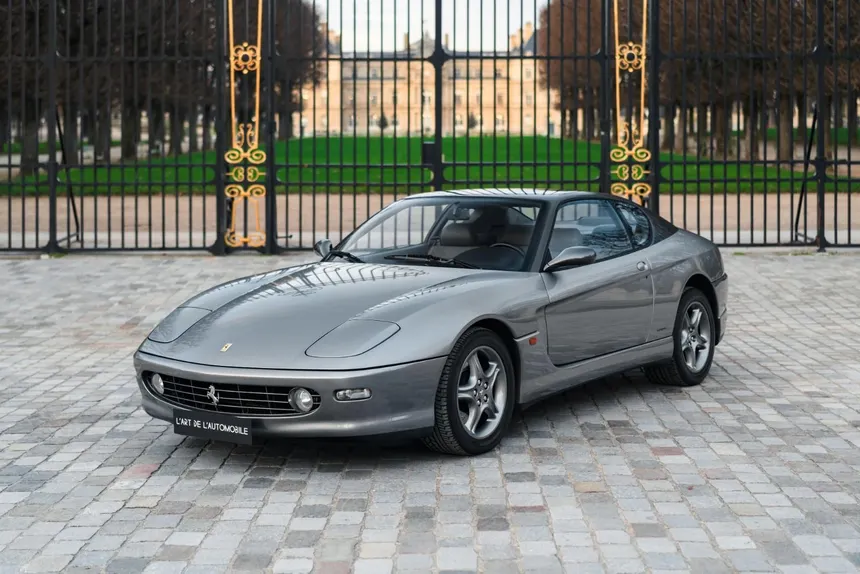
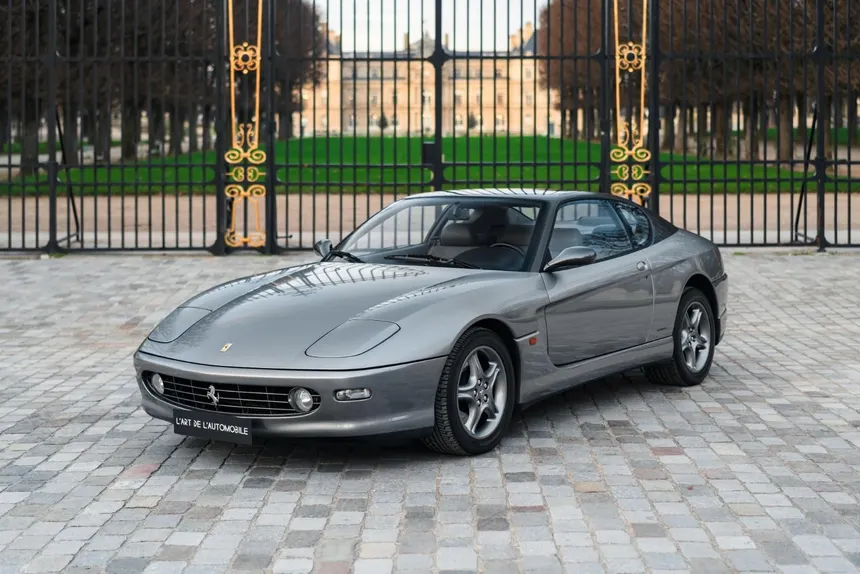
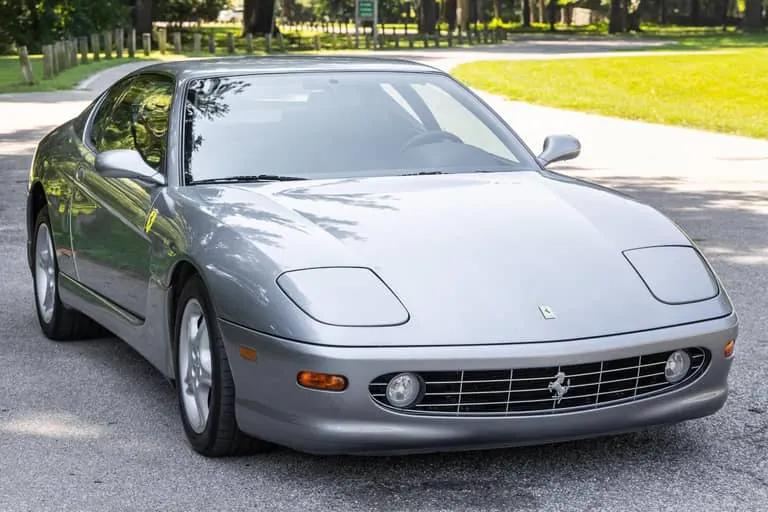
His 456 abandons the straight, angular lines of the 412 for curved, fluid forms, with an obvious nod to the Daytona: the long hood with a vent on each side, the C-shaped undulation starting behind the front wheel, the round taillights and, above all, the pop-up headlights.
Those headlights carry a historical weight that rarely gets mentioned. The 456, in its 456M form, is the last Ferrari ever built with pop-up headlights. That solution, which defined the brand’s face from the Daytona onward, ended with this car.
Steel, aluminum and a foil that welds the unweldable
The construction deserves explaining because it solves a real problem.
The chassis is a tubular steel space frame with substructures carrying the mechanical components and bodywork. The body panels are aluminum. And there is the problem: steel and aluminum cannot be welded directly to each other.
The answer was Feran, a specially treated foil laid between the two metals that allows a sandwich-type joint. With it Ferrari kept the rigidity of steel and the lightness of aluminum in the same car. The hood is single-piece composite with carbon fiber reinforcement and aluminum honeycomb. The doors are aluminum with a steel frame inside for side-impact protection.
The suspension uses four model-specific Bilstein dampers, electrohydraulically operated under electronic control, with three programs selectable from the dashboard: soft, medium and hard.
And in the rear bumper sits a retractable spoiler that deploys on its own above roughly 65 mph and varies its angle of attack with speed. Downforce without breaking the line, which is the precise opposite of what the competition was doing in those years.
The engine does not come from where you think
Here is a technical fact that changes how you read the car.
The 5,474 cc V12 is entirely new and sits at 65 degrees, not 60. Its architecture derives from the Dino V6, not from the traditional twelve-cylinder engines used in the 412 and the Daytona.
Which means the twelve-cylinder grand tourer that returned Ferrari to tradition carries an engine rooted in the car Enzo refused to badge. It makes 442 hp at 6,250 rpm and 550 Nm at 4,500.
With that, the 456 cleared 300 km/h. Roughly 48 km/h more than the 412 it replaced, which in grand tourers is an enormous generational jump. Sources vary between 302 and 309 km/h depending on version and publication, and Ferrari simply says it exceeds 300. What every source agrees on is the consequence: at launch it was the fastest production four-seater in the world, at 188 mph.
The 456M and the end of a silhouette
In March 1998, again at Geneva, the 456M arrived, the M standing for Modificata. Ken Okuyama signed the update at Pininfarina.
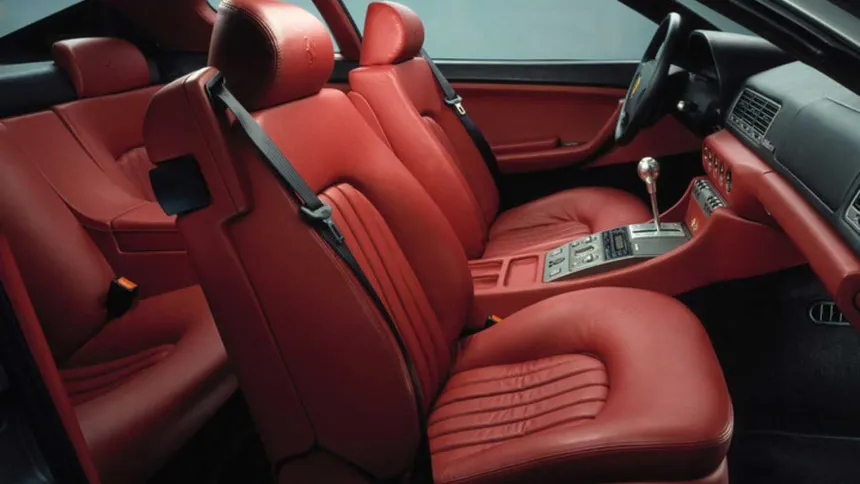
The changes went to aerodynamics and cooling, with a larger grille feeding the engine better, a revised rear diffuser and a cleaner nose. Inside, new seats, fewer gauges and a Becker sound system. The 456M’s hood was the company’s first application of carbon fiber for that panel.
And one change I read as a step backward: the powered spoiler disappears, replaced by a fixed unit integrated into the bumper.
Production closed in 2003, and in 2004 the 612 Scaglietti we have already covered took over. The numbers: 1,548 units of the 456 GT according to Ferrari’s own archive, and around 3,289 counting every variant through the end of the 456M. Pininfarina built 1,435 bodies until 1996, when production moved to Ferrari’s own facilities.
Brunei, or the catalog Ferrari does not show
Now the part that gives this piece its title.
The Brunei royal family assembled a car collection whose size has never been pinned down, and it included several 456s. The coupe was not enough, so Pininfarina was commissioned to build bodies Ferrari did not sell. The estate was ordered by Prince Jefri Bolkiah, the Sultan’s brother, according to the specialist coachbuilding sources.
Pininfarina built them, with Maranello’s express consent. Three distinct body styles emerged under the Venice name.
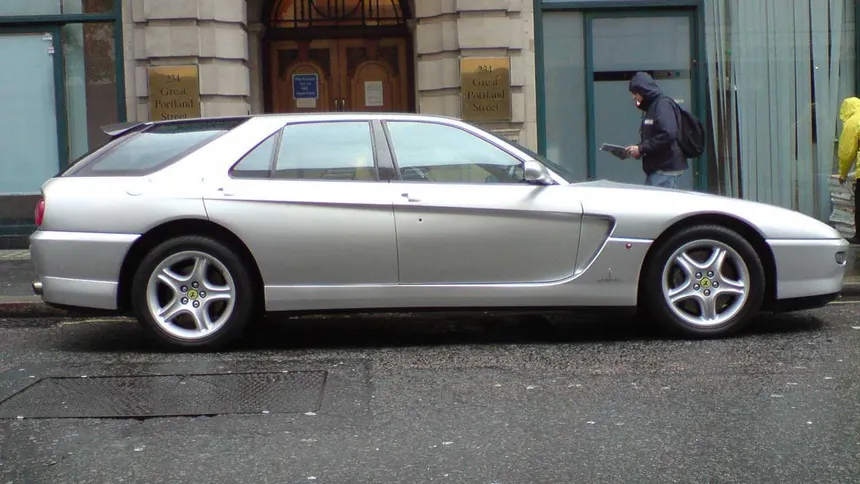
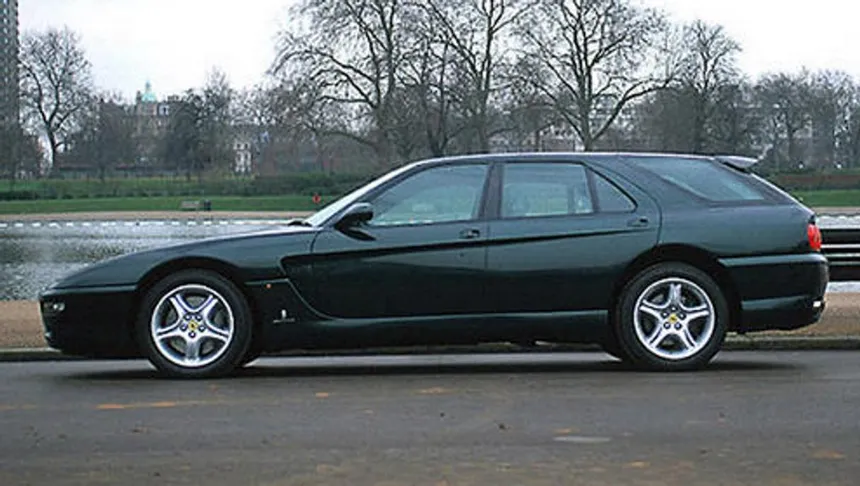
The 456 GT Venice Estate is a five-door wagon: two front doors, two added rear doors and a tailgate. Seven were built, all right-hand drive. Prince Jefri kept six, and the seventh, in silver, ended up with a British collector. It is, strictly speaking, the first station wagon in Ferrari’s history.
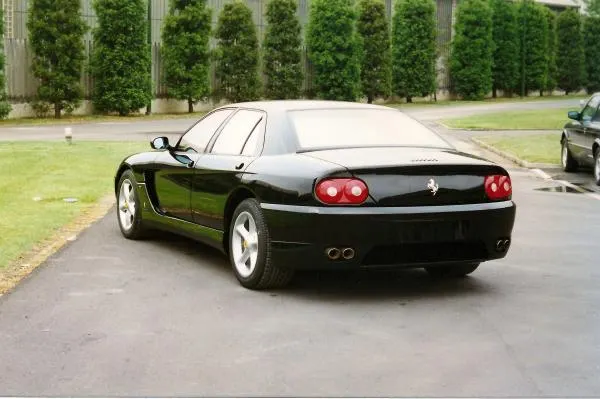
The 456 Venice Saloon is the long-wheelbase four-door sedan. Here the sources disagree on the count: some say three cars, others four, others seven, and they do not agree on the colors either. I am flagging that the figure is open.
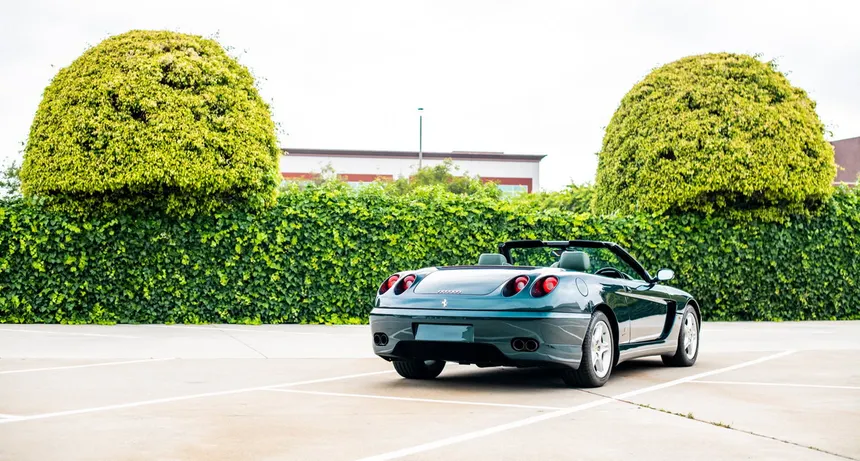
And the 456 Venice Convertible, also called the 456 GT Spider, of which Pininfarina built two, one red and one green. Converting the coupe required completely redesigning the tail, and the roof was adapted from a Mercedes-Benz SL.
Add it up: seven estates, two convertibles and between three and seven sedans. Thirteen cars according to the sources that agree with each other.
There was also a run of conversions built in California on private customers’ cars, one of them for boxer Mike Tyson. Sources disagree on which body they reproduced: some describe estate replicas, others describe convertibles. The discrepancy stands flagged.
What the gray market did not have to fix here
One note for American buyers, because it sets this car apart from the earlier twelves in this series.
Unlike the Berlinetta Boxer and the 400 family, which Ferrari never certified for the United States and which arrived one car at a time through private importers, the 456 was sold here through official channels. That changes what you are checking. On a Boxer you are establishing what an importer did to the car in 1979. On a 456 you are reading service history and nothing more exotic than that.
It also means US-specification cars are not a compromised subset of the model. They are the model, with the same Feran-bonded body, the same Bilstein damping and the same Michigan-built automatic in GTA form. The only thing worth confirming is which gearbox you are buying, because that single letter moves the price more than mileage, color or condition will.
Why the GTA is cheap
If you want the most affordable way into a four-seat Maranello twelve-cylinder, it is here, and the reason is exactly what makes a manual 599 expensive: the lever.
The market rewards the 456 GT with its gated manual and punishes the automatic GTA, and the gap is considerable even though the automatic is good, well executed and does not spoil how the car behaves. The product is not being penalized. The letter at the end of the badge is.
There is a clear opportunity there for anyone who wants to drive rather than collect. With the usual caveat for this brand: buying the capital cheaply does not reduce a Maranello twelve-cylinder’s invoices by a dollar.
The verdict
The 456 is the Ferrari that did everything Ferrari swears it does not do.
It bought its automatic gearbox in Michigan with General Motors hardware inside, twenty years after buying one out of the Cadillac parts bin. It used an engine derived from the Dino, the car Enzo refused to badge. And it allowed Pininfarina to build a five-door station wagon, a sedan and a convertible on its platform, everything the company had spent decades swearing it would never build.
Then the Purosangue arrived and we got two years of outraged articles about the betrayal of the brand’s essence. Ferrari never came out and said the obvious, that it had already done a station wagon in the nineties and that the same house which drew its sports cars had designed it. It let the outrage run, because outrage sells and historical consistency does not.
That is the part of this story that interests me. Not that Ferrari has done strange things, because it always has. It is that Ferrari deletes them from the record when convenient and brings them back thirty years later as a revolution.
The 456 has spent twenty years as the cheapest twelve-cylinder Ferrari on the market, and it is probably the one with the most to say.
What else has Maranello done that Maranello has decided to forget?
Check you’re still alive.