Lamborghini Urraco, Silhouette and Jalpa: Eighteen Years of a V8 That Never Sold
Lamborghini spent eighteen years trying to sell a small eight-cylinder sports car. Between the Urraco, the Silhouette and the Jalpa it managed roughly 1,255 cars.
Ferrari, in the same segment with a single model, sold more than twelve thousand 308s.
That is the whole story of Sant’Agata’s V8, and it is worth telling in full because it explains how the company ended up in other people’s hands.
The brief: a Lamborghini for people who could not afford a Lamborghini
The idea was sound. By the late sixties the mid-engined sports car market was opening up from below: Ferrari had the Dino, Maserati was preparing the Merak, and Porsche was selling 911s by the trainload. Sant’Agata only knew how to build ruinously expensive twelve-cylinders.
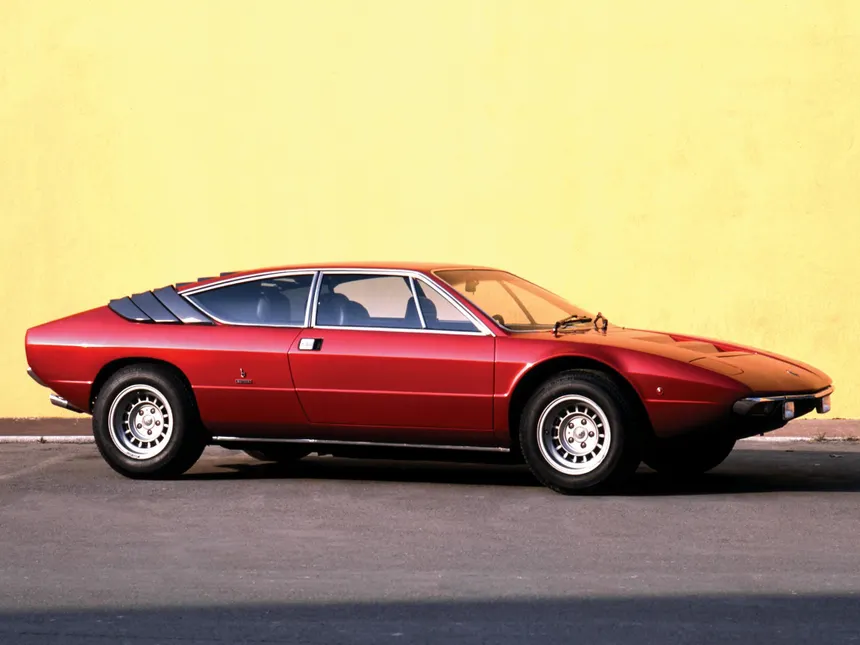
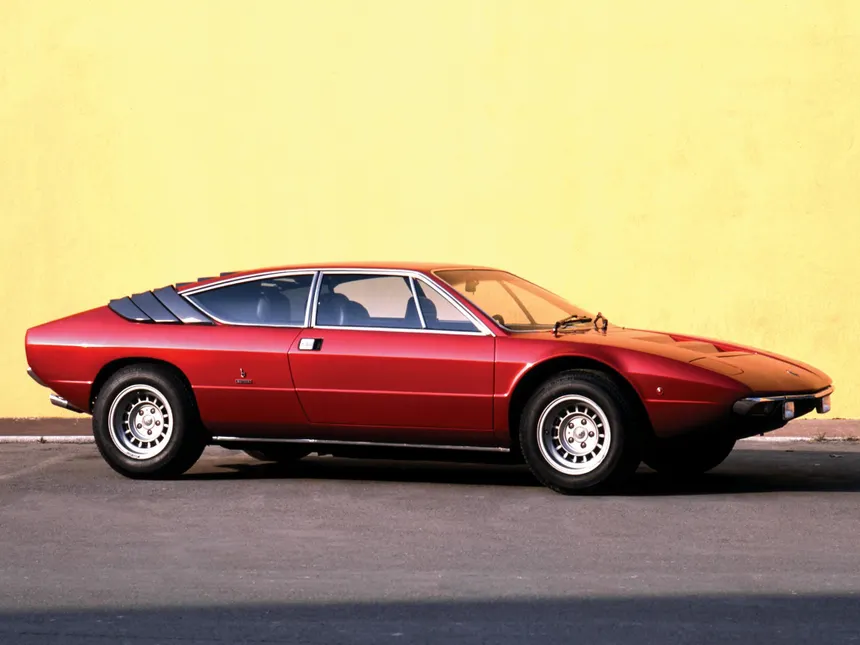
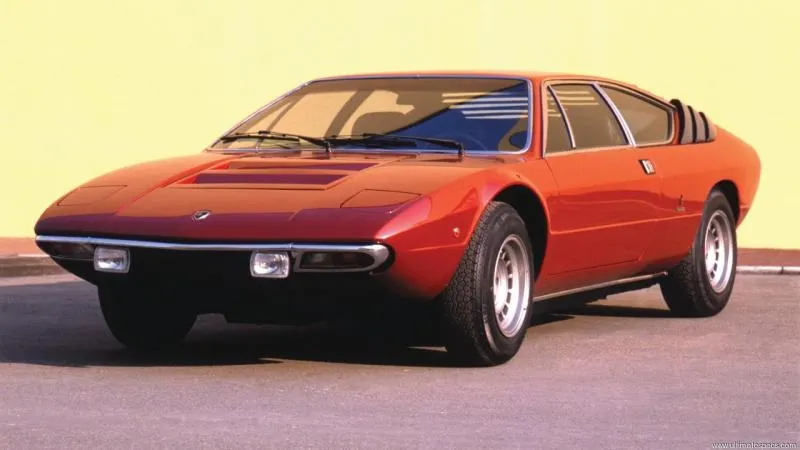
The Urraco appeared as a prototype at the Turin show in November 1970, designed by Marcello Gandini at Bertone. A mid-engined 2+2 with the V8 mounted transversely, 4,250 mm long, 1,160 tall, and 1,250 to 1,300 kg.
Then the worst thing that can happen to a car happened: it did not arrive. Production did not start until November 1972. Twenty-four months exactly between the applause at the show and the first invoice. Two years in which the buyer who fell in love in Turin bought something else.
By the time deliveries began, the world was about to change with the oil crisis. The timing was not bad luck. It was a company unable to industrialize on time what it showed on a stand.
Two bulls and an outlier
The names are worth a line, because they are not marketing noise. Urraco means “little bull”, the name given to a breed of smaller but notably fierce fighting bulls. Jalpa comes from Jalpa Kandachia, another well-known Spanish fighting-bull breed. Silhouette is the odd one out in the trio — and also the one that sold almost nothing.
Even at its lowest point, with the accounts bleeding and an entry model nobody wanted, Lamborghini kept drawing its vocabulary from the Spanish bullring. It was the one piece of identity the company held on to while everything else changed hands.
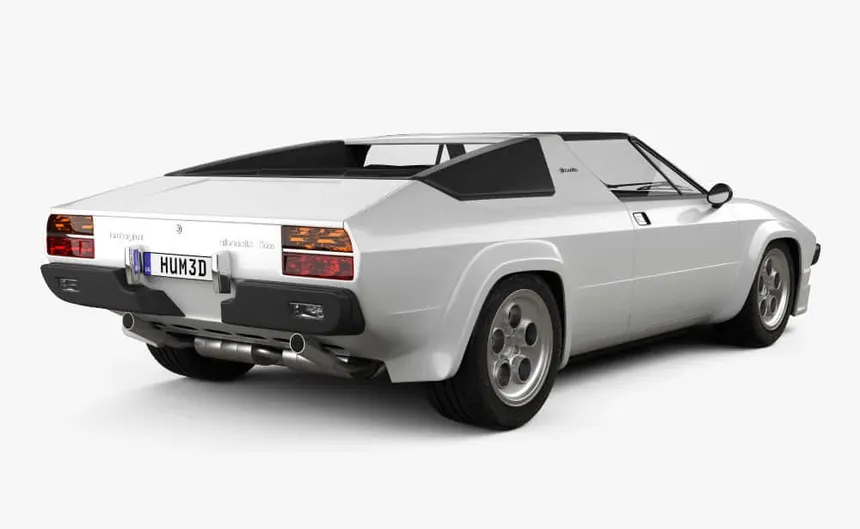
An entire new engine, for nothing
The painful part is that the Urraco was no parts-bin job. Lamborghini developed a completely new V8 for it.
The P250 had 2.5 liters with a single overhead camshaft per bank and 220 horsepower at 7,500 rpm. Five-speed manual. The P300 followed with three liters, twin cams per bank and 250 horsepower, also at 7,500. Measured figures for the P250 run to 149 mph and 0 to 62 mph in 6.7 seconds at 1,300 kg.
For a company the size of Sant’Agata, with the V12 already in the catalog and its own gearbox only a few years old, developing a whole engine from scratch for the entry model was an enormous bet. The P250 accounted for 520 cars, including 21 P111s built for the United States. The P300 added 190.
The plan was a thousand cars a year
One figure measures the disaster precisely, and it rarely gets put on the table.
The Urraco was conceived to be built at a thousand units a year. Its best year was 1973, at 285 cars. It never came close, and the entire model across three versions and seven years stopped at around 791.
Underneath, it was a steel monocoque with a 2,450 mm wheelbase, laid out to carry the engine transversely as the Miura did, with all-independent suspension by MacPherson struts, coil springs and telescopic dampers.
That deserves explaining, because MacPherson struts are unusual in a mid-engined sports car of the period. They are more compact and considerably cheaper to build and assemble than the double wishbones used by the Miura, the Espada and the Jarama. Sant’Agata did not choose them out of engineering conviction. It chose them because the Urraco had to be cheap to produce to sell at a thousand a year. That is an accounting decision dressed as engineering, built into the model that was supposed to save the company.
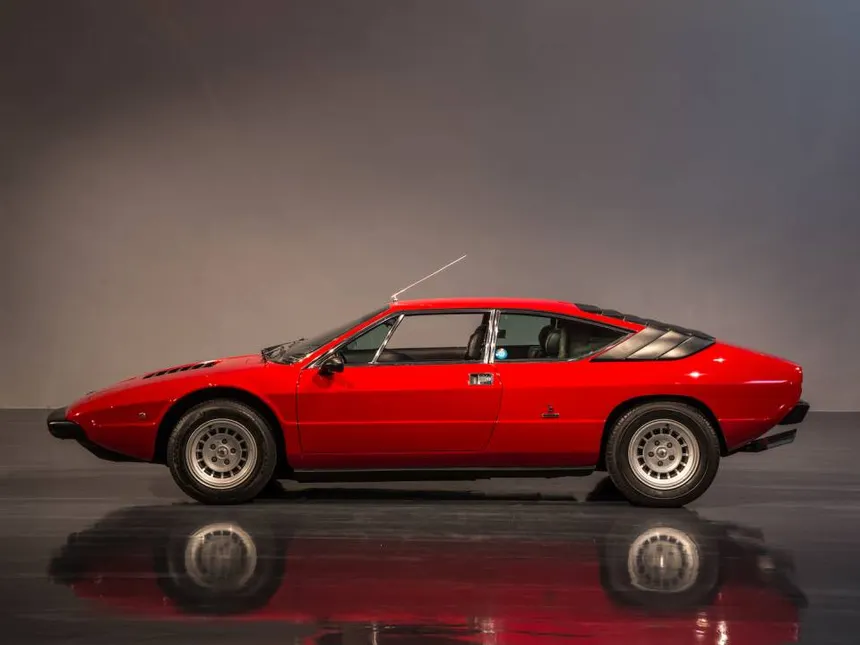
Gandini versus Gandini
And now the part that borders on comedy.
At the Paris show in October 1973, Ferrari unveiled the 308 GT4. A mid-engined transverse 2+2, 2.9-liter V8 with 255 horsepower in European trim, bodied by Bertone and designed by Marcello Gandini. The only production Ferrari ever bodied by Bertone.
The same designer, the same design house, the same mechanical layout, the same segment and effectively the same years. Journalists of the day compared the two cars for their stylistic likeness, and that likeness hurt the Ferrari’s reception.
Ferrari built 2,826 308 GT4s between 1973 and 1980, plus 840 208 GT4s. Lamborghini built 791 Urracos in total.
Same pencil, same concept, and the Ferrari sold more than three times as many. When the product is nearly identical and the result looks like that, the problem is not the product.
The Lamborghini that existed because of a tax bracket
This is the detail that captures the whole era.
Italy applied 38 percent VAT to cars with engines over two liters. So Lamborghini built a version of the Urraco underneath that line: the P200, with exactly two liters and 182 horsepower at 7,500 rpm, for the Italian market only.
A Lamborghini designed around a tax threshold. Not around a driving idea, or a race, or a founder’s whim. Around a percentage set by the treasury.
Between 66 and 77 were built, depending on the source. Even that maneuver failed.
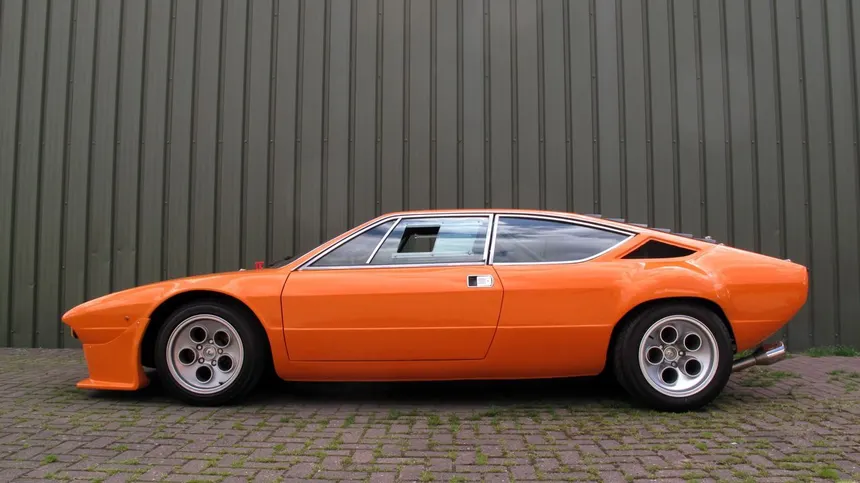
The Urraco Bob Wallace turned into a weapon
The best story in this saga, as always with this marque, belongs to the test driver.
Bob Wallace built the Urraco Bob in 1973. It was the third and last of the factory-sanctioned hot rods, after the Jota of 1970 and the Jarama RS of 1972.
He took the engine from 2,463 to 2,997 cc by lengthening the stroke. He added dry-sump lubrication, a front oil cooler, larger Weber carburetors and an experimental four-valve cylinder head. Off came the front bumper; on went a huge integrated front spoiler and an adjustable rear wing on the engine lid. Plexiglass windows, black anodized window frames, twin unsilenced megaphone exhausts.
The result: around 310 horsepower, ninety more than a P250, in a car under 1,100 kg. Expected figures were roughly 170 mph and under five seconds to 62 mph.
It never raced. For two documented reasons: Ferruccio Lamborghini‘s opposition to motorsport, and the fact that the Urraco was not built in sufficient volume to homologate under racing regulations.
The strongest sporting argument the V8 range ever had sat still because the company neither wanted to race nor sold enough cars to be allowed to.
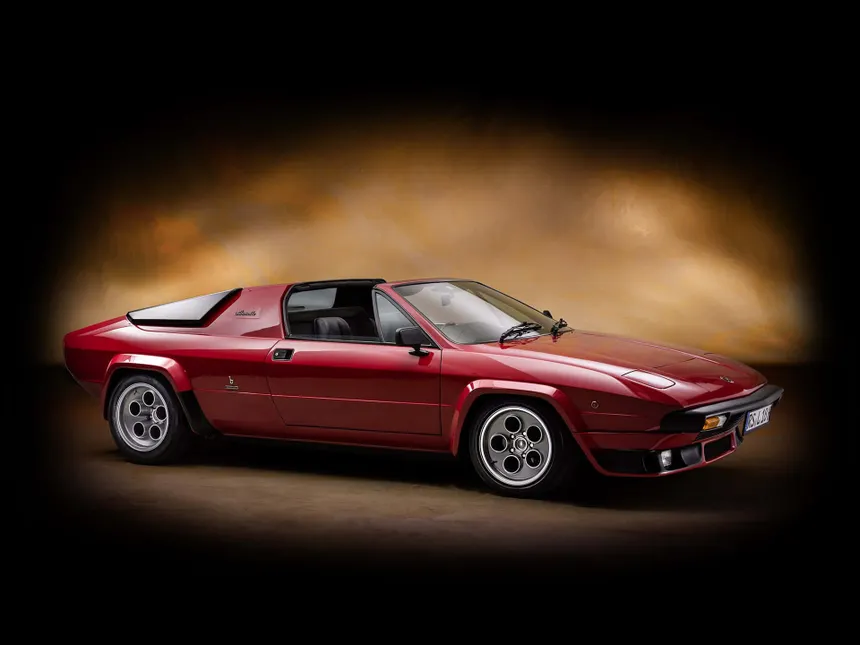
Silhouette: 54 cars and no way into America
At the Geneva show in 1976, Bertone presented the rescue attempt. The Silhouette was a restyle of the Urraco P300, more angular, again signed by Gandini.
It used the all-alloy 2,997 cc V8 mounted transversely, with 265 horsepower and 275 Nm. It measured 4,320 mm long, 1,880 wide and 1,120 tall, weighed 1,240 kg dry and delivered 0 to 100 km/h in 6.5 seconds with a 260 km/h top speed.
Two details make it historically significant. It was the first Lamborghini with a targa roof. And it introduced the latest-generation Pirelli P7 tires, 285 mm wide at the rear on wheels that grew from 14 to 15 inches and reached eleven inches of width at the back.
A brilliant spec sheet. Commercial result: 54 cars, 42 left-hand drive and 12 right-hand drive. Other sources count around 52 over two years. Between 27 and 31 are known to survive.
The main reason is the one that should stop any American reader cold: the company never managed to certify the car for sale in the United States, which was precisely its natural market. On top of that, its finances were so weak that the factory could not convince customers a Silhouette was a sensible purchase.
Selling a 265-horsepower sports car in the second half of the seventies without access to the American market is playing with half the field missing.
Jalpa: the one that nearly worked, arriving late
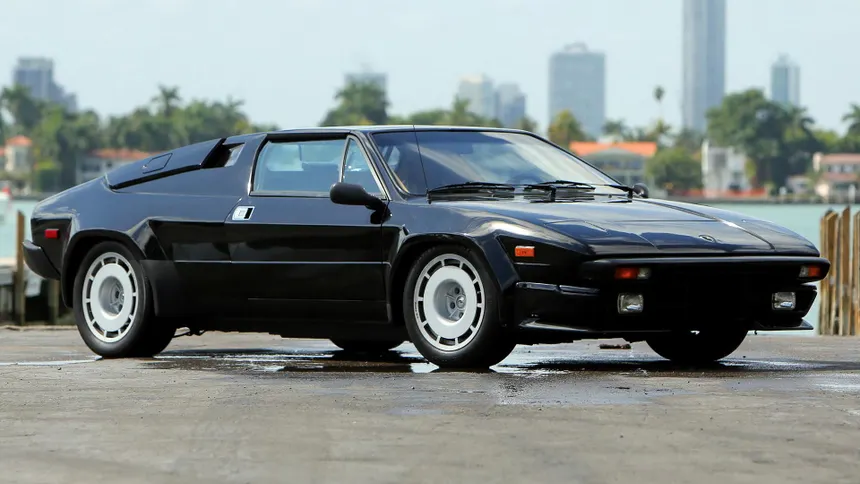
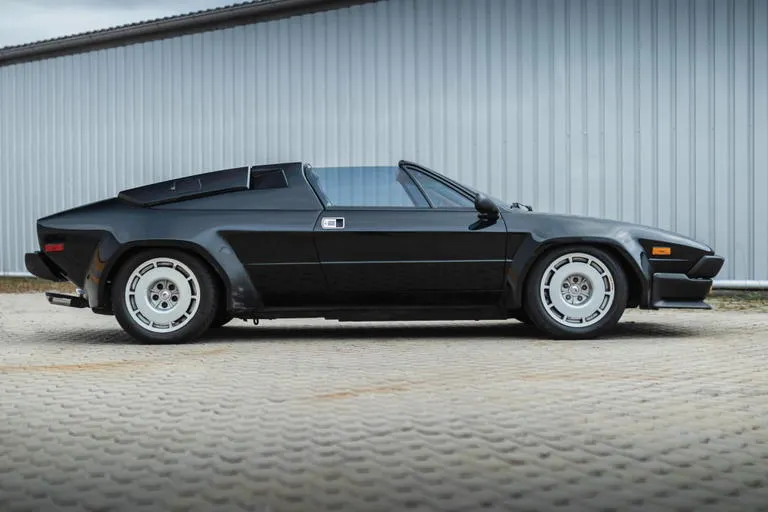
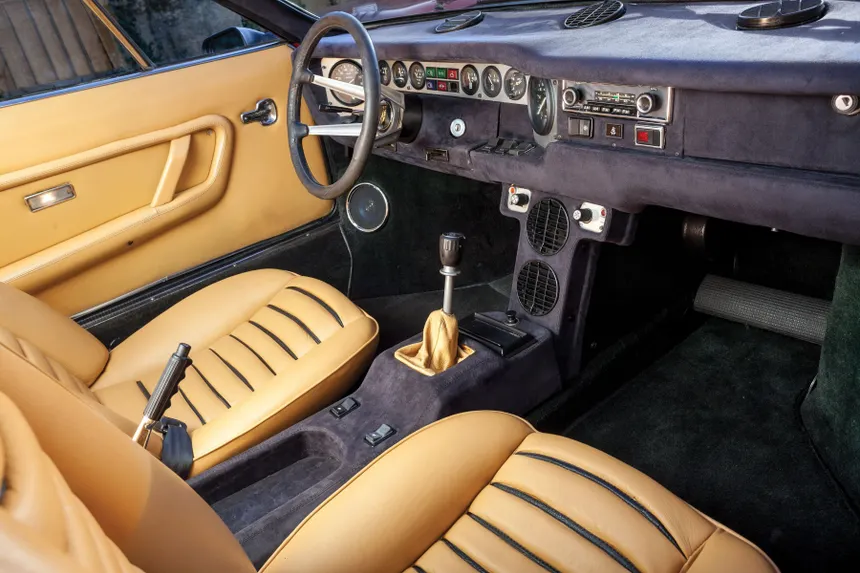
The last attempt appeared at the Geneva show in 1981. The Jalpa was based on the Silhouette, restyled by Marc Deschamps at Bertone.
The V8 grew to 3,485 cc for 255 horsepower in European trim and 250 in US specification. Official figures claimed 6.0 seconds to 100 km/h and 249 km/h — 155 mph; Car and Driver measured 5.8 seconds to 60 mph. Weight rose to 1,510 kg.
And finally something half worked: 410 cars between 1981 and 1988, more than the Urraco P300 and the Silhouette combined. It even got its screen moment, with a 1984 Jalpa P3500 appearing in Rocky IV, released in 1985.
But four hundred cars in seven years is still a rounding error. Production ended in 1988 with sales falling and the company already under Chrysler control.
Eighteen years after that Turin prototype, Sant’Agata gave up on the eight-cylinder.
The comparison that explains everything
What is missing is the direct rival, placed alongside.
The Ferrari 308 GTB was introduced at the Paris show in 1975, with a 2.9-liter V8 and 255 horsepower in European trim. Maranello built it through 1985 in all its variants: 2,897 GTBs and 3,219 GTSs in the first phase, 494 GTBis and 1,743 GTSis with fuel injection, and 748 GTBs and 3,042 GTSs in Quattrovalvole form.
Add it up and the 308 passes twelve thousand cars in a decade.
The Urraco, Silhouette and Jalpa together, over eighteen years, stop at about 1,255. Ferrari sold nearly ten times as many with one model, in less time, with a similar-capacity engine, in exactly the same segment.
It was not because the Ferrari was the better car on paper. It was because it was available, certified and in showrooms — and because a 308 GTS became the car Tom Selleck drove every week on Magnum, which half of America watched. The Silhouette could not even be sold in that country.
It was not short of engineering, it was short of company
The legend says Lamborghini nearly died because of the oil crisis. The crisis was real and it squeezed everybody, but it squeezed Ferrari too, and Ferrari sold ten times more.
Lamborghini nearly died because it took two years to get from prototype to customer, because it built an entire version of a model to dodge an Italian tax, because it could not certify its mid-range sports car in the largest market on earth, and because by the time it finally got the product right with the Jalpa, it had lost a decade and was changing owners every few years.
The talent was never the problem. A V8 developed from scratch. The marque’s first targa. P7s before anyone else. And a test driver who could find 310 horsepower and remove 150 kilos in a workshop, with no race to take it to.
That is the real tragedy of Sant’Agata in the seventies: it was not short of engineering, it was short of company. Forty years on, the factory sells the Urraco as a charming curiosity in its anniversary posts, without mentioning that it was the model that was supposed to save the place and could not.
Some marques die from building bad cars. This one nearly died from being unable to deliver them.
Check you’re still alive.