Zenvo Aurora: 1,850 horsepower and a V12 that spins to nearly 10,000 rpm
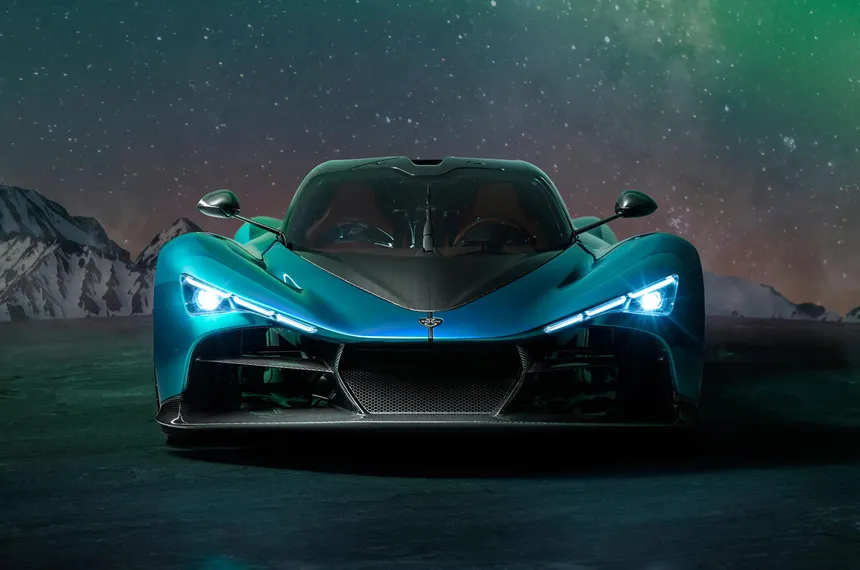
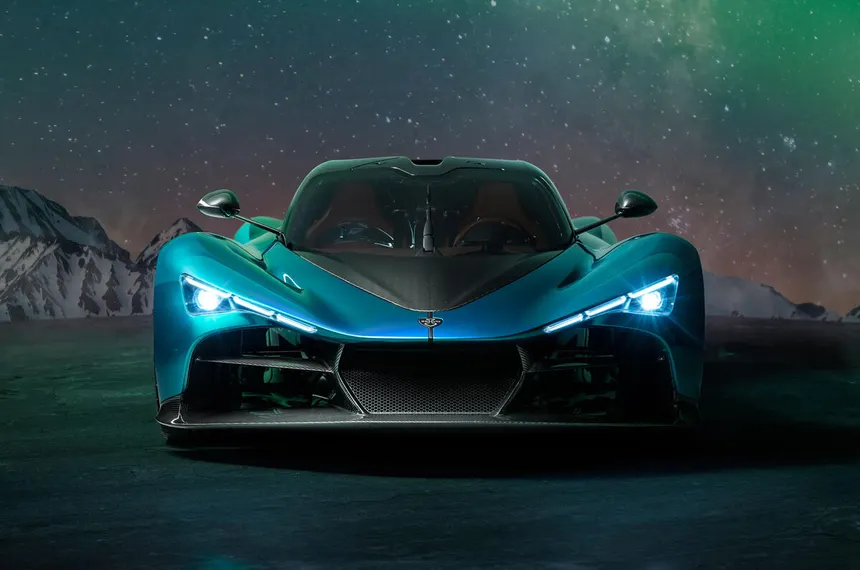
Every few months another hypercar turns up promising to move heaven and earth, then settles for a borrowed engine and four round numbers. The Zenvo Aurora isn’t that. It’s a car designed from a blank sheet, with an engine built specifically for it, and with two personalities so different they almost read as two cars. The name is no accident either: it’s borrowed from the aurora borealis, the northern lights, a nod to the brand’s Scandinavian roots and to a car meant to be light and fast rather than heavy and brutal. Let’s take it apart piece by piece, because there’s a lot more here than the 1,850-horsepower headline.
The Mjølner: a V12 like almost nothing else
Start with the engine, because it’s the jewel and because Zenvo didn’t take the easy road. The easy road, for a small maker, is to buy a V8 or a V12 from a supplier and adapt it. Zenvo commissioned a new one, named Mjølner after Thor’s hammer. It’s a 6.6-liter V12, twelve cylinders in a 90-degree vee, and its strangest feature is where the turbos live.
There are four of them, and instead of sitting outside the engine, as is usual, they’re tucked into the angle formed by the two banks of cylinders, in the valley of the vee. That’s called a hot-V layout, and it isn’t a gimmick. Putting the turbos there shortens the path the exhaust gases travel from the cylinders to the turbines, and that makes the turbos react sooner, with less delay between your right foot and the shove. The price is thermal: you’ve got four turbines glowing red right in the center of the engine, a fiendish heat problem to manage. That Zenvo walked into that thicket says plenty about what it was chasing: instant response, the feel of a naturally aspirated engine despite the forced induction.
The block is all aluminum and weighs around 260 kilos, roughly 573 pounds, remarkably low for a twelve of nearly seven liters. And it revs to 9,800 rpm, a race-engine ceiling most road V12s never approach. On its own, with no electric help, it’s rated at 1,250 horsepower. Zenvo developed it with MAHLE Powertrain, the engineering arm of the German components giant, and it’s the foundation everything else is built on.
That sky-high redline isn’t there to look good on paper. An engine’s power is torque multiplied by rpm: if you can spin a motor faster while keeping the cylinders filling well, you make more horsepower without more displacement. Reaching 9,800 rpm with twelve pistons, their rods and their valves flinging around without tearing themselves apart demands race-grade materials and tolerances, because the forces on the parts grow with the square of the rpm: double the revs and you don’t double the stress, you quadruple it. That a road engine, meant to last and to start every morning, holds together up there is exactly the hard part, and it’s where you see whether there’s real engineering or just a marketing figure. The noise, incidentally, is a byproduct of the same thing: a V12 climbing to nearly 10,000 rpm is one of the few sounds left that can stand your hair on end.
Worth pausing on the headline you’ve read everywhere: the most powerful V12 in the world. True, but read the fine print. It’s talking about twelve cylinders in a vee. A Bugatti Chiron makes 1,600 horsepower from its combustion engine with no electric help at all, but that’s a W16, a different architecture. An Aston Martin Valkyrie has a 1,000-horsepower naturally aspirated V12, the reference among twelves until now. The Mjølner, with that 1,250 target, edges ahead within its family. Step outside it and there are wilder combustion engines. The feat is real, but it’s fenced into a specific category.
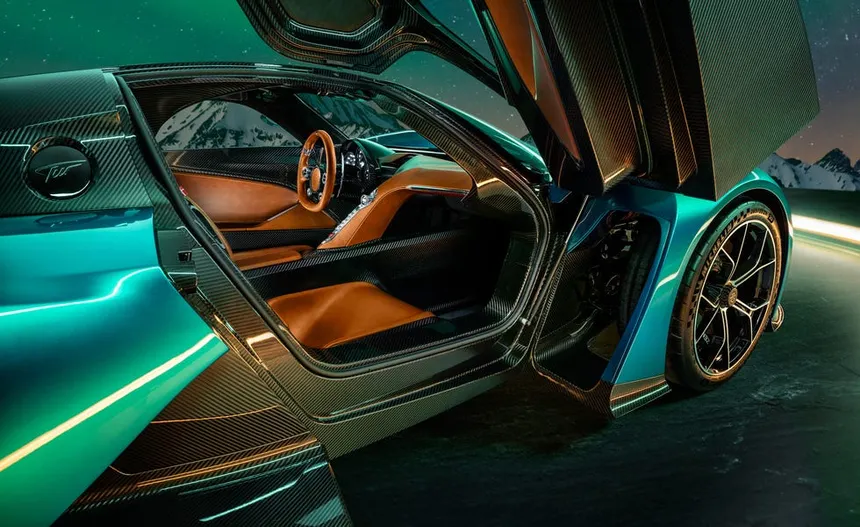
Two cars, one heart: Agil and Tur
The 1,850 horsepower on the spec sheet isn’t just the V12: it’s the V12 plus the electric motors. And here Zenvo does something interesting, because it doesn’t sell one car with two trims, it sells two cars with opposite philosophies that share an engine.
The Tur is the grand tourer. It runs all-wheel drive thanks to three electric motors, two on the front axle and one built into the gearbox, and with them it reaches 1,850 horsepower. It’s the big-number car: 0 to 62 mph in 2.3 seconds and a target top speed of 280 mph, a figure to treat as a development goal rather than a homologated or verified top speed. It’s built to swallow highway and to leave the driver intact after hundreds of miles. If it’s reached, that figure would put it among the fastest hypercars in the world, ahead of most, which top out around 220 mph. Those two front electric motors, moreover, aren’t only there to add horsepower: by braking and driving each front wheel independently, they help turn the car into a corner, something a heavy grand tourer appreciates.
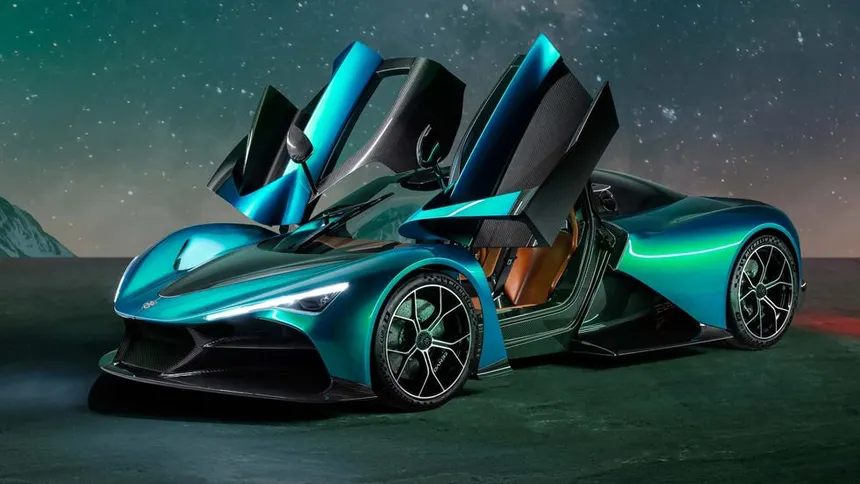
The Agil is the track car. It gives up all-wheel drive and keeps rear drive, with a single 200-horsepower electric motor coupled to the rear end, for 1,450 horsepower total. On paper it has less power and a lower top speed, but that’s not its game. Its game is the corner. It wears a far more aggressive aero package, with a huge rear wing that at 155 mph generates close to 1,940 pounds of downforce, roughly the weight of a small car pressing it into the asphalt. Less weight, more grip, more precision. It’s the one you’d want on a tight circuit; the Tur is the one you’d want to cross a country.
The gearbox is shared: a seven-speed automatic with paddles. And it has a detail worth explaining, because it’s more than a gearbox. It houses an electric motor-generator that fills the torque gap during the change, acts as starter motor, and lets the car do without a mechanical reverse gear by reversing the electric motor’s rotation. That torque fill is what keeps delivery from breaking up: the electric motor can cover both the gap that appears during a gearshift and the response lag of the turbos, and the driver feels continuous delivery instead of a shove with a pause in it. It’s the same trick that lets the Aurora behave civilly at low speed and then detonate when you ask for everything: the electric side covers the moment the combustion engine is least willing, so there’s no dead spot to drive around. For anyone raised on big-inch American V8s, where torque is abundant from just off idle, this is the European route to the same sensation by a completely different path, small displacement per cylinder, huge revs, and electricity papering over the gaps.
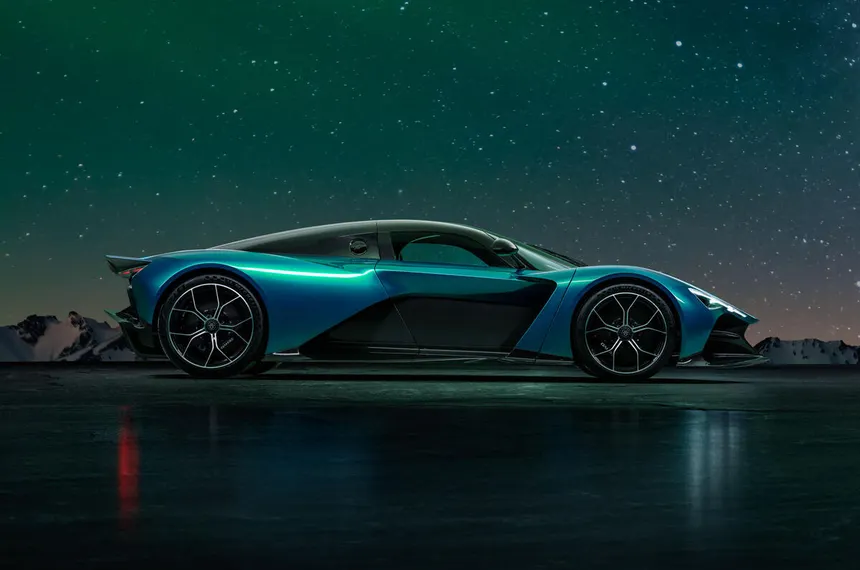
The chassis: why the car weighs what it weighs
A 260-kilo aluminum V12, four turbos, up to three electric machines, batteries, gearbox and suspension all have to mount on something that won’t twist when all of that pushes, and that weighs as little as possible so the acceleration figures aren’t wet paper. That something is the platform Zenvo calls the ZM1, a modular carbon monocoque.
The idea is to integrate the central cabin and the structures that go front and rear to carry engine and suspension into one carbon architecture, rather than the classic scheme of a central tub with two bolted-on metal subframes. Zenvo gives a target rigidity of 63,000 newton-meters per degree between the points where the suspension anchors, with the structure weighing under 120 kilos. In plain terms: that figure expresses how much twisting torque it would take to produce a single degree of deformation between the points where the suspension anchors. And that matters because a chassis that doesn’t flex lets the suspension work with precision; if the chassis bends, it eats part of the dampers’ job and the car turns vague. Worth flagging that these figures are a project target, the word Zenvo itself uses is target, not certified measurements on customer cars, which is normal for a car only now reaching buyers.
The total weight target is what explains the logic of the whole structure: Zenvo quotes figures around 1,300 kilos, roughly 2,866 pounds, for the Agil and about 1,450, roughly 3,197, for the Tur, though those numbers may shift between prototypes, homologation specs and customer cars. They’re remarkably low for carrying nearly seven liters of engine and a full hybrid system. An equivalent metal structure would penalize weight and force compromises elsewhere in the car. The structural development is credited to the Spanish firm Managing Composites, including the carbon architecture, the energy-absorbing crash structures and the exterior panels.
And there’s an aesthetic decision that comes out of that same part: Zenvo leaves much of the carbon on display, in the cabin and in areas of the bodywork, instead of hiding it under paint. It compares it to the open mechanism of a watch. You only show a structural part off like that if you’re sure it’s flawless, because a defect on something visible can’t be covered.
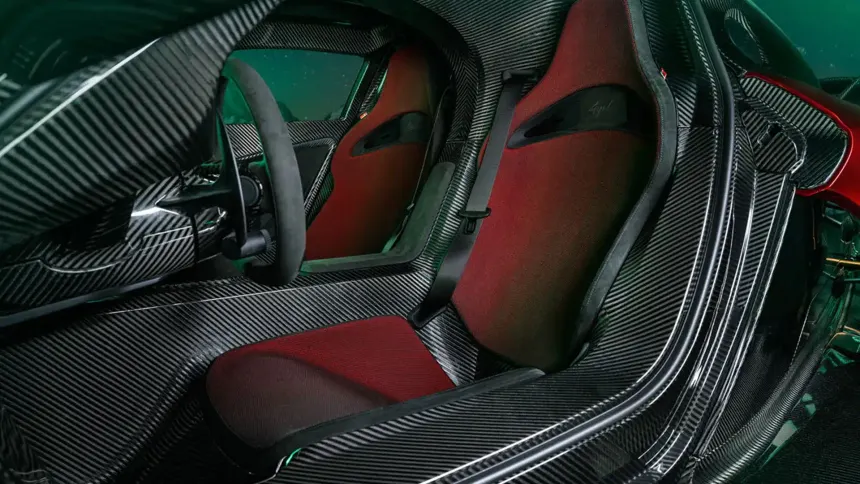
What it promises behind the wheel
Everything above points at one idea Zenvo keeps repeating: connection. The brand insists the Aurora chases a direct, unfiltered feel between driver and asphalt, closer to a motorcycle than to a rolling living room. The mid-mounted engine behind the cabin, the stiff chassis, the driving position integrated into the carbon cell, and the instant response of the hot-V with its electric fill all pull in that direction.
It’s a bold bet in an era when many hypercars chase raw numbers and electronics that do everything for you. The Aurora wants both: the numbers of the hybrid age and the analog feel of an engine that climbs to 9,800 rpm and sounds like twelve cylinders. Whether it pulls it off we won’t fully know until customer cars are running. But the recipe, on paper, is one of the most coherent this crop of hypercars has produced: a bespoke engine, a chassis obsessed with weight, and two versions that don’t overlap.
That leap in ambition makes more sense knowing where the brand comes from. Zenvo made its name for the spectacular more than the good: an ST1 catching fire during a Top Gear test in 2014, attributed at the time to a thermal-management problem, and another fire at an event in 2015. The Aurora is the answer to that, the car Zenvo wants to be taken seriously with, to the point of calling it its second era internally. That’s why the engine is new, the chassis is new and nothing carries over from earlier models. It’s a hand played all in.
Zenvo will build 100 cars, 50 of each version, assembled by hand at its plant in Præstø, south of Copenhagen. Building by hand in such small numbers fits the brand’s industrial scale and positioning, and it’s also what allows the level of finish that leaving the carbon exposed demands. The starting price was announced at 2.59 million euros at launch, roughly 2.83 million dollars, and figures quoted since run higher, around 2.8 million before taxes and options, with heavily specced examples advertised above that. After several changes to the timeline, first customer deliveries are now expected in the second half of 2027. Whoever pays that isn’t buying the horsepower figure, which anyone with a budget can have. They’re buying an engine developed specifically for the Aurora, one it shares with no other production car for now, and a way of driving almost nobody else is attempting.
Check you’re still alive.