Ferrari Pinin: The Car That Proved Enzo Didn’t Run Ferrari
We take one thing for granted that simply isn’t true: that Enzo Ferrari did whatever he pleased at Ferrari. The old man, the patriarch, sole master of the Prancing Horse, deciding by decree what got built and what didn’t. Well, there was one car — exactly one — that exposed that story as a fairy tale. A car Enzo wanted, a car Enzo verbally approved, and which still never got built. Because above Enzo sat somebody with a calculator.
That car is the Ferrari Pinin. And its story isn’t about a pretty 1980s concept. It’s about who actually held the power at Maranello, about an engine fitted where it had no business being, and about a ghost that took thirty years to fire up. One thing at a time.
First angle: the only saloon Ferrari ever blessed — by accident
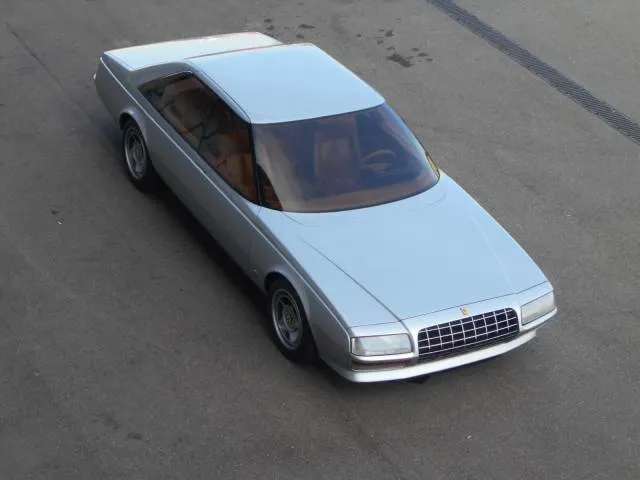
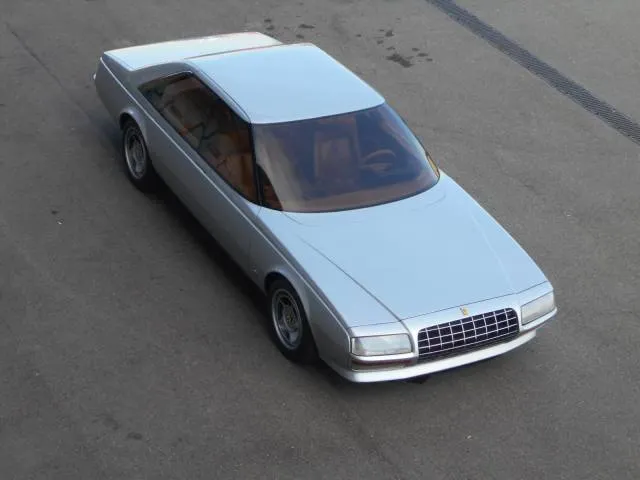
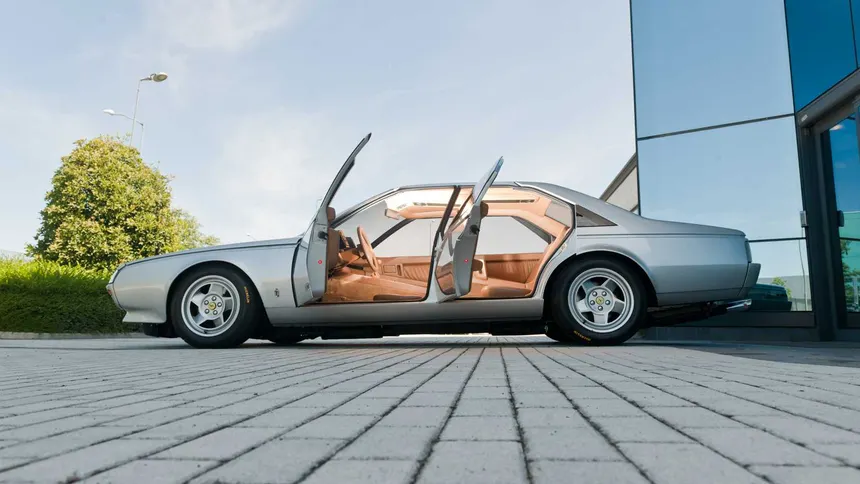
Start with the fact that looks trivial and isn’t. The Pinin is the only officially sanctioned four-door Ferrari in the marque’s entire history. The only one. In seventy-odd years of the cavallino, with everything that has rolled out of Maranello, there is exactly one saloon carrying the factory’s official blessing, and this is it. Even today’s Purosangue isn’t a four-door saloon in the classic sense; it’s a high-riding crossover. Pure four-door, a genuine sedan with the shield on its nose: only the Pinin.
And here’s the joke: it wasn’t even born at Ferrari. It was born at Pininfarina. In 1980 the coachbuilder turned fifty and, instead of baking itself a cake, Sergio Pininfarina decided to indulge the most expensive whim imaginable — a concept car to show what his house could do. Not just any concept. It had to be a Ferrari, because no marque was so tightly bound to its history. They unveiled it at the Turin show and named it after the design house’s founding father, Battista “Pinin” Farina.
So the only blessed saloon in Ferrari’s history was conceived by a supplier for its own birthday party, not by Maranello’s product department. That already tells you what kind of car this is: an intruder. A visitor. Something that wandered into the Ferrari universe through the back door and, against all odds, very nearly stayed.
Second angle: the engine sat where it shouldn’t, on purpose
Here comes the part that raises an eyebrow if you’ve ever had a car in pieces on the workshop floor.
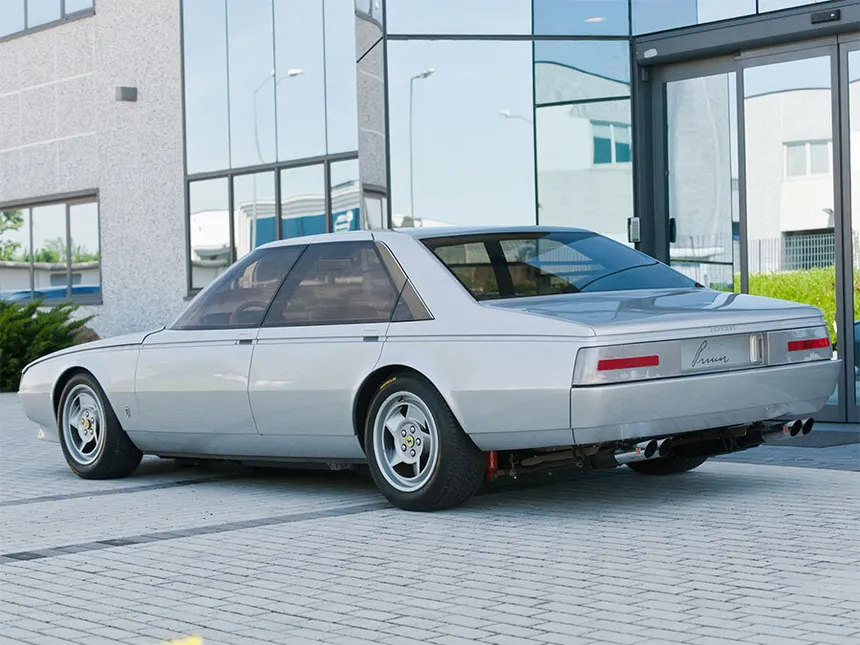
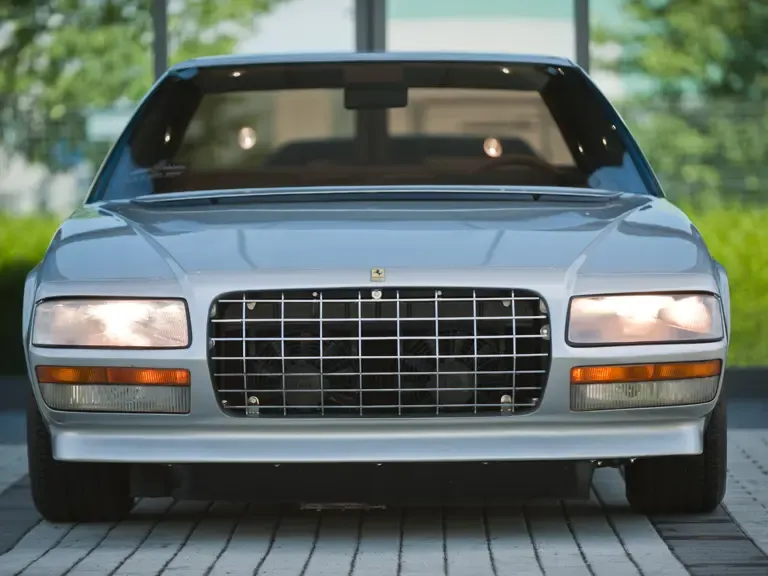
The production Ferrari 400 — the grand tourer the Pinin borrowed its chassis from — used the classic V12. Logical, normal, exactly as expected. But the Pinin wanted no part of it. They chose the flat-12 instead, the boxer twelve that lived in the Berlinetta Boxer and would later be inherited by the Testarossa. An engine with competition roots, conceived with Formula 1 in mind. And note this carefully, because it is genuinely unique: in the whole of Ferrari history, the Pinin was the only car to mount that flat-12 ahead of the driver. Always, without a single exception, that engine sat behind, in a mid-rear position. In the Pinin it sat up front. Once. Never again.
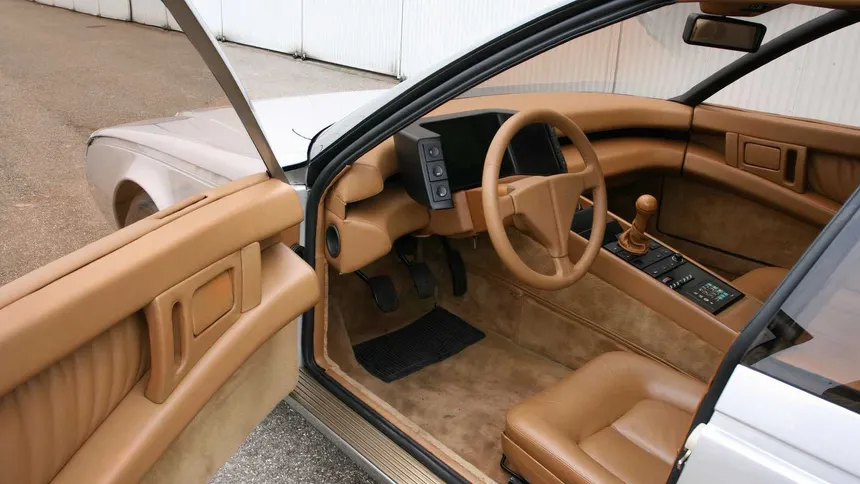
Why commit such an oddity? For a purely aesthetic reason, and here’s the engineering with no varnish on it: the flat-12, being flat and low, drops the centre of gravity and lowers the bonnet line far more than the V12, which is tall and gets in the way. A 60- or 65-degree V12 builds a tower of aluminium over the crankshaft; a boxer lays it flat to the sides. Pininfarina wanted a car hunkered down, welded to the road, with a nose impossible to achieve with the traditional vee twelve without the bonnet looking like a piano lid. The boxer engine was the key. The irony is delicious: they took an engine with single-seater racing DNA, a motor built to win and to run lean of luxuries, and dropped it into a limousine designed to ferry men in suits to the opera, complete with dual-zone climate control and an onboard telephone. Conceptually it didn’t fit at all. A war engine in a ballroom. But in terms of line, it worked. And in an anniversary concept, where the only thing being sold is the silhouette, the line ruled over everything else.
That said, NEC won’t sell you smoke. That 1980 car was a mock-up. The engine it wore in Turin didn’t run; it wasn’t even connected to the transmission. It was a sculpture. Pininfarina didn’t care about noise, vibration or cooling, because there was never a plan to take it beyond prototype. It was a rolling statement of intent, not a car you started. And that matters for what came next, because the Pinin spent thirty years as a beautiful corpse before it ever drew breath.
Third angle: Enzo said yes and lost anyway
Now we reach the heart of it, the part that dismantles the myth of the all-powerful patriarch.
The Pinin didn’t sit in a Pininfarina hall gathering dust. It went on tour, hitting shows across half the world, Los Angeles included, through 1980 and 1981. And somewhere on that circuit, it was shown to Enzo Ferrari in person. The old man — the one who supposedly despised anything with more than two doors, who insisted a Ferrari was for racing and not for cruising — was impressed. Impressed enough to seriously discuss turning it into a production model. For the reader who doesn’t grasp the scale of that: Enzo Ferrari, in the flesh, considering building a saloon. The equivalent of the Pope mulling over opening a cocktail bar.
Sergio Pininfarina had a clear dream behind the whim. He wanted Ferrari to have a true performance saloon, one to square up to the Maserati Quattroporte, the Jaguar XJ and the Mercedes 450SEL 6.9 — serious-money markets Ferrari had never entered. Think about that field for a second. The Quattroporte was the established Italian fast four-door, the Jaguar XJ the benchmark for ride and refinement, the 450SEL 6.9 the autobahn missile with a 6.9-litre V8 and a price to match. Every one of them sold to people with the means to own a Ferrari and the family that stopped them. A four-door Prancing Horse aimed squarely at that crowd wasn’t a vanity exercise; it was a genuine commercial gap, decades before anyone in Maranello admitted it. The Pinin was the Trojan horse meant to tempt Enzo into that leap. And it nearly worked.
Nearly. Because at Ferrari’s annual board meeting in 1980, the project fell. Enzo, for all his early enthusiasm, did not approve it. Why? The theory in circulation, attributed to Eugenio Alzati, points to Vittorio Ghidella, then president of Fiat, which owned a large slice of Ferrari. Without Fiat’s backing, the car didn’t happen. And Fiat didn’t back it.
Read that slowly, because here is the NEC thesis of the whole piece: the car Enzo wanted never got made because Enzo, in truth, didn’t have the final word. Above the patriarch, above the myth, above the man who IS Ferrari, sat a Fiat boardroom with a spreadsheet and an industrial logic that said no. The Pinin is the physical proof that the all-powerful Enzo was, in part, a legend. Maranello dreamed; Turin signed off. And that time, Turin said no.
Fourth angle: the corpse that took thirty years to start
The story could end there, with the Pinin as another dead concept in a museum. But it has an epilogue that turns it into something else, tying the car back into the Ferrari universe in a way you won’t see coming.
The Pinin spent years in Pininfarina‘s collection until 1993, when it was bought by Jacques Swaters, a Belgian collector, friend of Enzo and head of Ecurie Francorchamps. In 2008 it changed hands again at auction. And the new owner made a decision nobody had made in almost thirty years: the car that had never moved under its own power was finally going to. For the job he didn’t call just any workshop. He called Oral Engineering, the firm of Mauro Forghieri. The same Forghieri who had been Ferrari’s chief engineer in the sixties and seventies, the brain behind the winning Ferraris of that era, the man you already know if you’ve read the 330 P4 article.
The challenge was no joke. The Boxer’s flat-12 was mounted above the gearbox to save space. Under the Pinin’s impossibly low bonnet, that arrangement wouldn’t fit. Forghieri had to redesign the whole assembly: engine mounts moved up and forward, a bespoke fuel tank, fresh wiring, a cooling system rebuilt from scratch. And at last, in 2010, three decades after appearing in Turin as a mute mock-up, the only four-door Ferrari in history fired up and moved under its own power.
Sit with the symmetry of that. The car was dreamed up by the house bearing Pinin Farina’s name. Enzo wanted it. Fiat‘s politics buried it. And the man who finally gave it life, three decades late, was Forghieri, the engineer who had made Ferrari win on the track. Four enormous names from Maranello’s story tied to a car that, officially, never existed as a product. The Pinin is a ghost with a thoroughbred family tree.
The closing argument
This is where most sites would sign off with “and so the Pinin remained an eighties curiosity.” NEC doesn’t.
The Pinin isn’t a curiosity. It’s proof of several stinging things at once. Proof that Enzo Ferrari wasn’t the absolute god the legend sells, because there was a car he wanted and couldn’t have. Proof that the best idea doesn’t always win, because the Pinin was forty years ahead and they buried it anyway. And proof that in the car world, as in nearly everything, arriving too early is punished just as hard as arriving too late.
Because look at the final twist. Forty years after that Turin show, every supercar marque builds saloons and SUVs without a flicker of shame. Lamborghini, Aston Martin, Porsche, all of them. And Ferrari itself eventually produced the Purosangue, its first production four-door, sold by the truckload and hailed as a masterstroke of business. What in 1980 was a heresy that Fiat killed, by 2022 was a textbook decision. The Pinin wasn’t wrong. It was alone, and it was early, and in the end those two things cost it everything.
And that’s the question it leaves hanging, the one that actually matters. How many good ideas have we buried in this world not because they were bad, but because they arrived before the boardroom of the day was ready to sign them off? The Pinin was right. It took forty years to prove it, and by then nobody remembered it existed. In the car world, being right too soon is almost worse than being wrong.
Check you’re still alive.