
Motor Oil: What Your Mechanic Isn’t Telling You (And What’s at Stake If You Choose Wrong)

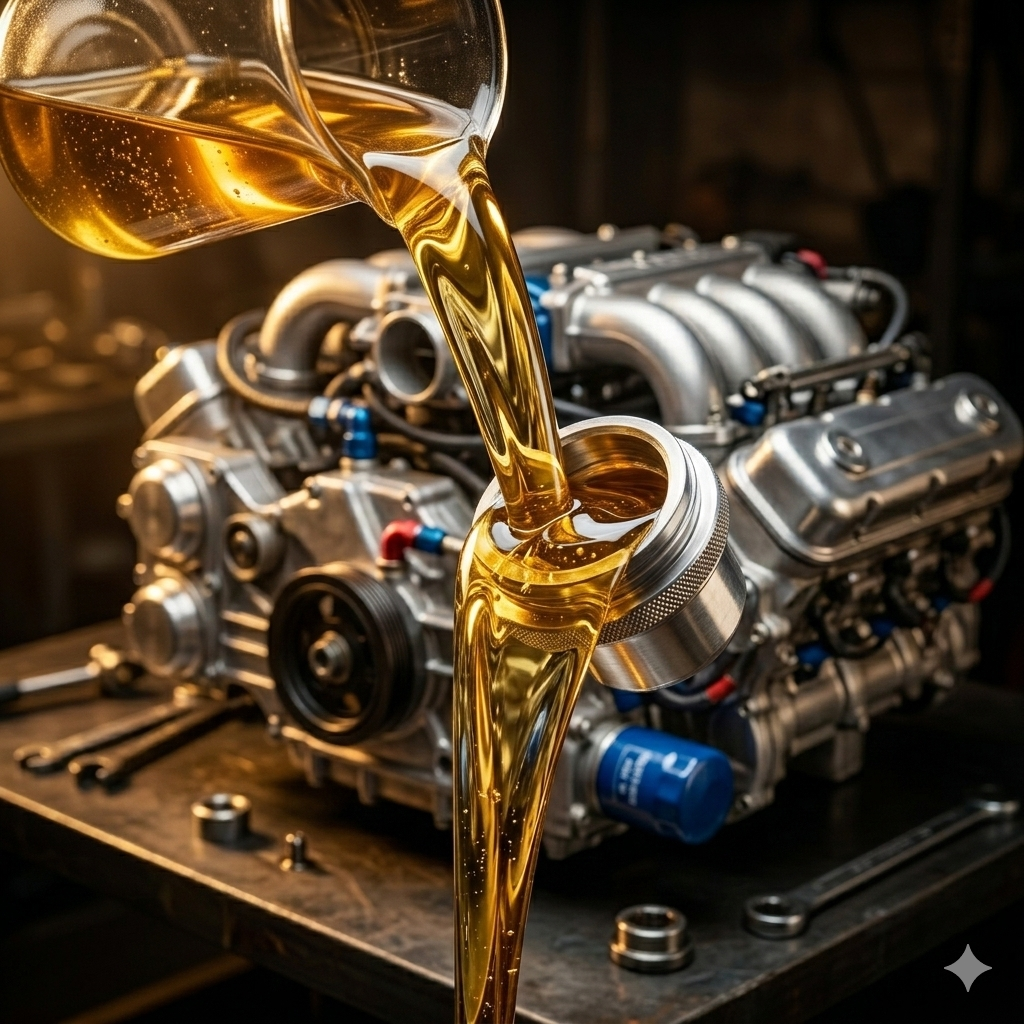
Your engine has blood. It’s called oil. And most drivers have absolutely no idea what’s flowing through their engine, why it matters, or how much money they’re throwing away by ignoring it.
Let’s fix that today.
Because no, not all oils are the same. Not even close. The difference between the right oil and the wrong one can mean the difference between an engine that lasts 200,000 miles and one that starts burning oil at 50,000. Between a turbo that breathes clean and one that chokes on carbon buildup. Between a DPF that regenerates properly and one that leaves you stranded on the highway with a warning light and a repair bill north of $2,000.
Sound dramatic? It’s not. And by the time you finish reading this, you’ll understand exactly why.
SAE: The Numbers Everyone Sees and Almost Nobody Understands
When you pick up a bottle of oil, the first thing you see on the label is something like 5W-30 or 10W-40. These are SAE (Society of Automotive Engineers) viscosity grades, and here’s how they work:
The number before the W (which stands for Winter) indicates how well the oil flows at cold temperatures. The lower the number, the better it flows when cold. The number after the hyphen indicates viscosity at operating temperature (100 °C / 212 °F). The higher it is, the “thicker” the oil stays when hot.
Let’s break down what each number actually means in practice:
Winter Number (before the W) — Cold Flow Capability
- 0W: flows down to -40 °C (-40 °F). Instant protection even in extreme cold starts. This is what many modern engines demand for minimum friction from the very first crankshaft rotation.
- 5W: flows down to -35 °C (-31 °F). The most common grade in Europe. Covers any winter from the Mediterranean to Scandinavia.
- 10W: flows down to -25 °C (-13 °F). Fine for temperate climates. If you live in the southern US, coastal Europe, or anywhere that doesn’t see serious freezing, it’s adequate.
- 15W: flows down to -20 °C (-4 °F). For warm climates or older engines with wider tolerances. Already marginal for cold northern winters.
- 20W: flows down to -15 °C (5 °F). Practically only for tropical climates or stationary industrial engines.
- 25W: flows down to -10 °C (14 °F). Very rare in passenger cars. You’ll see it in agricultural machinery or very specific applications.
Hot Number (after the hyphen) — Protection at Operating Temperature
- 20: kinematic viscosity at 100 °C between 5.6 and 9.3 cSt. Very thin. For latest-generation engines designed for minimum internal friction (many modern Toyota, Honda, Subaru). Do not use if your engine doesn’t specifically call for it.
- 30: between 9.3 and 12.5 cSt. The current standard for most European passenger cars. Good balance between protection and efficiency.
- 40: between 12.5 and 16.3 cSt. Thicker film for engines that run at higher temperatures or loads. Common in turbodiesels, performance engines, and higher-mileage cars.
- 50: between 16.3 and 21.9 cSt. For high-performance engines, competition use, or classic cars with generous clearances.
- 60: between 21.9 and 26.1 cSt. Extreme. Competition, supercars, engines subjected to brutal loads where the lubricating film must withstand enormous pressures.
Why does this matter so much? Because in the first few seconds after startup — when between 50% and 75% of total engine wear occurs — the oil needs to reach every corner as quickly as possible. If it’s too thick when cold, bearings, camshafts, and cylinder walls run dry during those critical moments. And if it’s too thin when hot, the lubricating film breaks down under load and you get metal-on-metal contact.
Practical example: Most modern European cars call for 5W-30 or 0W-20. If your neighbor tells you they use 15W-40 “because thicker means more protection,” your neighbor is wrong. Modern engines are built to micron-level tolerances. They need exactly the viscosity the manufacturer specifies. No more, no less. And yes, this applies to those downsized turbo engines that are everywhere now.
API: The American Standard Your Oil Should Meet
The API (American Petroleum Institute) classifies oils by performance level. Gasoline engine categories start with S (Spark Ignition) and diesel categories start with C (Compression Ignition). Each new letter represents a technological leap:
- API SP (effective since May 2020): the current standard for gasoline engines. It introduced seven new tests compared to its predecessor (API SN), with special focus on LSPI (Low-Speed Pre-Ignition) protection — a phenomenon that can destroy pistons in turbocharged direct-injection engines. It also improves timing chain wear protection and oxidation stability.
- API CK-4 (2017): the current standard for conventional diesel, compatible with Euro V/VI engines and aftertreatment systems (DPF, EGR, SCR).
- API FA-4: a specific variant for very low-viscosity heavy-duty diesel oils. Important: it is not backward compatible with CK-4, CJ-4, or earlier categories.
What you need to know: API SP is fully backward compatible with SN, SM, SL, and SJ. If your car calls for SN, an SP oil works perfectly. But the reverse doesn’t apply: never use an oil with a lower specification than your engine requires.
ACEA: The European Standard That Actually Matters for Your Car
This is where things get serious for those of us driving European-engineered vehicles. The ACEA (Association des Constructeurs Européens d’Automobiles) defines the specifications that truly matter for European engines. They’re divided into three main classes:
A/B Class — Gasoline and Diesel (No Specific Catalyst Requirements)
- A3/B4: high-stability oils, HTHS viscosity ≥ 3.5 mPa·s. The classic “full SAPS” for engines without DPF or where the manufacturer specifies this category.
- A5/B5: low HTHS viscosity (2.9–3.5 mPa·s) for fuel economy. Only for engines specifically designed for them.
- A7/B7 (new, introduced 2021): adds LSPI protection and turbocharger compressor deposit (TCCD) control. The natural evolution of A3/B4 for modern engines.
C Class — Catalyst and Filter Compatible (Low SAPS)
This is the critical class for any diesel with a DPF or gasoline with a GPF:
- C2: mid-SAPS, HTHS ≥ 2.9 mPa·s. Typical for PSA (Peugeot/Citroën) and some Toyota models.
- C3: mid-SAPS, HTHS ≥ 3.5 mPa·s. The most universal in the VAG, BMW, and Mercedes world.
- C4: low-SAPS, HTHS ≥ 3.5 mPa·s. Specific to Renault.
- C5: mid-SAPS, HTHS ≥ 2.6 mPa·s. Maximum fuel economy focus.
- C6 (new, 2021): mid-SAPS, HTHS ≥ 2.6 mPa·s. Adds LSPI and TCCD protection over C5. Designed for the latest-generation engines running xW-20 viscosity grades.
E Class — Heavy-Duty Diesel (Trucks)
- E4, E7, E8, E11: various levels of protection and aftertreatment compatibility.
- F01 (new, ACEA 2024): a category specifically for low HTHS viscosity oils in heavy-duty vehicles, targeting fuel efficiency and emissions reduction.
Low SAPS: Why Your DPF’s Life Depends on Every Oil Change
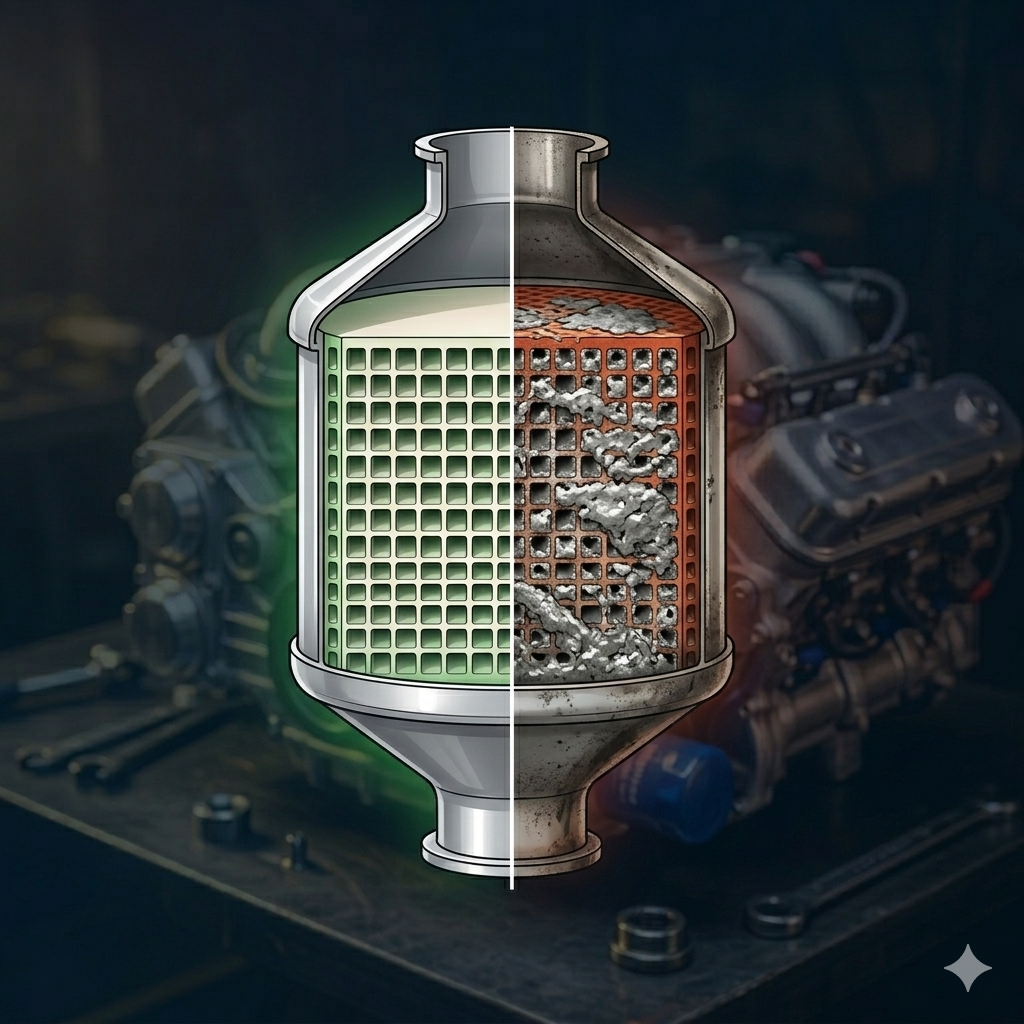
SAPS stands for Sulphated Ash, Phosphorus and Sulphur. These are components of oil additives that, when burned, produce solid residues. Those residues end up in your particulate filter.
A “full SAPS” oil (like ACEA A3/B4) generates more ash. A “low SAPS” or “mid-SAPS” oil (ACEA C2, C3, C4, C5, C6) is formulated to minimize that ash without sacrificing engine protection.
The real problem: if your car has a DPF and you use an oil that isn’t Low SAPS, you’re accumulating metallic ash in the filter that does not burn off during regeneration. Regeneration burns off soot, yes, but metallic ash stays there permanently. The filter gradually clogs until it fails. And a new DPF, depending on the car, can cost anywhere from $1,500 to $5,000.
All because someone saved $5 on the wrong oil.
And this connects directly to other problems we’ve covered: the EGR valve and the AdBlue/DEF system. The entire aftertreatment system of a modern diesel is an interconnected ecosystem. If the oil fails, the DPF fails. If the EGR fails, the intake carbonizes. If the AdBlue fails, the car goes into limp mode. A domino chain of failures that often starts with one badly done oil change.
Mineral, Semi-Synthetic, Synthetic: Which Do You Need?
Let’s keep it straightforward:
Mineral oil: derived directly from petroleum refining. Cheaper, less stable, degrades faster. Suitable for older engines with wider tolerances that don’t demand high performance. If you drive an 80s or 90s classic with a simple naturally aspirated engine — like the PSA XUD diesels that were virtually indestructible — it can be a reasonable choice. Those engines were designed for mineral oils and don’t need the additive complexity of a modern synthetic.
Semi-synthetic oil: a blend of mineral and synthetic bases. A compromise between cost and performance. Adequate for many everyday cars without extreme demands.
Synthetic oil: manufactured through chemical processes from high-quality bases (PAO, esters, GTL). Offers superior thermal stability, better cold-flow properties, greater oxidation resistance, and longer drain intervals. It’s the standard for any modern turbocharged or direct-injection engine.
The reality: virtually every current European manufacturer requires synthetic oil. If your car is newer than 2010 and has a turbo, there’s no debate: synthetic. And not the cheapest one you can find, but one that meets the ACEA specification and OEM approval your manual calls for.
OEM Approvals: The Specification That Really Counts
Beyond API and ACEA, car manufacturers define their own proprietary specifications. These are more restrictive and specific than generic standards:
- VW 504.00 / 507.00: Volkswagen’s spec for long drain intervals (Long Life). DPF compatible.
- MB 229.51 / 229.52: Mercedes-Benz, DPF compatible, low ash.
- BMW LL-04: BMW Longlife-04, low SAPS, for engines with DPF. If you have a BMW with the legendary M57D30 diesel, this is what it needs.
- PSA B71 2290: Peugeot/Citroën, ACEA C2, low HTHS viscosity.
- Renault RN0720: low SAPS, for diesel engines with DPF.
The real advice: open your car’s owner manual. Find the lubricant section. Write down the exact OEM specification and recommended SAE grade. Then buy an oil that meets it. Don’t trust the mechanic who says “this one works for everything” while pouring a generic drum. It doesn’t work for everything. Every engine is designed for a specific formulation. And if your shop can’t answer that question, you have a problem.
SASH 0W60 by Spania GTA: When Oil Is Engineered for a Supercar
And this is where theory becomes tangible. Because everything we’ve just explained — viscosity, standards, formulation, technical demands — takes on a whole different dimension when we’re talking about an engine producing over 900 horsepower.
SASH Lubricantes is a Valencia-based company founded in 1990 in Puzol, just outside Valencia, Spain. Over 30 years manufacturing high-quality lubricants with a presence in more than 60 countries. This isn’t a giant multinational: it’s an independent company with 50 employees, its own 7,000-square-meter blending plant, and a philosophy built on technical specialization.
So what does SASH have to do with a Spanish supercar? Everything.
Spania GTA, the company founded by Domingo Ochoa in Ribarroja del Turia (also in Valencia), chose SASH as the lubricant supplier for the GTA Spano — Spain’s definitive supercar, powered by a twin-turbo 8.3-liter V10 derived from the Dodge Viper that delivers over 900 horsepower and exceeds 370 km/h (230 mph). This wasn’t a marketing decision: it was an engineering one. When you push an engine to those limits, at those temperatures and pressures, oil isn’t just a consumable. It’s a critical survival component.
From that collaboration came the SASH 0W60 by Spania GTA: an oil formulated, tested, and approved specifically for the extreme conditions of the GTA Spano. What does 0W-60 mean in practice? Referring back to our chart above: it flows at -40 °C (-40 °F) (total protection from the very first startup) with a hot viscosity of 21.9 to 26.1 cSt at 100 °C (the most resilient lubricating film available on the civilian market). It’s the kind of grade used in competition and ultra-high-performance engines, where oil temperatures can easily exceed 130–140 °C (265–285 °F).
What’s fascinating is that both companies are Valencian. The oil protecting the engine of the most powerful supercar ever built in Spain is produced less than 30 kilometers from where the car is assembled. That’s local engineering at the highest level, competing head-to-head with major international brands.
And Domingo Ochoa’s message put it clearly: you may not be able to buy a GTA Spano, but you can carry a piece of one in your engine.
Oil Doesn’t Travel Alone: Maintenance People Ignore
We’ve talked a lot about oil, but oil is just one piece of the puzzle. Here’s a handful of things that 90% of drivers ignore — and that make the difference between a car that lasts and one that breaks:
Every time you change the oil, change the filter. No exceptions. Doesn’t matter what the shop tells you to save 8 bucks. The old oil filter is saturated with microscopic metal particles, combustion residue, and grime. If you put fresh oil through an old filter, you’re contaminating the new oil the moment it enters the circuit. It’s like showering and putting on dirty clothes.
Brake fluid gets changed every two years. Doesn’t matter if you’ve driven 3,000 miles or 30,000. Brake fluid is hygroscopic: it absorbs moisture from the atmosphere through the circuit. That moisture lowers the fluid’s boiling point. Fresh DOT 4 boils at around 230 °C (446 °F). With 3% moisture content (easily reached in two years), that drops below 155 °C (311 °F). If you brake hard on a mountain pass or highway, you can boil the fluid. When it boils, vapor bubbles form. And vapor doesn’t transmit hydraulic pressure. Result: you press the brake pedal and nothing happens. Total fade. This isn’t theory — it happens. And it kills.
Coolant has an expiration date too. Between 2 and 5 years depending on the type (organic, inorganic, hybrid). Over time it loses its anti-corrosion properties and its freeze protection degrades. An engine overheated by old coolant can cost you a head gasket — and in a modern aluminum engine, that can mean the end.
The PCV valve is a $30 part that can destroy your engine. We covered it in detail in its own article, but the summary is that it regulates crankcase gases and if it sticks, the internal pressure wrecks seals, causes excessive oil consumption, and contaminates the intake.
The dual-mass flywheel and Start-Stop system are two other major budget killers. And both are directly connected to lubrication: Start-Stop subjects the engine to constant restarts (the moment of greatest wear, as we’ve discussed), and the dual-mass flywheel suffers more when lubrication isn’t optimal.
Everything is connected. Everything.
Practical Guide: How to Choose the Right Oil for Your Car
After everything above, the recipe is simple:
Step 1: Open your car’s owner manual (or find the PDF online if you’ve lost it). Locate the lubricant section. Note down the exact OEM specification and recommended SAE grade.
Step 2: Find an oil that meets that OEM specification. Not just the generic API or ACEA — the specific OEM approval. If your Volkswagen calls for VW 504.00, look for an oil that states it on the label.
Step 3: Choose synthetic whenever your engine requires it (and if it’s a 2005–2010 or newer model, it does). The additional cost over semi-synthetic pays for itself in protection and drain intervals.
Step 4: If your car has a DPF or GPF, make sure the oil is Low SAPS (ACEA C2, C3, C4, C5, or C6 as specified by your manufacturer). This is non-negotiable.
Step 5: Change the oil filter with every oil change. Always. Don’t cut corners here.
Step 6: Respect drain intervals. A quality synthetic oil under normal conditions can last between 10,000 and 20,000 miles depending on the specification (Long Life or not). But if you do a lot of short urban trips, shorten the interval. Oil gets contaminated faster when the engine doesn’t reach optimal operating temperature.
Conclusion: Your Engine Talks. Listen to It.
Motor oil isn’t an expense. It’s an investment. It’s the most frequent technical decision you make as a driver, and probably the one with the greatest impact on your vehicle’s longevity.
Don’t let anyone pour “whatever’s available” into your engine. Demand the correct specification. Ask what oil they’re using and verify it. And if your mechanic can’t answer that question with concrete data, find a different mechanic.
This article is just the tip of the iceberg. In upcoming posts, we’ll dive deep into each of these topics: coolant, brake fluid, transmissions, and everything your shop should be telling you but isn’t. Because maintenance isn’t magic: it’s science, data, and common sense.
Your engine has blood. Make sure it’s the right kind.
Want to know more about maintenance, mechanics, and the unfiltered truth about the automotive world? This is Not Enough Cylinders. Grease on our hands, no filter on our words.