
Chaparral 2E: the Texas Can-Am car with a movable wing and a pedal where the clutch should be
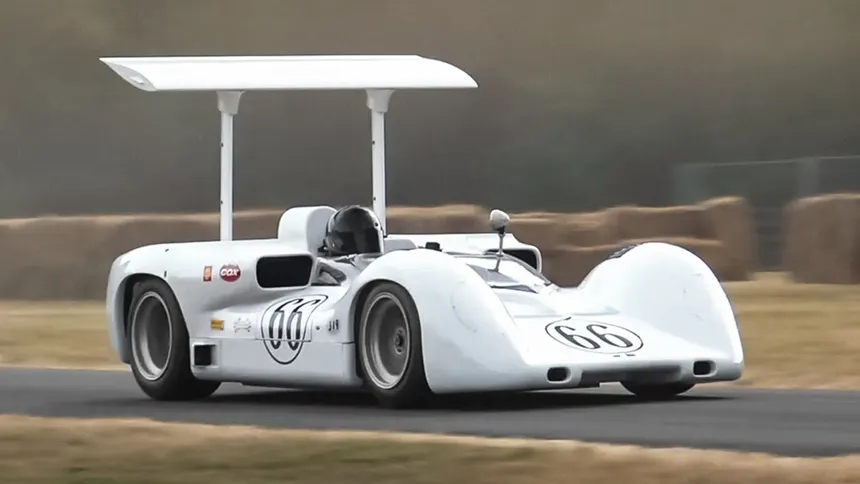
Formula 1 teams now spend hundreds of millions of dollars a year chasing downforce, and every Grand Prix weekend a driver presses a button on the steering wheel, a flap in the rear wing opens, and the car gains a few miles per hour down the straight. That’s DRS, and it arrived in 2011. A rancher’s son from West Texas had a car doing the same job with a foot pedal in 1966. His name was Jim Hall, the car was the Chaparral 2E, and it raced in the very first season of Can-Am, the series that let American engineers do almost anything they liked. The rule makers spent the next three years working out how to stop him.
The white car in the Bridgehampton paddock
Picture the paddock at Bridgehampton, out on the far end of Long Island, in September 1966. The Canadian-American Challenge Cup is two races old. The fields are full of Lolas and McLarens with big American V8s, the fastest sports racing cars anyone had built, and most of them look roughly alike: low, wide, wedge-shaped, the driver sitting in an open cockpit.
Then the Chaparral team unloads two white cars with a wing perched on tall struts high above the rear wheels. Up front, the nose has a duct cut through it. The radiators aren’t where radiators are supposed to be. Inside, there are three pedals, though the car has no clutch.
The story the Chaparral crew told for decades is that Bruce McLaren, the New Zealander whose cars would dominate Can-Am a year later, walked over, looked at the car for a long time and muttered, "Bugger me, Hall’s done it to me again." Nobody recorded it, so treat it as paddock legend. What isn’t legend is that within two seasons almost every serious car in Can-Am and Formula 1 had a wing on it.
Can-Am, the series with almost no rules
To understand why a car like the 2E could exist at all, you need to know what Can-Am was. The Canadian-American Challenge Cup started in 1966, run jointly by the Sports Car Club of America and Canada’s motorsport authority, for cars built to the international Group 7 rules. Group 7 asked for very little: two seats, enclosed wheels, some basic safety equipment. There was no limit on engine size, no minimum weight worth worrying about and, at first, nothing about wings. The races were two-hour sprints with big prize money, enough to attract Formula 1 stars like John Surtees, Bruce McLaren, Denny Hulme and Dan Gurney.
For a team with an engineering budget, that was an open invitation. Most entrants answered it the American way, with ever bigger V8s. Hall answered it with the air.
Who Jim Hall was
Jim Hall wasn’t a typical racing team owner of the sixties. Born in 1935, he grew up in a Texas oil family, studied engineering at Caltech in Pasadena, and raced sports cars and briefly Formula 1, including a full season in 1963 for the British Racing Partnership. Back home in Midland he built his own race shop and his own private test track, Rattlesnake Raceway, so he could test whenever he wanted, without anyone watching. The full story of the man is in our profile of Jim Hall and his Chaparral aerodynamics.
His partner in the Chaparral cars was Hap Sharp, another Texas oilman and racer. And the third partner, the one that never appeared on a sign, was Chevrolet. General Motors had officially pulled out of racing in 1957 under the industry’s Automobile Manufacturers Association agreement, but its research and development engineers kept helping a few chosen teams. Chaparral was the favorite. Chevrolet R&D designed chassis, developed transmissions and supplied aluminum small-block V8s that weren’t for sale to anyone else. Hall got a factory’s brains without a factory’s paperwork, and GM got a rolling laboratory it could deny owning.
Somebody had tried it before
Hall wasn’t the first person to bolt a wing onto a race car. In 1956 the Swiss engineer Michael May fitted an inverted wing above the cockpit of his Porsche 550 Spyder and showed up at the Nürburgring 1000 km. In practice he was quick enough that the officials, nervous about the strange device, made him take it off. The idea went back in the box for almost a decade.
The difference with Hall was persistence. He had the money, the test track and the Chevrolet engineers to turn an odd idea into a system, and the stubbornness to keep racing it while it broke.
The 2C: where the pedal came from
Most stories about the 2E start with the wing. The real start is the car before it, the Chaparral 2C, which showed up in the second half of 1965.

The 2C was smaller and lighter than the earlier Chaparral 2A because it used an aluminum tub based on a design Chevrolet R&D had built for its own GS-II research car, in place of the fiberglass chassis Hall had raced before. It also carried the second key ingredient: an automatic transmission developed with Chevrolet’s engineers. A race car with an automatic sounds like a joke, but this was no showroom slushbox. It was a heavily reworked torque converter and gearbox designed to survive racing loads and to let the driver stop worrying about shifts and clutch work.
That transmission had a side effect nobody else in racing had. Without a clutch, the driver’s left foot had nothing to do. Hall gave it a job.
The 2C carried a large rear spoiler across the tail, a flat panel that the driver could move with a pedal mounted to the left of the brake. Its resting position was upright. Coming into a corner, the raised spoiler acted like an air brake and then, through the turn, pressed down on the rear tires. On the straight, the driver pushed the pedal with his left foot, the spoiler tipped nearly flat, and the drag went away. It was the first time a driver could change his car’s aerodynamics on the move, every lap, as part of driving it.
What was wrong with a spoiler
The 2C worked, but Hall could see its limits. A spoiler sitting on the tail lives in dirty air, the turbulent wake that comes off the cockpit, the body and the wheels. Air that has already been churned up can’t be counted on to do much. And whatever downforce the spoiler did make went into the bodywork and the chassis, through the springs, and only then to the tires. Pile on aerodynamic load that way and the car squats at speed, changes its ride height and suspension geometry, and becomes harder to set up.

So for 1966, Hall and Sharp moved the downforce somewhere better.
A wing on stilts
The 2E’s wing sat on two tall struts that put it well above the bodywork, out in clean, undisturbed air where it could work almost as it would in a wind tunnel. That alone made it far more effective than a spoiler on the tail.
The clever part was where the struts went. They didn’t bolt to the body or the chassis. They ran down to the rear suspension uprights, the parts that carry the wheel hubs. The downforce from the wing pushed straight down on the tires without passing through the springs. The suspension kept doing its normal job of handling bumps and weight transfer, and the aerodynamic load arrived at the contact patches directly. At 150 mph the 2E could carry big downforce without squashing its own suspension.
The wing worked the same way as the 2C’s spoiler. Its normal position was angled for downforce. Press the left pedal and it flattened for the straight; lift your foot and it tilted back to load the rear tires for braking and cornering. Sources disagree on exactly how the system was actuated, and at least one describes hydraulic actuators hidden inside the strut fairings. What everyone agrees on is that the driver controlled it with his left foot, lap after lap, at every corner.
Driving with three feet
Imagine climbing into the 2E as a professional driver in 1966. The cockpit is tight, and a mechanic straps you in from outside. The shift lever sits low on your right, but there are no gears to choose in the usual sense: the automatic handles the work. Then you look down and find three pedals. Throttle on the right, brake in the middle, and on the left, where every instinct you have says a clutch should be, the wing pedal.

The routine went like this. Down the straight, left foot pressing the pedal, wing flat, car running free. Braking point: lift the left foot, the wing snaps back to its angle and starts shoving the rear tires into the road, right foot on the brake. Through the corner, the wing working at full load. Exit, back on the throttle, and once the car was straight, left foot back down. Every corner, every lap, for two hours. Drivers raised on manual gearboxes had to retrain their left legs. For a driver like Phil Hill, who had spent years heel-and-toeing Ferraris, the left foot suddenly had a whole new job.
Balancing the front end
Load up the rear of a car and take nothing away from the front, and you upset its balance every time you flatten or tilt the wing. Hall solved that too. The nose of the 2E had a duct running through it, a venturi shaped so that air speeding through it created low pressure and pulled the front of the car down. A flap at the duct’s entrance was linked to the same pedal as the wing. Press the pedal: the wing flattened and the flap closed the front duct at the same time. Release it: both went back to making downforce. Front and rear changed together, so the car’s balance stayed put whether it was set for the corners or the straights.
Radiators on the sides
To make room for that duct, the radiators had to leave the nose, where nearly every racing car of the era carried them. Hall moved them into two pods alongside the cockpit, with the hot air leaving over the rear of the car. That freed the nose for aerodynamics, kept the hot water lines away from the driver’s feet and moved weight toward the middle of the car. Formula 1 adopted side-mounted radiators as a general layout around 1970, with the Lotus 72 the car that made them famous. Today every F1 and IndyCar runs them. The 2E had them in 1966.
The other Chaparral of 1966
The 2E wasn’t the only Chaparral racing that year. Its closed-cockpit sibling, the 2D, went to Europe for endurance racing, and in June 1966 Phil Hill and the Swedish driver Jo Bonnier won the Nürburgring 1000 km with it. A Texas-built car with a Chevrolet engine and an automatic transmission beat the Europeans at the toughest circuit in the world, ten years after Michael May had been told to take his wing off at the same track. The 2D carried a spoiler, and the 2F that followed it in 1967 got the high wing developed on the 2E.

What it had under the hood
The rest of the car was simple by Can-Am standards. Its engine was a 327-cubic-inch, 5.4-liter all-aluminum Chevrolet small-block V8, good for roughly 450 to 475 horsepower at 6,800 rpm. That was less than many rivals: Can-Am rules put no limit on displacement, and teams were already moving to six- and seven-liter iron-block engines. The 2E weighed only about 1,550 pounds and rode on a 90-inch wheelbase. Hall’s bet was to win with lightness and downforce instead of raw cubic inches, which in America in 1966 was close to heresy. It was the high point of the muscle car era, and "there’s no replacement for displacement" was gospel.
Phil Hill and the 1966 season
Hall’s teammate was Phil Hill, from Santa Monica, the first American-born Formula 1 world champion, who won the 1961 title for Ferrari with the shark-nosed 156 designed by Carlo Chiti. By 1966 Hill had left Ferrari behind and found a home at Chaparral.

The team skipped the opening round at Mont-Tremblant in Quebec and showed up at Bridgehampton on September 18. Hall didn’t start. Hill took the car and finished fourth after trouble with the wing system. At Mosport in Canada a week later, Hill finished second and Hall retired.
Laguna Seca, on October 16, was the day the 2E did what Hall had designed it to do. The race ran as two one-hour heats with combined results, and the Chaparrals finished one-two overall: Phil Hill first, Jim Hall second. It was the only win the 2E ever scored.
At Riverside two weeks later, Hall finished second and Hill retired. The season ended at Stardust Raceway outside Las Vegas, where the wing mechanisms broke on both cars. Hall retired. Hill’s crew took the wing off in the pits and he struggled home seventh in a car he called a handful. John Surtees won the race and the first Can-Am title in a Lola T70, the same kind of British chassis that went on to a long career in endurance racing, as in the Lola T70 that raced at Daytona in 1969.
So the 2E won one race out of the five it entered. By the numbers, a disappointment. Its influence was much bigger. Hill said for the rest of his life that the 2E was his favorite Chaparral, and Hall has said the same.
The wings everybody copied
What happened next is the best measure of the 2E. In 1967 the high-wing Chaparral 2F went endurance racing in Europe, and Phil Hill and Mike Spence won the BOAC 500 at Brands Hatch with it. In 1968 Formula 1 discovered wings: Ferrari and Brabham ran rear wings at the Belgian Grand Prix at Spa, and within months teams were putting them on tall struts, some of them mounted straight to the suspension the way Hall had done.
What F1 teams copied badly was the engineering. In 1969, at the Spanish Grand Prix on the Montjuïc street circuit in Barcelona, the high wings on both works Lotus 49s broke within a few laps of each other. Graham Hill crashed, and then Jochen Rindt crashed hard at the same spot. Two weeks later in Monaco the FIA banned high wings in the middle of practice. Movable aerodynamic devices were outlawed, and Can-Am followed. If you want the physics of why a wing works at all, we cover it in our explainer on how car wings make downforce.
Hall’s answer to the ban was the Chaparral 2J of 1970, a car that used two fans driven by a snowmobile engine to suck itself to the ground. It was banned too, after one season.
The crash that ended Hall’s driving
Hall kept racing his own cars after 1966, and the wings kept growing. The 1968 Chaparral 2G carried an even bigger wing, fed by wider tires, and it was quick. At the Stardust Grand Prix in Las Vegas that November, the same track where the 2E’s wings had broken two years earlier, Hall came up on Lothar Motschenbacher’s slower McLaren, which suddenly slowed in front of him. The Chaparral hit it, went airborne and smashed into the ground. Hall survived with badly broken legs. He was thirty-three, and his career as a front-line driver was over.
From then on he ran the team from the pit wall and the drawing board. That may be the best thing that could have happened to racing technology. The 2H of 1969, a slippery, low-drag experiment, and the 2J fan car came from a man who no longer had to drive them himself. And years later, Hall’s own Indy car team won the 1980 Indianapolis 500 with Johnny Rutherford in the Chaparral 2K, one of the first ground-effect cars at the Speedway.
Fifty years later
Here’s the irony. In 2011 Formula 1 introduced DRS, the Drag Reduction System. On the straights, in specific zones and under specific conditions, the driver presses a button, a flap in the rear wing opens, drag drops and the car goes faster. The physics are exactly the 2E’s: let the driver change the wing between a high-downforce setting for corners and a low-drag setting for straights. What was banned as dangerous in 1969 came back as a tool to improve the show.
The difference is the control. Hall gave his drivers a free hand, or a free foot, to use the wing everywhere, all the time. F1 hands the button out in measured doses, decided by the rule book and a timing loop.
Where to see it
The Chaparral cars didn’t vanish into private collections. Hall kept them, and many of them, including the 2E, ended up on display in a dedicated Chaparral gallery at the Petroleum Museum in Midland, Texas, a short drive from the shop where they were built. A town best known for oil wells holds one of the most important collections of race car aerodynamics anywhere. Standing in front of the 2E there, with its wing towering over the tail, you can still see how far ahead of its time it was.
The 2E’s career lasted one season, it won once, and it broke wings in front of everybody. It also changed how every racing car since has been designed. The left pedal that started it was only there because a Texas team had built a race car with an automatic transmission.
Check you’re still alive.
; ; ; ; ;