Volkswagen Golf GTI Mk1: the bootleg hot hatch America bought as a Rabbit from Pennsylvania
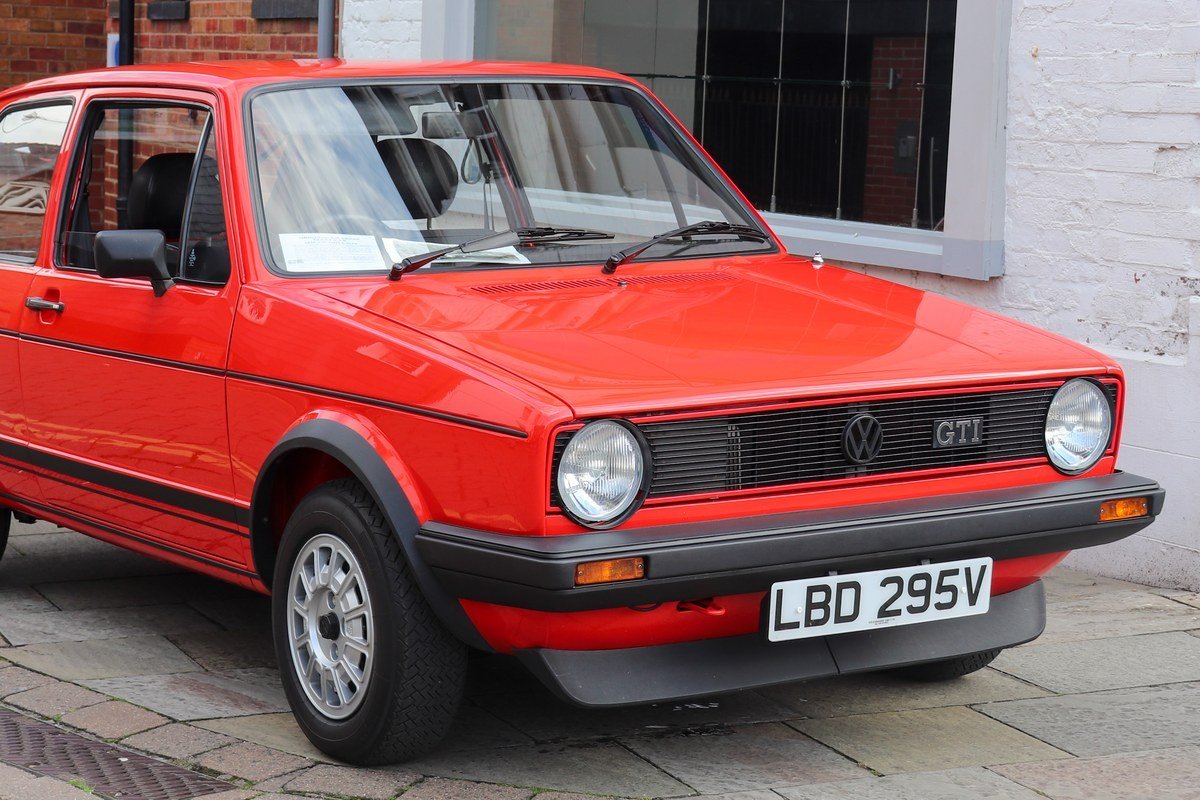
In 1982 Volkswagen of America was in trouble. Rabbit sales that year were down a devastating 44 percent on the year before, according to the Christian Science Monitor, and the cheap, clever little hatchback that was supposed to replace the Beetle in American driveways was being eaten alive by Hondas and Toyotas. VW’s answer arrived for the 1983 model year with a sticker of $7,990, about $1,700 more than a Rabbit L, a 1.8-liter engine, a close-ratio five-speed and three letters on the grille. The Monitor’s verdict was simple: “The GTI is still a Rabbit, but a performing Rabbit all the way.”
It was also made in America. The Rabbit GTI came off the line at Westmoreland County, Pennsylvania, in a plant that had made Volkswagen the first foreign carmaker to build cars in the United States since Rolls-Royce shut its Springfield, Massachusetts works in 1931. Most of the kids who bought one had no idea that the car they were thrashing around the Pennsylvania hills had been born as a conspiracy inside Volkswagen, built by a few employees behind their bosses’ backs.
The memo nobody answered
Wolfsburg in 1973 was a scared place. Volkswagen still lived off the Beetle, which was getting old fast, and the company had bet its future on the Golf, a water-cooled, front-drive hatchback designed by Giorgetto Giugiaro that would go on sale in 1974. Management had no time for side projects.
That same year VW had dressed up a Beetle as the 1303 S “Gelb-Schwarzer Renner”, the yellow-and-black racer. It built 3,500 of them and, by Volkswagen’s own account, sold them all in about two months. A test engineer named Alfons Löwenberg took the hint. On March 18, 1973, he sent an internal memo proposing a sporty version of the Golf. Nothing came back.
So he went ahead anyway. Löwenberg recruited press chief Anton Konrad and marketing man Horst-Dieter Schwittlinsky, and the three began working on what they called the “Sport Golf” without a budget or a green light. Suspension specialist Herbert Schuster joined them, along with Franz Hauk, who had developed the EA827 engine, plus Gunter Kühl, Hermann Hablitzel and Jürgen Adler. Schwittlinsky came up with the name: GTI, for Grand Touring Injection. In the auto industry that kind of under-the-radar operation is called a skunkworks, after Lockheed’s secret aircraft shop. VW didn’t call it anything, because officially it didn’t exist.
Undrivable, then too expensive
The first prototype wasn’t even a Golf. The team built it on a Scirocco, the coupe that shared the Golf’s platform, with a twin-carburetor 1.5-liter good for somewhere between 85 and 100 horsepower and a slammed, rock-hard suspension. Development chief Ernst Fiala drove it and called it “undrivable”: harsh, and so loud through the intake that it wore you out. The next version was knocked back because it cost too much.
What unlocked the project came from the sister brand. Over at Audi, Ferdinand Piëch, later the most powerful man in the whole Volkswagen Group, was preparing the Audi 80 GTE, and he offered the team 5,000 of its 1.6-liter engines with Bosch K-Jetronic fuel injection and 110 horsepower (metric). Konrad later called that the moment everything turned. Fuel injection meters gasoline into the engine continuously and precisely instead of letting it get sucked through a carburetor, so the engine made more power, used less fuel and stopped howling through the intake like a shop vac.
With that engine, Schuster’s suspension, 175/70 HR 13 tires and the body dropped 10 mm in front and 20 mm in back, the car went to management in early 1975. On May 28 that year, chairman Toni Schmücker signed off. The conspirators could hardly believe it.
Five thousand cars, they said
The production target says everything about how much faith VW had in it: 5,000 units, the minimum number of road cars needed to homologate a model for Group 1 production touring-car racing. It matched Piëch’s 5,000 engines, too. As far as the company was concerned, the GTI was a short-run racing formality.
The Golf GTI debuted at the Frankfurt show in September 1975 and went on sale in Germany in June 1976 for 13,850 marks, about 5,050 more than a 50-horsepower Golf L. You could have it in Mars Red or Diamond Silver metallic, and that was it. Between 1976 and 1983 Volkswagen built 461,690 first-generation GTIs, almost a hundred times the plan. Most of them never stayed in Germany: VW’s own archive says 35 percent went to France, 18 percent to Italy and 13 percent to Switzerland.
The numbers, in American
The European car’s engine was the EA827, 1,588 cc, with 110 hp at 6,100 rpm and 103 lb-ft of torque at 5,000. That’s not a lot even for the seventies. A 1976 Chevy Camaro’s base inline-six made 105 net horsepower and the V8s went up from there, but the Camaro also weighed well over 3,000 pounds. The Golf GTI weighed 1,786 pounds by Volkswagen’s figure, and British buying guides put a dry car at around 1,720. That’s the whole trick. Power-to-weight decides whether a car feels quick or feels like a brick, and with so little mass to haul, the GTI ran 0 to 62 mph in 9.2 seconds and topped out at 113 mph, in fourth gear. Today a compact crossover weighs nearly twice as much, which is the core of what we called the great weight lie.
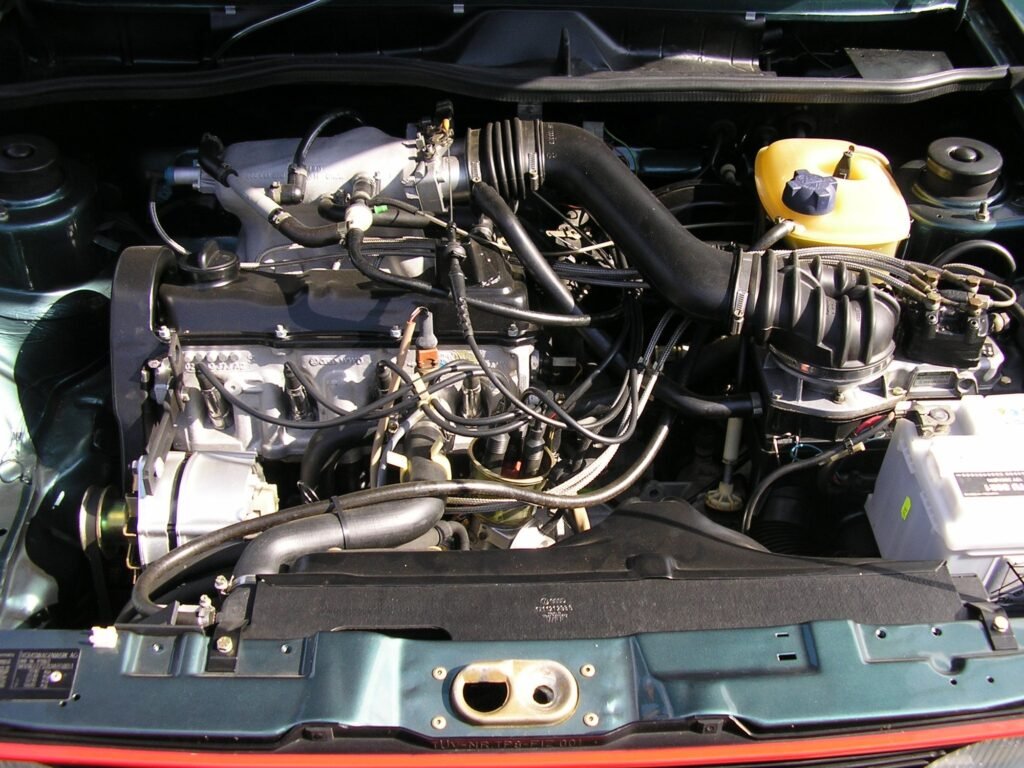
Early cars had a close-ratio four-speed. A five-speed became standard in August 1979, along with better brakes and three-point belts. Bigger plastic bumpers in 1978 added almost four inches of length, and 1981 brought larger taillights and a new dash. In 1982 the engine grew to 1,781 cc and 112 hp, with torque up to 113 lb-ft at only 3,500 rpm. It pulled harder from low revs but lost some of the 1.6’s appetite for the redline. The German send-off was the 1983 Pirelli edition, 10,500 cars built between May and October with 14-inch Pirelli wheels.
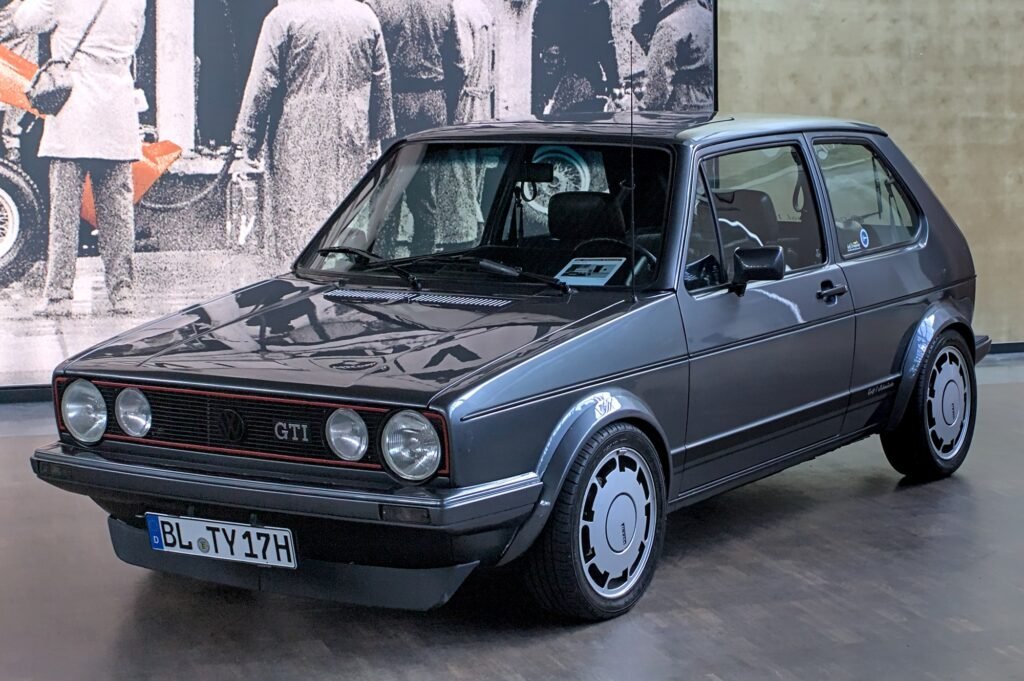
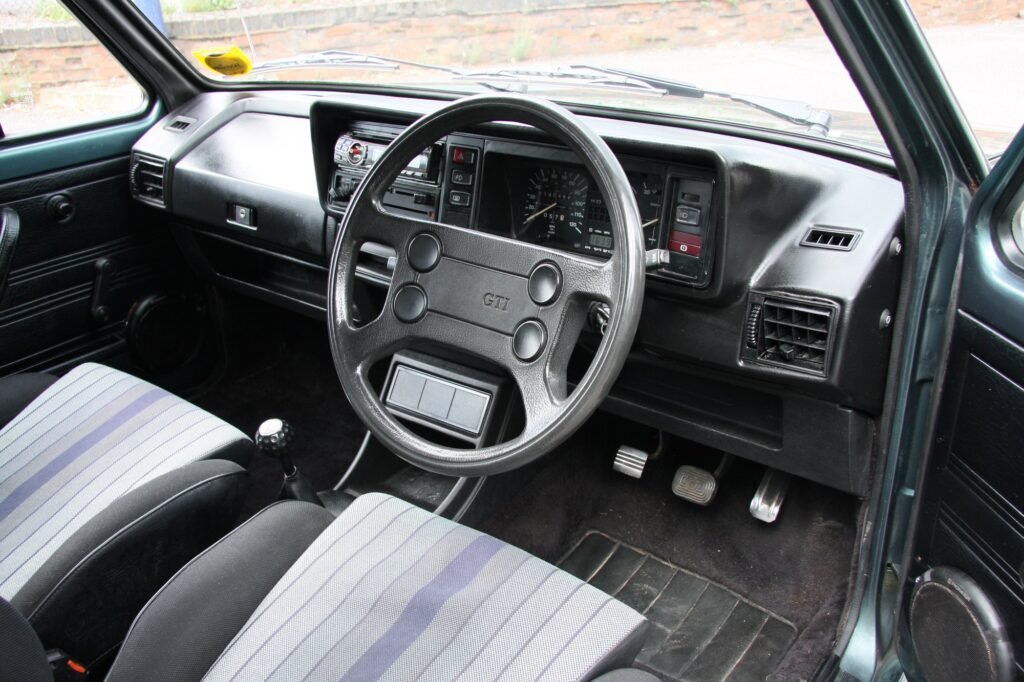
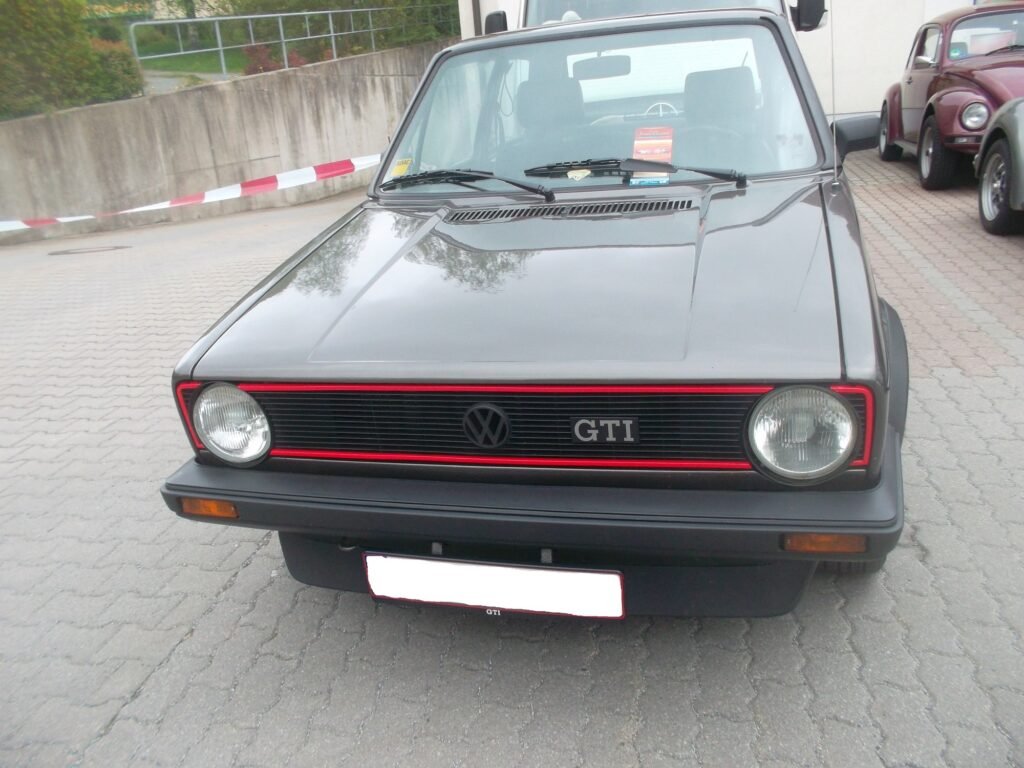
Then there are the details that made it a cult object. Once the project was approved, designer Gunhild Liljequist and Herbert Schäfer did the interior and the face: a shift knob shaped like a golf ball, dimples and all, tartan plaid seats, a thin red stripe around the grille, and every bit of chrome on the regular Golf turned to matte black. The joke on the knob is a pun the name doesn’t actually support, because “Golf” comes from Golfstrom, the German word for the Gulf Stream. VW still puts tartan and a red stripe on the GTI fifty years later.
What Pennsylvania changed
The Rabbit GTI wasn’t a European GTI with a different badge, and anyone who has seen both side by side can tell. It wore square headlights instead of round ones. It made 90 hp from its 1.8, against roughly 70 in a regular 1.8 Rabbit, while the European car had more power and stiffer springs. Much of the switchgear was American-sourced and cheaper, and Sports Car Market later judged the build quality below German standards.
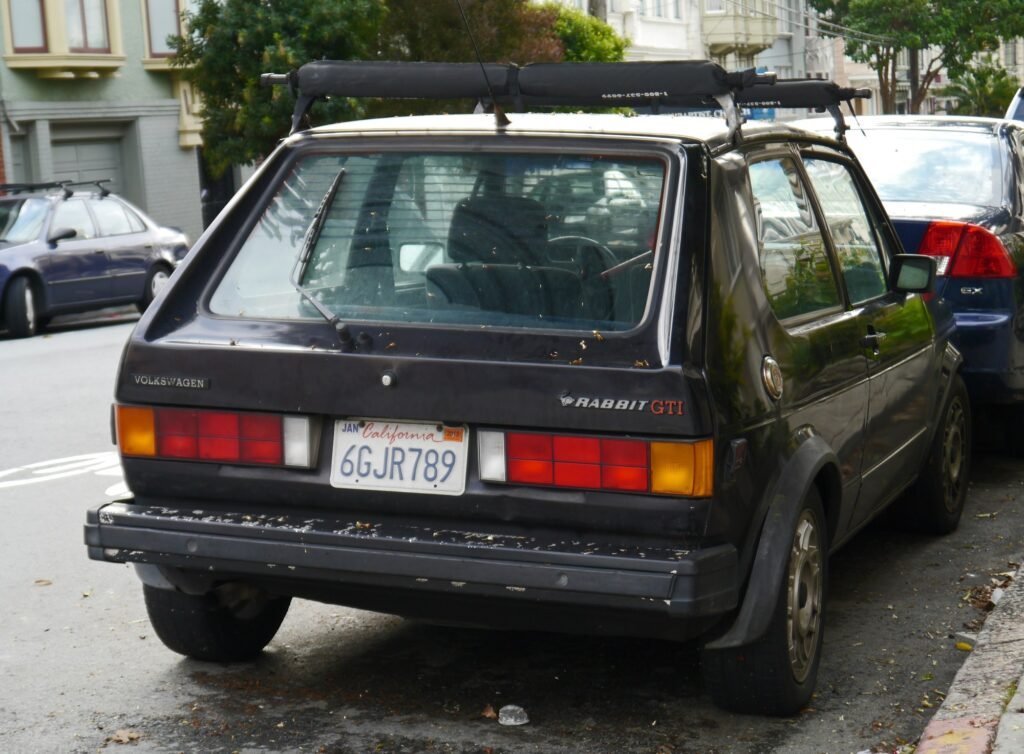
None of that stopped it from being the best thing VW sold here. It had 60-series Pirelli P6 tires, alloy wheels, a sport exhaust and stripes along the rockers, and it came in black, a dull red, silver or white. VW claimed 0.82 g on the skidpad, the Monitor timed 0 to 50 mph in 7.2 seconds, a full second quicker than a regular Rabbit, and the EPA rated it at 26 mpg city and 36 highway. Zero to 60 took a tick under ten seconds. It wasn’t fast by Camaro standards. It just went around corners like nothing else at its price.
Canada had actually seen a Rabbit GTI before the US did, from 1979, though early Canadian cars had a 71 hp 1.5 or a 78 hp 1.6. The real American GTI arrived for 1983, built from parts shipped in from several countries, and stayed through 1984. When the second-generation car arrived, Westmoreland built that too, and the GTI dropped the Rabbit name for good. If you want to know how that car grew up, it’s in our story on the Golf GTI Mk2 and Mk3.
Westmoreland itself didn’t make it. The plant opened in April 1978, peaked at about 6,000 workers in 1981 and built around 1.15 million cars before it closed on July 14, 1988. The welding line and tooling were shipped to First Automotive Works in China to build Jettas. Sony made TVs there from 1990 to 2009, and later a battery start-up called Aquion Energy used it from 2014 to 2017. The first American home of the hot hatch ended up building batteries.
The Spanish detour
The GTI’s route into Spain is a story Americans never hear. Spain kept foreign cars out with quotas and tariffs for decades. When imports opened up in 1980, a foreign car still paid a 63 percent duty on its origin price plus a 24 percent luxury tax. A handful of early GTIs got in anyway and a few still wear Spanish plates.
The door really opened through SEAT, the Spanish brand that had spent its whole life building Fiats under license. When Fiat walked away in the early eighties, SEAT signed with Volkswagen: in September 1982 to build the Polo and Passat in Spain, and in June 1983 to distribute VW and Audi. The GTI arrived in numbers that year, seven years late, mostly with the 1.8. Officially SEAT imported only the diesel and the GTI, and the GTI sold so well that in Spain “Golf” basically meant “GTI”. VW took 51 percent of SEAT in 1986 and all of it in 1990. One more twist: the first SEAT Ibiza, launched in 1984, was also a Giugiaro design, and the story that has followed it ever since is that it started life as a proposal for the Mk2 Golf that Volkswagen turned down. It has never been officially confirmed.
Rust, and why survivors are worth so much
The Mk1’s real enemy wasn’t the competition. It was rust. Corrosion protection on cars built before 1980 was poor, and even later cars weren’t galvanized, meaning the steel never got the zinc bath that keeps rot away. Hagerty’s UK buying guide is blunt about the inner fenders: rust there means walk away. After that, check the lower A-pillars, the windshield surround, the sunroof opening, the rockers, the wheel arches, the front valance seams, the door bottoms, the area around the fuel filler, the spare-tire well and the floors. Mechanically, look for smoke at start-up from hardened valve-stem seals, smoke under throttle from worn guides, tired rings and a crunch going into second. The brakes need a firm foot. The wipers are slow by design.
That cull is why clean originals are now serious money. Hagerty puts the best early four-speed European cars near £30,000. On this side of the Atlantic, Sports Car Market reported a 500-mile black Rabbit GTI going for more than $18,000 back in 2010, when worn-out ones changed hands for $1,500. With the 25-year import rule long since covering every European Mk1, the round-headlight original is now a legal and very desirable buy here too.
The question everyone else had to answer
When Peugeot launched the 205 GTI, when Renault built the 5 GT Turbo and Fiat bolted a turbo onto the Uno, they were all answering the question the Golf asked first: what if a cheap commuter car could be a riot without giving up the back seat and the hatch? Some of them went faster or sharper. None of them got there first.
In America the answer took longer, and it came from Detroit’s opposite instinct. The muscle-car playbook had always been a bigger engine, as we covered in our history of the pony car wars. The GTI said take weight out instead. It’s the reason Volkswagen kept the name for every generation since, from the Golf Rallye G60 to the VR6 to the Mk4 GTI, even as each one got heavier. A current GTI weighs over 3,100 pounds. Our sister site Not Enough Battery has the extreme version of where that road leads in the GMC Hummer EV’s weight problem.
The Mk1 wasn’t the fastest or the most powerful car of its era. It was the one that proved a cheap car could be fun, agile, reliable and practical all at once. A test engineer, a press chief and a marketing guy did that without permission, with a borrowed Audi engine and a production run meant to tick a racing box. Then a factory in Pennsylvania put it in front of Americans who had never asked for one.
Check you’re still alive.
Photos: Vauxford (CC BY-SA 4.0), Mib18 (CC BY-SA 3.0), Tony Harrison (CC BY-SA 2.0), Alexander-93 (CC BY-SA 4.0), Mic from Reading (CC BY 2.0), Fiver, der Hellseher (CC BY-SA 4.0), via Wikimedia Commons.