
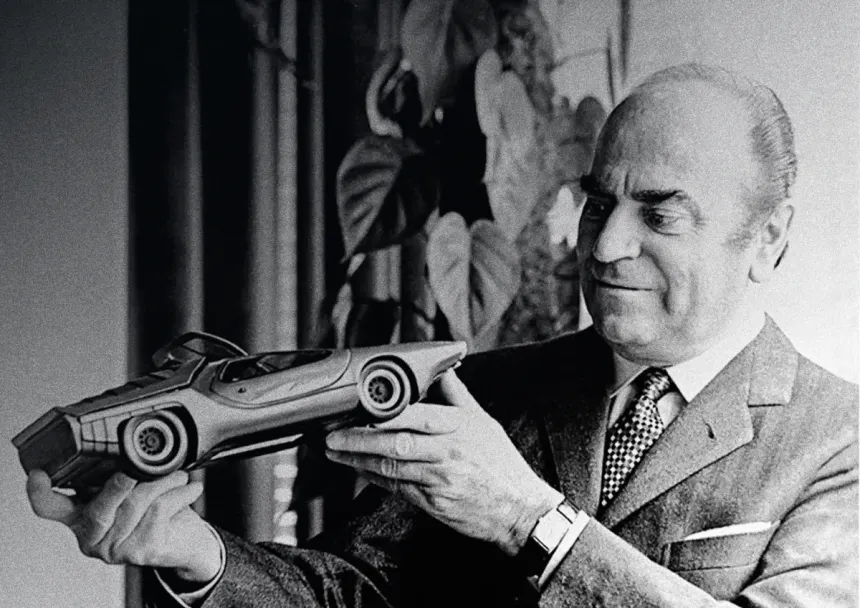
BERTONE — THE FACTORY THAT INVENTED WHAT YOU SEE WHEN YOU CLOSE YOUR EYES AND THINK OF A SPORTS CAR
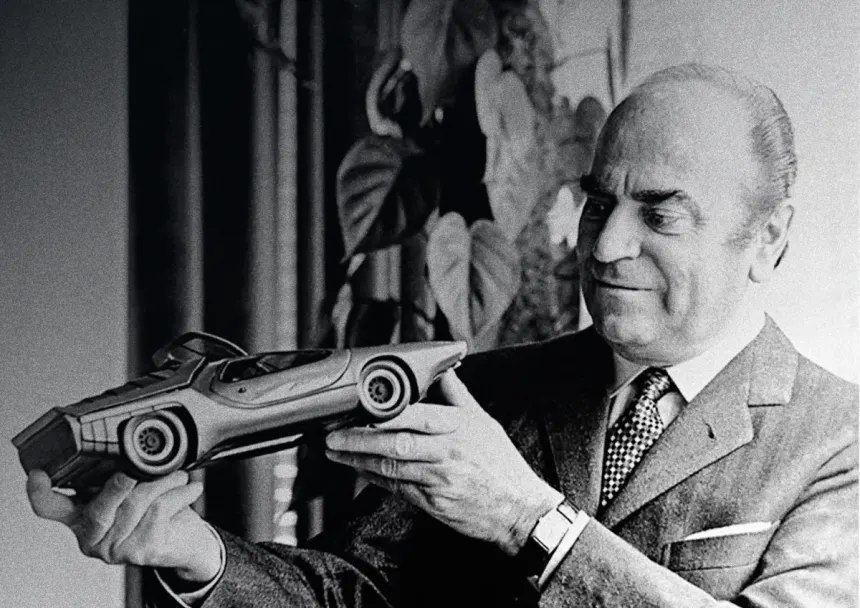
There are names that need no introduction and then there’s Bertone, which doesn’t even need you to say the full name. You say Bertone and you’re already seeing a car. You don’t know which one, but you know it’s the kind that forces you to turn your head. The kind that makes a functioning adult stop dead on a sidewalk with their mouth open.
Carrozzeria Bertone. Turin, 1912. A horse-drawn carriage workshop founded by a 28-year-old named Giovanni Bertone, sixth of seven sons from a farming family in Mondovì, Piedmont. Three employees. Wood and wheels. Nothing to suggest that from there would come the Miura, the Countach, the Stratos, the X1/9, and half a century of the wildest concept cars humanity has ever produced.
But it did. All of it came from there.
From carriages to coachwork: Giovanni’s DNA
Giovanni Bertone had worked as a carriage wheelmaker and spent time at Diatto before opening his own shop on Corso Pesciera in 1912. He knew Vincenzo Lancia personally — they were friends — and that opened doors to contracts with Fiat and Lancia that transformed his carriage repair business into an automobile coachbuilding workshop. His first self-made car body was built on a SPA 9000 chassis in 1921.
He wasn’t a designer. He was a craftsman. The distinction matters. Giovanni Bertone built things with his hands and understood materials. Those who knew his work said you could identify a Bertone carriage by the sound it made rolling over Turin’s cobblestones. That obsession with quality — with how something sounds, how something feels, not just how it looks — is what later turned Bertone into Bertone.
In 1933 his son joined the workshop. Giuseppe Bertone, whom everyone called Nuccio. He was nineteen. And with him came a designer named Mario Revelli de Beaumont, who was twenty-nine. Together they presented at the 1934 Milan Motor Show a Fiat 527 S Ardita 2500 they called “Superaerodinamica” — a ridiculous name for a car that was actually defining a philosophy: a car’s lines aren’t decoration, they’re engineering.
War, destruction, and rebirth
World War II forced Bertone into military vehicle production. Giovanni kept the workshop alive through conservative management and pure stubbornness. When the war ended, Nuccio took the reins of the family business and began transforming the small coachbuilding shop into something nobody had seen before: an industrial design house with series production capability.
The key moment arrived at the 1952 Turin Motor Show. Bertone showed up with two rebodied MG TDs and almost no money. The company was on the brink of extinction. But those two cars caught the attention of exactly the right people. Alfa Romeo commissioned Bertone to design and produce the Giulietta Sprint — and that changed absolutely everything.
Scaglione, Giugiaro, Gandini: the school that had no name
Nuccio Bertone was not a designer. He was something better: a talent scout with a supernatural instinct for identifying young geniuses and letting them work. His skill wasn’t in the pencil. It was in knowing who to hand the pencil to.
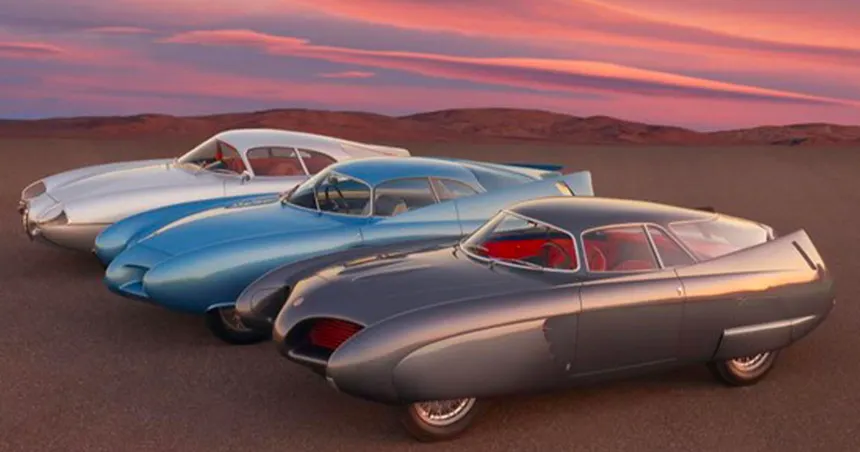
The first was Franco Scaglione. Florentine aristocrat, former aeronautics student, former women’s fashion designer. A man whose mind recognised no boundaries between disciplines. Scaglione gave Bertone the B.A.T. cars — three concept cars on Alfa Romeo 1900 chassis that achieved a drag coefficient of 0.19 in 1954 without a wind tunnel, by taping wool threads to the bodywork and photographing them in motion. He also gave them the Giulietta Sprint, the car that turned Bertone into a volume manufacturer, and the Giulietta Sprint Speciale. Scaglione worked at Bertone throughout the 1950s.
When Scaglione left, any other studio would have gone into crisis. Nuccio simply reloaded. This time with a 21-year-old named Giorgetto Giugiaro, whose talent was so evident that he would later be declared the outstanding automotive designer of the 20th century in a poll of experts. Giugiaro gave Bertone the Chevrolet Corvair Testudo in 1963, a car that directly influenced later designs like the Miura, Montreal, and 850 Spider. He’s also credited with the first sketches of the Gordon-Keeble and the Iso Grifo.
Giugiaro left for Ghia. And Nuccio found another young man, 27-year-old Marcello Gandini. Son of an orchestra conductor, with no formal academic training in design but with staggering talent. In 1963 he’d applied for a job with Nuccio, but Giugiaro — then head of design — opposed his hiring. When Giugiaro departed in 1965, Gandini walked in. And almost immediately drew the car that changed the world.
The Miura and everything that followed
The 1966 Lamborghini Miura. The first supercar in history. Mid-mounted transverse V12 engine. Designed by Gandini in four months. Low, curved, sensual, extraordinarily fast. Nothing resembled it. Nothing before it prepared you for it. The Miura wasn’t an evolution — it was a total break with everything that existed before.
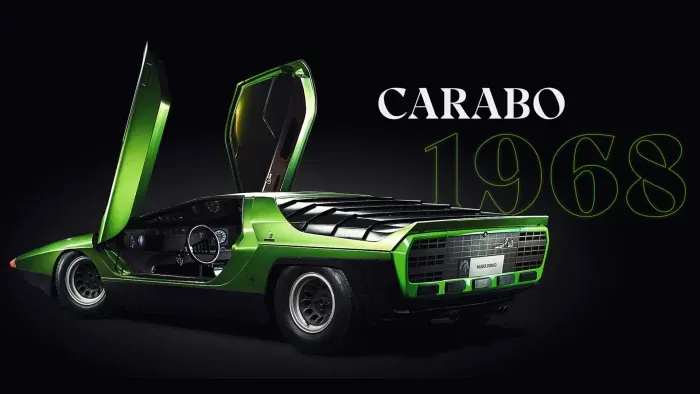
And from there, the avalanche. Gandini gave Bertone the Alfa Romeo Montreal for the 1967 Expo. The Lamborghini Espada. The 1968 Carabo — the first wedge-shaped concept car, the one that invented the visual language that defined the 1970s. The 1970 Lancia Stratos Zero, a self-propelled science fiction sculpture that Nuccio Bertone took to documenta in Kassel alongside works by Francis Bacon and Balthus. And in 1971, the Lamborghini Countach LP500, in sunflower yellow, with a 5-litre V12 and 440 horsepower that debuted at the Geneva Motor Show and made people say “countach” — the Piedmontese exclamation that gave it its name.
Think about that. A design studio from Turin presented the first supercar in history, invented the wedge design, created the most radical concept car ever taken to a contemporary art exhibition, and then topped it all with the Countach — all within five years. Five.
Production and the other Bertone
But Bertone wasn’t just impossible concepts and poster supercars. Nuccio understood that a design studio needs volume to survive, and he was equally brilliant at that.
The Fiat X1/9, launched in 1972 on a Fiat 128 chassis with a mid-rear engine, was manufactured on Bertone’s own production line. Over 160,000 units were built through 1988. It was an accessible, agile, fun sports car — the car that put the mid-engine layout within reach of normal people. The 1973 Ferrari Dino 308 GT4 was a controversial commission that infuriated Pininfarina, who considered Ferrari exclusive territory. The Citroën BX. The Innocenti Mini 90. The Opel Astra Coupé and Cabriolet. The Volvo 262C and 780. Bertone bodied cars for virtually every European manufacturer, and some of their production cars were as good as their concepts.
In 1971, Nuccio moved the design studio from the Corso Allemano factory to Caprie, west of Turin. He wanted a more inspirational environment for the designers — and wanted to separate them from the factory’s labour complications. It was a gesture that said a lot about how he understood creativity: to design something nobody has seen before, you need mental space, not just physical space.
Gandini left in 1980 after fourteen years as head of design, but his successor Marc Deschamps maintained the standard. The 1989 Citroën XM, voted 1990 Car of the Year for its design and technological innovation, was designed by Deschamps for Bertone — a car that surpassed even Citroën’s own style centre proposal.
Nuccio leaves and the end begins
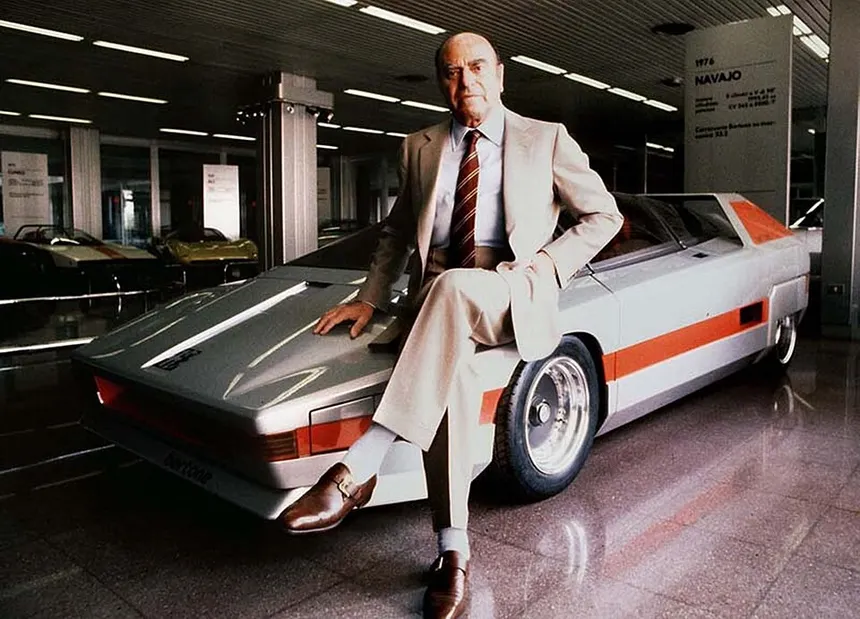
Nuccio Bertone died in Turin on February 26, 1997. He was 82. He was posthumously inducted into the European Automotive Hall of Fame in 2003. He left behind a studio that had defined automobile design for half a century. And he left a void that was impossible to fill.
His widow, Ermelinda “Lilli” Bertone, took the reins alongside their two daughters, Barbara and Marie-Jeanne. Lilli had determination — in 2012 she presented a concept called “Nuccio” at the Geneva Motor Show to celebrate the company’s centenary and promised not to let her husband’s dream die. But determination isn’t the same as Nuccio’s entrepreneurial genius, and the world had changed. Manufacturers were internalising their design centres. Production contracts were being withdrawn. The business model that had sustained Italian carrozzerie for decades was crumbling.
From 2007, Bertone entered continuous financial turbulence. In 2009 they sold their manufacturing plant to Fiat — the facility where over 160,000 X1/9s had been built and which had capacity for 70,000 vehicles per year. In 2011 they sold part of their concept car collection. Employees stopped getting paid. Suppliers sued. In March 2014, with 160 unpaid employees and unable to file their 2013 accounts, Bertone confirmed it would enter bankruptcy proceedings if no buyer was found by the end of April.
None was found.
On June 4, 2014, Stile Bertone was officially declared bankrupt. Over 31 million euros of debt accumulated in less than five years. The car collection, classified as Italian national historic heritage, could only be sold as a complete set. The rights to the Bertone name and logo expired at the end of 2014 and belonged to a separate entity, Bertone Cento.
The studio that had invented the supercar, the wedge design, and the idea that an automobile can be a self-propelled sculpture was being sold off piecemeal at a bankruptcy auction.
The ghosts keep driving
In 2020, brothers Mauro and Jean-Franck Ricci acquired the rights to the Bertone brand. The Riccis came from engineering consultancy — they’d built a company with over 22,000 engineers working for the automotive and aerospace industry. In 2022 they presented the GB110, a 1,100-horsepower hypercar with a twin-turbo 5.2-litre V10, limited to 33 units, priced at 2 million euros. The name celebrates the 110th anniversary of the founding.
It’s a legitimate attempt at resurrection. But let’s be clear: the Riccis’ Bertone is not Nuccio’s Bertone. It can’t be. Nuccio’s Bertone wasn’t a name or a logo — it was a man with a supernatural instinct for finding 21-year-old geniuses and giving them the freedom to reinvent the automobile. You can’t buy that at a bankruptcy auction. You can’t inherit it. It dies with the person who had it.
What remains is the most extraordinary catalogue in the history of automobile design. The B.A.T.s. The Miuras. The Countachs. The Stratos. The Carabo. The X1/9. The archive of 70,000 sketches and plans signed by Scaglione, Giugiaro, and Gandini. The irrefutable proof that Italy, in a Turin workshop, invented the visual language with which the entire world still designs cars today.
Giovanni Bertone built carriages you could recognise by how they sounded on cobblestones. His son found the three most important designers of the 20th century and let them draw whatever they wanted. And between the two of them, they built something that, when you look at it now, seems impossible to have ever existed.
Check you’re still alive.
7 thoughts on “BERTONE”