The Man Who Built the Most Recognisable Brand on Earth and Buried Eight of His Drivers
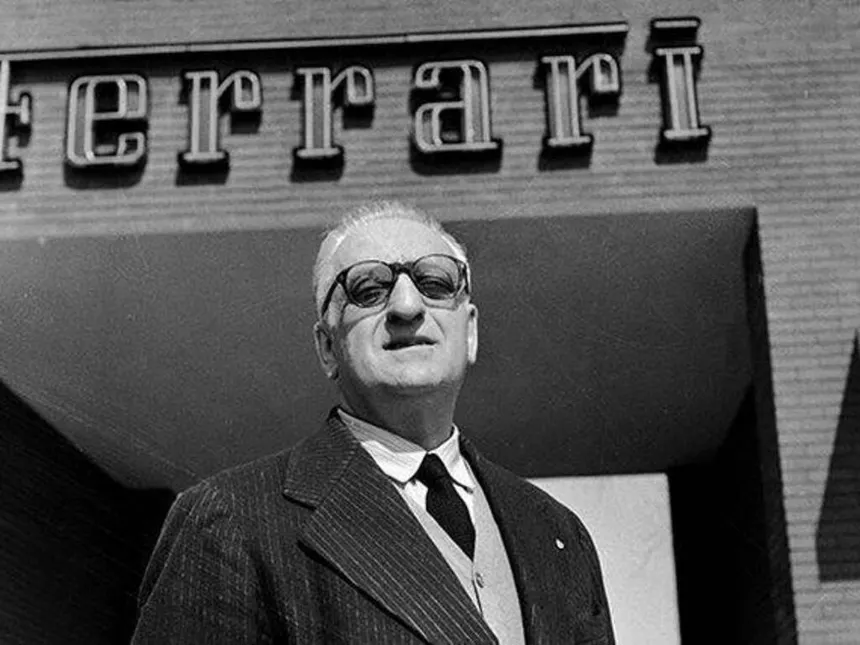
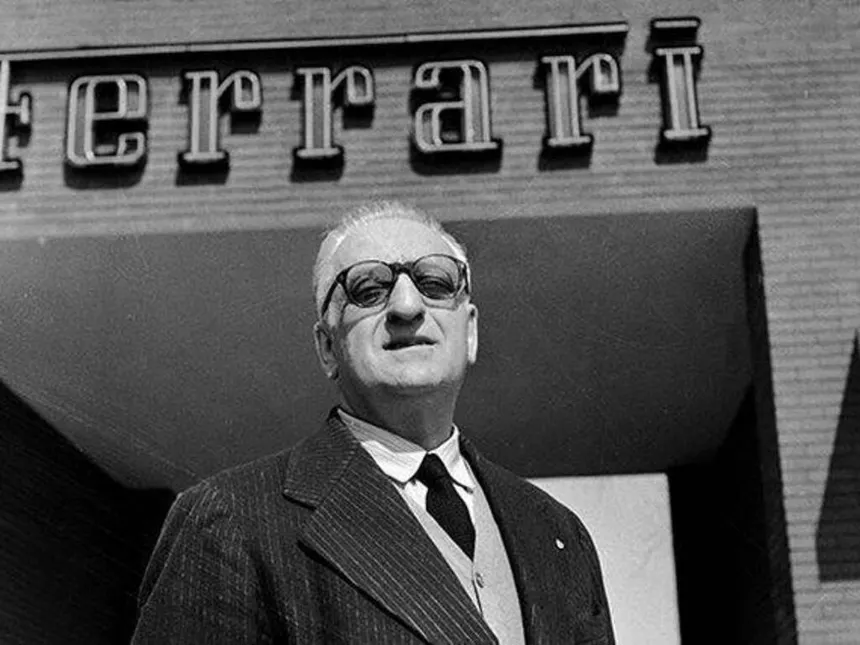
The official newspaper of the Vatican compared him to Saturn devouring his own children.
Not a rival. Not a bitter ex-driver. Not some leftist tabloid sniffing around for controversy. L’Osservatore Romano. The official newspaper of the Holy See. In black and white. While Italy was burying yet another young driver killed in a red car.
Enzo Ferrari read that article. Kept a copy of it. And carried on as if nothing had happened.
If you want to understand what came afterwards — the championships, the millions, the three letters your kid can draw without ever having seen a Ferrari up close — you have to understand the man. And to understand the man you have to accept that the official Maranello story has only told you one half. The other half exists. It’s documented. And it’s the half that matters.
The boy from Modena
Enzo Anselmo Ferrari was born in Modena on 18 February 1898. Son of a small-time metalworker. Second of two brothers. He went with his father to a race in Bologna at the age of ten and something got under his skin that day and never left.
1916: His father died of pneumonia. A few months later his brother Alfredo died too. The 1918 flu nearly took him as well. He survived the war, came home, and in 1919 walked into Fiat in Turin looking for a job as a mechanic. They told him no. Try somewhere else.
That’s the first scene. Hold onto it. Ferrari wasn’t born into nothing. He also wasn’t born into anything special. What stuck to his bones for the next seventy years was a very specific cocktail of wounded pride and a need to prove something to someone.
He found work at a small shop rebuilding Lancia chassis to sell as light trucks. From there he jumped to Alfa Romeo as a driver and salesman. Won a few races. Not enough that you’d remember him as a great driver, but enough to learn from inside what makes a car win and what makes a driver bring it home in one piece.
1929: He founded Scuderia Ferrari as a satellite team to Alfa Romeo. His job was to prepare and race Alfas for the gentlemen drivers who paid for the privilege. He was good at it. So good that throughout the 1930s the Scuderia became, in practice if not in writing, the official Alfa Romeo racing operation.
1939: Argument with Alfa management. Ferrari walks out. He signs an agreement preventing him from using his own name on competition cars for four years. He sets up Auto Avio Costruzioni, builds machine tools, survives the war, and the moment the clause expires, starts building cars with his name on the nose.
1947: The first Ferrari rolls out of the Maranello workshop. 125 S. V12. The marque starts there.
You know what came next.
The dead
What you probably don’t know, or not in full, is this.
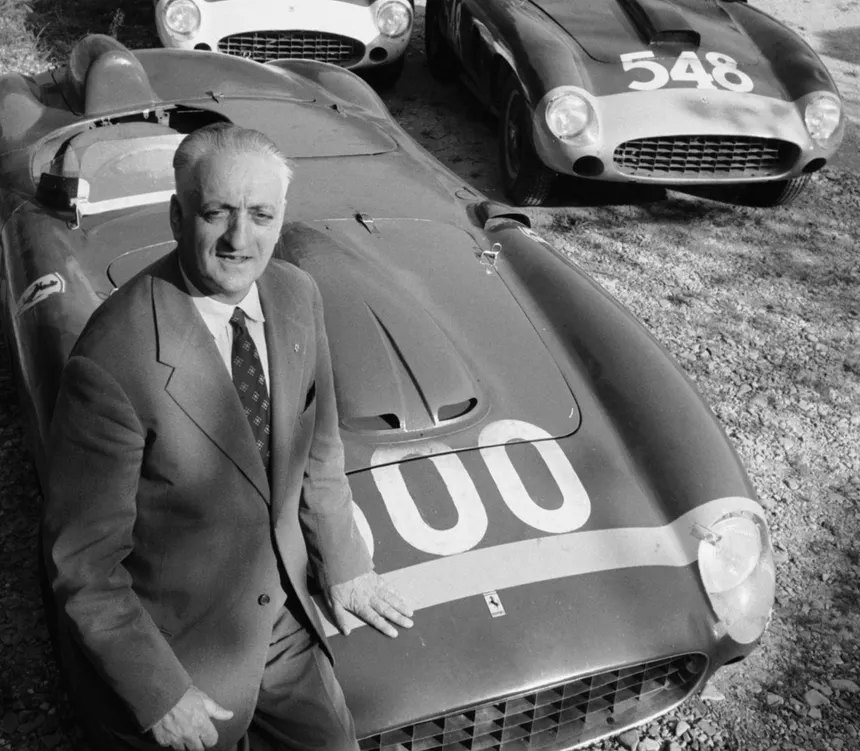
Between 1955 and 1971, eight drivers under contract to Ferrari died driving cars built by Ferrari. It wasn’t a streak. It was the standard of that era. But the list, written out one after the other, hits differently.
Alberto Ascari. Two-time world champion with Ferrari, 1952 and 1953. Killed in 1955 at Monza testing a Ferrari Sport that wasn’t even his. He was just doing a few laps for fun. Wearing a friend’s helmet.
Eugenio Castellotti. March 1957. Testing in Modena.
Alfonso de Portago. May 1957. Mille Miglia. The left rear tyre on the Ferrari 335 S blew at high speed. The car went off, killed De Portago, killed his co-driver Edmund Nelson, killed at least nine spectators among them five children. Enzo Ferrari was charged with manslaughter. He was acquitted. De Portago’s widow publicly called him “The Murderer” until the day she died. The Italian government shut the Mille Miglia down forever. Ferrari attended no funerals that month.
Luigi Musso. July 1958. French Grand Prix, Reims. Died trying to catch Mike Hawthorn through a fast corner. He was under financial pressure to win. Ferrari paid by victory.
Peter Collins. August 1958. German Grand Prix, Nürburgring. A few weeks after Musso. The other British number one of the season, in the other red car.
Wolfgang von Trips. September 1961. Italian Grand Prix, Monza. He was leading the world championship. The collision with Jim Clark’s Lotus killed the German and fourteen spectators standing behind the fence.
Lorenzo Bandini. May 1967. Monaco Grand Prix. His Ferrari hit the straw bales, flipped, caught fire. He took three days to die in hospital with burns over seventy percent of his body.
Ignazio Giunti. January 1971. Buenos Aires 1000 km. He hit the back of Beltoise’s Matra, which was being pushed along the track with the engine off. The Ferrari burst into flames with Giunti inside.
Eight. In sixteen years. Under contract.
Stirling Moss, defending Enzo years later, made a famous remark: he couldn’t recall a single case in which a Ferrari driver had died because of a mechanical failure. It’s an interesting line of defence. What it actually says is that the cars were reliable. The drivers were dying of something else.
What were they dying of?
They were dying of pushing absolutely to the limit, knowing that if they didn’t there was someone right behind them ready to. That was the system.
The method
Enzo Ferrari never named a number one driver. Deliberately. His explicit philosophy was to put his own drivers up against each other inside the same garage to extract the last tenth out of them. He called it “stimulating competition”. His engineers, in private, called it something else.
1951: Stirling Moss, who would go on to be five times runner-up in the World Championship, travelled from the United Kingdom down to Bari for a race. Ferrari had offered him a car. He showed up at the circuit, looked for his Ferrari, and discovered they had given it to Piero Taruffi without telling him. No call. No telegram. Moss went home to England and swore he would never drive for Ferrari again as long as he lived. He kept the promise.
1976: Niki Lauda is one season into his time at Ferrari, already a world champion, on his way to the second. Nürburgring. The car goes off, hits the bank, bursts into flames with him inside. Other drivers — Merzario, Edwards, Ertl, Lunger — pull him out of the fire. He inhales smoke, burns his head, his lungs, his ears. A priest gives him last rites in the hospital. Doctors tell his wife to prepare for the worst.
While Lauda is fighting to breathe, Ferrari signs Carlos Reutemann as his replacement. Lauda finds out about it through the press. From his hospital bed. Nobody had told him.
Forty-two days later he is back behind the wheel of a Ferrari at Monza, burns still raw, blood seeping through his balaclava. He finishes fourth. He loses the 1976 championship by a single point after pulling out at Fuji in the rain. He wins the 1977 title. He leaves for Brabham.
He never speaks well of Enzo Ferrari again. Not once.
The desk
Inside Maranello there was, for decades, an office with a desk of unusual proportions. The desk was wide. Wider than was reasonable. So wide that a visitor who sat opposite and wanted to shake the hand of the man on the other side had to lean halfway across the surface, almost rise out of his seat, to reach the offered hand.
The people closest to him described it as a calculated ritual. Important men arrived in Maranello already carrying a mix of admiration and fear, and the first thing they did upon entering that office was physically bend forward to greet Enzo Ferrari. A genuflection dressed up as protocol.
He completed the effect with another habit known throughout the paddock: making the visitor wait. Sometimes for hours. Fiat industrialists, rival team principals, drivers under contract negotiation, journalists with confirmed appointments — they all sat in the same antechamber where time stretched without explanation.
When the door finally opened, the visitor walked in carrying one very clear thought already inserted into his head. I am the one who decides things here.
The Great Walkout
1961: The men who had built Ferrari’s engineering and racing operation up to that point — Carlo Chiti, Giotto Bizzarrini, Romolo Tavoni, Girolamo Gardini and others — walked out of the company together. One of the most famous mass departures in motoring history. The Great Walkout.
Versions differ depending on who tells it. The common thread doesn’t. Working for Enzo Ferrari, on his terms, beyond a certain point, was unsustainable. Decisions were not open to debate. Opinions were not requested. Laura Ferrari, Enzo’s wife, had been getting increasingly involved in internal company matters in the months before the break, and that had stretched the rope to its limit.
Enzo’s response was telling. He summoned to his office a 26-year-old engineer who had been at the company for twelve months, a man called Mauro Forghieri. He handed him the technical leadership of the entire racing operation. Forghieri spent the next twenty-seven years building the cars that would win four drivers’ championships and seven constructors’. In 1985, Enzo sidelined him with a decorative title. Forghieri resigned three times before they let him go.
That other side — the engineer who built almost everything and got silence in return — exists on NEC too. Read it whenever you want. It’s the missing half of this story.
The customer as instrument
There’s a sentence Enzo Ferrari said in different variations throughout his life. It sums up his entire commercial philosophy.
“Road cars are the way I pay for racing.”
Sit with what that sentence implies. The customer who walks into a dealership to buy a road-going Ferrari is not the target of Enzo Ferrari’s passion. He is the means. He is the cheque that pays for the actual business, which is the Scuderia. Carlo Benzi, accountant and close personal friend of Enzo’s for decades, confirmed this in private years afterwards. For Ferrari, the racing car was the reason. Everything else was a tool.
That philosophy explains a lot. It explains why for years Ferrari deliberately sold fewer cars than the market wanted — making sure demand was always greater than supply. It explains why customer service was often dry, distant, almost dismissive. It also explains why the brand grew as much in mystique as it did in numbers. You were buying something its creator considered secondary. You were paying to enter a church where the priest wasn’t there for you. He was there for his dead.
And it worked. It still works. That’s the uncomfortable part.
Ford
1963: Henry Ford II wants to buy Ferrari. Negotiations advance. There are teams of lawyers, written numbers, formal meetings at Maranello. Enzo is willing to sell the road-car division but not the racing one. Ford accepts the road-car division. When the moment to sign arrives, a clause appears stating, in essence, that Ferrari’s racing decisions will be subject to Detroit’s approval. Specifically, the budget for Le Mans.
Enzo gets up from the table. The deal collapses.
Henry Ford II flies back to the United States furious. He gives the internal order to build a car capable of destroying Ferrari on its own ground. Le Mans. The project is called GT40. It stumbles at first, accelerates, evolves, and in 1966 the GT40s finish 1-2-3 at Le Mans with Ferrari off the podium.
Enzo replies the following year with the 330 P4 and slams the door at Daytona, also with a 1-2-3, photographed deliberately in formation to humiliate Ford with the same image they had used against him.
The war was personal. It stayed personal forever. Hollywood made a film about it not long ago, telling Ford’s version. Enzo’s version is simpler. He should never have entertained the sale in the first place. But the money Ford offered was serious money.
Ferruccio
The legend goes like this. Ferruccio Lamborghini, tractor manufacturer with enough money for several Ferraris, has a clutch problem with his Ferrari 250 GT. He drives to Maranello to complain in person. Enzo receives him — or doesn’t quite receive him, depending on the version — and delivers a line along the lines of: “The problem isn’t with the clutch. The problem is with the driver. A tractor manufacturer has no business telling me about sports cars.”
Ferruccio drives back to Sant’Agata, opens a workshop, and in 1963 founds Automobili Lamborghini.
Some historians question the exact wording of the conversation. None of them question the pattern. Enzo Ferrari treated a wealthy, sharp, mechanically literate man who had built his fortune with his own hands as if he were a peasant who had wandered into the wrong drawing room.
The result of that single moment of contempt is the other Italian supercar marque of the twentieth century. Lamborghini does not exist without Enzo Ferrari’s bad manners that day. That’s the parallel legacy of the man.
Dino
His legitimate son, Alfredo — known to everyone as Dino — was born in 1932. He suffered from muscular dystrophy. A bright young man, training as an engineer, working on engine design at the factory from his teenage years onwards. His father loved him in his own particular way. A very particular way.
Enzo Ferrari built calorie tables to manage Dino’s diet. Kept a daily medical log. Recorded weight, pulse, medication. He did it with the discipline of an engineer running a project. Carroll Shelby, who knew them up close, said years later that Dino spent most of his illness inside the factory with the mechanics, playing with engines. His father barely visited him at home.
Dino died in 1956. He was 24. Enzo did not really attend the funeral in any meaningful sense. He shut himself away. Then visited his son’s tomb every single day for years, always in a dark suit and tinted glasses. That image — the broken father visiting the grave — is the one the official Maranello narrative prefers to remember.
The other image — the father who barely visited his sick son at home because the factory was easier — does not appear in the authorised documentaries.
Both images are true at the same time. That’s the part that’s hard to swallow.
It later emerged that Enzo also had a second son, Piero, the result of a decades-long relationship with Lina Lardi. Both relationships — the official one with Laura, the parallel one with Lina — ran simultaneously for almost the whole of his adult life. Enzo did not legally recognise Piero until after Laura’s death in 1978. Twenty-nine years of an unrecognised son. Piero today is vice-chairman of Ferrari. He carries the name. He arrived late and he arrived through the right door. But he arrived.
The end
14 August 1988. Enzo Ferrari died in Maranello, aged 90. Leukaemia. He was buried before his death was made public. No open funeral, no cortège, no city of Modena lining the streets to say goodbye. The family chose to inform the country only after the body was already in the ground.
The last car he saw born was the F40. A car many consider his testament — no driver aids, no luxuries, no concessions to comfort, everything thrown at speed. He unveiled it himself. He was 89.
He sold 50 percent of Ferrari to Fiat in 1969. In 1988, the year of his death, Fiat raised its stake to 90. The brand stayed in Italy. The brand stayed.
The question with no answer
Enzo Ferrari built the most recognisable car brand on the planet. He did. It’s a fact. Four letters in any language. A prancing horse millions of people draw from memory without having ever seen a real one.
He built it on a system in which drivers died and nobody from the team turned up at the funeral. In which engineers walked out together and the answer was to hand the technical department to a 26-year-old. In which customers were instruments, rivals were people to humiliate, sons were projects to manage, and the desk in the office was designed to make the visitor lean forward.
The Vatican newspaper compared him to Saturn. He read it and carried on as if nothing had happened.
Can you admire what he built without looking at how he built it?
That’s the question. I’m not going to answer it for you. Each person’s answer says more about them than it does about Enzo Ferrari.
Check you’re still alive.
27 thoughts on “ENZO FERRARI”