The Italian Who Walked Away From Henry Ford
Detroit, 1920. The Rouge plant was still being built but Highland Park was already running flat out, churning out Model Ts at a pace nobody in Europe could match. Henry Ford himself sat down with a 27-year-old visitor from Turin and offered him a job. Stay in America. Build cars at the scale only America could build them. Battista Farina, the tenth child of an eleven-kid family from a wine-village in Piedmont, said no thanks and bought a ticket back to Italy.
Think about that for a second. This is the same decade Raymond Loewy was about to redraw American consumer products, the same decade Harley Earl was about to invent industrial design at General Motors. Detroit was the center of the automotive universe. And a coach-builder’s apprentice from Cortanze d’Asti turned down Henry Ford because he had a different idea of what a car was supposed to be.
That refusal is the key to everything Pininfarina ever did.
A name that stuck
He was born Giovanni Battista Farina on November 2, 1893, in Cortanze, a village of a few hundred souls in the Asti hills. The family nickname Pinin — Piedmontese for little Joseph — wasn’t about being small or being the baby of the family. It was about looking like his father Giuseppe. The name stuck for life and eventually became a company, a marque, and a legal surname by presidential decree. But it started as a kitchen-table joke about resemblance.
The Farinas had moved down from the vineyards to Turin during the agricultural crisis of the 1880s. Battista’s father sold wine retail under the shadow of the Mole Antonelliana, doing the same thing thousands of farming families did in Italy at the turn of the century: trading the unpredictability of harvests for the unpredictability of city work. At eleven, Battista walked into his older brother Giovanni Carlo’s body shop, Stabilimenti Farina, and started learning the trade the only way it could be learned in 1904: hammers, sheet metal, a forge in the back, and whoever was older than you teaching you what they’d learned the same way.
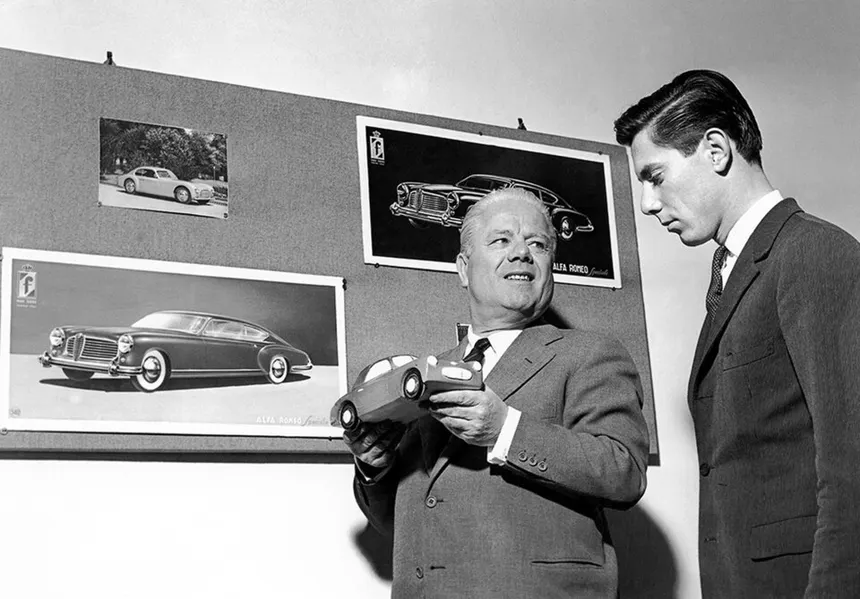
By eighteen he was good enough to design a radiator grille for the Fiat Zero. The grille caught the eye of avvocato Giovanni Agnelli himself. When the founder of Fiat notices your work at eighteen, you’re not on the wrong track.
The war that taught him aerodynamics
Most biographies skip what Battista did between 1915 and 1918, and that’s a mistake because it changed him. He didn’t go to the trenches. He stayed in Turin and supervised the production of Aviatik training aircraft, the German-designed two-seat biplanes built under license for the Italian air arm. Wood spars, doped fabric, riveted aluminum. Aerodynamic structures decades before anyone was talking seriously about car aerodynamics.
When Battista Farina later wrote in his memoirs that “aerodynamics is the form of speed”, he wasn’t borrowing a slogan. He was describing something he had actually built with his own hands. That’s why his streamlined Alfa Romeo 6C of 1935, his enclosed Lancia Astura cabriolets, and eventually the Cisitalia 202 — which we’ll get to — didn’t look like styling exercises. They looked like aircraft fuselages with wheels. Because the man who shaped them had spent four years shaping aircraft fuselages.
This is the under-appreciated part of Italian coachbuilding history. The generation that defined it — Touring, Bertone, Ghia, Pininfarina — came of age in the same window when aviation was teaching everyone what fluid dynamics actually meant. They translated that knowledge into automotive shapes years before American Detroit got there. Harley Earl drew rocket ships. Battista drew streamlined volumes that actually moved through air efficiently. Different cultures, different priorities.
The American detour
So back to 1920. After the war ended, Battista crossed the Atlantic to see Detroit firsthand. He met Henry Ford. He met the engineering culture that was inventing mass production as we know it. And then, with the offer of a Ford job in his pocket, he turned around and went home.
The romantic version of this story says he was attached to Italy. The boring version says he ran the numbers. In Detroit, Battista would have been one engineer among thousands, brilliant or not. In Italy, the coach-building trade was still wide open, still respected, still capable of supporting independent shops with their own identity. Detroit was for men who wanted to be part of the biggest. Turin was for men who wanted to be the best at something specific.
He chose specific.
1930: the wrong year to start a company
He came home, married Rosa Copasso in 1920, and over the next few years had two children — Gianna in 1922, Sergio in 1926. None of that reads like a corporate origin story, but it is one. The Farina household functioned for forty years as an industrial unit. The wealthy aunt who provided seed capital was Rosa’s, not Battista’s. The son-in-law who would eventually run the company alongside Sergio, Renzo Carli, would be Gianna’s husband. When Battista handed over management in 1961, he didn’t hand it to a board: he handed it to his son and his son-in-law. American family firms of the same scale would have professionalized long before. The Pininfarinas didn’t. That stubbornly Italian decision turned out to be one of the reasons the house outlasted most of its peers.
Battista kept working at his brother’s shop until he had enough capital to leave. Vincenzo Lancia, who he’d befriended during a brief but successful racing career, put up additional money. Yes, he raced. He won the Aosta-Gran San Bernardo hillclimb in 1921 in his own car, setting a course record that stood for eleven years. The man knew what cars did at speed because he had driven them at speed.
On May 22, 1930, in the depth of the Great Depression, he opened Carrozzeria Pinin Farina at 107 Corso Trapani in Turin. Ninety-two hundred square meters, 150 employees, capacity for seven or eight bodies a day. Lancia was a minority shareholder. The aunt was a minority shareholder. Battista held the rest.
What happened inside that building wasn’t yet a Detroit-style assembly line. Pinin Farina in 1930 was a hybrid: modern machinery for stamping and forming sheet metal on one side, traditional coachbuilding craft on the other. Panels were hammered over bucks, finished with files and slappers, fitted by eye against wooden frames. The shop smelled like any coachbuilder’s shop in that era — hot oil, lead-loaded body filler, lacquer, freshly cut leather for the interiors. The noise wasn’t Detroit’s continuous roar but a punctuated rhythm: hammers, presses cycling in batches, hand-finishing in relative quiet. Battista wanted both at once: serial production and artisanal execution. That apparent contradiction became the company’s DNA for the next sixty years.
In those early years he worked closely with Mario Revelli di Beaumont, a respected Turin designer, on some of the studio’s most innovative early projects. The first significant commissions came quickly: a Hispano-Suiza coupe, the Fiat 518 Ardita in 1933, continuous work for Lancia on the Augusta, Astura and Aprilia chassis. By 1939, before the war froze everything, Pinin Farina was producing eight hundred bodies a year and the workforce had grown to roughly five hundred people. Twenty times the 1930 launch.
The timing was either brilliant or insane. Italy was sliding into Fascist economic autarky, the global luxury market had collapsed, and most coach-builders were scaling down. Battista scaled up.
The dark years
Italy entered the war on June 10, 1940, and the civilian industrial program froze overnight. Pinin Farina, like Fiat, Lancia, Alfa Romeo and most of northern Italy’s manufacturing base, was forced to convert. At Corso Trapani the aerodynamic coupes gave way to ambulance bodies and to carriages for anti-aircraft searchlights. It wasn’t a total conversion like Fiat’s — the plant remained a coachbuilder rather than an arms factory — but the civilian side emptied out. Workers who weren’t drafted spent five years riveting sheet metal for purposes Battista had never imagined.
Turin paid heavily. It was one of the most heavily bombed cities in northern Italy between 1940 and 1945, with Fiat, Lancia and Michelin plants all hit in various Allied raids. That Corso Trapani survived without serious damage was partly geography, partly the fact that the plant was not a priority military target. But the fear marked the place. Five years of working with one eye on the sky, shelters nearby, sirens periodically stopping production while everyone waited underground for the all-clear.
When the war ended, Battista was 51. The workforce was decimated, the machinery worn, the Italian economy in ruins. And the first thing he did was restart civilian production with a Lancia Aprilia Bilux. Before the big commissions came back. Before Paris. As if getting a road car out the door at Corso Trapani was the only way he knew of declaring that the war was over.
Paris, 1946: two cars at the door
The end of the war left Italy in an awkward position. As an Axis country, Italian manufacturers were barred from the 1946 Paris Motor Show — the first major postwar event, the one that would establish who counted in European industry going forward. Battista Farina was not invited.
He drove anyway. Took a freshly finished Alfa Romeo 6C 2500 and a Lancia Aprilia Cabriolet, put his son Sergio behind the wheel of one, drove from Turin to Paris, and parked both cars at the entrance of the Grand Palais.
No stand. No invitation. No permission. Two Italian cars planted in the doorway of the show that wouldn’t let him in.
The French press photographed them. The public stopped to look. And without firing a shot or making a speech, Battista made the point that mattered: Italian coachbuilding didn’t need a hall. It needed two cars and a sidewalk.
The Cisitalia and the Museum of Modern Art
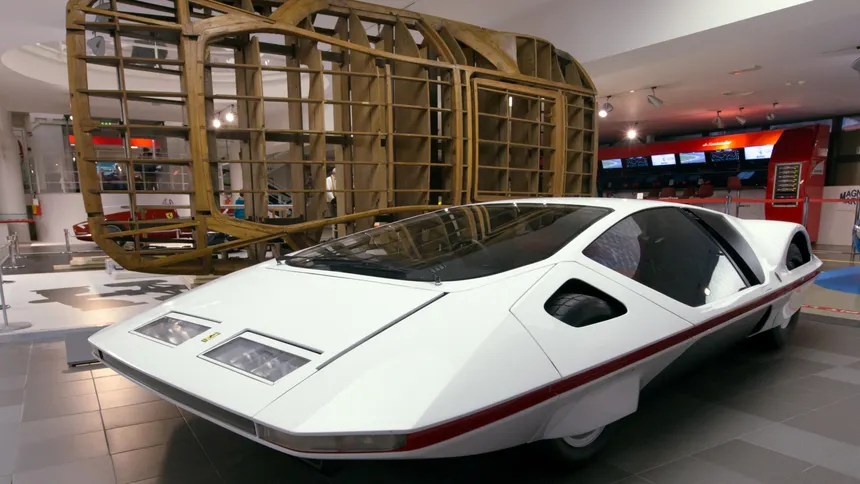
A year later, Piero Dusio commissioned a sports coupe on Fiat 1100 mechanicals. The result was the Cisitalia 202. Continuous bodywork. No running boards. No separate fenders. A single sculpted volume that absorbed hood, fenders, and cabin into one shape. Before the 202, cars were assemblies of parts. After it, cars were sculpted objects.
In 1951, the Museum of Modern Art in New York included the Cisitalia 202 in Eight Automobiles, a landmark exhibition curated by architecture historian Arthur Drexler. A car, indoors, in an art museum, presented as an aesthetic object equal to anything Mies van der Rohe had drawn. Battista didn’t attend the opening. He was already working on the next one.
That decision — by an American institution, framed in American art-critical terms — did more for the global reputation of Italian coachbuilding than any motor show ever could. The visual language of the 202 got copied wholesale by every manufacturer on both sides of the Atlantic for the next twenty years. Look at any 1950s coupe and you can trace the silhouette back to Cortanze.
The Cisitalia deserves its own piece, and it’ll get one. Here we just need to register the fact: Battista Farina built the car that art accepted as art, and he did it without ever stopping being a tradesman.
Tortona, 1951: the neutral table
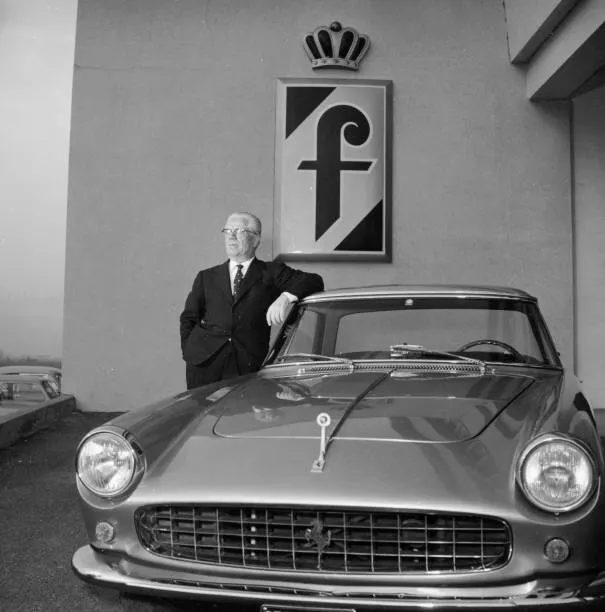
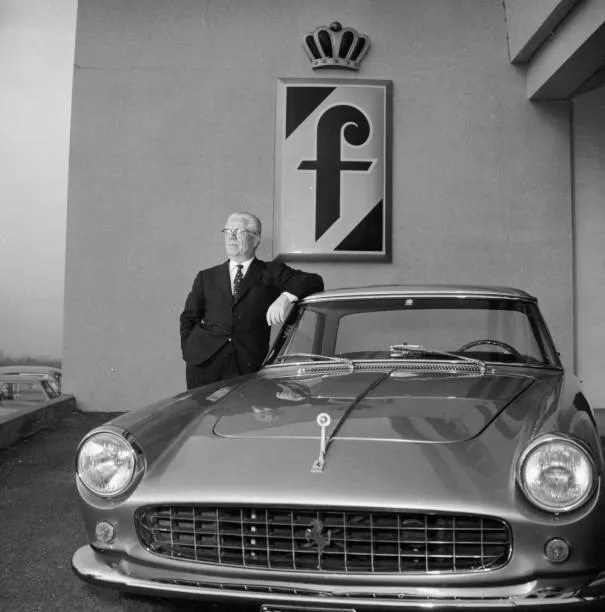
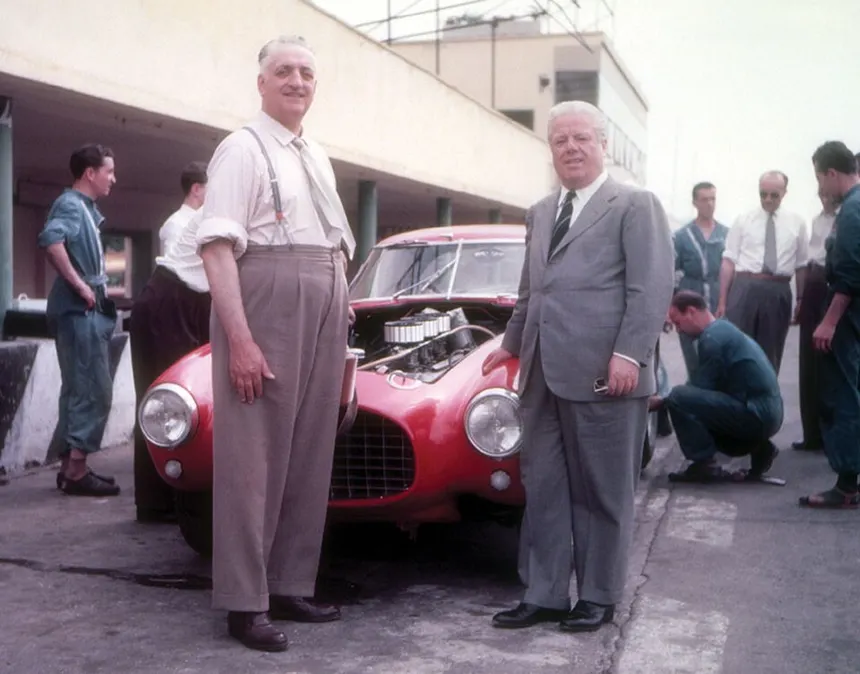
Same year. Enzo Ferrari wanted Pinin Farina to body his cars. Pinin Farina wanted the contract. But neither man would travel to the other’s territory — Enzo wouldn’t go to Turin, Battista wouldn’t go to Maranello. Italian pride is a load-bearing element in this story.
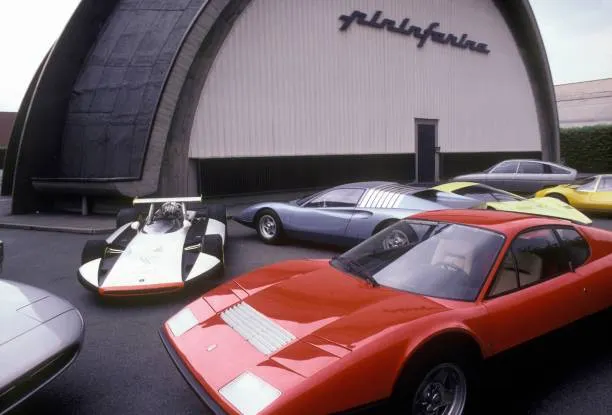
They picked a restaurant in Tortona, halfway between the two cities. Lunch. Conversation. A handshake. What came out of that table lasted sixty years. Almost every road-going Ferrari from 1952 to the F12 Berlinetta of 2012 carried Pininfarina design. Only one escaped: the Dino 308 GT4, drawn by Bertone. Sixty years, one infidelity.
That relationship gets its own article too. The point here is that Battista didn’t show up to Tortona asking for work. He showed up with the Cisitalia in his back pocket and the MoMA on his résumé, and negotiated as an equal. The difference between asking for a job and being recruited is the entire difference between a coach-builder and a styling contractor.
A surname becomes a marque
In 1961, after fifty years in the trade, the President of the Italian Republic — Giovanni Gronchi, acting on a proposal from his Minister of Justice — formally authorized Battista to change his legal surname from Farina to Pininfarina. The nickname became the name. This isn’t a quaint footnote. Italy doesn’t change family names by presidential decree casually. The state was acknowledging that Pininfarina was no longer just a person; it was an institution.
Same year, Battista handed day-to-day management to his son Sergio and his son-in-law Renzo Carli. He was 68. He’d been at the bench since he was 11. Fifty-seven years on the tools.
Lausanne, 1966
He died on April 3, 1966, in Lausanne, Switzerland — a detail most accounts skip past. His last personal design, co-credited with Aldo Brovarone, was the Alfa Romeo Duetto 1600. It debuted at the Geneva Motor Show in March 1966, less than a month before he was gone.
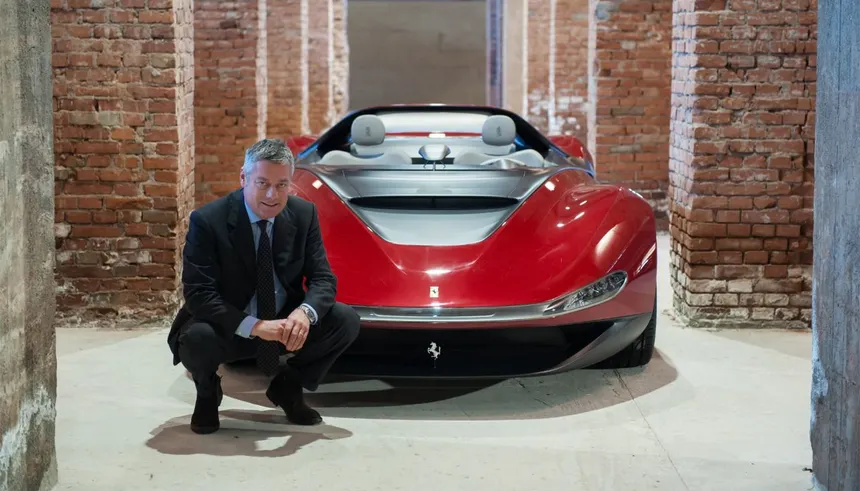
Sergio took over the chair. Sergio’s Pininfarina would design the Daytona, the Dino, the Testarossa, the F40 — the run of Ferraris that defined what a supercar looked like for an entire generation. But that’s another story.
What Battista taught the workshop
Anyone who’s spent thirty years with their hands on cars recognizes the difference Battista made, and it’s hard to explain to anyone who hasn’t. The gap between a car that looks well-built and a car that is well-built shows up in the details that don’t make the photographs: how panels meet, how doors close, how a windshield seats so it doesn’t drum at speed, how sheet metal stays straight after twenty years and a hundred thousand miles. Those details exist because someone at the design stage thought about how the car would be assembled, serviced, and eventually restored.
Battista knew those details because he’d done them with his own hands. He didn’t delegate them. He didn’t assume them away. That’s why his cars were buildable while other studios’ designs stayed on the drawing board. That’s why Lancia, Alfa Romeo, Fiat and Ferrari picked Pininfarina decade after decade. And that’s why a car wearing the Pininfarina badge today, when it isn’t actually built in Cambiano under Pininfarina engineering, isn’t really a Pininfarina. It’s something else with a famous name attached.
Battista didn’t draw beautiful cars. He drew cars that lasted. That could be restored. That aged into something rather than out of something. Industrial objects designed to serve, not to be admired. The admiration came later, on its own, as a consequence — never as a goal.
Check you’re still alive.