
Alfa Romeo Montreal: The Prototype-Engined GT That Arrived Late to Its Own Party
Picture this scenario. You have access to one of the most exotic V8s ever produced in 1960s European motor engineering: a 90-degree, 2.6-litre, twin-cam-per-bank, dry-sump, cross-plane-crankshaft, SPICA mechanical fuel-injected unit, derived directly from the Tipo 33 sports racing prototype that Autodelta had been developing between 1966 and 1967. You have Marcello Gandini at Bertone available to design the bodywork, fresh from his Lamborghini Miura. You have the Alfa Romeo Giulia Sprint GT chassis as a base. You have a worldwide platform: the 1967 Montreal World Expo, where over 50 million visitors will pass through in six months. And in industrial terms, all you have to do is take all of these ingredients, put them together properly, and get the car to market as quickly as possible.
Alfa Romeo, at the end of the 1960s, had every one of those ingredients in hand. They had the engine. They had Gandini. They had the platform. They had the Expo audience. And nonetheless, they took three years between the 1967 concept and the 1970 production version, set up a production process that ran absurdly across four separate factories, priced the finished car higher than a Jaguar E-Type V12 and higher than a Porsche 911, never corrected the suspension or fuel injection issues that the motoring press identified from the very first road test, and then, just as sales were stabilising in 1972, the October 1973 oil crisis arrived and the car effectively died overnight.
Total production 1970-1977: 3,917 units. For a GT carrying a competition-derived V8 and Marcello Gandini coachwork from the man who would shortly design the Lamborghini Countach, that is one of the most baffling commercial failures in post-war European motoring history. And simultaneously, it produced one of the most fascinating cars to ever leave Portello in a century of Alfa Romeo brand history.
This is the story of why. And why today, five decades later, the few Montreals that survive command absolute cult status among the Alfisti who understand what they’re looking at.
Expo 67: how an unnamed concept became its own title
The Alfa Romeo Montreal began life as an idea without a name. In 1967, Bertone, the Turin coachbuilder that had been working with Alfa Romeo for years (they had penned the Giulietta Sprint, the Giulia Sprint GT, the Carabo), received an unusual commission. Alfa Romeo and the organising committee of the Italian national pavilion at the 1967 Montreal World Exposition wanted to display a car that represented “the highest aspiration of the automobile-loving man”. Catalogue-grade pomp. Translated into practical terms: design two beautiful prototypes so the Italian industry can show off in front of 50 million Canadian visitors.
The job was assigned to a young designer who had been at Bertone barely three years: Marcello Gandini. Twenty-eight years old at the time. He had just signed off the Lamborghini Miura the year before. He was at the start of the most fertile creative run of his career. They gave him two months to deliver the car. Two months. To design a complete 2+2 GT from silhouette to instrument cluster. Gandini did it.
The two white prototypes that arrived in Montreal in April 1967 used the short-wheelbase Giulia Sprint GT chassis and the 1.6-litre twin-cam four from the Giulia TI, an entirely ordinary engine. The bodywork showed long lines, a near-endless bonnet, a low roof, narrow windows, and a cabin pushed almost over the rear axle. Curiosity worth noting: the instrument cluster was designed by Paolo Martin (the same man who would later pen the Ferrari Modulo of 1970). For 1967, that cluster looked like something from the deck of the USS Enterprise.
The car had no official name. But the Canadian public, without quite realising it, christened it themselves. Visitors started calling it “the Montreal car”, first half-jokingly, then as an actual designation. Alfa Romeo, showing rare editorial nous, kept the name when the car went into production. That was one of the few clean decisions the marque made with this model.
Three years of delay and a heart transplant
The 1967 concept was 1.6 litres, four cylinders, Giulia-based. The production car that arrived at the March 1970 Geneva Motor Show bore no mechanical resemblance to the original prototype. Three years of delay during which something significant happened at the heart of the car.
While Bertone was finalising the coachwork for production, in Settimo Milanese, at Autodelta (Alfa Romeo’s competition division, run by Carlo Chiti), they had been developing a 2-litre V8 for the Tipo 33 sports prototype since 1966. 270 horsepower at 9,600 rpm. A brutal piece of mechanical engineering, designed as a Group 6 engine to take on Porsche, Ferrari and the Ford GT40 in the World Sportscar Championship. Five units of the Tipo 33 base were built between 1966 and 1967. And from that core, derivative variants spread out into various championships.
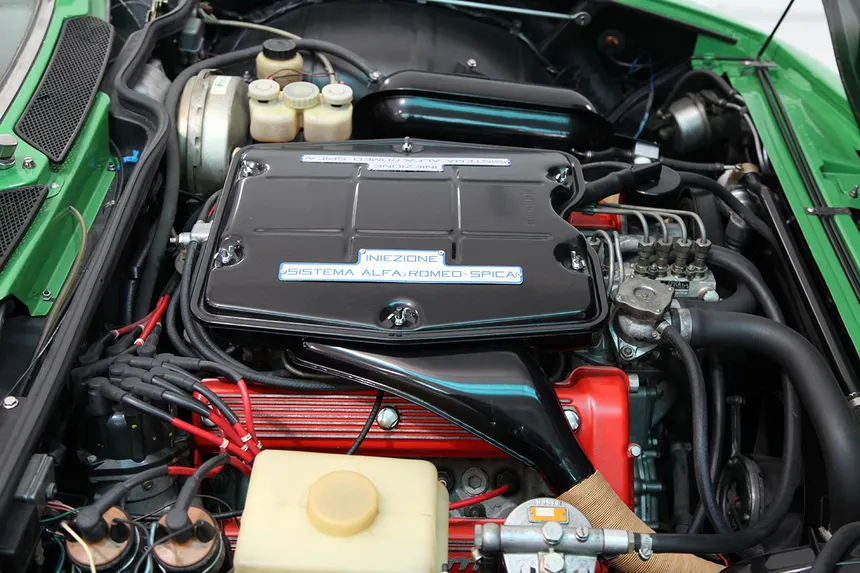
Someone at Arese, sometime between 1968 and 1969, had the right idea. If we have this competition V8, and we’re about to produce a GT, why not put the Tipo 33 engine into the Montreal? The decision was taken. The engine was stretched from 2.0 to 2.6 litres (2,593 cc exactly, 80 mm bore × 64.5 mm stroke), softened slightly for road use, given SPICA mechanical fuel injection (Società Pompe Iniezione Cassani & Affini), and handed over to the production department for installation in the Montreal.
The result: 200 horsepower at 6,500 rpm. A brutal climb-down from the Tipo 33’s 270, but still a road-going engine well above anything the European competition was offering in 1970. The cross-plane crankshaft, unusual in European V8s of the era (common in American V8s like the Chevrolet small-block), gave the engine a deep, almost muscle-car-like sound that remains one of the most recognisable acoustic signatures of any 1970s Italian V8.
Technical decision: brilliant. Industrial decision: complicated, as we’ll see.
The four-city industrial madness
Here comes one of the most absurd decisions Alfa Romeo made with this car. The Montreal production line was split across four separate stops in four different northern Italian cities.
Stop one: Arese, Alfa Romeo‘s main factory. Here they manufactured the chassis (derived from the Giulia GTV), the V8 engine, and all the mechanicals. The rolling chassis without bodywork left Arese and was shipped to Caselle, near Turin.
Stop two: Caselle, where Bertone had a factory for bodywork. Here the body was built and fitted onto the chassis. The car with body but without paint or interior trim was then sent to Grugliasco, also near Turin.
Stop three: Grugliasco, where the anti-corrosion treatment was applied (zinc phosphate plus electro-deposition of the primer), the final hand spray painting was done, and the entire interior was fitted (seats, dashboard, carpets, door panels). The fully painted and trimmed car was then shipped back to Arese.
Stop four: Arese again. Here the engine and mechanical components were finally installed in the now-bodied and painted chassis. And the car was delivered to the customer.
Four stops. Roughly one thousand kilometres of internal transport between the four plants (Arese to Caselle is around 130 km one way, multiplied by two separate round trips). For this reason, there is no clean correspondence between chassis number, engine number and production date for any specific Montreal that comes up for auction today. The cars were criss-crossing between factories at different speeds, and the traceability was lost in the process.
In industrial cost terms, this is a disaster. The Montreal came out expensive because its production was expensive. 5,700,000 Italian lire in 1970, equivalent to about $8,990 USD at the time, equivalent to roughly $64,400 USD today adjusted for inflation. More expensive than the Jaguar E-Type V12. More expensive than the base Porsche 911. Fifty percent more expensive than the V8-powered Triumph Stag. Only £522 cheaper than a Ferrari Dino 246 GT in the UK.
Was the price justified? Mechanically, yes. The Montreal was the only European GT of the moment with a V8 derived directly from a competition prototype. The only one with a dry sump. The only one with a cross-plane crank signed off by Carlo Chiti. But commercially, the customer with that kind of money could go to Maranello and buy a Dino with almost the same outlay. Or go to Stuttgart and buy a cheaper 911 with a serious dealer network. The Montreal was overpriced for its brand emotional positioning.
Gandini design: shutters, NACA ducts, and futurism
What the Montreal undeniably did offer as a pure object was one of the most recognisable visual signatures of 1970s Italian motoring. Marcello Gandini built four design features into the car that anyone who has ever seen a Montreal remembers for life.
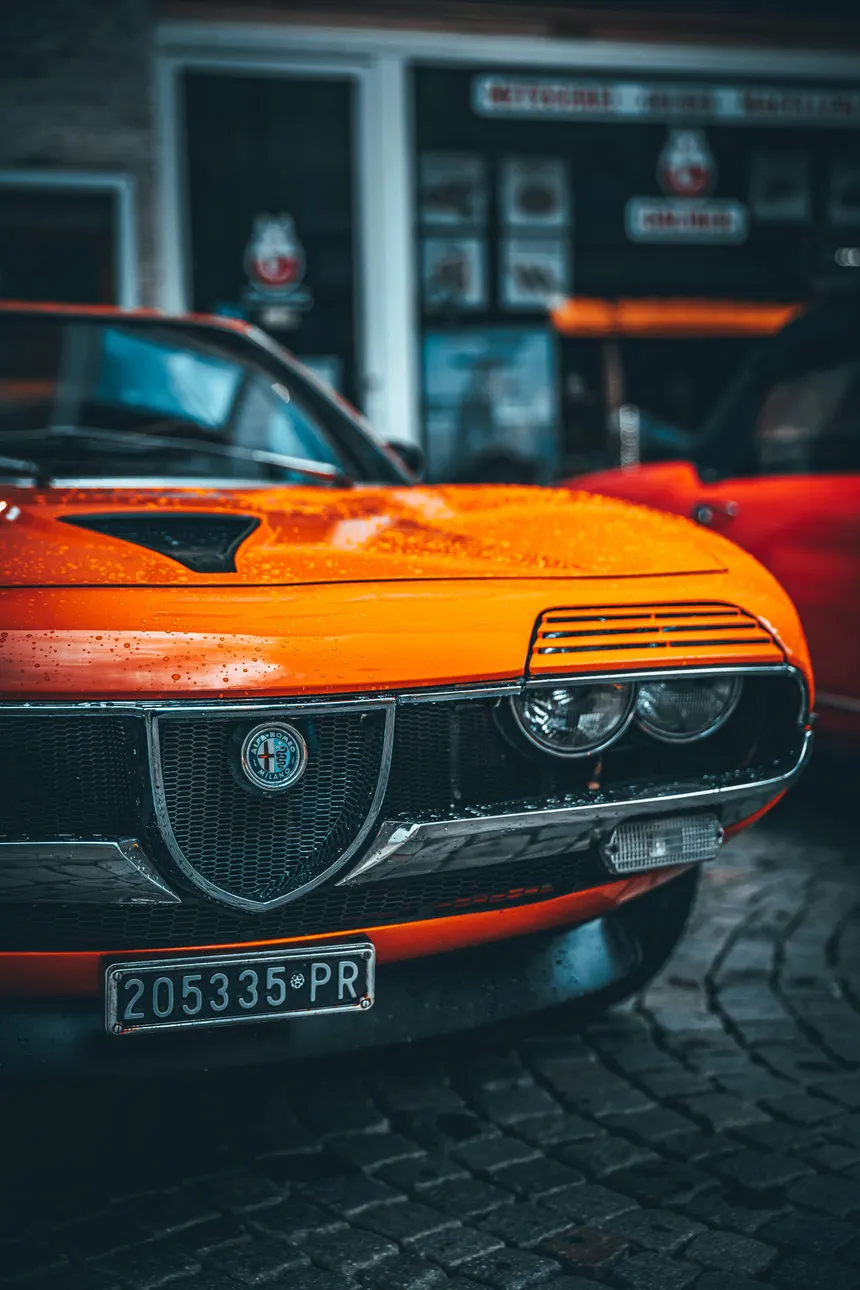
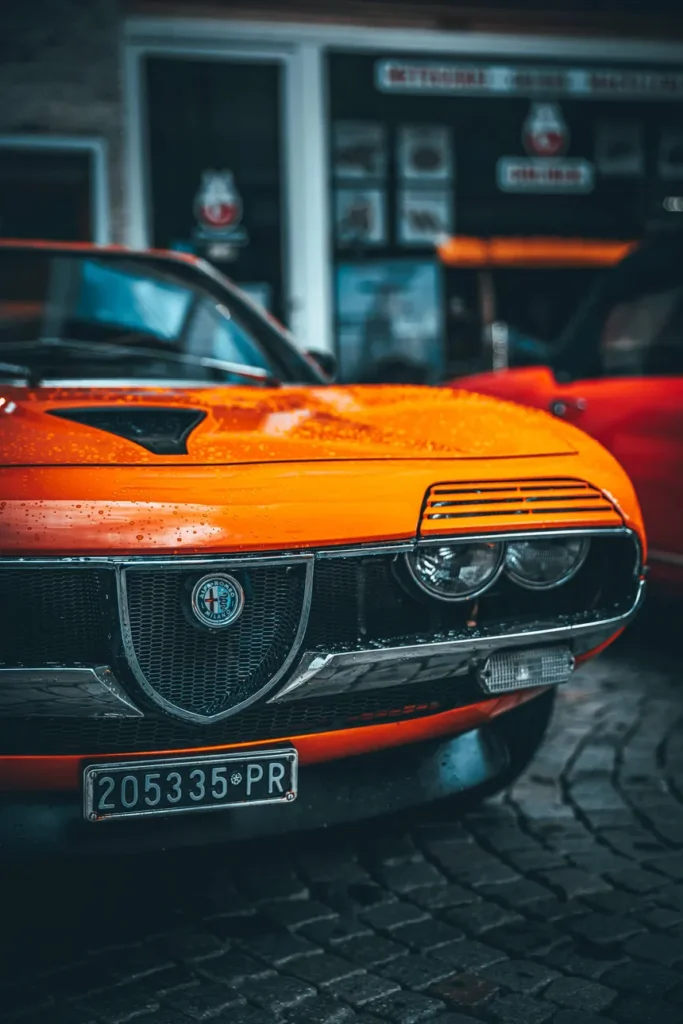
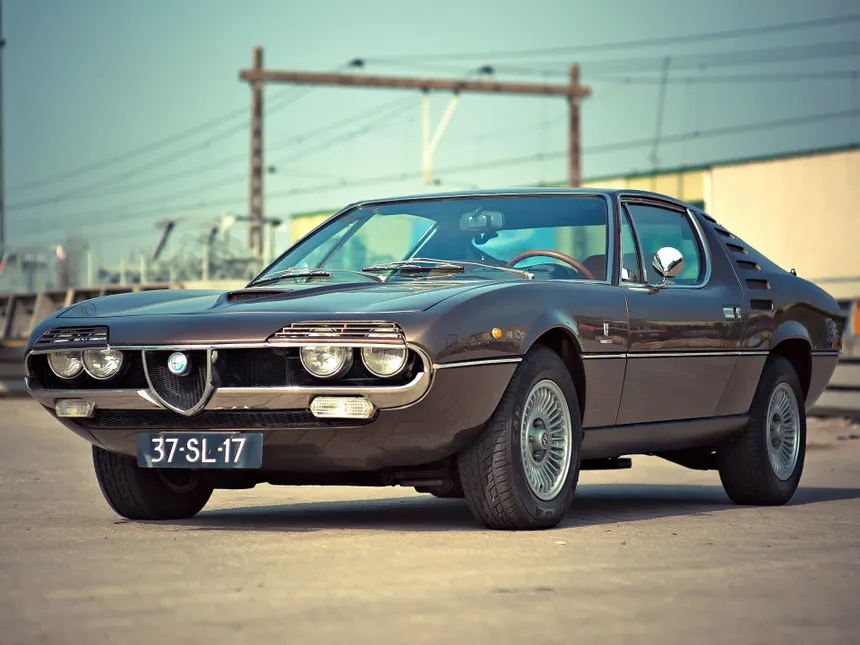
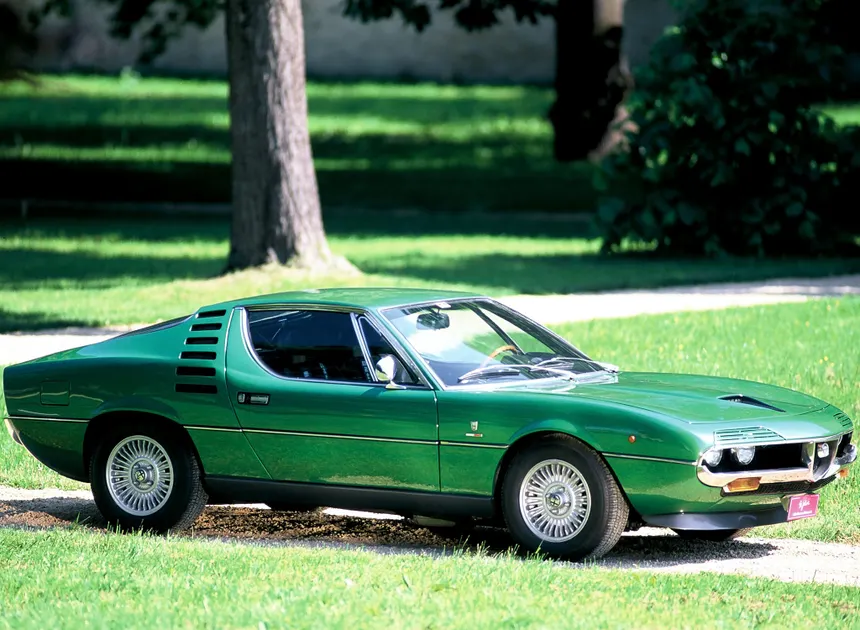
One: the retractable shutters over the headlights. Four headlights on the front of the car, partially covered by four small vertical shutters that only retract when you switch the lights on. With the lights off, the shutters partially cover the headlights, giving the front of the car a “half-closed eyelid” expression, almost feline. Switch the lights on and the shutters retract backwards, fully exposing the headlights. It is one of the most-talked-about design features of the car, and frankly one of the most beautiful gestures. Gandini designed them as fixed grilles for the Expo 67 prototypes, and only in the production version were they made retractable due to European safety homologation requirements.
Two: the NACA duct in the bonnet. An air intake with a NACA profile (the aerodynamic geometry developed by the NACA, predecessor of NASA, in the 1930s for military aircraft intakes). The NACA duct provides very low drag relative to the volume of air it ingests. Gandini placed it in the centre of the Montreal’s bonnet, in a position that recalls aero engine intakes. It serves to cool the engine compartment. It was, additionally, one of the first uses of a NACA duct on a production European road car. You see them on thousands of performance cars today. In 1970 it was rare.
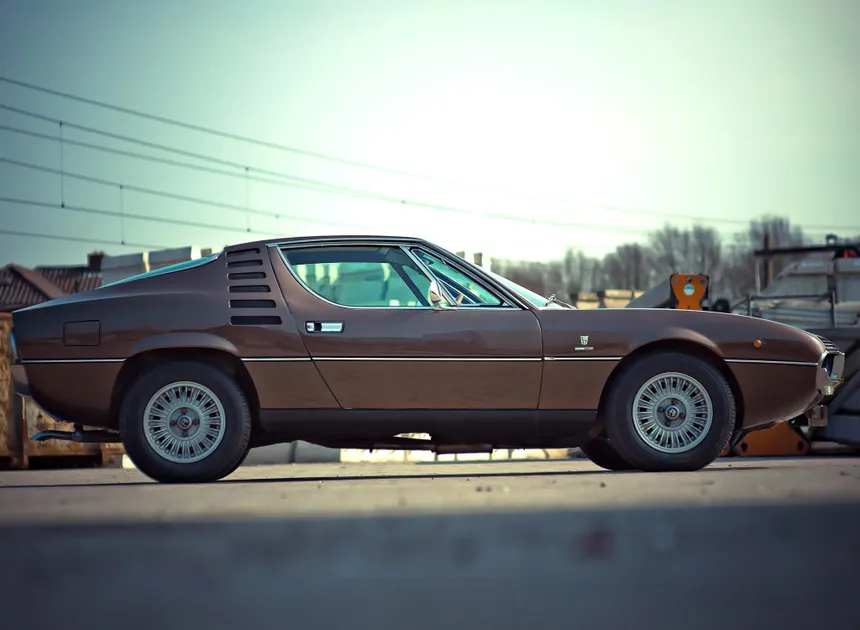
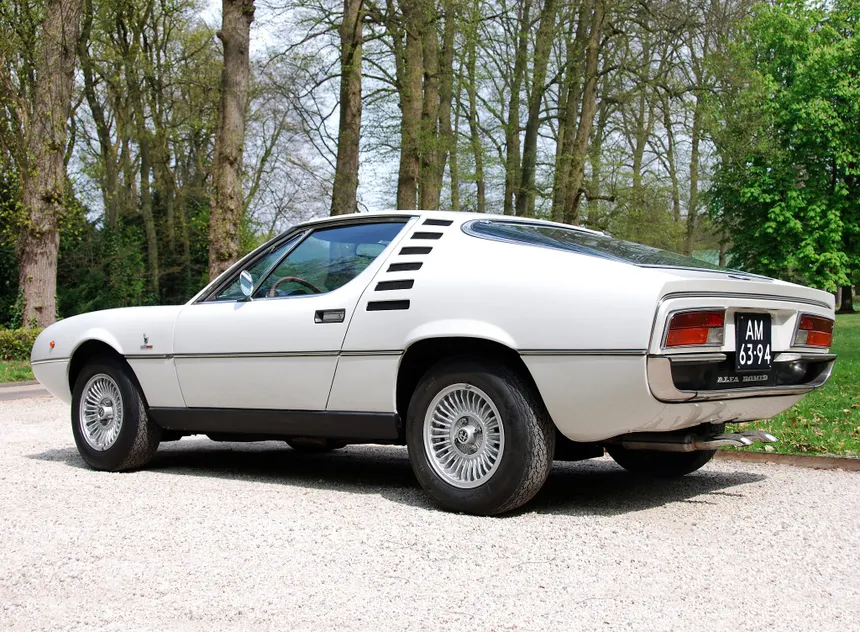
Three: the silhouette. Long bonnet, low cabin pushed backwards almost over the rear axle, steeply raked liftgate, total length 4.22 metres, height only 1.205 metres. Proportions that recall the Porsche 911 stretched and Italianised. There was a serious effort to achieve a good drag coefficient. The Montreal was among the European GTs of its era with the lowest Cd, although the exact figure was never officially published.
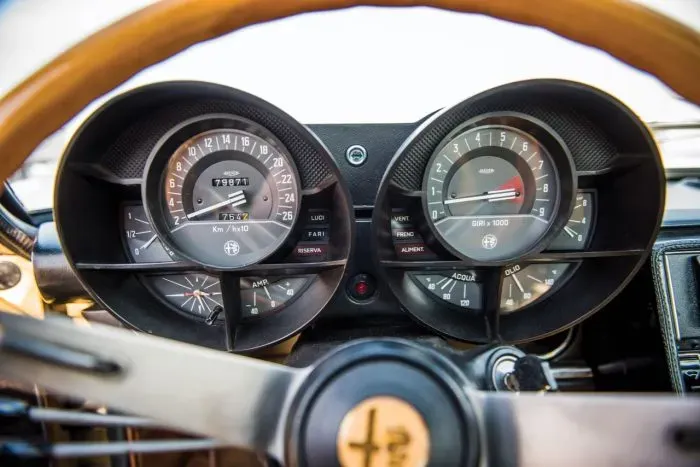
Four: the instrument cluster. Designed by Paolo Martin for the prototypes. Kept almost intact for production. A mix of large circular dials and rectangular indicators with futuristic typography, arranged in an asymmetric pattern that recalled an aerospace console more than a car interior. In 1970 it looked like something from a science-fiction craft. Today it has become one of the most photographed elements of the car in vintage exhibitions.
October 1973: the knife in the side
The Montreal got off to a reasonable start in its first year. 1970: Geneva launch. 1971-1972: rising sales. The sales peak was reached in 1972: 2,377 units, almost 60% of the total seven-year production. It looked as if the car had found its market. Expensive but exclusive. Beautiful. Fierce-sounding. A competition-engined GT that was actually selling.
And then, on 17 October 1973, the event that redefined the European sports-car market for the rest of the decade. The Arab member countries of OPEC declared an oil embargo against the United States, the United Kingdom, Canada, Japan and the Netherlands in retaliation for those countries’ support of Israel in the Yom Kippur War (October 1973). The price of a barrel of crude quadrupled within weeks. Petrol was rationed in several European countries. Sales of any car with a V8 collapsed practically overnight.
The effect on the Montreal was savage: 1973 production dropped to 319 units (against the 2,377 of the previous year). An 86.6% collapse in a single year. The potential Montreal customer was a European upper-middle-class buyer prepared to pay serious money for a sporting GT. That same customer, in October 1973, decided his next car was going to have four cylinders, not eight.
Alfa Romeo didn’t surrender. They kept the car in production. But the following years were an agony. 1974-1975: production essentially paused (some sources indicate a formal halt that winter). 1976-1977: small closing batches to clear stock, with no development, no upgrades, no renewal. The Montreal was removed from Alfa Romeo’s official price lists in 1977, after seven years without a single facelift or any meaningful mechanical revision.
The product Alfa never dared to develop
Here is a detail almost nobody tells properly and which is probably the key to understanding the Montreal’s commercial failure: Alfa Romeo did not develop the car during its production run. The suspension, which the European press criticised from the very first road test for being too soft and derived directly from the road-going Giulia GTV (not engineered for the V8’s 200 horsepower), was never redesigned. The SPICA fuel injection, mechanically complex and notoriously difficult to maintain in good order, was never updated to electronic injection when Bosch, by the mid-1970s, had reliable electronic systems readily available. The brakes were not improved. The ZF five-speed gearbox stayed identical from 1970 to 1977. The bodywork never received a facelift or even a minor restyling.
This is notable because Alfa Romeo did develop other cars in its range during the same period. The Giulia was refreshed. The GTV evolved into the Alfetta GTV. The 33 Stradale evolved into the 33/3 prototype. But the Montreal stayed frozen at its 1970 specification until 1977. The probable reason is financial: the marque, in the middle of the IRI crisis (the Italian state holding that had owned Alfa since the 1930s), couldn’t justify investing in a model that wasn’t generating volume.
Industrial decision: let it die. The Montreal was effectively abandoned by its manufacturer while still in production. That is the real commercial tragedy of the model. It wasn’t only a victim of the oil crisis. It was also a victim of a company that didn’t dare make the necessary investment to keep the car competitive once the crisis passed.
The racing attempt: Autodelta and BOBCOR
Despite the commercial disaster, the Montreal did try to have a racing life. At the end of 1972, Autodelta built a Group 4 version of the car, launched at the London Racing Car Show in January 1973. 2,997 cc engine, 370 horsepower at 9,000 rpm. Lightweight bodywork, prepared suspension, revised ratios. The car was sold to Alfa Romeo Germany to compete in the German DRM championship for GT cars. The driver was specialist Dieter Gleich. Results: mediocre. Without further development, the car was obsolete almost immediately.
In the United States, the parallel attempt. BOBCOR Racing, Bob Cozza’s outfit based in Buffalo, New York, had been campaigning Alfa Romeo GTAs in Trans-Am racing since 1968. When Datsun’s works 510s ended the GTA’s winning streak in 1972, Cozza approached Alfa Romeo USA to develop a racing Montreal. With backing from Autodelta and Carlo Chiti himself, the mechanic Oscar Feldman, and the engineer Dennis Turpin (who came from Cosworth), the BOBCOR Montreal was assembled in early 1973. After initial disappointment, they fitted the full racing 3.3-litre version of the Tipo 33 V8. Debut: Six Hours of Watkins Glen 1973. Result: retired after two hours with oil seal failure. Next race: Road America Trans-Am. Result: retired after 10 laps with gearbox issues. The car was returned to Italy for further development. It never raced seriously again.
Two attempts, two failures, two situations where Alfa Romeo plus Autodelta failed to live up to the car they themselves had designed. The Montreal could have been the dominant GT4 racer of the 1970s with serious development. It wasn’t. Nobody at Arese had the will to make it so.
What I take from the Montreal on the workshop floor
There’s a lesson any mechanic learns within his first few years on the bench: a brilliant engine does not save a car with everything else done badly. The Montreal’s engine was the engine of a GT fifteen thousand pounds more expensive. But the suspension was that of a cheap road car. The injection was fragile. The production was madness. The price was overshot. The company abandoned it commercially from day one. When you put a competition engine into a GT that the rest of the organisation never finished engineering, what you get is a cursed car.
And that is exactly what the Montreal is. A cursed car in the literal sense. It had every ingredient to be a commercial legend of the 1970s: the prototype-derived V8, Gandini at his creative peak, the proven Giulia chassis, an established Italian premium brand. And it all fell apart because of Alfa Romeo’s industrial decisions, not because of any defect in the car itself. Three years of delay between concept and production. Four factories and a thousand kilometres of internal transport. An overshot price. Zero development during the production run. And on top of all that, an oil crisis arriving just as the car was starting to sell.
The curious thing, the thing that interests me from the workshop floor, is this. The Montreal is still a fascinating car to drive, five decades later. Anyone who has put themselves into a properly restored example says the same thing: the V8 sounds unlike any other European V8 of the era, the headlight shutters operate with a delicate clockwork mechanism, the instrument cluster still looks futuristic today, the car carries a low line and a long bonnet of a kind of elegance that no modern GT with pedestrian-impact homologation can replicate. What killed the Montreal in 1973 has made it more interesting today: these are now rare cars, beloved, restorable, and acoustically unmistakable.
The current collector market has vindicated the Montreal. A properly restored example sells today between 80,000 and 250,000 euros, with exceptional cases above that. Five times more in relative value than any non-special contemporary 911. The market says what it says. Late, but it says it.
If you ever see a Montreal pass on the road (something which will probably never happen, because fewer than 4,000 of them exist in the world, and many of them sit in garages without moving), stop. Look at the shutters if the headlights are on. Listen to the V8 if it’s accelerating. Remember that what you’re looking at is a car carrying under its bonnet the engine of the Tipo 33 that fought against Porsche and Ferrari in the World Sportscar Championship. A car that Alfa Romeo never managed to save commercially because it never quite dared finish its own homework. And that is why today it is one of the most loved cars among the Alfisti who actually understand what it is.
Check you’re still alive.