Autobianchi: The Brand Fiat Used to Take Risks It Wouldn’t Sign Its Name To
Almost nothing you drive today would exist in its current form without a company most Americans have never heard of.
That’s not hyperbole and it isn’t nostalgia. If your car has its engine mounted sideways, driving the front wheels, with the transmission bolted to the side of the block rather than underneath it — and unless you’re driving a truck or a sports car, it almost certainly does — you’re driving an architecture that was validated by a small Italian company in Desio, near Milan, that Fiat treated as an expendable test bed and then quietly dissolved.
Autobianchi built cars for forty years. It never once got credit for what it proved.
The deal: three names, three million lire
The agreement was signed on January 11, 1955.
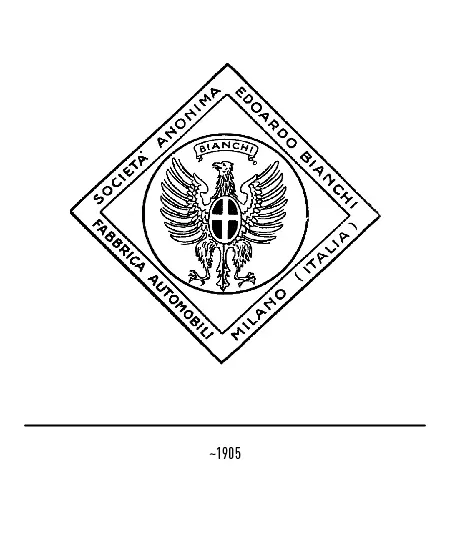
The idea belonged to Ferruccio Quintavalle, general manager of Bianchi, and it came out of a very specific bind. Edoardo Bianchi had started building bicycles in 1885, added motorcycles, and moved into automobiles in 1905. The Second World War flattened the plants. By the fifties, the company had no realistic path back into car production on its own.
Quintavalle didn’t look for a loan. He looked for partners, and he landed two heavyweights: Fiat and Pirelli. Share capital of three million lire, split in equal thirds. Giuseppe Bianchi — the founder’s son — as president. Quintavalle as managing director.
Each partner had a defined angle, and it’s worth being unsentimental about them. Pirelli expanded its tire supply business without building anything. Bianchi got back into cars by splitting a cost it couldn’t carry alone. And Fiat got two things: access to the premium small-car niche then occupied by coachbuilders like Moretti and Vignale working on Fiat chassis, and — far more valuable — a place to test alternative engineering without any failure touching the Fiat badge.
That last part wasn’t a later interpretation by historians. It was written into the rationale from day one.
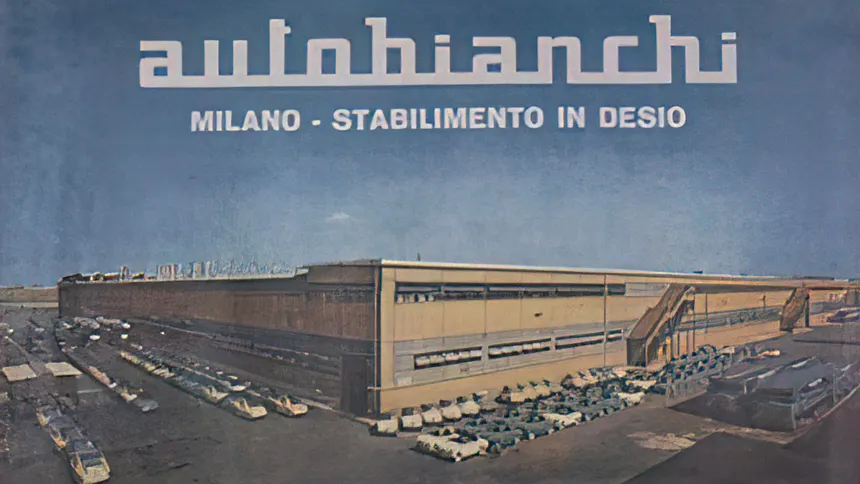
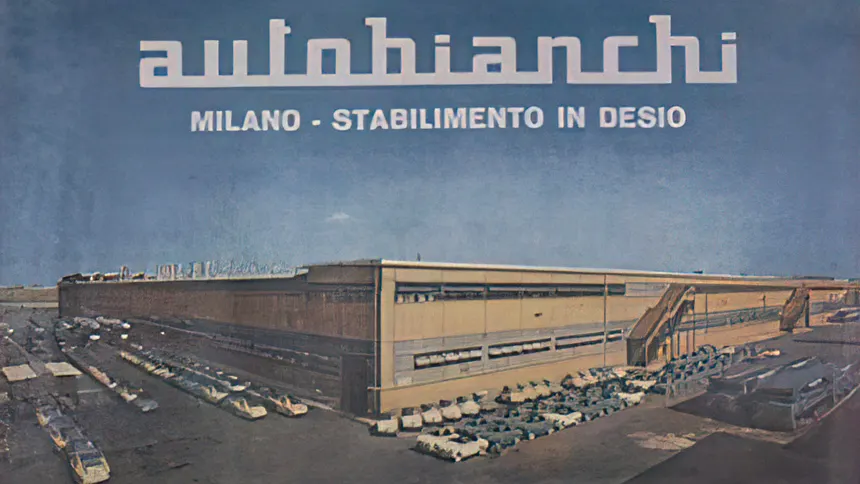
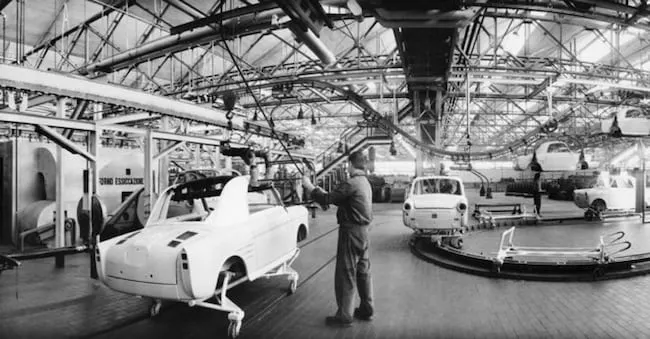
The plant was Bianchi’s facility at Desio, 140,000 square meters, rebuilt and modernized for the new operation. Lombardy, well outside Turin. That distance mattered.
Understand this first: Fiat had banned front-wheel drive
Here’s the part that makes the whole story make sense.
On an afternoon in March 1932, Senator Giovanni Agnelli — founder of Fiat, grandfather of the Gianni Agnelli most Americans have heard of — insisted on riding along during a prototype test. He habitually did this. The prototype was a front-wheel-drive car developed in Dante Giacosa’s orbit, based on a layout conceived at Fiat by an engineer named Oreste Lardone back in 1928.
On the third lap, the car caught fire. Agnelli and the test driver got out unhurt.
From that day forward, front-wheel drive was effectively forbidden inside Fiat. Not discouraged — forbidden. The prohibition held for three decades.
Now consider what that meant in the early sixties. Alec Issigonis had launched the Mini in 1959 and demonstrated conclusively that transverse front-drive was the correct answer for small cars. Fiat, the largest automaker in Italy, was institutionally incapable of building one because of a fire in 1932.
Dante Giacosa — chief engineer, the man behind essentially every small Fiat through 1970 — spent years arguing the case. He finally got approval, with Lardone by then consulting from outside, on one condition.
It would not wear a Fiat badge.
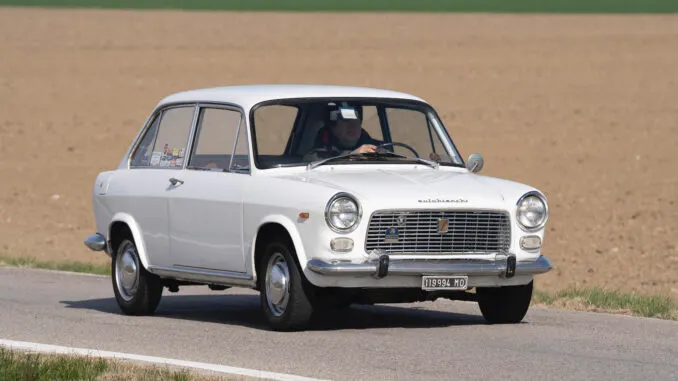
The Primula: the car that beat the Mini at its own game
Project 109 started in 1961. The car appeared at the Turin Motor Show in 1964 as the Autobianchi Primula. Lardone never saw it; he died in 1961, the year the project was greenlit.
Let’s be precise about what the Primula was and wasn’t, because this gets mangled constantly.
It was not the first transverse front-drive car. That’s the Mini, 1959. Anyone who tells you otherwise is selling something.
What it was: the first front-wheel-drive car in the Fiat Group, the first Italian production front-driver — and, critically, the layout that actually won.
Issigonis put the Mini’s gearbox underneath the engine, sharing a sump and sharing oil between the two. Compact, ingenious, and a maintenance nightmare. Engine oil lubricating the transmission means metal particles and shear breakdown in the same fluid keeping your bearings alive. Anyone who’s ever pulled a Mini apart knows exactly what that meant in practice.
Giacosa put the gearbox beside the block, inline with the crankshaft, separate sumps, unequal-length driveshafts. Powertrain sourced from the Fiat 1100 D: 1,221cc inline-four, carbureted, on a new platform.
That configuration — transverse engine, end-on gearbox, independent lubrication — is what the global industry adopted. Not the Mini’s. Volkswagen, Honda, Ford, GM, Toyota: everybody landed on Giacosa’s answer. It debuted on a badge Fiat considered disposable.
The Primula also offered a hatchback in 1964, available as a two-, three-, four- or five-door plus a two-door coupe, while most of the industry was still arguing about whether a trunk needed its own separate lid.
Fiat watched the sales figures, confirmed the layout worked, and launched the 128 in 1969 using it. The 128 won European Car of the Year 1970. The Primula went out of production that same year with no ceremony whatsoever.
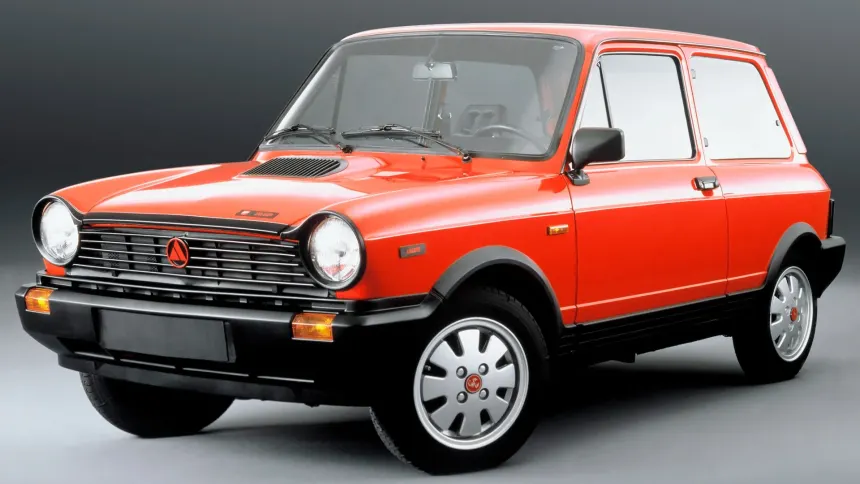
A112: seventeen years, 1.25 million cars, and a driver factory
By the late sixties Fiat had an English-language problem. The Mini was taking Italian market share, and it was doing it from inside the country — Innocenti built it under license in Italy, sidestepping the tariffs. It sold particularly well to young buyers and to women, exactly the demographic Turin kept missing.
The counterpunch went through Desio again. The A112 debuted at Turin in 1969: three doors, hatchback, front-wheel drive, 3,230mm long, 670 kg. The body was penned by Marcello Gandini at Bertone — the same Gandini responsible for the Lamborghini Miura and Countach, drawing an economy car. The mechanicals underneath became the Fiat 127.
Same pattern. Autobianchi launches it, Fiat inherits it. The 127 arrived in 1971.
The A112 outran every forecast. Waiting lists passed twelve months despite repeated expansion of the assembly lines. Eight series, seventeen years, 1,254,178 built between 1969 and 1986.
Then came the version that matters.
In October 1971, supervised by Carlo Abarth himself — who had recently sold his company to Fiat and stayed on as a consultant — the A112 Abarth arrived. 982cc, 57 hp, 152 km/h (94 mph), 0-100 km/h in 13 seconds. Matte black hood, black rocker stripes. In 1975 came the 1,050cc, 70 hp version good for 160 km/h.
The pricing was audacious. 1,325,000 lire — just under the Innocenti Mini Cooper MK3 at 1,365,000, but above the Fiat 128 Coupé (1,300,000), the 128 Rally (1,220,000), the NSU 1200 TT (1,215,000) and the Ford Escort Sport (1,185,000). Autobianchi was charging more than Fiat for a smaller car. Buyers paid it.
Over 121,000 Abarths sold across roughly fourteen years, close to 10% of total A112 production. The first series, the one collectors chase now, accounted for just 4,641 cars.
And then the Trofeo A112 Abarth — a one-make championship with a homologated safety kit including roll bar, fire suppression, harnesses, auxiliary lights and sump guard. It turned a sub-one-liter economy car into the entry ramp to rallying for an entire generation. First competition homologation registered March 1972; the last expired December 1990. Eighteen unbroken years.
Attilio Bettega came through it. So did Michele Cinotto and Gianfranco Cunico. Paola de Martini made her name in the women’s category. Half the Italian rally grid of the 1980s learned to drive in a car built by Fiat’s test-bed brand.
For an American frame of reference: imagine if the Spec Miata ladder had been run by a brand GM owned, and then GM deleted the brand.
The detail almost nobody knows
In 1966 Fiat moved production of the 500 Giardiniera — the wagon version of the car that motorized Italy — to Autobianchi. Initially the cars left Desio wearing Fiat badges. Between 1965 and 1968 it got confused enough that some examples were registered on paper as Fiat and others as Autobianchi, depending on the document. From 1968 the model carried the Autobianchi badge outright.
The 500 sedan ended production in Turin in 1975 with the R series. The Giardiniera kept coming out of Desio until 1977, with the last examples sold in 1978.
Read that again. The last Fiat 500 ever built didn’t wear a Fiat badge. It wore an Autobianchi one. Turin closed the book and Desio kept building it for two more years.
Production figures for the Autobianchi-badged Giardiniera vary by source — some cite roughly 120,000 units out of Desio, while the commonly quoted figure of around 330,000 covers the entire model run including the Fiat era from 1960. They shouldn’t be conflated.
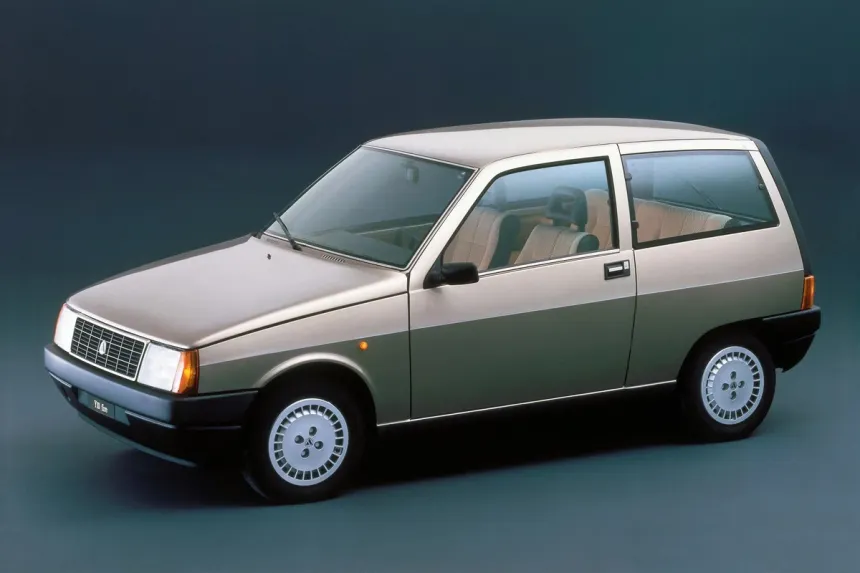
Y10: the last job
The A112’s replacement launched at Geneva in March 1985. The Y10 was a different animal: aerodynamic wedge with a 0.31 drag coefficient, black tailgate, Fiat Panda platform, and equipment levels that made no sense for the segment — four power windows on a three-door, among other things.
The design competition ran internally against Pininfarina and Giugiaro’s Italdesign; the winning proposal came from Antonio Piovano at Centro Stile Fiat, with Tom Tjaarda involved in development. The brief asked, in effect, for a miniature flagship.
And it launched something that outlived the brand entirely: the 999cc FIRE engine — Fully Integrated Robotized Engine — the simplified, robot-assembled architecture Fiat would build for decades. It also introduced the Omega rigid rear axle, later adopted by the facelifted Panda.
Same story one final time. Autobianchi debuts it, the group banks it.
Outside Italy it sold as the Lancia Y10, except in France and Japan where the Autobianchi badge survived into the late eighties. That was the warning sign: the brand only really existed at home anymore.
The industrial ending came earlier than the usually quoted date. The Desio plant — the same 140,000 square meters Bianchi contributed in 1955 — closed in 1992. Y10 production moved to Arese, Alfa Romeo’s home, and to Pomigliano d’Arco. The Autobianchi name continued commercially in Italy until 1995.
Sources disagree on the exact end: some record 1995, others 1996, depending on whether you’re counting the end of production or the sell-through of remaining stock. Total Y10 output is likewise disputed, ranging from around 850,000 to well over a million depending on the source. What isn’t disputed is the sequence — the factory closed first, the badge went dark afterward.
Autobianchi didn’t fail. Competition didn’t kill it. Lancia absorbed it because it had stopped being useful as a laboratory.
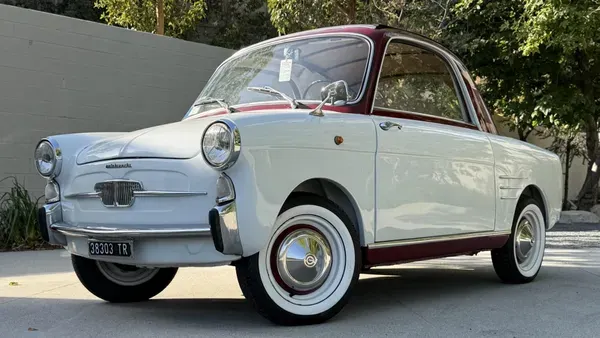
What survived
The car division is gone. The bicycles aren’t.
Edoardo Bianchi built an operation in 1885 that eventually spanned bicycles, motorcycles, automobiles and aviation. Fausto Coppi won on his bikes; Tazio Nuvolari raced his motorcycles. Of that entire industrial empire, the branch that survived the twentieth century intact was the first one — the humblest, two wheels and no engine. Bianchi still exists. Anyone who’s ridden serious road bikes knows that shade of celeste on sight.
Autobianchi has been a museum plaque for thirty years.
There’s an industrial lesson in that which no business school teaches: the division doing the most innovative engineering in the entire group is the one that disappeared, and the one that kept making pedal-powered machines is still standing after a hundred and forty years.
The NEC take
Ours, no anesthetic.
Autobianchi wasn’t a brand. It was a liability shield with a design department.
Fiat used Desio precisely the way any company uses a third party in a risky operation: so the risk carries somebody else’s name. Transverse front-wheel drive. The modern hatchback. The sub-one-liter hot hatch. The FIRE engine. The Omega axle. All of it launched under the Autobianchi badge. All of it banked by Turin. And when the laboratory stopped being necessary, it got folded into Lancia without so much as a decent press release.
You could argue this is just how industrial groups work. Brands are tools. Autobianchi existed because Fiat funded it, and without Fiat there’d have been no Primula and no A112.
True. And that’s exactly what makes it worth looking at.
Because this isn’t an injustice. It’s the business model. It’s the auto industry operating exactly as designed: credit gets recorded wherever it’s convenient to record it, and the official history gets written by whoever pays the invoices. The Primula isn’t in anyone’s collective memory and the Fiat 128 is. The A112 Abarth trained half the Italian rally grid and the brand that absorbed it took the trophy home.
Forty years on, we’re still buying cars built to the layout Giacosa proved in Desio, and almost nobody knows where it was proved.
How many brands that look “minor” to us right now are doing the work that shows up in thirty years under somebody else’s signature?
Check you’re still alive.