
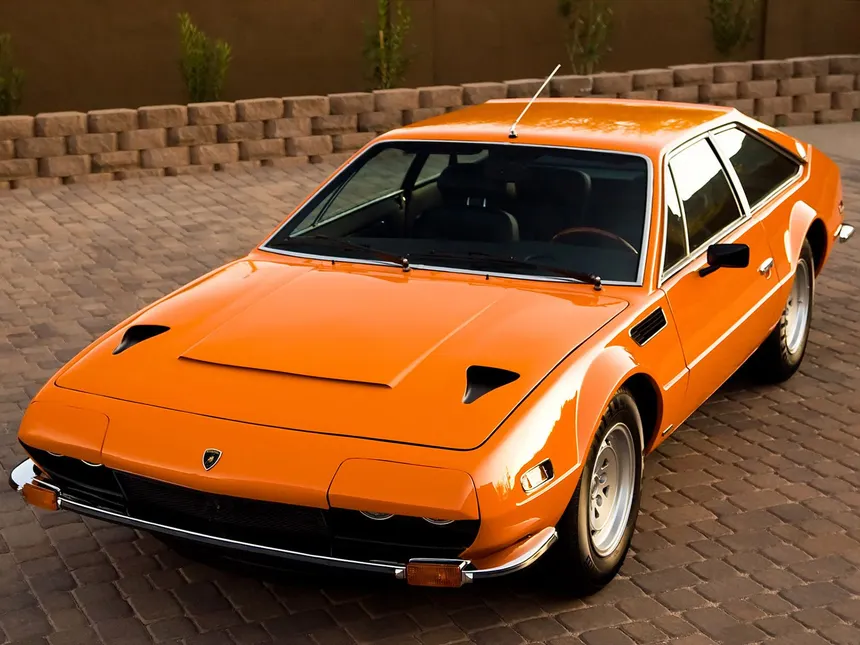
Lamborghini Jarama: Ferruccio’s Own Favorite
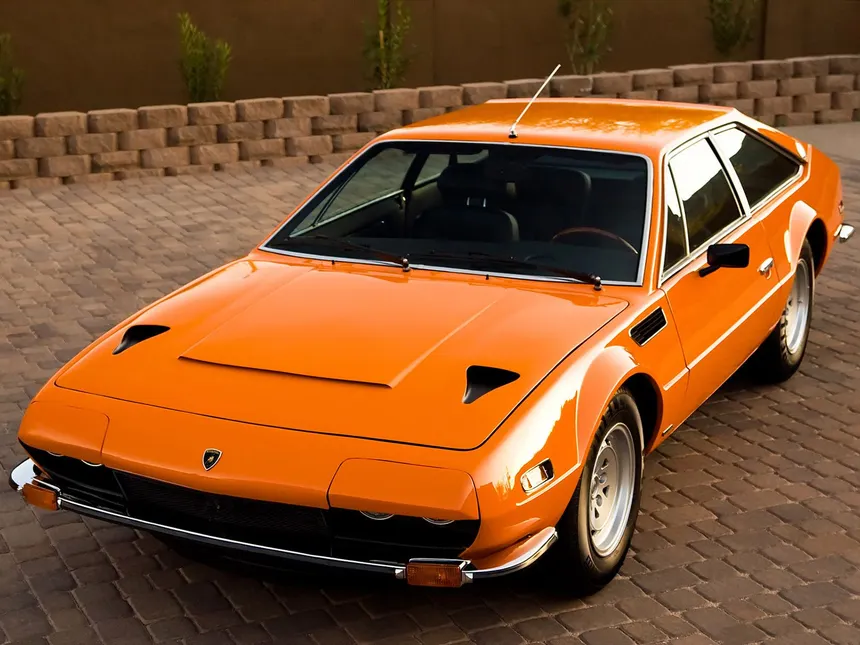
Asked which of his cars he preferred, Ferruccio Lamborghini did not say Miura. He said Jarama. And he said it late, in 1991, when he had nothing left to sell: he preferred it to all the others because it was the perfect compromise between the Miura and the Espada.
That car sold barely three hundred units, had to change coachbuilders mid-production over quality problems, and saw its final examples assembled while the company was sinking. It is by a distance the least-discussed classic Lamborghini.
The name has nothing to do with the racetrack
Start with the mistake almost everyone makes, including people who have written about cars for decades.
The Jarama is not named after the circuit outside Madrid. Ferruccio chose the name thinking of the fighting bulls bred in the area of the Jarama river in Spain. The overlap with the racetrack is coincidence, and it has been enough to keep the wrong version in circulation for half a century.
It fits everything else the company did. Miura after the Sevillian ranch. Islero after the bull that killed Manolete. Espada after the matador’s blade. Ferruccio did not name cars after circuits. He named them after bulls.
March 1970: an Espada with the middle cut out
The Jarama was shown at the Geneva motor show in March 1970 as the Islero‘s replacement, styled by Marcello Gandini at Bertone.
There is no new platform underneath. It is the Espada’s, with the wheelbase cut from 2,650 mm to 2,380 mm. That is 270 mm — about 10.7 inches — removed from between the axles, and it is not a footnote: shortening an existing platform that hard gives you a sharper car and a much harder one to sit in behind. The Jarama is a 2+2 with token rear seats because it came from cutting down a genuine four-seater, not from designing a cabin around people.
Dimensions came out at 4,485 mm long, 1,820 wide and 1,190 tall. Weight distribution: 53/47.
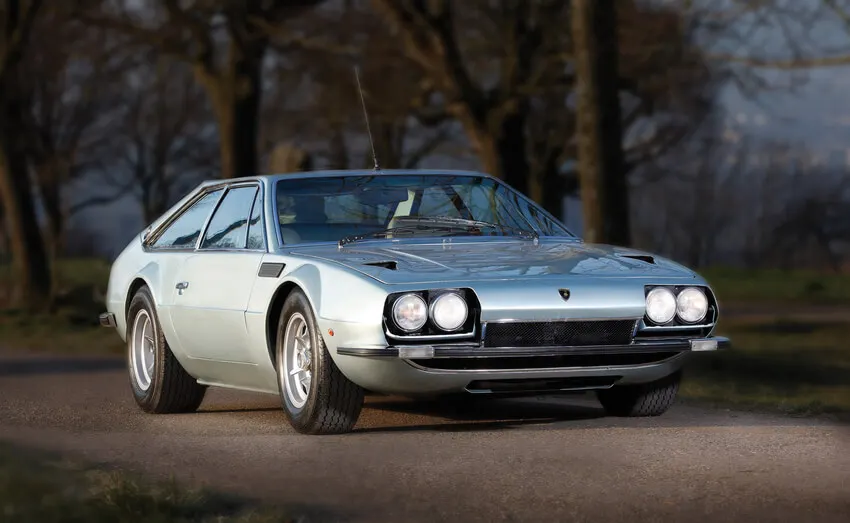
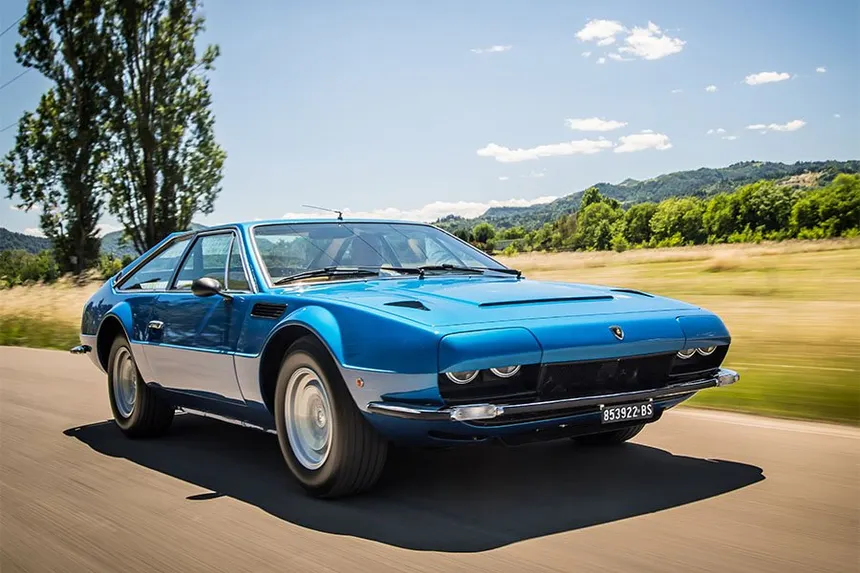
The visual signature is a set of headlights partly covered by a metal eyelid that drops over the lens — a solution that looks like nothing else from its era — plus an enormous rear side window.
The mechanicals
The 3,929 cc V12 with six Weber 40 DCOE carburetors made 350 horsepower at 7,500 rpm in the Jarama 400 GT. Five-speed manual, with a three-speed TorqueFlite automatic offered later that went into roughly four cars.
Measured figures run to 152 mph and 0 to 62 mph in 6.6 seconds, with 1,540 kg on the scales against the 1,450 kg dry weight on the spec sheet — about 3,395 lb versus 3,197 lb.
Its reference rival at launch was still the Ferrari 365 GT 2+2, with 4,390 cc and 320 horsepower, of which around 800 were built in four years. The Lamborghini had thirty more horsepower from half a liter less. And it sold four times fewer cars.
Why cutting up a platform matters
The technical decision that defines this car deserves a paragraph of its own, because it explains the virtues and the faults at once.
Taking the Espada frame and removing 270 mm of wheelbase is the fast, cheap route to a new model: you reuse the suspension, engine, transmission and much of the structure, and you skip developing a platform from scratch. A small company running three twelve-cylinder models at once has no budget for anything else.
You pay for it twice. First in the cabin: wheelbase is what gives rear passengers legroom, and the cut came out of exactly the place that hurts, so the rear seats became token. Second in balance: the same front-mounted V12 in a shorter car makes the front axle count for more of the total, which is where that 53/47 comes from — and it is exactly what Bob Wallace set about fixing in his competition version by moving the engine rearward.
A sharper car than the Espada and a less usable one. Precisely what Ferruccio wanted, by his own account, and precisely what a luxury GT buyer was not asking for.
The coachbuilder that had to be replaced
The spec sheets floating around online get this wrong almost every time.
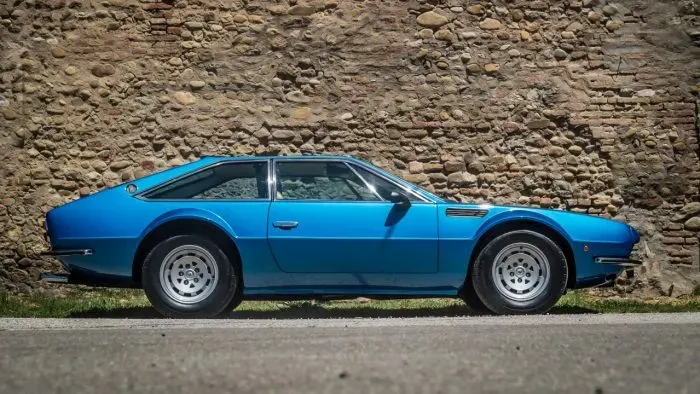
The Jarama was designed by Bertone, but the bodies were built and assembled by Carrozzeria Marazzi, in the province of Varese. That is the same firm that had bodied the Islero, made up of former Touring workers after the Milanese house closed. The Touring bloodline does not end with the Islero. It runs this far.
And it ends badly. Production moved entirely to Bertone in 1972 after quality control problems at Marazzi. The criticism of the early Jarama is specific and harsh: poor workmanship, panel fit that left a lot to be desired, a cluttered dashboard.
That move was not a styling decision. It was a manufacturer admitting its coachbuilder was not up to standard and taking the work elsewhere halfway through the model’s life.
The S, and figures that refuse to agree
The Jarama S, also called the 400 GTS, arrived in 1972 with 365 horsepower at 7,500 rpm after revisions to the exhaust, cylinder heads and carburetors. Outside: a hood scoop, fender vents, relocated indicators and a repositioned windshield. Inside: a new aluminum instrument panel, controls moved to the center console, more sound and heat insulation, better rear seats, and power steering standard from mid-production. Options included removable roof panels, fitted to somewhere between six and twenty cars depending on the source.
Then the usual chapter for this marque in that decade: the numbers.
English-language Wikipedia and Lamborghini’s own official history both give 177 Jaramas and 150 S, for 327 — though 328 also appears. Supercar Nostalgia lists 176 of the first version, with only six in right-hand drive. Secret Classics splits it 188 and 139. Three sources, three different counts, none matching either of the others.
With barely three hundred cars in total, half a century on, there is no good figure. There are three versions and a shrug.
The end-of-production dates do not match either: the factory runs the GTS to 1978, other sources close it in 1976. The documented explanation is sadder than a filing error. Manufacturing ceased in 1976 and the last cars were completed as late as 1978 because of the company’s financial troubles.
A parts bin shared with its own siblings
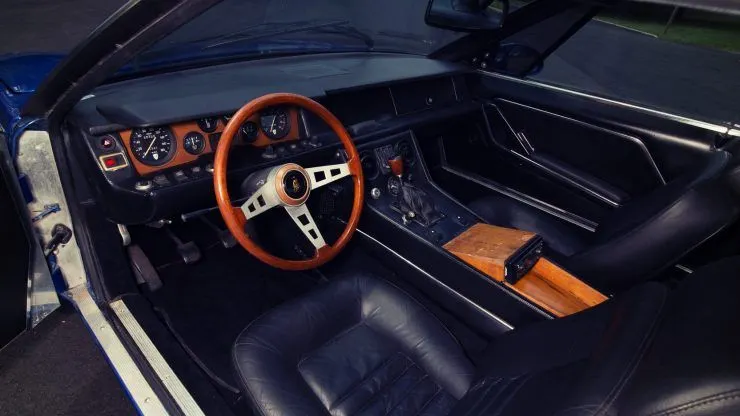
The wheels tell the family story better than any brochure. The early Jarama rode on magnesium center-lock wheels of the type used by the Miura and the first two series of Espada. The S switched to five-bolt wheels identical to those of the Espada Series 3.
That is what a small manufacturer looks like from the inside: one V12, one platform stretched or cut to suit, one set of wheels shared across the range, one gearbox. Nothing gets developed twice because nothing can afford to be.
It is worth measuring the Jarama against the car it replaced, too. The Islero managed 225 units across both versions between 1968 and 1970. The Jarama, over six years, reached roughly 327. Better, and still a failure by any normal reading — an average of around fifty cars a year from a company with a twelve-cylinder engine and a name people already knew.
Who it was really fighting: the cars beside it
The Jarama’s problem was not only in Maranello. It was in Sant’Agata’s own price list.
Lamborghini was selling, in 1970, the Miura in P400 S form, of which 338 were built between 1969 and 1971, and the Espada, then entering its second series, which alone accounted for 575 cars. The Jarama arrived as the third option, using the same engine as the other two, more expensive to build than an Espada and less spectacular than a Miura.
If you wanted a Lamborghini with room, you bought the Espada, which had genuine four-seat space. If you wanted a Lamborghini to be seen in, you bought the Miura. The Jarama was the sensible choice, and the sensible choice is exactly what nobody walks into a Lamborghini showroom looking for.
Then the worst possible thing happened. The Countach entered production as the LP400 in 1974, 157 of which were built through 1978 — precisely the years the Jarama spent dying at the back of the catalog. A wedge with scissor doors sharing a brochure with a 2+2 with eyelids over its headlights.
From that point the Jarama stopped existing in the conversation. The market did not kill it and neither did Ferrari. Its own brand buried it with the model parked next to it.
The Jarama Bob Wallace built to race
Bob Wallace, the New Zealander who was the factory test driver, built a competition Jarama of his own from a bare shell. It is known as the Jarama Rally, or Jarama Sport depending on the source.
He moved the engine rearward to correct the weight distribution to 50/50. He fitted lightweight aluminum bodywork, aluminum doors and plastic windows. Off came the headlight eyelids. In went a reinforced steel roll cage. Center-lock wheels of the Miura type.
The engine went to 380 horsepower at 8,000 rpm. Weight dropped by around 300 kg to roughly 1,170 — about 2,580 lb. On paper that gave 270 km/h and around five seconds to 100 km/h.
It never raced.
The car dropped off the radar for years and eventually surfaced in Saudi Arabia, from where it was taken to the United Kingdom for restoration in 1990.
A luxury grand tourer turned into a rally weapon by the works test driver, with no race to enter, ending up parked in the Arabian peninsula. That does not make the anniversary brochures.
Ferruccio’s own car
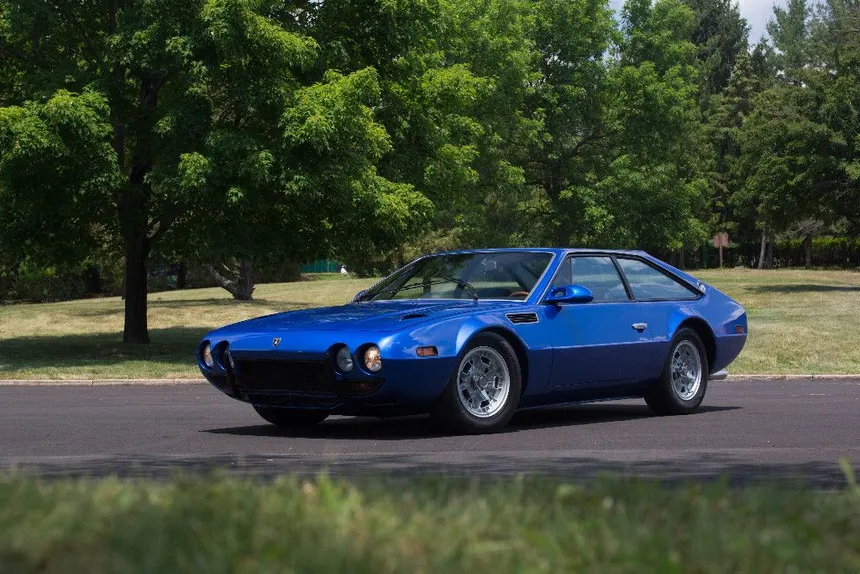
The personalized Jarama S that Ferruccio Lamborghini used is on display today at the official museum in Sant’Agata Bolognese. The factory acknowledges it as one of the founder’s favorites and describes the model as the final evolution of the front-engined 2+2 concept.
That is this car’s commercial career in one line: the man who founded the company picked it as his own and said so in public; his customers picked something else.
Being right with nobody watching
The Jarama proves that being right is worth nothing if nobody is looking.
Ferruccio nailed the concept: a short, agile V12 with rear seats you can use some of the time, more manageable than an Espada and far more livable than a Miura. That car is exactly what the classic market is now screaming for. In 1970 nobody wanted it.
And the company finished the job itself. You sell an expensive grand tourer with badly fitting panels and a cluttered dashboard, you take two years to move production to another coachbuilder, and you complete the last cars with the bank account empty. There is no need to look for villains in the marketplace. Sant’Agata wrote its own verdict on the model its founder preferred.
And half a century later nobody knows exactly how many were built. Three serious sources give three different counts of the favorite car of the man whose name is on the badge.
A company that cannot count the cars its owner loved most does not have an archiving problem. It has a problem respecting its own work.
Check you’re still alive.