Renault 21 Turbo: America Got the Medallion, Europe Got the One With 175 hp
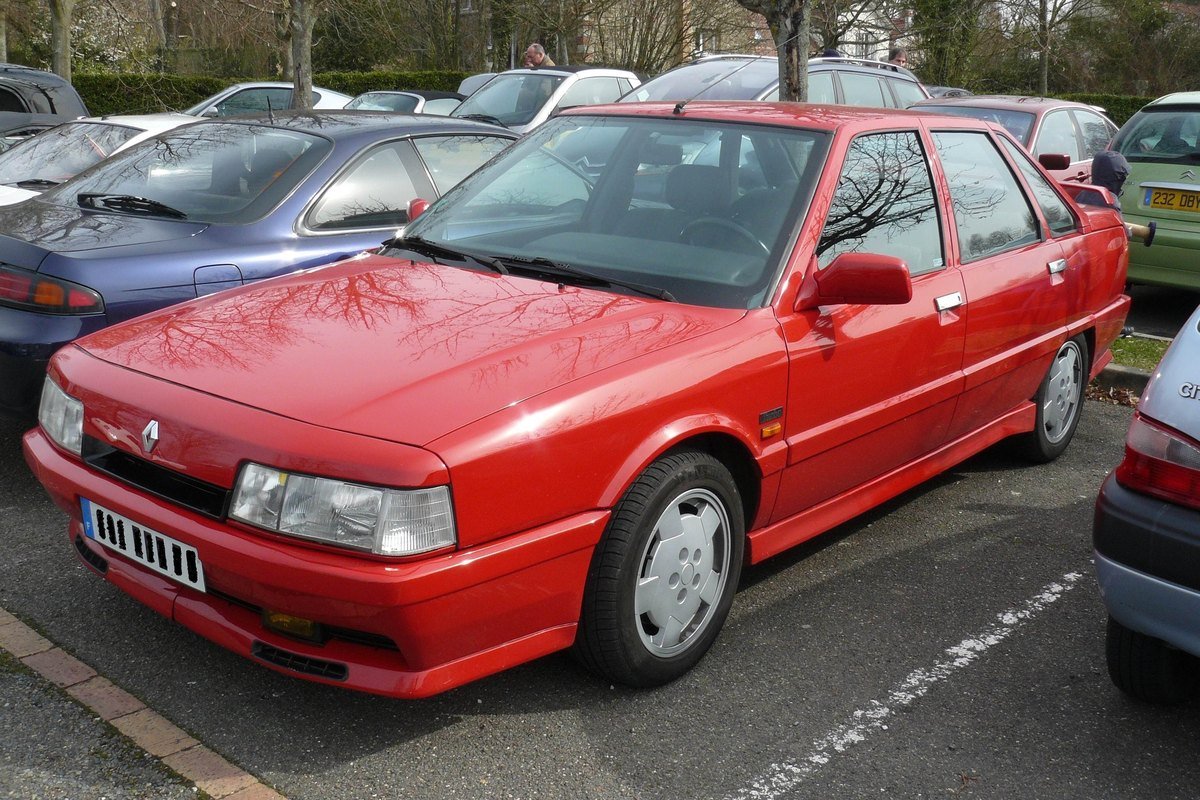
In March 1987, AMC dealers started selling a sensible French sedan called the Renault Medallion. It had a 2.2-liter four with 103 hp, an optional three-speed automatic, and the misfortune of arriving months before Chrysler bought American Motors and lost interest in everything with a diamond on the grille. By 1989 it wore an Eagle badge. By the end of that year it was gone, replaced by Mitsubishi-built cars, and almost nobody noticed.
That Medallion was a Renault 21. Back in Europe, the same body was being sold with a turbocharged two-liter, 175 hp, standard ABS and a top speed of 141 mph. It ran with the BMW M3 on the autobahn, it chased speeders for the French police, it set a world speed record on a frozen lake in Sweden, and it was rallied by a young engineer who would later run Chrysler’s parent company. America got the commuter. It never saw the car that made the 21 worth remembering.
A family car built in Spain, sold to France
Renault launched the 21 in 1986 to replace the 18, which itself had come to the States as the 18i. Most of the range was what you’d expect: diesels, modest gas engines, and a seven-seat wagon called the Nevada that hauled half of Europe’s school runs. Some of them came off the line at FASA-Renault in Valladolid, Spain, which built the 21 from 1986 to 1992 and turned out 278,501 of them. Spain had just joined the European Economic Community, and the Valladolid plant, which had worked mostly for the home market, suddenly found itself exporting up to 85 percent of what it built. Nobody has published whether any of the Turbos were among them, and we won’t pretend to know.
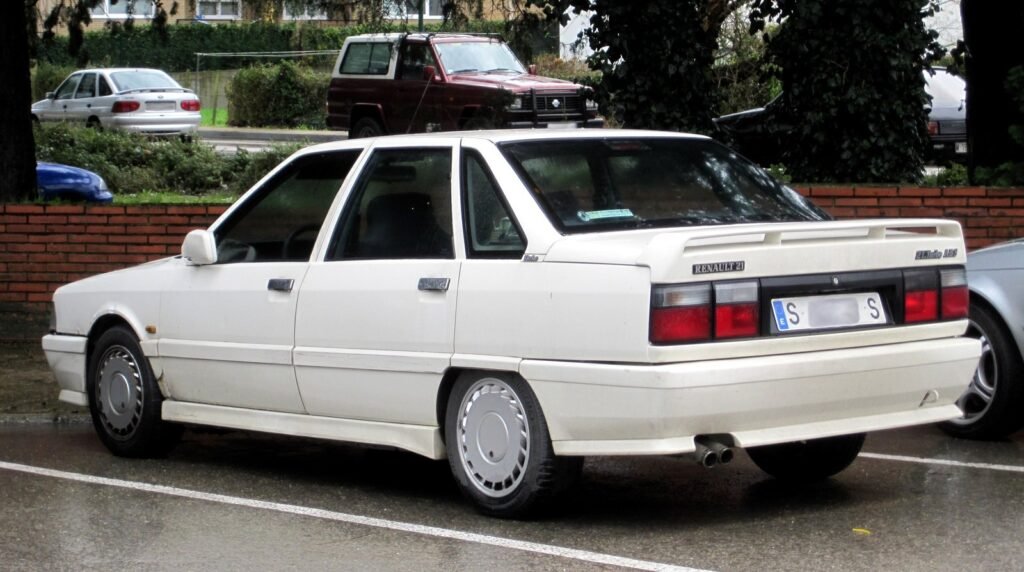
Renault in the 1980s had a turbo habit. The R5 Turbo, the 9 and 11 Turbo, the 18 Turbo, the 25 V6 Turbo, and the Fuego Turbo that AMC dealers had already tried to sell to Americans. Formula 1 had made Renault the turbo company, and every showroom model was expected to carry some of that. So when the 21 Turbo appeared in June 1987, it surprised exactly nobody in France. What surprised people was how fast it was.
Same engine family as the DeLorean, sort of
The engine is where this car stops being a rebadged commuter. It was the Douvrin four-cylinder, also known as the J engine, 1,995 cc, built by the Société Française de Mécanique in northern France.
That plant was the product of a 1969 agreement between Renault and Peugeot to stop paying twice for the same engineering. The program produced three engines. One was a small four. One was this two-liter. The third, developed with Volvo, was the PRV V6, the engine that ended up behind the seats of the DeLorean DMC-12. So the gullwing car from Back to the Future and the Renault 21 Turbo share a bloodline, even if they never shared a single part.
French sources credit the Douvrin’s design to Jean-Jacques His, who joined Renault at the end of 1972 straight out of the École Centrale in Paris. His later ran Ferrari’s racing engine department in Maranello from 1986 to 1988, then came home to lead the Renault V10 that won Formula 1 championships with Williams and Benetton through the mid-1990s. Few family sedans can name a lineage like that.
For the turbo car, the engine (internal code J7R-752) got a water-cooled Garrett T3 turbocharger, two air-to-air intercoolers and sodium-filled exhaust valves to survive the heat. Output was 175 hp at 5,200 rpm and 199 lb-ft of torque at 3,000 rpm. ABS came standard, which in 1987 was something you mostly found on cars with three-pointed stars on the hood.
One more oddity. Renault had no transverse gearbox strong enough for its bigger engines, so the 21 was built two ways. The 1.7-liter cars had a transverse engine like any other front-driver. The two-liter cars, and the American Medallion with its 2.2, had the engine mounted longitudinally, front to back. The two versions even had slightly different wheelbases. In the Turbo, all that torque went through the front wheels alone, on 195/55 tires that auto motor und sport found running out of grip early in corners.
How it stacked up
Renault claimed 141 mph and 0 to 62 mph in 7.4 seconds. When auto motor und sport tested one in 1987, it saw 143 mph flat out and 8.2 seconds to 62. Curb weight sat around 2,650 pounds, although published figures wander between 1,195 and 1,230 kilos depending on who you ask.
The cars Europeans measured it against were the BMW M3 E30 and the Mercedes 190E 2.3-16, the two benchmarks of the decade. The same German magazine got the M3 to 62 mph in 7.2 seconds, a second quicker than the Renault. The catch was price. The 21 Turbo cost about 40,000 Deutschmarks in Germany. The M3 and the Cosworth-headed Mercedes were both around 60,000. For two-thirds of the money you got most of the pace and four doors that a family could actually use.
For an American yardstick, think of the Merkur XR4Ti, the German-built Ford that Lincoln-Mercury dealers sold here from 1985: a turbocharged 2.3-liter four, also rated at 175 hp with the five-speed. Or the 1989 Taurus SHO, which needed a Yamaha-built V6 and 220 hp to do what the Renault did with a two-liter four.
Four helicopters on a German autobahn
Renault sold the car with a TV ad that would fit in a Michael Mann movie. A 21 Turbo blasts down a German autobahn, a Polizei helicopter spots it and calls for backup, and by the end the car has outrun four police helicopters, including a stunt run under a bridge, to a Robert Palmer soundtrack. It closes with a German voice grudgingly approving of the ABS.
There’s a twist. A French blog devoted to Renault advertising says the spot wasn’t shot in Germany at all but on the A75, a motorway in the middle of France. It’s the only source that says so, and we couldn’t confirm it with a second one. If it’s right, Renault humiliated the German police without leaving home.
The French Highway Patrol car
Here’s where the advert turns into a joke on itself. In 1992 the French Gendarmerie, the national police force that patrols highways and rural France, picked the 21 Turbo for its Brigades Rapides d’Intervention, the fast-response units that chase speeders on the autoroutes. Think of them as the French counterpart to the Mustangs that American highway patrols ran in the 1980s.
The gendarmes had been using Alpine A310 V6 sports cars, aging Renault 18 Turbos and Citroën CXs. They ordered 33 21 Turbos in three batches between 1992 and September 1993, all second-series front-wheel-drive cars. They passed on the all-wheel-drive Quadra, which was being dropped from the catalog as the order went in. Most were painted blue, with a roof light, antennas, and “Gendarmerie” lettered down the sides. Retirements started in 1995 when Peugeot 405 T16s arrived, and the last ones were gone by 1998, replaced by Peugeot 306 S16s.
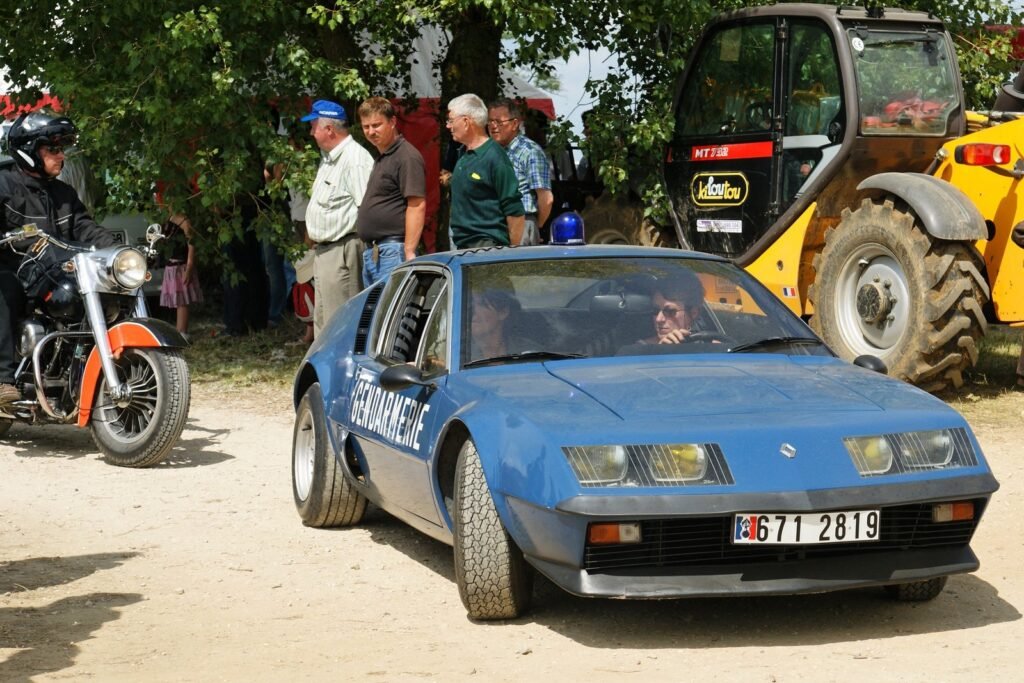
About 30 were sold at government auction. Many were stripped for parts or repainted, the Gendarmerie museum kept one, and French enthusiasts believe five or six at most still run. One that came up for sale in January 2021 showed 350,100 kilometers, roughly 217,500 miles, with the police radio still on the dash.
If you want to see one move, Netflix has you covered. Lost Bullet (Balle perdue), Guillaume Pierret’s 2020 French car-chase movie, builds its plot around a red 21 Turbo and calls it the first French police interceptor. The stunt crew went through four 21 Turbos and two 21 GTS sedans to make it.
Quadra: the all-wheel-drive one
Late in 1989, with a facelift that made the 21 look more like the bigger Renault 25, the 21 Turbo Quadra arrived. It answered the all-wheel-drive sedans Europe was going crazy for, like the Peugeot 405 Mi16 x4. Torque was split 65 percent front and 35 percent rear, with a center differential the driver could lock from the dashboard, and the propshaft was made of fiberglass to save weight.
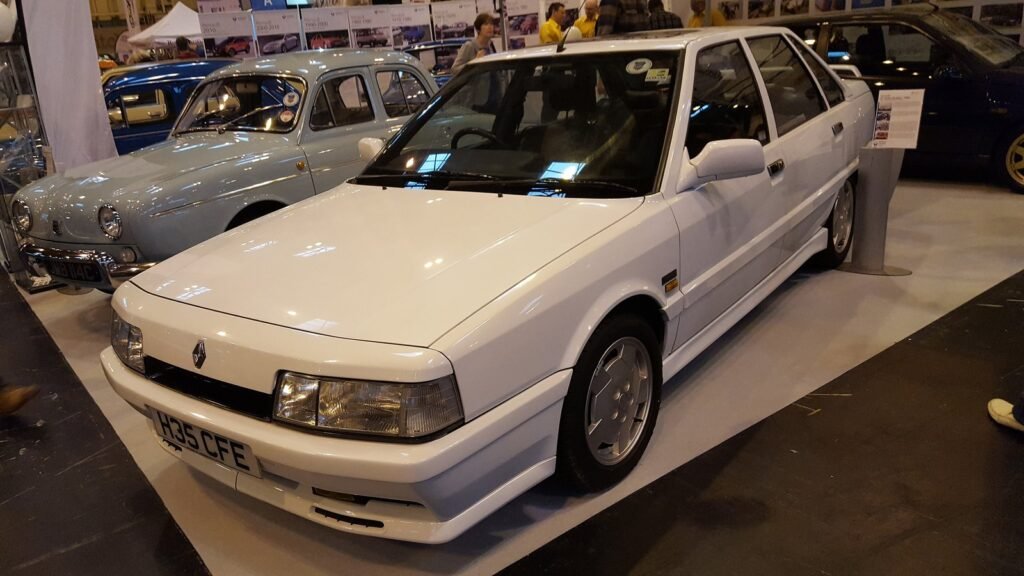
It still weighed about 130 kilos, close to 290 pounds, more than the front-driver, which cost it a little speed and bought it a lot of composure on wet roads. The fiberglass shaft turned out to be fragile, and very few Quadras were sold. The figure usually quoted is around 900, but it comes from a single source with nothing from Renault behind it. Even the total for all 21 Turbos is muddy: 13,781 according to some, while others say 13,781 is only the French sales tally and Renault itself talks about 14,000 built between 1987 and 1992.
155 mph on ice
On February 4, 1988, French journalist and racer Jean-Pierre Malcher took a lightly modified 21 Turbo onto frozen Lake Hornavan near Arjeplog, in Swedish Lapland, and set a world speed record on ice: 246.926 km/h on snow tires and 250.610 km/h, or 155.7 mph, on studded ones. The engine had been turned up to around 250 hp. The rest was close to the car you could order at a dealer.
Speed records have a long French accent. Back in 1899, at Achères outside Paris, an electric car called La Jamais Contente became the first car to break 100 km/h.
430 horsepower and a 360-degree spin
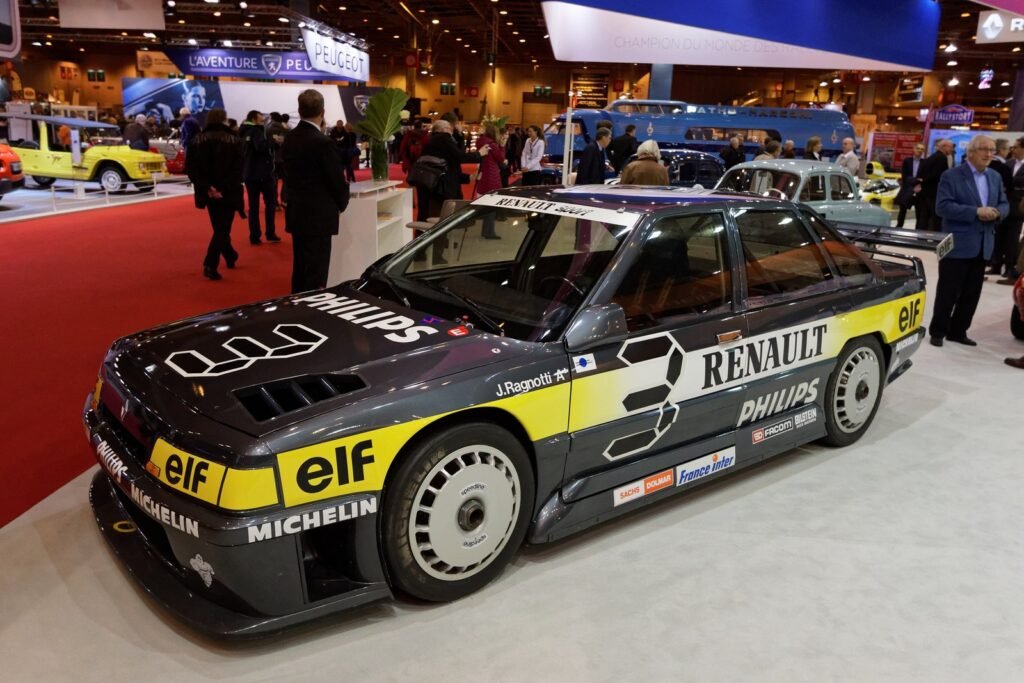
For the French Superproduction touring car championship, Renault had its tuning partner Sodemo build a 21 Turbo with a partly tubular chassis, lighter body panels and all-wheel drive with a carbon-fiber propshaft. The engine made 430 hp at 8,000 rpm. The race car was four-wheel drive in 1988, more than a year before the road-going Quadra reached showrooms.
Jean Ragnotti and Jean-Louis Bousquet drove it in 1988 and won six of the season’s ten races. Ragnotti took the title and celebrated every win with his signature 360-degree spin. In 1989 a rule change forced Renault to reposition the engine, the car ran in Philips colors, and it finished second in the championship with 11 poles from 14 races.
The rally driver who ended up running Jeep
Now the part that should interest anyone who has bought a Jeep, a Ram or a Dodge in the last few years.
Between 1988 and 1990, a 21 Turbo ran European Rally Championship events, first in Group N and then in Group A, with an amateur behind the wheel: a young Portuguese engineer working on the development of the future Renault Clio and Mégane. He finished 13th overall at the 1988 Madeira Rally, fourth in class at the 1989 Rallye Steiermark in Austria, and 29th out of 116 starters at the 1990 Semperit Rally, the car’s last outing with him.
His name was Carlos Tavares. He went on to run PSA, the Peugeot and Citroën group, and then Stellantis, the company that owns Chrysler, Jeep, Dodge and Ram, until he resigned at the end of 2024. Chrysler, remember, is the company that bought AMC in 1987 and let the Medallion die. Thirty years later, the man who once rallied the hot version of that same car was running Chrysler’s parent company. His 21 Turbo rally car sold for 27,692 euros at Artcurial’s “The Renault Icons” auction in December 2025.
Smog rules caught up
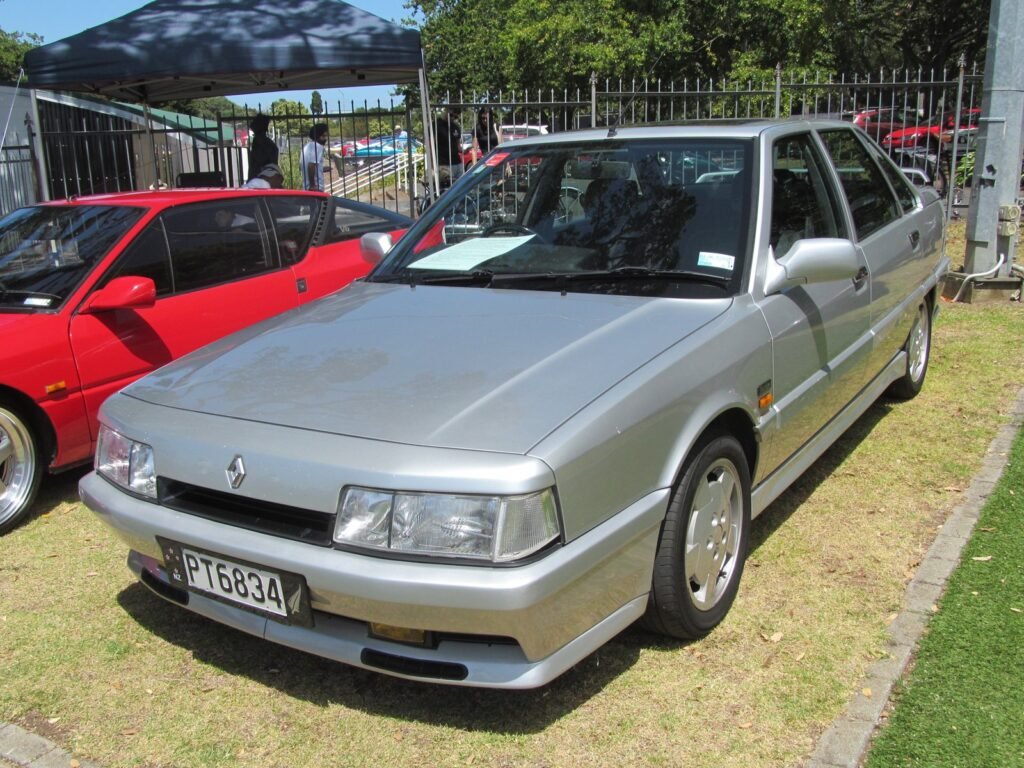
Americans had been living with catalytic converters since 1975. Europe made them mandatory on new gasoline cars from January 1993, and the 21 Turbo paid for it: from 175 hp down to 162. The whole 21 range was retired in 1994 to make way for the Laguna.
The Laguna never got a road car with the 21 Turbo’s attitude until the Laguna II GT and its 205 hp years later, but it did go racing. Run by the Williams Formula 1 team, Lagunas won the British Touring Car Championship manufacturers’ title in 1995, and Alain Menu took the drivers’ crown in 1997 with a record 12 wins.
Should you buy one
Every R21 Turbo is now more than 25 years old, which means any of them can be imported into the United States without federal crash and emissions certification. Whether that’s a good idea depends on your patience.
French buyer’s guides are blunt about the weak spots. Turbo lag is real. The nose understeers, and in the rain the front tires can’t put all 175 hp down, unless you found a Quadra. Overheating and intermittent electrical faults come up often, the underbody rusts, the ABS was never tuned for hard driving, and Renault has stopped supplying some Turbo-specific parts. Interior plastics were well below German standards. On the other side of the ledger, the Douvrin engine is famously tough, and that ex-police car with 217,000 miles on it was described as being in good shape.
Prices in Europe have stayed sane, roughly 3,500 to 5,000 euros for a usable car in Spain, more for a clean Quadra. For that money you get a four-door that a family can use, a turbo that kicks like turbos did before computers smoothed them out, and a car that really did make German engineers look at their stopwatches twice. The Medallion buyers in 1987 never knew what they were missing.
Check you’re still alive.
Photos: red Renault 21 Turbo, Lebubu93 (CC BY-SA 3.0); 1988 21 Turbo with Santander plates, Spanish Coches (CC BY 2.0); BRI Alpine A310, besopha (CC BY-SA 2.0); 21 Turbo Quadra, Kieran White (CC BY 2.0); 21 Superproduction, Thesupermat (CC BY-SA 4.0); second-series 21 Turbo, NZ Car Freak (CC BY 2.0). Via Wikimedia Commons.