Gianni Agnelli: The Man Who Ran Italy’s Car Industry
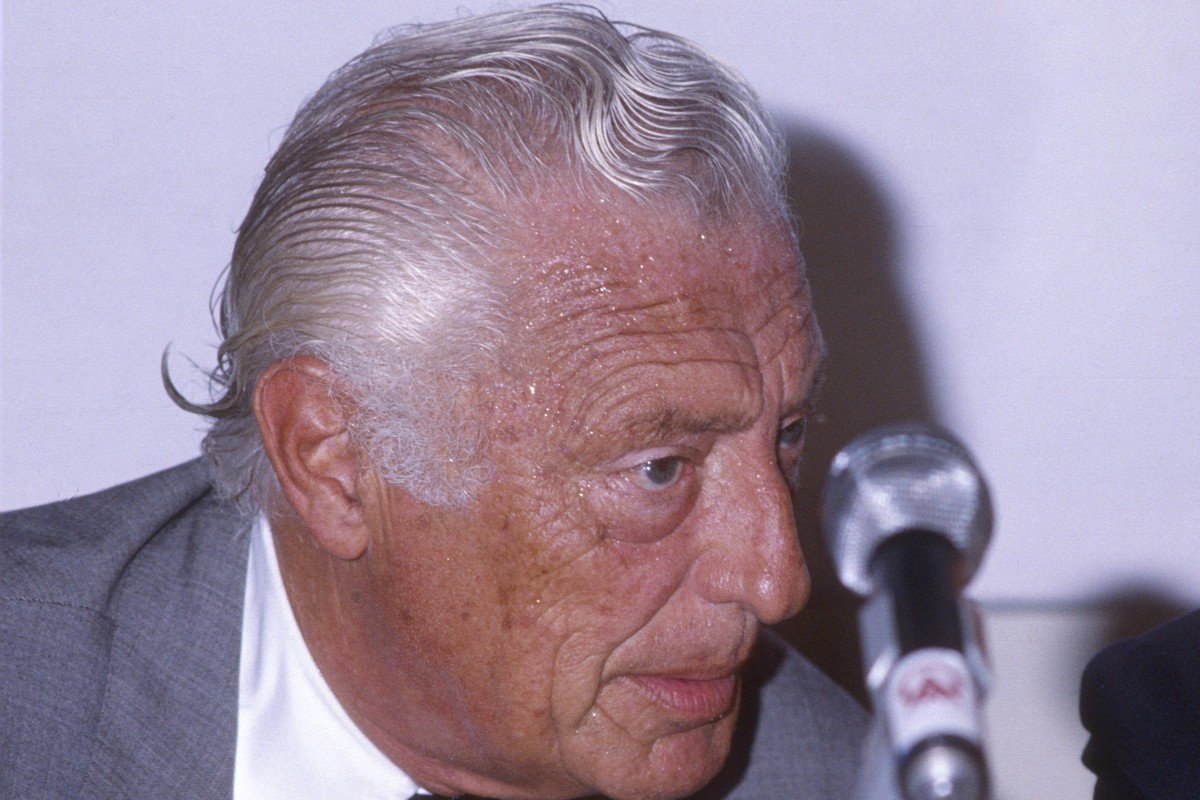
The best-known car of the Soviet bloc was a Fiat with a different badge, and the deal that put it there closed in the first months of Gianni Agnelli’s presidency.
That is the version of Agnelli worth knowing. Americans met him as a style reference, the watch worn over the shirt cuff, the hiking boots with a suit, the friendships with Kennedy and Rockefeller. The record underneath is a man who spent thirty years concentrating almost everything Italy built on four wheels under a single presidency: his own.
The office
Giovanni “Gianni” Agnelli was born in Turin on 12 March 1921, son of Edoardo Agnelli and grandson of Fiat’s founder. He took a law degree, served in the Second World War and then in the liberation fight.
He climbed slowly. Vice-chairman of Fiat in 1945, on his grandfather’s death. Managing director in 1963. Chairman in 1966, succeeding Vittorio Valletta, who retired that April at 83 after twenty years in the chair. He gave up the chairmanship in 1996 and stayed on as honorary chairman until his death on 24 January 2003.
Along the way he ran Confindustria, the Italian employers’ federation, from 1974 to 1976, and was made a senator for life in 1991. He also chaired IFI, the Giovanni Agnelli Foundation and the company that published the newspaper La Stampa.
Industry, the employers’ association and the press. Hold that combination for the chapter on the Years of Lead.
Detroit never built a plant like Togliatti
The first big move of his tenure was not entirely his, and it may be the most consequential in Fiat’s history.
The negotiation belonged to Valletta, who signed the first protocol of intent on 4 May 1966 in Turin. The general agreement to build the AutoVAZ plant was signed in Moscow that August, with Agnelli already chairman and in the delegation. A new city built around a factory, in the middle of the Cold War, by a company from a NATO country, for the Soviet bloc.
The chosen car was the Fiat 124. Reworked for cold, potholes and Soviet workshop practice, it became the VAZ 2101 and the world knew it as the Lada Zhiguli. Production started in April 1970 and the first year produced 22,000 cars. Installed capacity reached 660,000 a year by 1973, and on 21 December that year the millionth car was sold. By 1974 they were at a million and a half.

Put that next to what American manufacturers were doing behind the Iron Curtain at the same time, which was nothing. Fiat motorized half of communist Europe, and the man who had just taken the chair was in Moscow when it was signed.
The year he took Ferrari and Lancia at once
If one year explains how he operated, it is 1969.
With Ferrari, the two companies had been working together for years already. The FIA’s 1965 rules required Formula 2 engines to derive from a production unit, with a minimum of 500 cars built, and Ferrari had no capacity to build them. That produced the deal for Fiat to manufacture the V6, and from it came the Dinos of both marques; the Fiat Dino Spider was unveiled at the Turin show in November 1966. So when Fiat took 50% of Ferrari in 1969, the industrial relationship was already running. When Enzo died in August 1988, Fiat went to 90%, and the remaining 10% stayed with Piero Ferrari, who took the vice-chairmanship.
Lancia was a different kind of deal. Lancia was bleeding: twenty million pounds in 1969 alone, according to The Times. The Pesenti family, in control since 1956, could not carry it. Fiat launched a takeover bid in October that year and Lancia accepted. Autobianchi had already passed to Fiat shortly before and ended up under Lancia’s control.
Two transactions, two logics, one result. Ferrari he bought to own the jewel and give Enzo the money his racing team needed. Lancia he bought because it was falling over. In both cases the price included something no contract mentions: from then on, Italy’s most desirable sports car and its most refined saloon answered to the same office in Turin.
The bid that beat Ford
The 1986 operation is the one that explains the man, and it is the one an American reader will recognize fastest, because the loser is a Detroit company.
Alfa Romeo was state-owned, held by Finmeccanica, and it was a hole in the ground. It needed to sell 307,000 cars in 1985 to break even and sold fewer than 165,000.
Ford moved first. It showed interest in the spring of 1986, there were meetings in Britain and Germany about possible synergies with its European projects, and in September it formalized the offer: 20% up front, an option on majority control within three years and on the whole company after five.
Fiat came in that October with something else: buy the lot, 1,050 billion lire payable in five instalments, later adjusted to 1,024.6 billion. It also assumed net financial debt of up to 700 billion. The five equal annual instalments did not start until 2 January 1993, with the last in the tenth year from acquisition. Discounted to 1 January 1987 at an official rate of 13.05%, the present value of that price came to 389.9 billion.
The detail that settles it comes from the European Commission’s own decision on the deal. Measured by total net present value to the seller, Ford’s offer was on average somewhat higher in financial terms. But Ford’s left Finmeccanica exposed to Alfa Romeo’s net results between 1987 and 1993, and Fiat’s removed that risk. On that basis the Commission found the two prices broadly comparable and found no element of state aid.
Fiat took the assets on 2 January 1987 and the Alfa Lancia group was created the same day, with Fiat running the business from the 1st. The old Alfa Romeo SpA was renamed Finmilano in May and went into liquidation on 31 December 1987, passing what was left to Finmeccanica.
The strategic reading is Hagerty’s, and it holds up: Fiat did not want a competitor of that size acquiring a manufacturing stronghold on Italian soil. If you have ever wondered why Alfa spent the following two decades building cars on Fiat platforms, the thread starts here.
What it cost to run Fiat
Running Fiat in the seventies carried a price that was not paid in money.
On the morning of 21 September 1979, at via Petrarca 32 in Turin’s San Salvario district, a Prima Linea squad was waiting for Carlo Ghiglieno. An engineer, fifteen years at Olivetti, at Fiat Auto since 1974 as head of planning. They shot him dead as he was getting into his Fiat Ritmo on his way to work, with no bodyguard. In their claim of responsibility they announced a campaign of proletarian terror against the company’s management.
Being a Fiat executive in those years was a job with physical risk attached. And the man who chaired Fiat, who had chaired Confindustria from 1974 to 1976 and who chaired La Stampa’s publishing company was the largest symbolic target in the country.
With that in mind, the detail people repeat about his Fiat 130 Familiare stops being eccentric-millionaire trivia. That car carried an asymmetric third rear brake light, fitted so his security detail could better read his movements while following him. A man under permanent escort, solving a practical problem for the people escorting him.
He gave the auction world one of its favorite words
Open the catalogue for any major American sale and you will find the word barchetta attached to something with a five-figure estimate per cylinder. The word is his.
At the Turin show in 1948 he stopped in front of a 166 MM bodied by Touring using the Superleggera method, and out came barchetta, little boat. Ferrari’s own magazine credits him with coining it, and the trade has used it for open competition cars ever since.
In 1950 he ordered his, a one-off in green and blue with a bespoke cabin, the first car Maranello tailored to him. It ran the 1,995.02 cc Colombo V12 with 140 hp at 6,600 rpm and weighed 650 kg dry, with 220 km/h claimed by the factory. The car that took the headlines that same year was the Jaguar XK120, launched at Earls Court in October: 3,442 cc straight six, 160 hp at 5,000 rpm, 201 km/h claimed, around 1,295 kg at the kerb. The Englishman needed another litre and a half of displacement and twenty more horsepower to come in under the Ferrari’s claimed figure. Those are two different weight standards and I will not blend them, but the difference in concept is not up for debate.
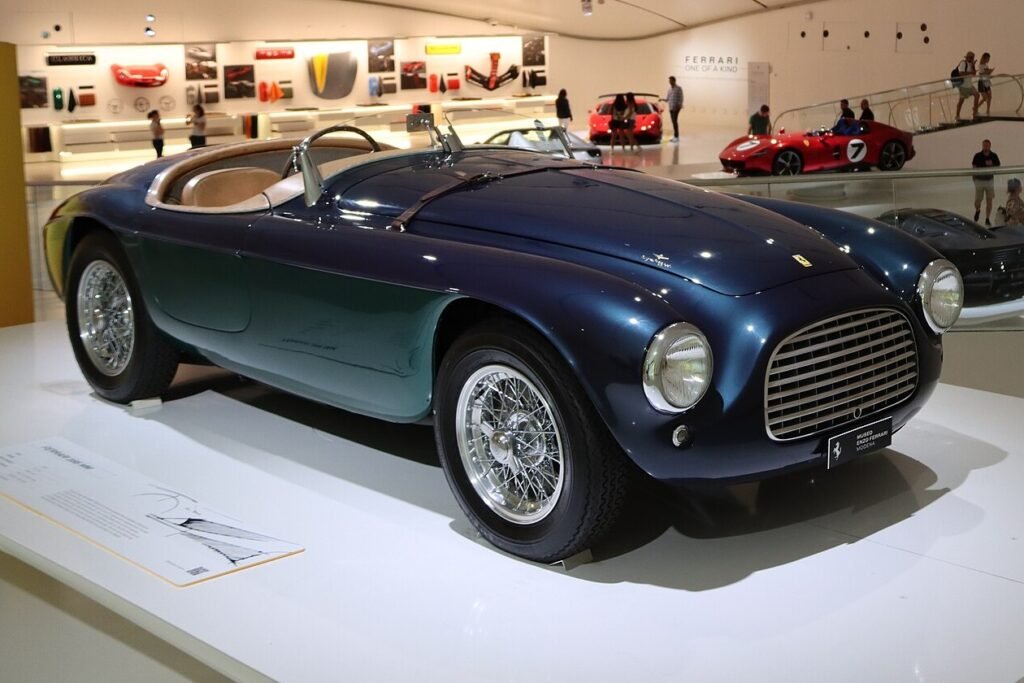
Then came a 212 Inter in 1952, in the family two-tone 456 blue with a magnolia roof and a pair of oversized headlights specified so that driving fast at night was as pleasant as driving fast at noon; a 375 America bodied by Pinin Farina; and a 400 Superamerica from the same house.
The three-seater with the wheel in the middle
The strangest commission came in 1966, the year he took the chair, and it has nothing to do with any adaptation.
Pininfarina built two 365 P Berlinetta Speciales, the design credited to Aldo Brovarone. Three seats, the driver’s in the center and slightly forward, the other two a little further back. Underneath, the 4,390 cc Colombo V12 derived from the 365 P2 racer, 380 hp at 7,300 rpm.
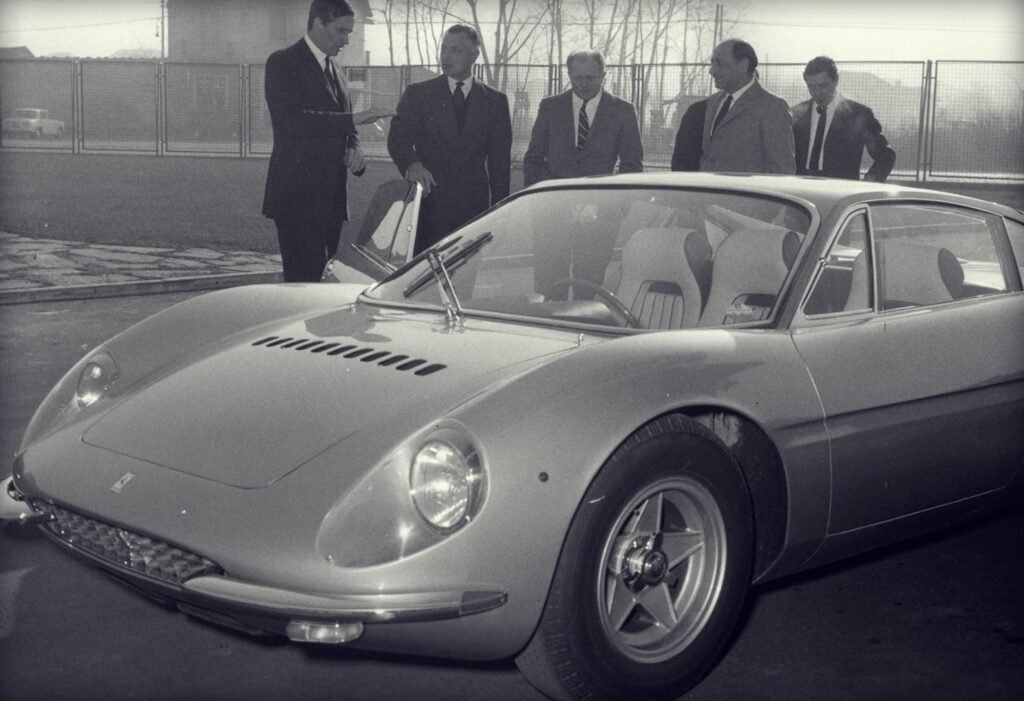
Chassis 8971 was the show car: Paris in October 1966, the circuit of shows into 1967, then sold to Luigi Chinetti, Ferrari’s American importer, in May that year. He sold it twice and bought it back twice. From 1969 it stayed in the family, used by Luigi Chinetti Junior. Gooding offered it in 2014 and it failed to meet reserve on a high bid of 23.5 million dollars.
The other, chassis 8815, he kept. Metallic grey with a black stripe down the body, a substantial chromed rear spoiler and cloth-trimmed seats. It left without a sunroof and got one shortly after. Over the years it went to metallic blue and then red.
Watch the seats, because the pattern repeats. Cloth in the 365 P in 1966. Black cloth in the F40 in 1989, when the others left with the standard red fabric. Cream velour in his last commission. The richest man in Italy consistently ordered the interiors a salesman today would try to talk you out of.
The only factory Testarossa Spider
Marking twenty years at the head of Fiat, he bought himself an open Testarossa. Ferrari offered none and never did: his is the only Spider that came out of the factory. Every other open Testarossa is somebody else’s work, from Straman’s conversions in California to Koenig in Germany.
Ferrari’s archives date the start of the Pininfarina bodywork to 27 February 1986, with four months of work on the body alone. The service book records the warranty opening on 13 June that year in the name of I.F.I. Spa, Agnelli’s financial holding company, on the Turin plate TO 00000G; the car went into his own name in March 1987. The paint is Argento 101/C with blue detailing and blue hide, because Ag is the periodic symbol for silver and also the first two letters of his surname.
The engine is the 4,943 cc twelve, and this is where most spec sheets slip: it is not a boxer. It is a 180-degree V12, because opposing connecting rods share a crank journal, which a true boxer does not do. European cars were rated 390 hp at 6,300 rpm, US-market cars 380 hp at 5,750 rpm, and 7,177 were built through the end of 1991. Its benchmark rival was the Lamborghini Countach LP5000 QV, on sale from 1985 with 455 hp at 7,000 rpm and 500 Nm from a 5,167 cc V12: on paper the Lamborghini won by 65 hp and 10 Nm, and on the road it lost on everything else.
That Spider was not a roof chop. It carried a Valeo system with a button on the center console: press it and the clutch pedal retracts, with the clutch going over to electronic actuation. The lever is unchanged and still selects the gears. It also had an electrically operated hoop that raised and lowered to hold the soft top in position.

Ferrari’s magazine describes the whole thing as an ingenious answer to an old leg injury, and notes the same system appeared afterward on the F40.
He drove it little. He eventually sold it to a family friend he played poker with, and that man’s children consigned it to Artcurial for the Rétromobile sale in February 2016. It crossed the block with 23,000 km, in exactly the configuration it had left the factory in, and sold for 1,210,080 euros including taxes and premium. The buyer was Ronald Stern, a London-based collector and marque archivist, and it was granted Ferrari Classiche certification, with Piero Ferrari bringing the documents to his house himself.
The F40 they took the pedal out of
The F40 is the altar of analog purism: 2,936 cc, twin-turbo V8, 478 hp at 7,000 rpm, 577 Nm, no aids, no luxuries. Enzo wanted it that way, deliberately stripped of the electronics meant to help a less expert driver. It was unveiled at Maranello’s Centro Civico on 21 July 1987 and 900 orders came in.
Two years later the owner of the company ordered his with the pedal removed. He commissioned it in 1989, in Rosso Corsa, with black cloth trim instead of the standard red fabric, and it is chassis 79883.
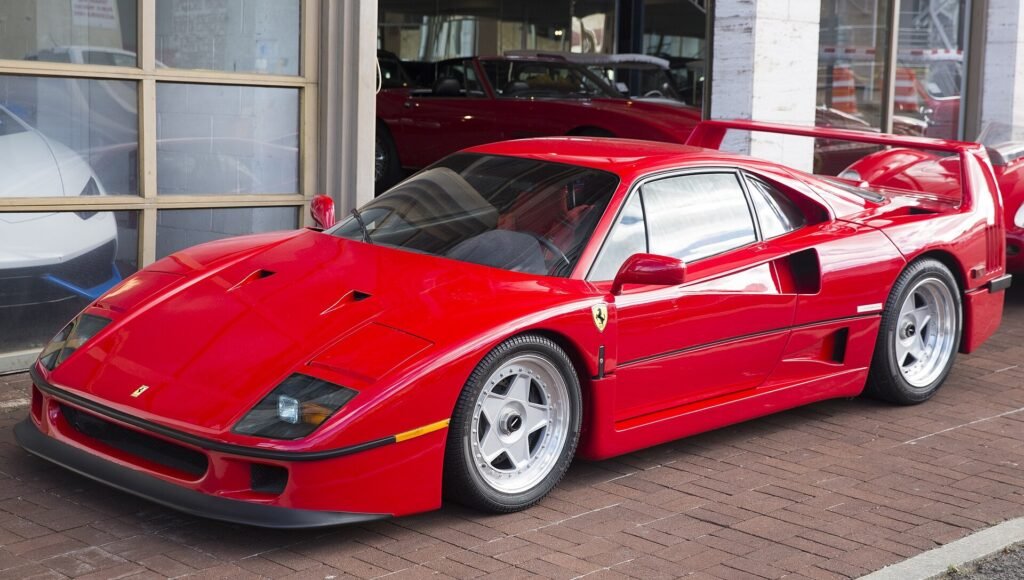
Two things get told as one, including by people who should know better. An automatic gearbox decides which gear you are in. An automatic clutch does not: it takes the work from your left foot and leaves the choice of gear in your hand, on the lever. Everything Agnelli had built was the second kind.
Ferrari states that 79883 ran the Mondial t’s automatic clutch in electronic form, able to engage and disengage in 100 milliseconds. Microswitches on the lever, a control unit, an actuator doing the left foot’s job, and safeguards that stop the car being started in gear or a ratio being selected that would destroy the engine.
He used it even less. Under 700 km when it changed hands.
The car American collectors treat as the last analog Ferrari had a two-pedal version, and Maranello has never hidden it: the factory put that car in its own museum in 2021 and published what it was for.
From there to the paddles
That clutch did not stay an indulgence, and the traceability is the interesting part.
According to the feature Forza magazine ran in June 2012, the Valeo system had been developed and proven on the Lancia Delta Integrale rally cars before it reached road cars. Another company in the same group, as it happens. From there it went to the Mondial t, offered as a catalogue option late in production: no clutch pedal, the transverse five-speed untouched, an electric servo under microprocessor control.
And from there, the rest. Engineer Paolo Martinelli saw what that electro-mechanically actuated clutch could become and adapted a car so the system operated the gearbox too. When Martinelli moved to Formula 1 engine development in 1994, Claudio Lombardi took over with Fiat Group researchers, Magneti Marelli and the University of Bologna. The 355 F1 of 1997 was the first road car with the complete system, its column-mounted paddles shaped with ergonomics specialists at the University of Delft. Within a few years the whole segment had followed, and by 2002 the Enzo offered no manual at all. Today there are Ferraris with no gearbox to shift at all.
I am not claiming Agnelli invented the paddle shift: the 355 F1’s electro-hydraulic unit descends from Formula 1 and is a separate engineering line. What I am saying is that the road-car branch starts on a rally stage, passes through two cars built to one customer’s measure, and ends on a price list.
The garage of the man who had everything
With Ferrari, Lancia, Alfa Romeo, Autobianchi and Fiat all inside his group, his favorite car was a Fiat 125.
He had a 130 Familiare, three built, one for his brother Umberto, one for his friend Guido Nicola and one for himself, assembled by Officina Introzzi outside Como, in silver, with fake wood side trim and a roof rack carrying a wicker basket for skis at St. Moritz. Plus the asymmetric third brake light. It went to auction with RM Sotheby’s in Milan in April 2025.
There is more. A Zagato-bodied Lancia Thema wagon bought in 1985, plated TO 56639D. A one-off Lancia Delta Spider Integrale from 1993 built by Officina Pilota Fiat on Evo2 underpinnings, 250 hp, 245 km/h, silver with a black top, used for a single summer. A 1956 Fiat Eden Roc, a Pininfarina beach car on 600 Multipla mechanicals. A Moretti-built Panda Rock kept in Corsica. And a Multipla Spider, the Eden Roc II, that Pininfarina built in 2001 to mark his eightieth birthday, in aluminum, steel, leather and mahogany like a yacht tender.
A man with a permanent driver does not order that list to be chauffeured around in it.
The last commission
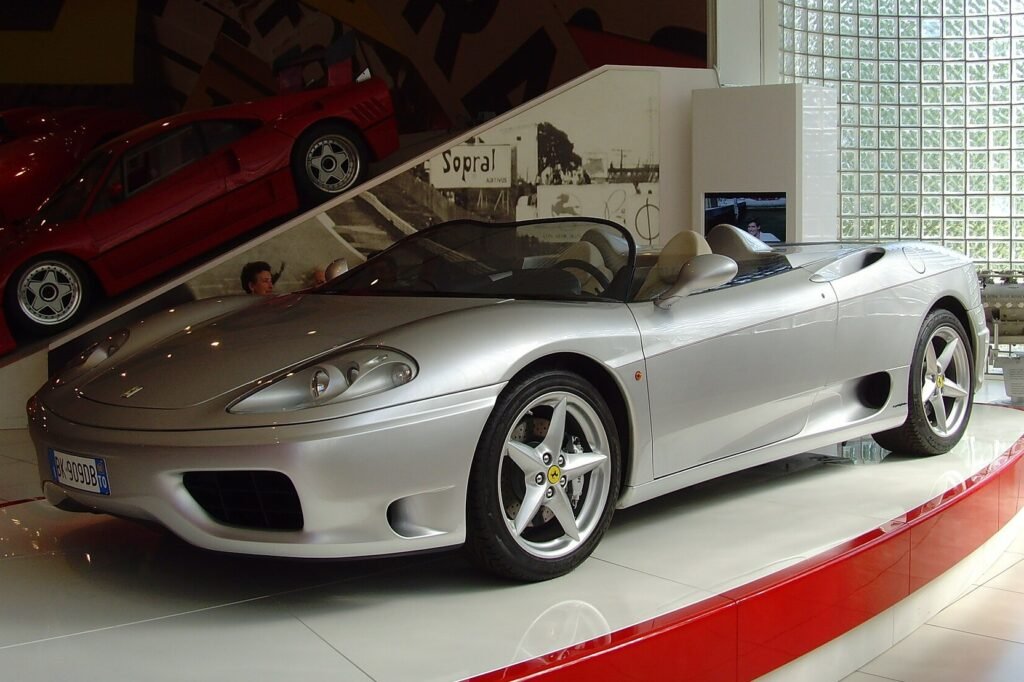
Luca di Montezemolo married in July 2000. Agnelli secretly commissioned a car as the wedding present: the 360 Barchetta, chassis 120020, in Argento Nürburgring with fine lines along the belt, a cut-down wraparound screen, short rear fairings drawn from fifties and sixties prototypes, and cream velour trim. It was delivered with no roof of any kind. Montezemolo has kept it ever since.
Montezemolo had joined Ferrari in 1973 at 26 as Enzo’s assistant and was soon running the Scuderia’s sporting side; Niki Lauda’s 1975 and 1977 championships came on his watch. He returned as president in November 1991 with the Agnelli family’s full confidence.
That 360 was the last car Agnelli ordered from Maranello. And it had an electro-hydraulic F1 gearbox with carbon fiber paddles.
Add up the dates. The man whose two most exclusive Ferraris exist because somebody automated a clutch for him ended up giving away a car with no clutch pedal because by then none of them had one. Fourteen years from one-off to price list, even if the system changed its nature along the way.
The Spanish bill
Agnelli’s group was ruthless outside Italy too, and Spain is where it showed. Fiat had been SEAT’s technical partner for thirty years when, in 1980, it decided not to take part in SEAT’s capital increase, and in 1981 it sold its stake to INI, the Spanish state holding. SEAT was left with no technology partner, no export network, 32,000 people on the payroll and 95% of its capital in state hands: overnight the first fully Spanish carmaker, and forced to invent a range of its own.
Then came the lawsuit. On 17 November 1982 it was Fiat that challenged the legality of exporting the Ronda, SEAT’s restyled Ritmo, the car Americans briefly knew as the Strada, arguing it was not different enough. SEAT’s defense became a famous image in Spain: a black Ronda with every body and interior part that differed from the Ritmo painted yellow, so anyone could see the changes at a glance. On 24 November 1983 the Court of Arbitration in Paris ruled for SEAT: the car could be sold anywhere in the world, Italy included.
Out of that came the Ibiza, the Málaga and the Marbella, and the road into the Volkswagen Group, where SEAT still sits and where the León Cupra would later be born.
Arese on the closure list
The ending is the best summary of everything above.
The reporting published on 10 October 2002 put it in writing: Fiat declared a state of crisis and presented a plan to suspend 8,100 workers on cassa integrazione straordinaria at zero hours, in tranches and starting in December. The plan called for closing Arese and Termini Imerese. At Termini Imerese production stopped completely, affecting around 1,800 workers across Fiat Auto, Comau and Magneti Marelli. At Mirafiori some 1,350 went in from December and another 2,000 in July 2003, when Panda production ended. At Cassino 25% of the workforce was suspended. Melfi was spared.
Arese was Alfa Romeo’s historic plant.
Sixteen years after buying Alfa Romeo so Ford could not have it, the group he chaired as honorary chairman was planning to close Alfa Romeo’s factory. He died on 24 January 2003 with that plan on the table.
Weeks later Ferrari named its season’s Formula 1 car after him: the F2003-GA, which debuted at the Spanish Grand Prix, won seven races, took the constructors’ title and delivered Michael Schumacher’s sixth championship, breaking Fangio’s record.
The verdict
What gets sold about Agnelli is the watch over the cuff, the boots with the suit and the one-offs from Maranello. He is a comfortable figure to tell that way: the most elegant Italian of the century, with a collection worth envying.
The record is something else. Thirty years concentrating most of what built cars in Italy under one presidency. Ferrari and Lancia in the same year, Alfa Romeo bought with an offer that took risk off the seller’s hands and shut the door on Ford, and a Fiat turned into the family saloon of half of Eastern Europe. That is not collecting, it is the industrial policy of a country run out of a private office. And the bill arrived in October 2002, with Alfa Romeo’s factory on the closure list and a plan to put 8,100 people on zero hours, three months before he died.
What saves it, and what actually interests me, is the one point where the man and the group touch. Able to ask anything of any of his marques, he asked Maranello for a one-off convertible and an F40 with no clutch pedal, because of an old leg injury, with black cloth instead of the standard red and velour in the last one. The guy who could have any car in the world spent his influence on being able to drive them himself.
It does not balance Arese. But it is the only part of his record a car guy can love without lying to himself.
It was Agnelli’s Fiat that sent Lancia’s engineers to Alfa in the nineties to beat the M3, a fight that runs all the way to the Alfa Romeo Giulia Quadrifoglio, the 505-hp sedan Alfa built to beat BMW.
Check you’re still alive.
Photos: Gorup de Besanez (CC BY-SA 4.0), Erremm (CC BY-SA 4.0), FrDr (CC BY-SA 4.0), giovanniagnelli.it (public domain), FrDr (CC BY-SA 4.0), Mr.choppers (CC BY-SA 4.0), Klaus Nahr (CC BY-SA 2.0).