Pininfarina, The House: Ninety-Five Years of Shaping Cars That Other People Built
The Geneva Motor Show of 2012. Ferrari unveiled the F12berlinetta. A brutal car — naturally aspirated V12, razor lines, the last card played by pre-turbo Maranello. Nobody made much of it that morning, but the F12 was the last road-going Ferrari drawn by Pininfarina. The next one, the LaFerrari of 2013, would be styled by Flavio Manzoni at Ferrari’s own Centro Stile in Maranello. Sixty years of exclusive marriage ended without a press release, without a farewell ceremony, without anyone saying “and by the way, this was the last one.” An F12 and that’s that.
That’s how these industrial endings usually arrive. Nobody sees them coming until they’re already past. Pininfarina — the house that had drawn nearly two hundred Ferraris, most of the ones you can name in ten seconds — suddenly found itself without its most famous client, with the Grugliasco factory shuttered since 2010, debt piled above a hundred million euros, and Paolo Pininfarina at the wheel trying to keep a business afloat where cars were now the nostalgia rather than the product.
This is the hub piece of the cluster. Individual profiles of Battista, Sergio, Andrea and Paolo have their own dedicated articles. The concept cars that shaped 20th-century automotive language — Cisitalia 202, BMC 1800 Aerodinamica, Sigma F1, Modulo, Mythos — will have theirs too. This one covers the house whole. How it started, how it grew, who kept it standing, and what’s left today of what was, for nearly a century, the industrial aristocracy of Italian design.
1928-1966: The House Battista Built
Battista Farina — Pinin to his family because he looked like his father Giuseppe — broke away from his brother Giovanni Carlo’s workshop in 1928. That first year he ran eighteen employees and built fifty bodies. On May 22, 1930, at 107 Corso Trapani in Turin, the operation was formalized as a corporation: Società Anonima Carrozzeria Pinin Farina. A hundred and fifty employees, ninety-two hundred square meters of floor space, capacity for seven or eight bodies a day. Vincenzo Lancia and Battista’s wife’s wealthy aunt held minority stakes.
The client list of the 1930s reads like a map of European luxury motoring: Lancia, Alfa Romeo, Fiat, Isotta-Fraschini, Hispano-Suiza, Cadillac, Rolls-Royce. All of them. Battista bodied chassis from every one. There’s a technical detail that usually gets skipped over: Pininfarina was the first coachbuilder anywhere to master unibody monocoque construction, thanks to close collaboration with Lancia — which pioneered the system — from the mid-1930s. While other coachbuilders saw the disappearance of the separate chassis as the death of their trade, Battista understood it as the next evolutionary step and adapted before the rest.
All of that, plus the dark years of wartime conversion, the audacious Paris gesture of 1946 with two cars planted at the entrance of the Grand Palais, the Cisitalia 202 and its 1951 entry into MoMA, and the neutral-territory lunch with Enzo Ferrari that same year in Tortona, is covered in the Battista profile. What matters here for understanding what came next: when Battista handed the firm to his son Sergio and his son-in-law Renzo Carli in 1961 — the same year that President Gronchi authorized by decree the family’s name change from Farina to Pininfarina — the house already held two assets that would carry it for the next four decades. A de facto contract with Ferrari, and a new industrial plant in Grugliasco, opened in 1958, with seventy-five thousand square meters and the capacity to produce at scale.
Battista died in Lausanne on April 3, 1966. A month earlier, in Geneva, his last personal design had debuted: the Alfa Romeo Duetto.
1966-2001: The Sergio Era
Sergio Pininfarina, born in 1926, had studied mechanical engineering at the Polytechnic University of Turin and had spent the whole 1950s working alongside his father. When he took the presidency in 1966, he was forty years old and knew exactly what to do with the house: professionalize it, industrialize it, and lock down the Ferrari relationship.
He pulled it off with an efficiency that, looking at contemporary Italian industry, feels almost impossible to believe. Under Sergio, Pininfarina drew the Ferraris that defined what a supercar looked like for two full generations. The Dino 206 GT and 246 GT (1967-1974), designed by Aldo Brovarone with detail work by Leonardo Fioravanti. The Daytona of 1968. The 512 BB of 1976 (Fioravanti). The 288 GTO of 1984 (Fioravanti). The F40 of 1987 (Fioravanti with Pietro Camardella). The Testarossa of 1984 (Ian Cameron). The F50 of 1995 (Camardella). One hundred and twenty-eight road-going Ferraris signed in total between 1952 and 2013. Only one escaped — the Dino 308 GT4 of 1973, styled by Bertone — in a relationship that lasted sixty-one years. That’s a batting average American brands can only dream of when it comes to design continuity.
Sergio also understood the house couldn’t live on Ferrari alone. He built out a client list broad enough to make Pininfarina the reference studio for half of Europe. Peugeot: the 504 sedan and coupe (Brovarone and Franco Martinengo), then 505, 306 Cabriolet, 406 Coupe — a relationship that ran for decades and planted Italian design language inside a French mass-market manufacturer. Alfa Romeo: the Duetto Spider (1966), the 164, the 90s GTV and Spider. Fiat: the 130 Coupe (Paolo Martin), the 124 Sport Spider (over two hundred thousand units sold, most of them to the American West Coast), the Coupe Fiat of 1993. Lancia: the Gamma Coupe (Brovarone). Cadillac Allanté — Detroit’s attempt to graft Italian style onto an Eldorado platform, with bodies shipped from Turin to Michigan by 747 cargo plane in one of the most expensive supply chains ever attempted for a mainstream car. Rolls-Royce Camargue (Paolo Martin, 1975). Bentley Azure and Continental.
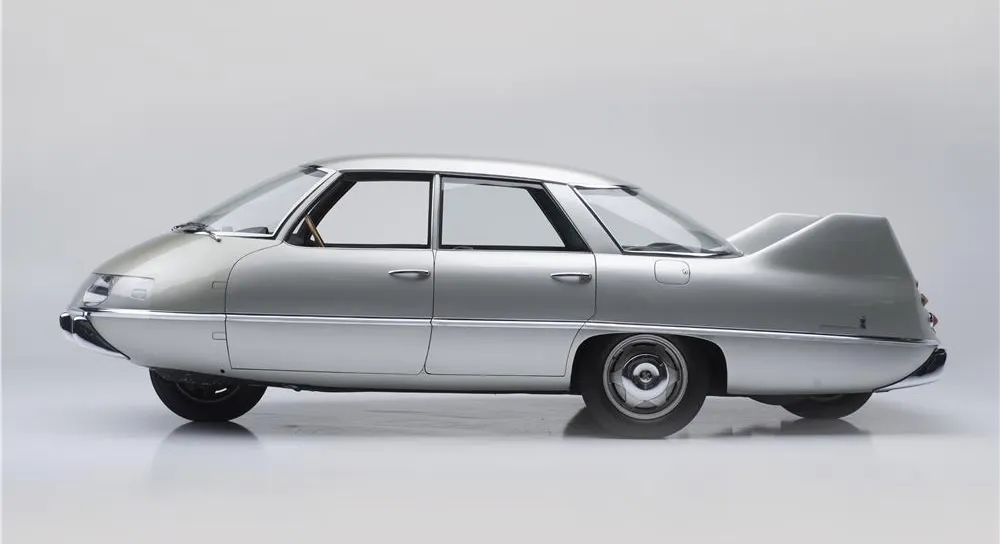
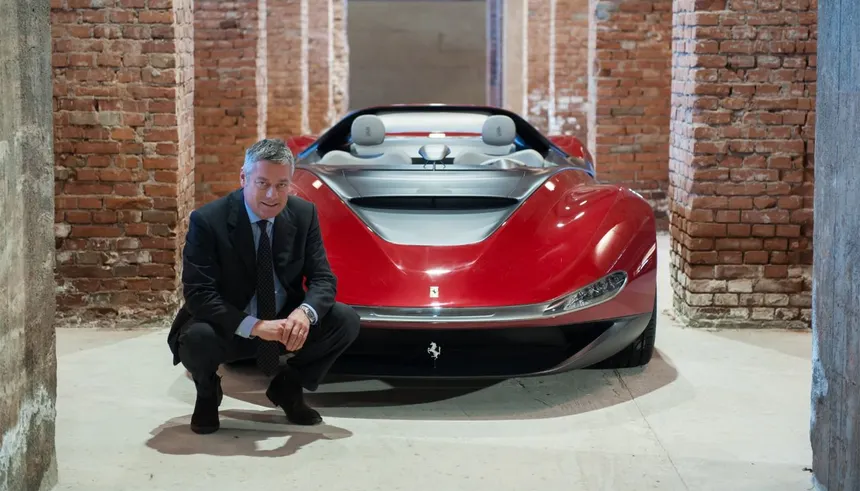
Then there were the concept cars. This is where Pininfarina under Sergio made its most durable contribution to the global language of the automobile. The BMC 1800 Aerodinamica of 1967 (Fioravanti) previewed the European hatchback by fifteen years — and never made it to production, because British Motor Corporation didn’t have the industrial nerve. The Ferrari Modulo of 1970 (Paolo Martin) remains one of the most radical rolling sculptures ever built. The Sigma F1 of 1969 proposed single-seater safety solutions — enclosed cockpit, programmed deformation zones — that Formula 1 would take fifty years to adopt as the Halo device. The Cisitalia GT of 1955. The Ferrari 250 P5 of 1968. The Mythos of 1989 on Testarossa mechanicals. The Ferrari Sergio of 2013, a posthumous tribute to the man himself, built in six units.
Every one of those concept cars will get its own piece in the cluster. What matters here is understanding that, under Sergio, Pininfarina became more than a coachbuilder. It became a language laboratory. A place manufacturers went to ask what the car of the future was going to look like — not to buy a specific design but to understand where the leading edge was pointing.
In 1978 the house opened the new design plant in Cambiano, still its operational headquarters today. In 1986 Pininfarina Extra was launched, the division that expanded the business into industrial design, furniture, architecture, marine and aeronautical work. In 1995 Sergio received the Compasso d’Oro, Italy’s highest industrial design award. That was no longer the Corso Trapani workshop. It was a global design group with five divisions and clients on four continents.
Sergio handed off to his son Andrea in 2001 and stayed on as honorary chairman until his death in 2012.
2001-2008: The Andrea Era
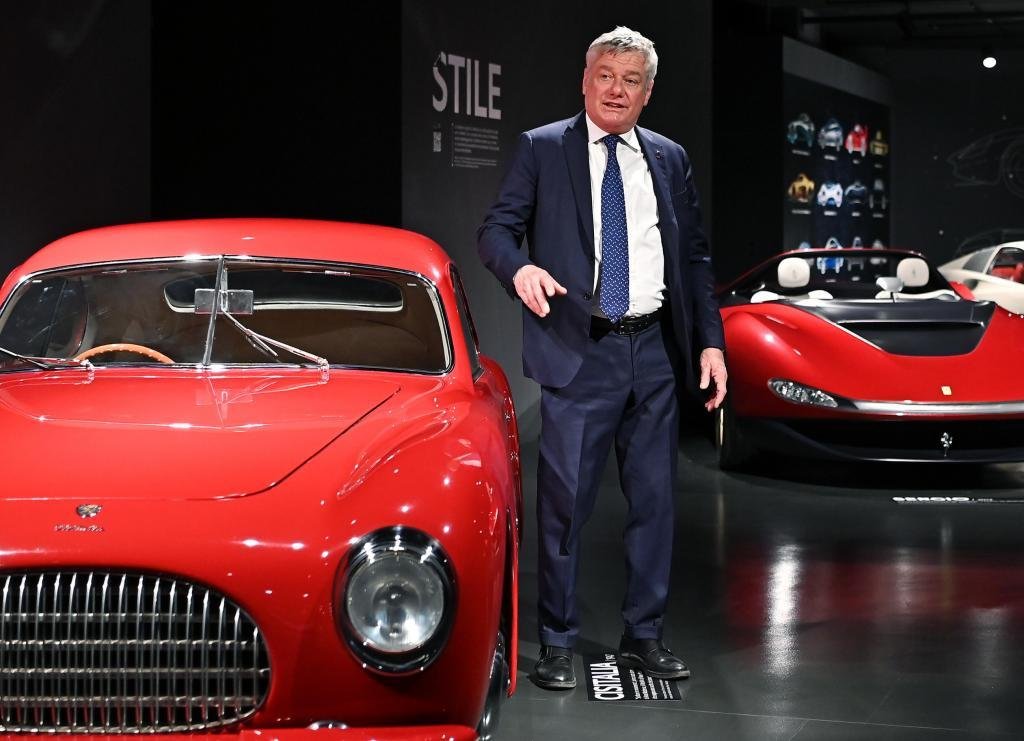
Andrea Pininfarina, born in 1957, mechanical engineer like his father and his younger brother, had joined the company in 1983 and spent years in senior management before taking over as CEO in 2001. His tenure landed at the worst possible moment for an Italian industrial design group: globalization was accelerating, carmakers were pulling design in-house to save cost, and platform sharing was collapsing the margins on bespoke contract work.
Andrea tried two responses. First: reinforce Pininfarina as a contract manufacturer, not just as a design studio. The house had produced Fiat 124 Sport Spiders and Alfa Spiders in the hundreds of thousands out of Grugliasco; Andrea tried to repeat that trick at scale with the Ford Focus CC, the Volvo C70, the Mitsubishi Colt CZC, the Alfa Romeo Brera and Spider. Second: get into electric. The house collaborated with Vincent Bolloré on the Bluecar project, an urban EV unveiled in 2008.
Neither bet closed the financial gap in time. Contract production ran razor-thin margins and dragged brutal fixed costs behind it. Electric arrived too early for a market still shopping for German turbo diesels. Group debt shot past a hundred million euros. In April 2008 the board announced the first restructuring plan, with Piero Ferrari, Alberto Bombassei (Brembo), the Marsiaj family (Sabelt), Vincent Bolloré and Ratan Tata all committing to a joint €100 million injection.
Andrea never got to see how the plan landed. On the morning of August 7, 2008, he was killed in a road collision while riding his Vespa near the Cambiano offices, in the vicinity of Trofarello. He was fifty-one. He was the third consecutive Pininfarina at the head of the house, and his death — at that age, in an ordinary traffic accident — opened the company to the deepest crisis in its history. Worse than the war.
2008-2024: Paolo and the Sale to Mahindra
Paolo Pininfarina, Andrea’s younger brother, born in 1958, mechanical engineer from Turin, had spent years running Pininfarina Extra and driving the diversification strategy. He assumed the chairmanship the same August of 2008, with the company in shock, the debt hanging, and no time. In December 2008 the board approved a debt restructuring that required the family to divest its stake. In March 2009 Pincar, the family holding, hired Leonardo & Co to find a buyer for its 50.6% stake in Pininfarina S.p.A.
The buyer took six years to appear. On December 14, 2015, India’s Mahindra Group announced the acquisition of 76.06% of Pininfarina S.p.A. for approximately one hundred and sixty-eight million euros (a portion for the stake purchase, the rest in a capital increase and debt guarantees). Anand Mahindra, who had already bought SsangYong in Korea and Peugeot’s scooter division, picked up the marquee Italian design name for less money than a single Ferrari LaFerrari cost at retail. Ten straight loss-making years — Pininfarina had turned a profit only once in the eleven fiscal years between 2004 and 2014 — had let the buyer name the price.
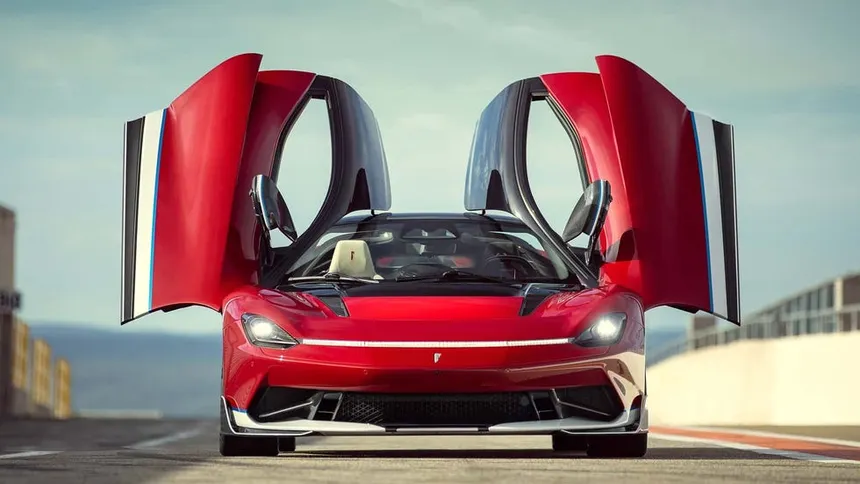
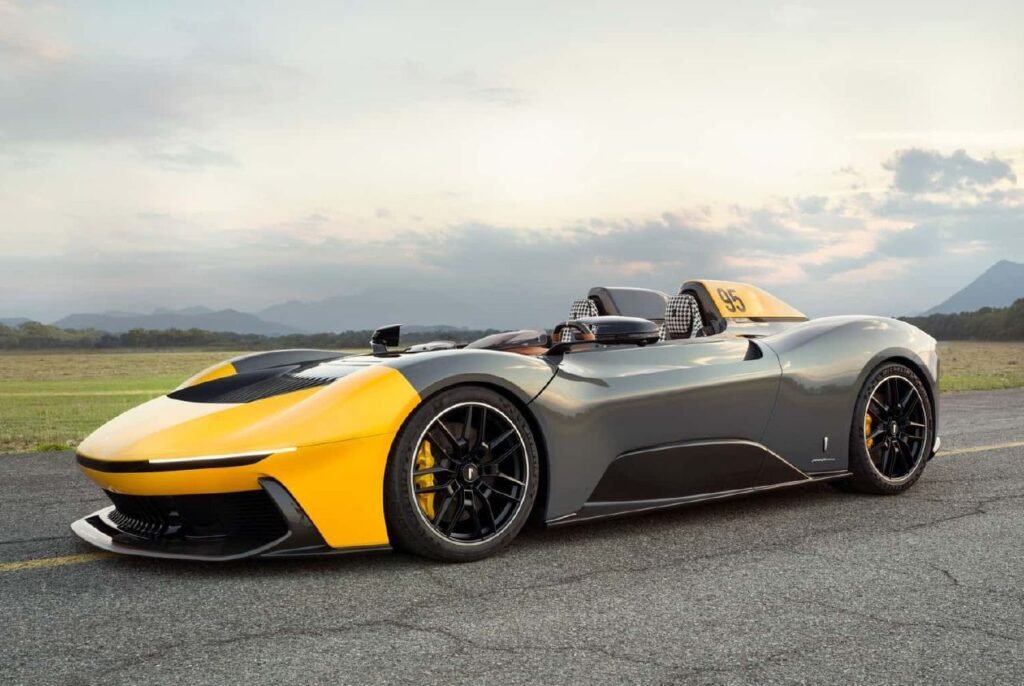
Paolo stayed on as chairman. Under Mahindra, the house reoriented around two axes: design consulting for emerging Asian manufacturers (VinFast in Vietnam, Chery and JAC in China, AviChina), and the launch of a proprietary hypercar brand, Automobili Pininfarina, with the Battista unveiled in 2019 and the Battista Anniversario in 2020. That hypercar, named after the founder, will get its own dedicated piece in the cluster because it deserves a separate discussion: €2 million for a car built on Rimac architecture, and one that — for technical and collectible reasons — doesn’t represent the same thing the cars from Corso Trapani, Grugliasco or Cambiano represented.
Paolo Pininfarina died on April 9, 2024, in Turin, aged sixty-five. With him the direct family line at the head of the house founded by his grandfather ended. Silvio Pietro Angori, CEO from before the Mahindra deal, stayed at the operational helm. After ninety-four years, the Pininfarinas no longer ran Pininfarina.
The Anonymous Designers
Any history of Pininfarina told only through the four Farinas is incomplete and, in the end, misleading. The cars were drawn by other hands, and those hands deserve names.
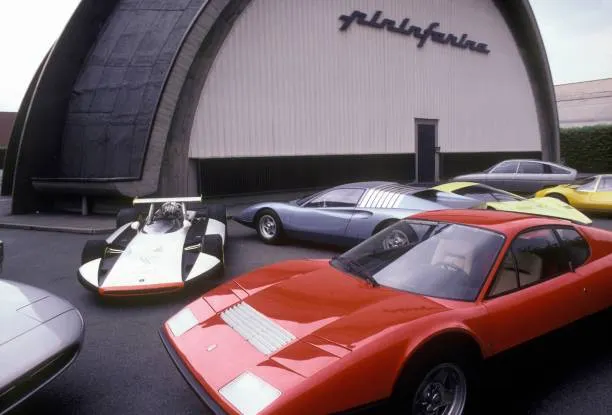
Aldo Brovarone (1926-2020), who arrived in 1952 via Piero Dusio and Cisitalia, was chief stylist between 1974 and 1988. His cars include the Ferrari Dino 206 GT, the Lancia Gamma Coupe and the Peugeot 504 sedan — three very different cars sharing the same restrained elegance that was his signature. Tom Tjaarda (1961-1965), American-born son of a Dutch engineer, designed the Ferrari 365 California, the De Tomaso Pantera and the Corvette Rondine prototype. Franco Martinengo signed the Peugeot 504 Coupe and Cabriolet of 1969, one of the most balanced postwar coupes anywhere. Paolo Martin (chief of styling 1968-1972) drew the Ferrari Modulo, the Rolls-Royce Camargue and the Fiat 130 Coupe.
Leonardo Fioravanti (Managing Director of Studi e Ricerche 1988-1991) is probably the most influential name to come out of the house. He joined as a junior designer in the mid-sixties and signed the BMC 1800 Aerodinamica, the Daytona, the 308 GTB, the 512 BB, the 288 GTO and the F40. It’s hard to think of another living designer with that Ferrari filmography. Pietro Camardella (1984-1993), trained inside Fioravanti’s team, contributed to the F40 and signed the F50. Lorenzo Ramaciotti (1973-2005) rose to general director of Studi e Ricerche and later CEO of R&D before leaving for Fiat Chrysler. Enrico Fumia (1976-1991), Ken Okuyama, Fabio Filippini, Maurizio Corbi, Jason Castriota. Dozens of names most enthusiasts never learned, and who drew — line by line — what the world called “a Pininfarina.”
The house never promoted them individually. Every car went out signed “Pininfarina,” never “Pininfarina by Fioravanti.” That corporate policy protected the brand but buried the careers. It’s one reason that today, when people talk about Italian automotive design, the names that come up first are Gandini (Bertone) and Giugiaro (Italdesign) — while it takes work to remember who exactly drew this or that 1980s Ferrari. Bertone and Italdesign trained their teams to talk to the press; Pininfarina trained its teams to sign the timesheet.
What Pininfarina Does Today That Isn’t Cars
Since the 1980s the house has diversified aggressively, and today the automotive business isn’t remotely the most profitable division. Pininfarina has designed high-speed trains for Nederlandse Spoorwegen. Trams for Lille. Buses. Subway carriages. Yachts, including the Wally 118. Private aircraft: interiors for the Boeing Business Jet, the Elysium jet, collaborations with Airbus Corporate Jets. Architecture: residential buildings in Miami, Singapore, Istanbul. Furniture for Poltrona Frau, Cassina, Snaidero. Domestic appliances for Bosch. Pens, eyewear, motorcycle helmets, even faucets.
The Grugliasco plant, where for decades Fiat 124 Sport Spiders, Peugeot 406 Coupes and Alfa Breras came together, closed production for good in 2011. The operational headquarters today is Cambiano, a purpose-built design facility with a driving simulator, wind tunnel and modeling studios. About six hundred people work there. Automotive production: zero.
What’s Left of Pininfarina
A surname, bought by Mahindra in 2015 for less money than a LaFerrari costs. A design studio in Cambiano still producing high-caliber work but spread across yachts, architecture and consulting for Asian manufacturers. A proprietary electric hypercar marque, built in Germany on Croatian architecture, that struggles to make the case for collectability. And one hundred and twenty-eight Ferraris, two hundred Peugeot models, hundreds of Alfa Romeos, Fiats, Lancias, Cadillacs and Rolls-Royces still circulating the world, aging well, being restored in small shops, appearing at concours events and auction blocks at prices that keep climbing.
The family no longer runs the firm. Proprietary automotive production is limited to the electric hypercar. The Ferrari contract ended over a decade ago. Cars are still being drawn at Cambiano, sure — but for other people. For VinFast, for Chery, for whoever pays.
That’s Pininfarina today. An industrial myth managed from Mumbai, executed in Turin, materialized in third-party factories all over the world. The word “Pininfarina” stamped on a new 2026 car means something very different from what it meant on a 1966 car. That isn’t tragedy — it’s industrial life running its course. It’s also why this cluster opens here, with the whole house, before diving into the individual pieces. Without this story, the isolated concept cars are just pretty objects. With it, they’re the footnotes of an industrial empire that was very large, very Italian and very real, and existed during the years when a coachbuilder could still decide, line by line, what the car of the next century was going to look like.
Check you’re still alive.