
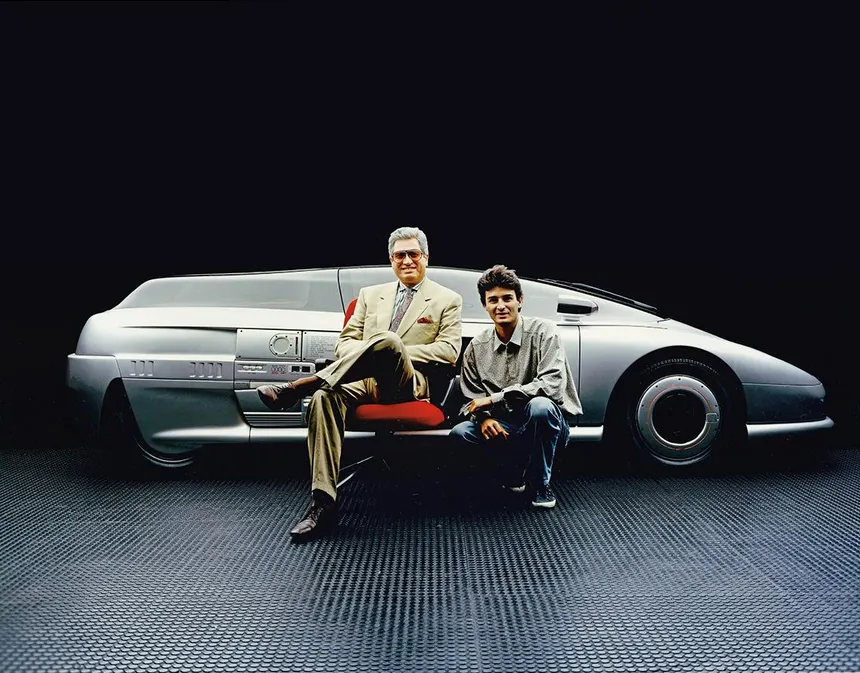
Giugiaro: The Man Who Drew Your Life — and You Don’t Know His Name
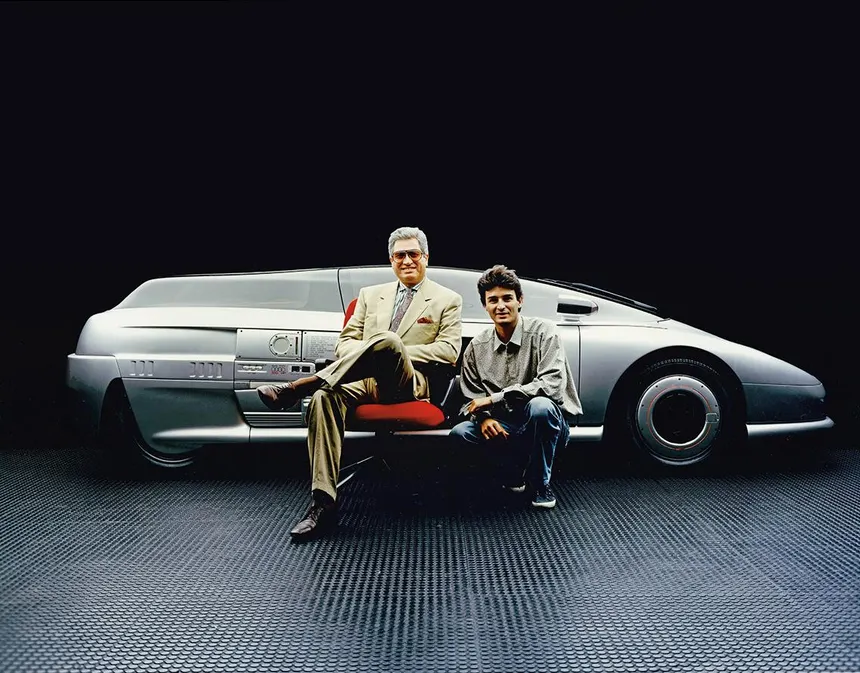
Play a game. Walk out onto any street in Europe, point at five cars, and bet that the same single human being shaped at least three of them. You’ll win that bet more often than not. Then ask the owners who designed their cars. None of them will be able to tell you.
That is not a story about ignorant drivers. It’s a story about the most important car designer who ever lived, and about why almost nobody can name him.
His name is Giorgetto Giugiaro. In 1999 the Global Automotive Elections Foundation ran a vote for Car Designer of the Century, backed by heavyweight magazines including Germany’s Auto Motor und Sport, and he won it. It doesn’t carry the institutional weight of an FIA title or Car of the Year, and you can argue about who sat on the panel. Argue all you like — his was the name at the top. And yet he remains, to the wider public, a near-blank. The Stig is more famous than the man who drew the cars half of Britain learned to drive in.
There’s a reason for that, and it’s the most interesting thing about him.
The cult of the wedge that screams
Petrolheads have a hero for the dramatic stuff, and his name is Marcello Gandini. Miura. Countach. Stratos. The posters on the bedroom wall, the cars Chris Harris slides sideways while grinning like a lunatic, the shapes that exist purely to make your pulse climb. Gandini drew dreams. Fair enough. He was brilliant at it.
Giugiaro could do that too, and we’ll get to the proof. But the work that actually matters, the work that touched more lives than every Gandini supercar combined, was the opposite of a scream. It was the quiet stuff. The Golf. The Panda. The first Ibiza. The Fiat Uno. The cars that didn’t go on a wall because they went on a driveway, every single one of them, for decades.
Gandini drew what you dreamed about. Giugiaro drew what you actually drove to work. Guess which one gets the applause.
From Bertone to his own front door
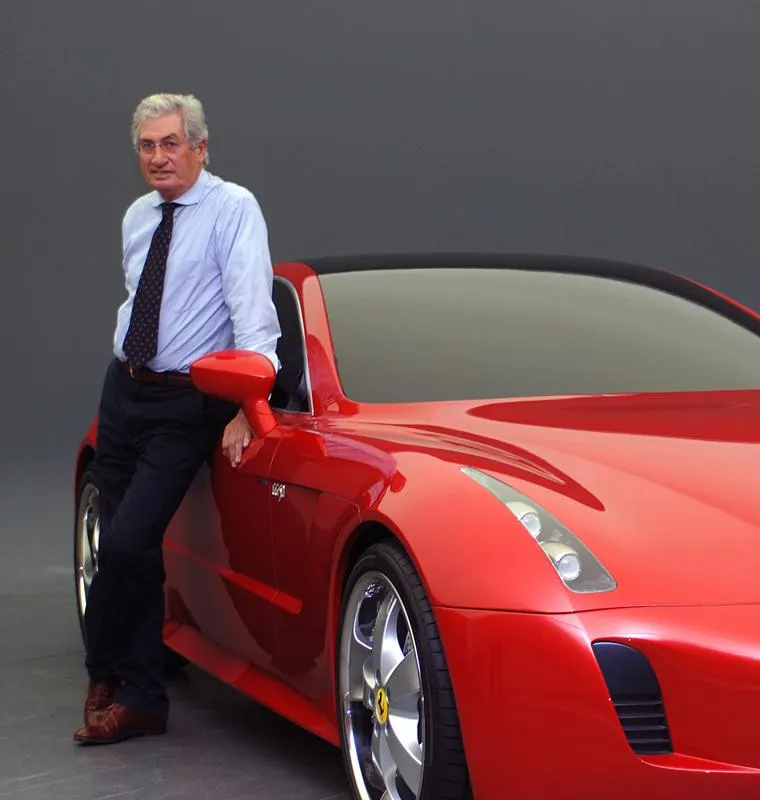
Giugiaro was born in Garessio, in Piedmont, in 1938, into a family of painters. He wanted to be an artist. At seventeen, somebody looked at his watercolours and offered him a job at Fiat instead. From there to Bertone, the great finishing school of Italian design, then Ghia.
Even as a kid he was drawing future museum pieces. The De Tomaso Mangusta, with its gullwing engine covers, came out of his Ghia years — a car so cool it later turned up in Kill Bill and a Kylie Minogue video, which is a sentence you don’t get to write about many cars. The Maserati Ghibli of 1967, one of the great grand tourers of its day, shown as a prototype first and on sale the year after, Maserati’s answer to a market that wanted a continent-crusher with the face of a predator.
And for Bizzarrini, the 1968 Manta: a one-box sports coupé with three seats abreast, reportedly drawn and built in forty days on a Bizzarrini racing chassis. The Manta was the first warning shot. The soft, hippy curves of the sixties were on the way out. Giugiaro wiped them off the page and replaced them with flat planes, hard edges, pure geometry. That impossibly raked screen, that knife of a nose — it was a trailer for everything that followed. The wedge was coming, and he was the one carrying it.
What’s telling about those early years is that both Giugiaros already lived inside the same man. The one drawing impossible sports cars for tiny firms, and the one who, given half a chance, would pour that exact talent into cars anybody could actually drive. Nobody knew it yet. Soon millions of people would benefit from it without ever noticing.
A man with a head like that doesn’t draw for other people forever. On 13 February 1968 he founded his own house: Italdesign. Not just a styling studio but a full workshop, from first sketch to production-ready tooling. That’s where he became who he is.
The scream: Boomerang
Anyone who thinks Giugiaro was just the sensible chap who drew tidy hatchbacks should look at the Maserati Boomerang. A static model at Turin in 1971, a fully running car at Geneva in 1972, built on the guts of the Maserati Bora: 4.7-litre V8, 310 horsepower, near enough 300 km/h.
The Boomerang is Giugiaro screaming. The wedge taken to the edge of madness. The windscreen was raked at thirteen degrees. Thirteen — two degrees flatter than the Bizzarrini Manta he’d drawn himself, so flat the glassmakers warned him about visibility. The steering wheel had its entire instrument pack mounted inside the rim. It looked like the future in 1972 and somehow it still does.
That single piece of lunacy seeded half the design language that followed — including, and this is the punchline, the most ordinary, best-selling car Europe has ever seen.
The whisper: Golf
Two years after that impossible Maserati, the same hand drew a box. Rational, sensible, buildable by the million. The 1974 Volkswagen Golf.
The Golf doesn’t scream. The Golf doesn’t go on a wall. The Golf simply works, and works so well, with proportions so clean and so right, that it defined an entire class and is still defining it half a century later. Every Golf since descends from that first line, and so, indirectly, does a fair chunk of every hatchback on earth.
Here’s the genius nobody claps for. Admiring the Boomerang is easy — it’s begging to be admired. The hard part, the genuinely hard part, is taking that exact same design language and distilling it until it fits a car that can be sold in millions and parked anywhere without looking like fancy dress. The Boomerang is the howl. The Golf is what’s left when you refine that howl into something ordinary people can own. Same year, near enough. Same hand.
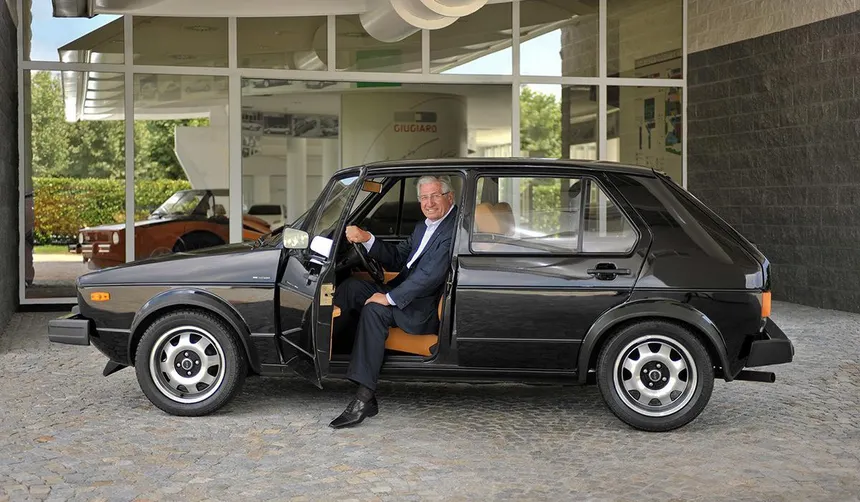
The wedge that reached the working man
And then there’s the rest, because if it were only the Boomerang and the Golf we’d already have plenty, but Giugiaro never stopped.
The Lotus Esprit, the sharpened wedge that stayed in production for nearly thirty years and went underwater with James Bond. The BMW M1, Munich’s only mid-engined supercar, drawn from his pen off the back of the 1972 Turbo concept. The DeLorean DMC-12, which without a certain film trilogy would have vanished and instead became immortal in brushed stainless steel and gullwing doors. The 1984 SEAT Ibiza, sold on the slogan “Italian line, German engine,” which shifted over 1.3 million units and gave SEAT a foundation to build on. That Ibiza was drawn by Italdesign and engineered for mass production by Germany’s Karmann — a Spanish badge, an Italian soul, German hands on the tooling, and the result became the car half a country grew up in. The Panda. The Fiat Uno, European Car of the Year in 1984, the natural evolution of the Panda into something slightly bigger with the same functional minimalism and a drag figure that was genuinely sharp for its time. The Hyundai Pony, the car an unknown Korean firm used to start building what is now a giant. Think about that one: a brand that now sells you premium electric cars was, in large part, born from an Italian pencil that decided those people deserved a properly drawn car too.
Look at that list again. It’s not a collector’s list. It’s a list of street cars, family cars, cars that turned over cold every morning to take somebody to work. That’s the real Giugiaro footprint — not the walls of rich men’s garages, but the roads of half the world. The supercar crowd will tell you design history is Miuras and Countaches. Half of design history is actually the school-run.
Every one of those cars has been through the hands of any mechanic who’s spent thirty years on the tools. Pandas, Unos, Ibizas, Golfs, Deltas — half the Giugiaro back-catalogue, opened up on the bench, by people who never once clocked that it was his. That’s exactly the point. Nobody tells you, when you slot the key into a Panda, that the same man drew the Maserati with the thirteen-degree screen. The car doesn’t shout about it. That’s why it’s good.
Two things, so this doesn’t slide into sainthood. First: “Giugiaro” also means Italdesign, a studio with a team behind it. He led it, he signed it, he set the standard, which is why we all credit him the way we do — but every one of those cars passed through other hands, modellers, engineers. The genius didn’t work alone. Second: not everything he touched turned to gold. The 1985 Fiat Croma was a perfectly competent saloon that never came close to the pull of the Uno or the Panda, and it sank into the grey mass of executive cars nobody remembers. There were other exercises that came and went without a ripple. A man who draws that much also misses, and that doesn’t shrink him — it makes him believable. The legend of the unbroken winning streak is for the brochures. The truth is that even the Car Designer of the Century laid an egg now and then, and got on with it.
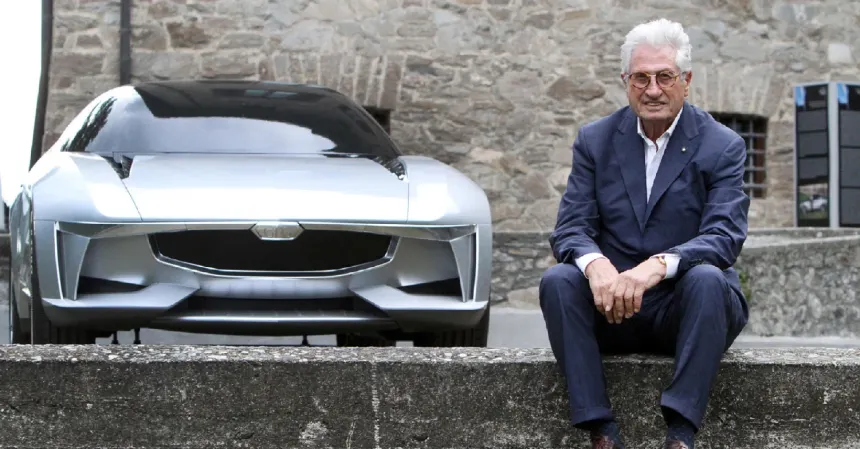
The price of being invisible
So here’s the thesis, no hedging. Gandini has a cult because he drew cars that scream. Giugiaro has a much cooler public reputation because he drew cars that didn’t need to. And that is precisely the measure of how good he was.
Two straight caveats before we go on, or the thesis turns into a cheap trick. First: Giugiaro is no unknown. Any enthusiast worth the name knows exactly who he is, designers treat him as scripture, and among the eighties petrolhead crowd his name lands hard. The person who can’t name the designer of his own car is the bloke who just wants the Golf to start on a cold morning — not the anorak. It’s anonymity among the masses, not among the trade. Second: the Gandini-screams, Giugiaro-whispers line is a good story, not a law of physics. Gandini drew plenty of quiet, sober machinery too, from the Innocenti Mini to the first BMW 5 Series, and Giugiaro screamed whenever he fancied it — that’s what the Boomerang is for. The difference isn’t that each man knew only one trick. It’s where each left his biggest mark: Gandini on bedroom walls, Giugiaro on the road.
When a design is so right that it becomes invisible — when it turns into air, into background, into “just a car” — nobody applauds it. You clap for the Miura because it screams in your face that it’s special. You don’t clap for the Golf because the Golf simply is, the way a good chair or a good spoon just is. And drawing the air, drawing the thing so natural it stops being noticed, is far harder than drawing the scream.
Giugiaro paid for his greatness with anonymity. He resolved cars so completely, made them so correct and so inevitable, that people stopped seeing them as design and started seeing them as just cars. That looks like a failure of fame. It’s the highest thing a designer can achieve: your work becomes part of the world instead of an exhibit in it.
Think of it the way you’d think of any invisible craft. Nobody praises the plumbing until it leaks. Nobody notices a door handle until it feels wrong in the hand. The best work disappears into use. Gandini built monuments you stand in front of; Giugiaro built the floor you walk on without looking down. Both matter. Only one gets the crowd. And if you had to pick which talent is rarer — the one that makes you gasp, or the one that makes a million strangers’ daily lives quietly better and never asks to be thanked — the truthful answer is a bitter pill for the poster-on-the-wall crowd.
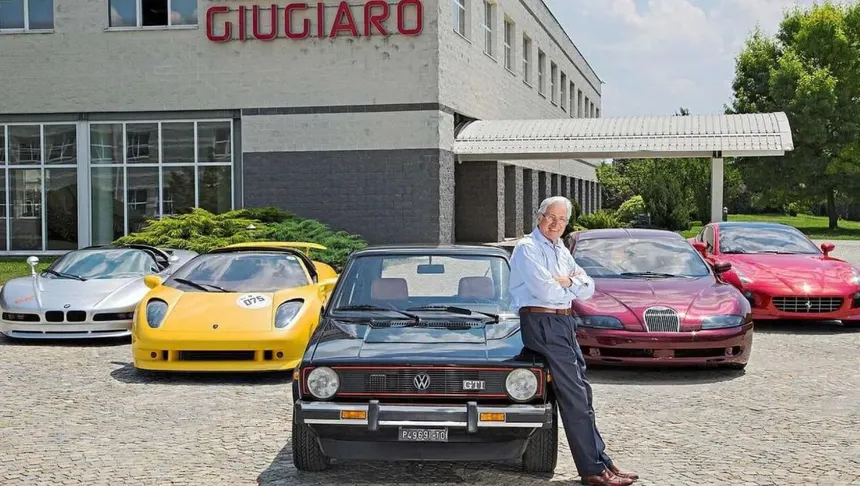
The bloodline holds
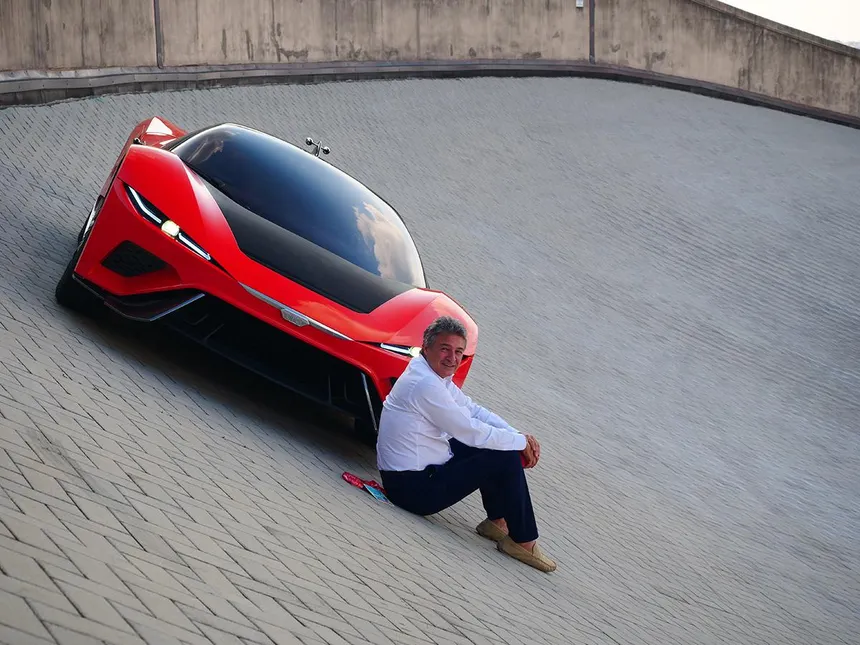
In 2015 Giugiaro sold Italdesign, which ended up inside the Volkswagen group, and set up a new house with his son Fabrizio: GFG Style. The wedge, it turns out, is hereditary. And the story closes almost too neatly: in 2025 Fabrizio revealed the Peralta S, a one-off built on a Maserati MC20, bodied in mirror-polished aluminium, inspired directly by the Boomerang his father drew half a century earlier. The name returns to the wedge. But that’s another story, and we’ll tell it on its own.
Take this with you instead. Next time you walk past a tired old Panda, a first-series Golf, an “Italian line” Ibiza, remember that the dull, everyday, nothing-special car in front of you came out of the same brain that signed the most radical Maserati of the seventies. Genius isn’t always where the noise is. More often it’s where you’d never think to look — taking someone to work every morning, asking for nothing in return, not even that you know its maker’s name.
Check you’re still alive.